
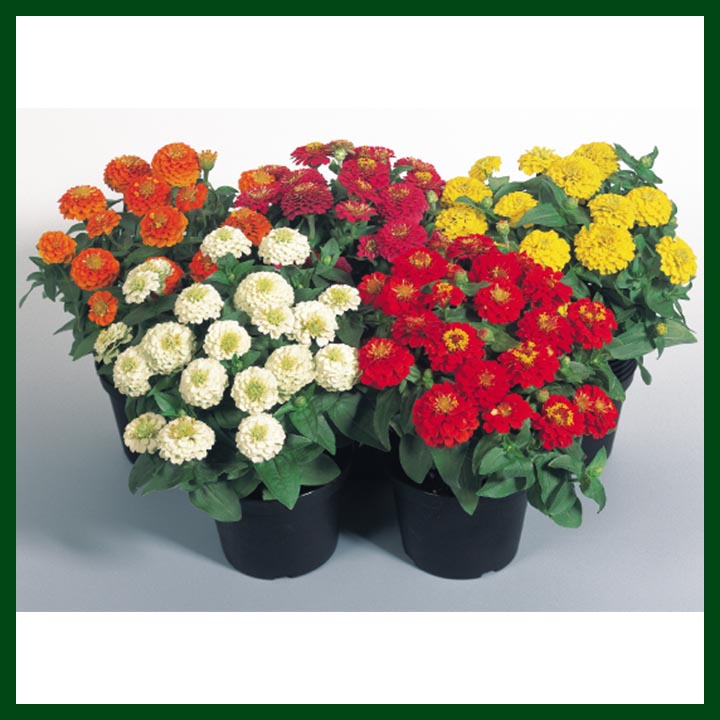
Zinnia Elegans Zinnita Mix – 1000 seeds – Benary
৳ 4,650.00
This item is available only on pre-order and is not kept in our regular stock.
- 50% advance payment is required to confirm the order.
- We will place the order with our vendor after receiving the confirmation payment.
- This system helps us source fresh/latest stock while avoiding unnecessary inventory and unconfirmed orders.
- Estimated arrival time: 1–7 working days after payment confirmation.
- Price and available quantity may vary depending on the latest supplier sourcing costs. Please contact us for the current price and available quantity before placing your order.
- Advance payment can be made via bKash, Bank Transfer, or Cash at our office.
For payment details or any queries, please contact our support team at 01722-988794.
Thank you for your understanding and cooperation.
| Specification | Recommended value |
| Plant | Zinnia elegans ‘Zinnita Mix’ |
| Type | Annual |
| Plant height | 7–8 in |
| Spread | 8–12 in |
| Flower diameter | 1.5–2 in |
| Flower type | Fully double |
| Germination | 5–10 days |
| Germination temperature | 21–24°C |
| Sowing depth | ¼ in / 5–6 mm |
| Plant spacing | 8–12 in |
| Sunlight | 6–8+ hours |
| First bloom | ~50–70 days |
| Container | 8–10 in diameter × ≥8 in deep |
| Ideal pH | 6.0–6.7 |
| Fragrance | Very mild, ~2/10 |
| Difficulty | Germination 2/10; growing 3/10 |
| Bangladesh sowing | October–November preferred |
| Propagation | Seed |
| Support | Normally unnecessary |
| Native species range | Mexico–Nicaragua |
Available on backorder
Description
Zinnia Elegans Zinnita Mix
Price: 4650 Taka per packet
- Note: Prices may vary. Please contact our support team to confirm the latest rates
Quantity: 1000 seeds
Brand: Benary
Color: Mixed color as shown in the picture
Country of Origin: Germany
Germination Rate (Approx.): 85%
Physical Purity (Min): 98%
Genetic Purity (Min): 98%
Basic growing characteristics
| # | Requirement | Recommended information |
| 01 | Germination temperature | 21–24°C optimum; 20–22°C also works well. Benary specifies 21–24°C during the first week; below 12°C germination becomes slow/uneven. Harris gives 21–24°C (70–75°F). (Benary) |
| 02 | Germination time | Usually 5–10 days. Under excellent conditions, radicle emergence can occur in 3–5 days. (Benary) |
| 03 | Height / spread / sowing depth | Height: 7–8 in (18–20 cm); practical spread 8–12 in (20–30 cm). Sow approximately ¼ in (6 mm) deep; do not bury deeply. (Benary) |
| 04 | Plant spacing | 8–10 in (20–25 cm) between plants is ideal for Zinnita Mix. In humid rooftop conditions, 10–12 in gives better airflow. |
| 05 | Row spacing | 10–12 in (25–30 cm). For a dense ornamental bed, 9–10 in can work, but disease risk rises. |
| 06 | Support | Normally none. Zinnita is compact and well-branched. A small bamboo/stake may be useful only on exposed rooftops with strong wind or if over-fertilized plants become soft. Benary specifically describes the cultivar as compact and well-branched. (Benary) |
| 07 | Seed → first bloom | Approximately 50–70 days under good conditions; commercial Zinnita crop timing is about 6–8 weeks in spring. (Benary) |
| 08 | How long blooms stay | Individual flowers commonly remain attractive for roughly 1–2 weeks on the plant, while the plant can continue producing flowers for many weeks. Cut-flower vase life is typically 7–10 days, with research showing substantially longer vase life under optimized floral-food treatments. (MSU Extension Service) |
| 09 | Flower shape / size | Usually fully double, rounded/dahlia-like or pompon-type heads, approximately 1½–2 in (4–5 cm) across. (Swallowtail Garden Seeds) |
| 10 | Life span | Annual. Normally one growing season; roughly 4–8 months in favorable tropical/subtropical conditions, although the exact useful flowering period depends strongly on heat, rainfall and disease. (Missouri Botanical Garden) |
Germination-light requirement: Light is not required for germination. The commercial technical guide actually recommends covering the seed lightly. After emergence, however, give seedlings strong light to prevent stretching. (Benary)
For your seed packets, we would recommend: “Sow 5–6 mm deep, keep the surface evenly moist, and provide bright light immediately after emergence.”
Recommended container:
For one Zinnita Mix plant:
Recommended
- Diameter: 8–10 inches
- Depth: minimum 8 inches
- Preferred: 10 × 10 inches or approximately 2–3 US gallons
- Drainage holes: essential
- One plant/container is preferable.
Benary lists Zinnita as suitable for 12–15 cm pots and 17–19 cm pots depending on production stage; other Zinnita sources describe it as an approximately 8-inch plant. (Benary)
For a Bangladesh rooftop, I would choose 10-inch diameter × 8–10-inch deep rather than a tiny 6-inch decorative pot.
Bed
For a bed:
Plant-to-plant: 10–12 in
Row-to-row: 12–15 in
This sacrifices a little density but substantially improves airflow in Dhaka’s humid conditions.
Soil requirements
Zinnia likes:
- fertile
- loose
- well-drained
- moderately moisture-retentive
- organic-matter-rich soil
- good aeration
- no prolonged waterlogging.
Published recommendations generally put acceptable pH around 5.5–7.5, while Benary’s commercial plug media is around pH 5.8–6.2. (University of Minnesota Extension)
Ideal rooftop target
pH: 6.0–6.7
target approximately 6.2–6.5 for the suggested potting mix.
Sunlight
- Mature plant: 6–8+ hours of direct sunlight/day
- For maximum flowering: 8 hours is excellent.
- Zinnia is a full-sun plant and high light helps shorten crop time and improve flowering. (Plant Toolbox)
Seed
Darkness is not essential for germination. Cover lightly rather than leaving seed exposed.
Seedling
Once emerged: 12–14 hours of bright light/day is useful when growing seedlings under artificial lighting, but avoid weak indoor light because Zinnia seedlings stretch quickly.
Water requirement:
Do not follow a rigid “X liters every X days” schedule regardless of weather.
Instead, use soil moisture + weather.
For a 10-inch rooftop container:
| Plant condition | Approx. water |
| Newly sown seed | 100–200 ml at a time, preferably mist/spray/small watering |
| Seedling 2–3 in | 200–350 ml |
| Plant 4–6 in | 350–600 ml |
| Mature 7–8 in | 500–900 ml |
| Extremely hot/windy rooftop | Up to 1.0–1.2 L when necessary |
Typical interval:
- Cool/dry season: every 2–3 days
- Hot sunny weather: every 1–2 days
- Rainy/humid weather: potentially 3–5+ days, or no irrigation
- Heavy rain: do not add water simply because the calendar says so.
Water when approximately the top 1–2 inches of medium is dry. Excess moisture promotes fungal problems. (University of Minnesota Extension)
Very important for Dhaka rooftops:
- Water at the soil surface, preferably in the morning.
- Avoid repeatedly wetting the foliage and flowers, particularly in humid weather. (MSU Extension Service)
Suggested rooftop potting mix:
Recommended 100% formulation
| Ingredient | % |
| Loamy Soil | 32% |
| Coconut Coir Dust | 15% |
| Vermicompost | 10% |
| Cow Dung Compost | 8% |
| Trichocompost | 5% |
| Brown River Sand | 10% |
| Perlite | 8% |
| Medium Coconut Husk | 5% |
| Wood Charcoal | 3% |
| Oyster Shell Powder | 1.5% |
| Neem Cake Powder | 0.8% |
| Bone Meal | 0.7% |
| Horn Meal | 0.5% |
| Mustard Cake Powder | 0.5% |
| TOTAL | 100% |
Deliberately excluded
We would not put these into the regular base mix:
- Small stones 5–22 mm
- Epsom salt
- Turmeric powder
- Cinder
- Jhama
Why?
- Small stones: don’t improve drainage inside a properly designed porous mix as effectively as coarse particles integrated throughout the medium; they also consume valuable root volume.
- Epsom: use only when magnesium deficiency/soil analysis warrants it.
- Turmeric: no meaningful reason to make it a routine nutrient component.
- Cinder/Jhama: unnecessary when you already have perlite + sand + husk + charcoal.
Rooftop advantage
- This formula intentionally uses coir + perlite + husk + charcoal to reduce compaction and improve aeration while limiting the amount of heavy mineral soil.
- For a 10-inch pot, make enough mix to fill the container without compacting it heavily. Leave approximately 1 inch headspace.
Companion plants
Good choices include:
- Marigold
- Basil
- Cosmos
- Salvia
- Vinca
- Coneflower
- Angelonia
- Tomato
- Pepper
- Sweet alyssum
The strongest practical choices for a Bangladesh rooftop would be marigold + basil + cosmos because they share broadly compatible sunny conditions and add pollinator value. Companion planting should not be treated as a guaranteed pest-control system. (Southern Living)
Fragrance: Yes, but generally weak. Zinnia is primarily grown for its visual appearance rather than perfume.
Fragrance rating: 2/10
Some flowers may have a faint green/floral or earthy smell, but it is generally noticeable only at close range. Interestingly, research has identified volatile compounds in Z. elegans essential oil, including α-terpineol, β-myrcene, myrtenal and camphene. (IJBCH)
Major pests
| Pest | Chemical active ingredient examples | Organic/IPM alternative |
| Aphids | Imidacloprid, acetamiprid, insecticidal soap | Neem/azadirachtin, insecticidal soap, water jet, ladybirds |
| Whiteflies | Imidacloprid, acetamiprid, pyriproxyfen | Yellow sticky traps + neem/azadirachtin |
| Thrips | Spinosad, spinetoram | Blue/yellow sticky traps, neem/azadirachtin |
| Spider mites | Abamectin, spiromesifen | Strong water spray, insecticidal soap, neem |
| Leafminers | Abamectin, cyromazine | Remove badly affected leaves + sticky traps |
| Caterpillars | Spinosad, Bt (Bacillus thuringiensis) | Bt is preferred organic option; hand-pick |
| Leafhoppers | Acetamiprid / appropriate registered systemic | Remove weeds, insect netting, neem |
Zinnias are documented hosts for aphids, mites, thrips, whiteflies, leafminers and other insects. (Ask IFAS – Powered by EDIS)
Important: chemical products should only be used according to the Bangladesh-approved label for the crop, pest and formulation. Don’t automatically apply an agricultural pesticide at a generic internet dose to flowers.
Diseases:
| Disease | Likely cause | Chemical option | Organic/low-chemical approach |
| Powdery mildew | Golovinomyces cichoracearum | Sulfur, potassium bicarbonate or a suitable registered fungicide | Improve airflow, remove affected leaves, avoid excess humidity |
| Alternaria leaf spot | Alternaria zinniae | Appropriate registered fungicide such as a chlorothalonil/copper-type product where legally labelled | Remove infected leaves, sanitation, avoid overhead irrigation |
| Bacterial leaf spot | Xanthomonas campestris pv. zinniae | Copper-based products may provide suppression, but are not a guaranteed cure | Remove infected plants/leaves; sanitation and dry foliage are critical |
| Botrytis/gray mold | Botrytis spp. | Appropriate registered fungicide | Reduce humidity, airflow, remove dead flowers |
| Aster yellows | Phytoplasma | No curative treatment | Remove infected plants; control leafhoppers |
| Root rot | Excess moisture/soil pathogens | Depends on pathogen | Improve drainage and irrigation management |
Penn State specifically identifies Alternaria leaf spot, bacterial leaf spot, powdery mildew and aster yellows among important Zinnia diseases. (Penn State Extension)
The single most important disease strategy in Dhaka
Sun + spacing + airflow + dry foliage + excellent drainage.
This is particularly important because Zinnia is susceptible to powdery mildew in humid environments. (University of Minnesota Extension)
Essential nutrients:
Rather than claiming that Zinnia requires a fixed tissue percentage, it is more useful for gardeners to specify a fertilizer target.
Practical nutrient emphasis
| Nutrient | Practical importance |
| N | ~moderate; supports leaves/stems |
| P | moderate; root and reproductive development |
| K | high importance during flowering |
| Ca | structural growth |
| Mg | chlorophyll/photosynthesis |
| S | protein formation |
| Fe | chlorophyll formation |
| Zn | enzyme/growth processes |
| B | reproductive/tissue development |
| Mn | photosynthesis/enzyme activity |
Practical fertilizer target
- During vegetative establishment: N–P₂O₅–K₂O ≈ 10–10–10 or 14–14–14
- During flowering: approximately 5–10–5, 10–20–10 or a similar moderate-N bloom formulation.
- Avoid excessive nitrogen because it can produce lush foliage and weaker stems rather than better flowers. (University of Minnesota Extension)
Organic ingredients:
- N: vermicompost, cow dung, trichocompost, horn meal, mustard cake, neem cake
- P: bone meal, vermicompost, compost
- K: compost, vermicompost, plant-derived organic matter
- Ca: oyster shell, bone meal
- Mg: Epsom salt
- S: Epsom, mustard cake
- Micronutrients: mature compost/vermicompost and organic amendments
Suggested Organic fertilizer quantity per plant:
For the recommended 10-inch container, I would use a light-feeding strategy, because your base mix already contains substantial organic nutrition.
At planting
Already incorporated in the potting mix:
- Vermicompost
- Cow dung compost
- Trichocompost
- Neem cake
- Bone meal
- Horn meal
- Mustard cake
Do not add another large dose immediately after transplanting.
After establishment
Approximately 20–25 days after transplanting:
| Fertilizer | Dose/plant |
| Vermicompost | 40–50 g |
| Cow dung compost | 20–30 g |
| Trichocompost | 15–20 g |
| Neem cake | 5–8 g |
| Mustard cake | 3–5 g |
Mix only into the upper 1–2 cm of soil and water.
During flowering
Every 20–25 days, choose:
- Vermicompost: 30–40 g, or
- mature compost: 30–50 g
Don’t keep adding every available organic fertilizer simultaneously.
Bone/horn meal
Because they are slow-release:
- Bone meal: 5–8 g/pot, approximately every 6–8 weeks
- Horn meal: 3–5 g/pot, approximately every 6–8 weeks
Usually one application during the short life of Zinnita is sufficient.
Epsom salt
Do not routinely add it.
If magnesium deficiency is confirmed/suspected:
1 g/L water, applied occasionally rather than continuously.
A Bangladesh study on Zinnia elegans found strong growth responses to organic amendments, including vermicompost, but fertilizer response varies with medium and rate; excessive fertilization can also be detrimental. (AUW Repository)
Chemical fertilizer program
For container Zinnita:
Stage A — establishment
After seedlings have 3–4 true leaves:
10-10-10 or 14-14-14
Use approximately ¼–½ label strength.
Stage B — vegetative growth
Every 2–3 weeks:
10-10-10 / 14-14-14
at approximately half the manufacturer’s normal concentration.
Stage C — bud formation/flowering
Change to:
5-10-5, 10-20-10 or similar moderate-N flowering fertilizer.
A controlled study has also evaluated 14-14-14 fertilizer in Zinnia production, while other research supports moderate rather than excessive fertilizer rates. (SJFOP)
Example practical container schedule
For a water-soluble fertilizer labelled around 1 g/L full strength:
- start around 0.5 g/L
- use approximately 300–500 ml solution/10-inch pot
- repeat approximately every 14–21 days
- always apply to already-moist soil.
Never combine a full chemical fertilizer dose with a fresh heavy dose of organic cakes/meal.
Health benefits / medicinal uses:
This needs some caution.
Zinnia is primarily an ornamental plant, not an established medicinal crop.
Research has identified:
- polyphenols
- chlorogenic acids
- apigenin-related compounds
- kaempferol glycosides
- quercetin glycosides
and some extracts demonstrated antioxidant-related activity in laboratory assays. (PubMed)
There are also ethnobotanical reports of medicinal use, but this does not establish a clinically proven human treatment.
Therefore: Do not use Zinnita flowers as a medicine or therapeutic treatment based on these laboratory/ethnobotanical findings.
Is it edible?
Yes, the flowers/petals are reported as edible.
The Auckland Botanic Gardens lists Zinnia as an edible flower with a neutral-to-slightly-bitter taste and recommends it primarily as a garnish. (Auckland Botanic Gardens)
Possible uses:
- salad garnish
- cake decoration
- dessert decoration
- decorative plating
- infused tea
Very important
Only eat flowers that were:
- specifically grown for culinary use
- free of pesticide residues
- not sprayed with ornamental pesticides/fungicides
- properly washed.
Never assume a commercially sold ornamental flower is food-safe.
Special characteristics:
- Compact Zinnita habit makes it particularly suitable for containers.
- Fully double flowers give it a high ornamental value despite its small plant size.
- It is heat tolerant and can perform well under warm conditions.
- Attracts bees and butterflies.
- Excellent as a border, bedding and container plant.
- Provides a wide mix of bright colors.
- It is a useful cut flower despite the compact plant.
- Flowers can continue for a prolonged season when regularly deadheaded.
Benary describes Zinnita as compact, early flowering and suitable for pots, mixed containers, bedding and cut flowers. (Benary)
How to encourage maximum flowering:
For rooftop production, these are the highest-impact practices:
- Maximum sunlight: Give 6–8+ hours of direct sunlight.
- Don’t overfeed nitrogen: Excess nitrogen = foliage rather than flowers.
- Pinch young plants: When approximately 5–6 inches tall, pinch the growing tip if you want a bushier plant.
- Deadhead: Remove faded flowers before they develop mature seed.
- Maintain airflow: Don’t crowd plants.
- Water deeply but don’t keep them wet
- Feed lightly: Use moderate fertilizer approximately every 2–3 weeks during active growth.
- Avoid root disturbance: Zinnia roots dislike unnecessary disturbance; direct sowing is often excellent.
- Protect from prolonged monsoon wetness: The combination of heat + humidity + wet leaves is particularly problematic.
Uses:
Zinnita Mix can be used for:
- rooftop gardens
- balcony gardening
- container displays
- flower beds
- borders
- window boxes
- mass planting
- pollinator gardens
- cut flowers
- bouquet making
- dried flowers
- event decoration
- edible floral decoration when grown safely.
Best Bangladesh sowing month
This is an important point because Bangladesh does not have the frost-based planting calendar commonly used by US/European seed companies.
For Dhaka rooftop conditions, we would recommend:
- Best primary window: October–November
- Secondary window: December–January, provided temperatures remain suitable.
- Also possible: February, particularly if you can protect seedlings from excessive heat.
Bangladeshi horticultural sources commonly describe Zinnia as a winter-season flower, with October–November suitable for planting and November–February as an important flowering period. (Bonayon)
Temperature-based Dhaka modelling gives a broader possible growing period, because Zinnia can tolerate much of the warm season, but this doesn’t mean every month gives the best-quality flowers. (Safe To Plant)
Practical Bangladesh recommendation
- Best seed sowing: October–November
- Best flowering: approximately November–February
- Avoid peak monsoon for premium-quality plants because humidity and leaf disease become major problems
The commercial Zinnita temperature range also supports warm conditions but warns against temperatures below approximately 10°C. (Benary)
Most effective propagation
#1 — Seed
Best and commercial standard method.
Zinnia is primarily propagated by seed. (Plant Toolbox)
Recommended procedure
- Use fresh seed.
- Use a sterile/light seed-starting medium.
- Sow about 5–6 mm deep.
- Keep moisture even.
- Maintain 21–24°C.
- Expect emergence around 5–10 days.
- Provide strong light immediately after emergence.
- Transplant before seedlings become root-bound.
Cuttings are not the normal commercial propagation method for Zinnita.
Native climate and region
- Native region: Mexico to Nicaragua / Central America.
- It belongs primarily to the seasonally dry tropical biome and is naturally adapted to warm, sunny conditions. (Plants of the World Online)
- It has subsequently become cultivated and naturalized in many parts of the world, including Bangladesh. (Plants of the World Online)
Seed germination difficulty: 2/10 — Easy
Under:
- correct temperature
- fresh seed
- shallow sowing
- proper moisture
Zinnita should be relatively straightforward.
Benary lists a minimum germination rate of 85% for its Zinnita seed under its specified testing conditions. (Benary)
Growing difficulty: 3/10 — Easy (The plant itself is forgiving.)
- The main challenge in Bangladesh is not growing it—it is managing humidity, excessive rainfall, powdery mildew and poor airflow.
Top commercial uses:
For a Bangladesh nursery/flower business, I would focus on:
- Potted flowering plants
- Rooftop/balcony garden plants
- Landscape bedding and borders
- Cut-flower production
- Bouquets/floral decoration
- Event/wedding/decorative flower production
Zinnia has established importance as both an ornamental and cut flower, and Zinnita specifically is marketed for pots, bedding and cut flowers. (ScienceDirect)
Average seeds per gram
This is one area where commercial sources differ substantially.
One commercial Zinnia source gives approximately 475 seeds/g, while another commercial source specifically listing Zinnita reports 150 seeds/g. (Wild Garden Seed)
That difference is large because seed size/count varies among cultivars, seed lots and counting conventions.
For Zinnita specifically, the commercial source giving: 150 seeds/g
Practical commercial estimate For planning inventory ≈150–250 seeds/g
Few specialties:
- Compact size + large visual impact: An approximately 7–8-inch plant can produce roughly 2-inch double flowers. (Benary)
- Early flowering: The Zinnita series was selected for a short crop time and early flowering. (Benary)
- Container suitability: It was specifically developed/marketed for pots, containers and borders. (Benary)
Fun quotes:
- “Small in stature, Zinnita turns every sunny corner into a little garden of celebration.”
- “Where the Zinnia blooms, colour seems to forget the boundaries between flower, sunlight and joy.”
Three less-known facts
- Fact 1: Zinnia flowers are not necessarily naturally strongly scented, despite the plant containing identifiable volatile compounds in essential-oil research. (IJBCH)
- Fact 2: Zinnia is a facultative short-day plant: it can flower under different day lengths, but shorter days can promote earlier flowering in commercial production. (Benary)
- Fact 3: The species has an unusually broad horticultural diversity in flower form, colour, size and plant height. Zinnia elegans has contributed an enormous range of modern ornamental cultivars. (Yard and Garden)
Native region of Zinnita
Here an important distinction is necessary:
- Zinnita is a cultivated cultivar/series, not a naturally occurring wild geographic population.
- Its species, Zinnia elegans, is native primarily to Mexico through Nicaragua/Central America. (Plants of the World Online)
- The commercial Zinnita series is associated with Ernst Benary, whose commercial documentation lists Zinnita under Zinnia elegans. (Benary)
Origin / history
The history has two layers.
Species history
- Zinnia elegans was first collected in 1789 at Tixtla, Guerrero, Mexico, by the botanical expedition associated with Martín Sessé and José Mariano Mociño.
- Antonio José Cavanilles formally described it as Zinnia violacea in 1791, while Nikolaus Joseph von Jacquin described it as Zinnia elegans in 1792. (Wikipedia)
- The name Zinnia honours German anatomist/botanist Johann Gottfried Zinn. (Plant Toolbox)
Zinnita history
- Zinnita is a modern cultivated Zinnia elegans series, associated commercially with Benary. Benary currently lists Zinnita cultivars such as Zinnita Yellow. (Benary)
- So it would be inaccurate to say that a single historical botanist “discovered Zinnita Mix.” It is better described as a modern horticultural cultivar/series developed through breeding and commercial selection.
Scientific classification
Scientific name: Zinnia elegans Jacq.
Cultivar/series: Zinnita Mix
Family: Asteraceae
Order: Asterales
Genus: Zinnia
Species: Zinnia elegans
Tutorial Link:
CLICK HERE TO LEARN MORE ABOUT GROWING TIPS
Recommended Items for Seedling Preparation:
Disclaimer: In accordance with the universal custom of seed trade we give no warranty expressed or implied as to description, quality, productivity or any other matter of any way for the crop results beyond the purchased price especially under unsuitable season, abnormal weather, unsuitable soil and other unexpected conditions.
বীজ ব্যবসার সার্বজনীন প্রথা অনুযায়ী আমরা বিশেষত অনুপযুক্ত ঋতুতে, বিশেষত অনিয়মিত আবহাওয়া, অনুপযুক্ত মাটি এবং অন্যান্য ক্রয়মূল্যের বাইরে ফসলের ফলনের বর্ণনা, গুণমান, উৎপাদনশীলতা বা অন্য যে কোনও বিষয়ে বর্ণিত ওয়ারেন্টি প্রদান করি না অপ্রত্যাশিত শর্ত
#benary #benaryinside #Zinnia #elegans #zinnita #mix #german #germany #3630T-1000PCS(23092026MANIK) #good #top #best #premium #supreme #f1 #hybrid #quality #summer #flower #seed #seeds #Color #Plant #Rooftop #Balcony #online #store #my #garden #bd #mygardenbd #nature #ছাদ #বাগান #টব #গাছ # ফুল #বীজ #buy #purchase #store #online #shop #office #supply #supplies #wholesale #bulk #retail #outlet #price #cost #of #near #me #in #Dhaka #Bangladesh #Zinnia #ZinniaElegans #Zinnita #ZinnitaMix #ZinniaMix #ZinniaFlower #ZinniaFlowers #ZinniaPlant #ZinniaGarden #ZinniaLover #ZinniaLovers #ZinniaSeeds #ZinniaSeed #ZinniaGrowing #GrowZinnia #GrowingZinnia #ZinniaCare #ZinniaGardening #ZinniaGarden #ZinniaBloom #ZinniaBlooms #ZinniaSeason #ZinniaLove #ZinniaBeauty #ZinniaColor #ZinniaColors #FlowerGarden #FlowerGardening #GardenFlowers #AnnualFlowers #AnnualFlower #FlowerPlant #FlowerPlants #FlowerSeeds #FlowerSeed #SeedStarting #SeedGermination #GardenSeeds #HomeGardening #RooftopGardening #ContainerGardening #PotGardening #UrbanGardening #BalconyGarden #TerraceGarden #OrganicGardening #GardeningTips #GardeningBangladesh #BangladeshGardening #DhakaGardening #GardeningBD #PollinatorGarden #PollinatorFriendly #ButterflyGarden #BeeFriendly #Bees #ButterflyGarden #PollinatorPlants #WildlifeGarden #CutFlowers #CutFlowerGarden #CutFlowerFarming #FlowerFarming #FlowerBusiness #Floriculture #CommercialFlower #FlowerNursery #NurseryBusiness #FlowerMarket #FloralDesign #FlowerArrangement #জিনিয়া #জিনিয়াফুল #জিনিয়াগাছ #জিনিয়াবীজ #জিনিয়ামিক্স #জিনিয়াএলিগ্যান্স #জিনিয়াচাষ #জিনিয়াচারা #জিনিয়াফুলেরবীজ #জিনিয়াফুলগাছ #ফুল #ফুলগাছ #ফুলেরবাগান #ফুলচাষ #ফুলেরবীজ #বাগান #বাগানকরা #ছাদবাগান #ছাদেবাগান #টবেরবাগান #বারান্দারবাগান #শহুরেবাগান #বাগানপ্রেমী #বাগানপ্রেমী #বাগানকরুন #বাগানটিপস #বীজথেকেগাছ #বীজবপন #বীজথেকেফুল #জৈববাগান #জৈবসার #প্রাকৃতিকবাগান #প্রজাপতিরবাগান #মৌমাছিবান্ধব #ফুলচাষাবাদ #ফুলব্যবসা #ফুলেরব্যবসা #নার্সারি #নার্সারিব্যবসা #বাংলাদেশেবাগান #ঢাকাছাদবাগান #বাংলাদেশেরবাগান #আমারবাগান
Only logged in customers who have purchased this product may leave a review.


Reviews
There are no reviews yet.