
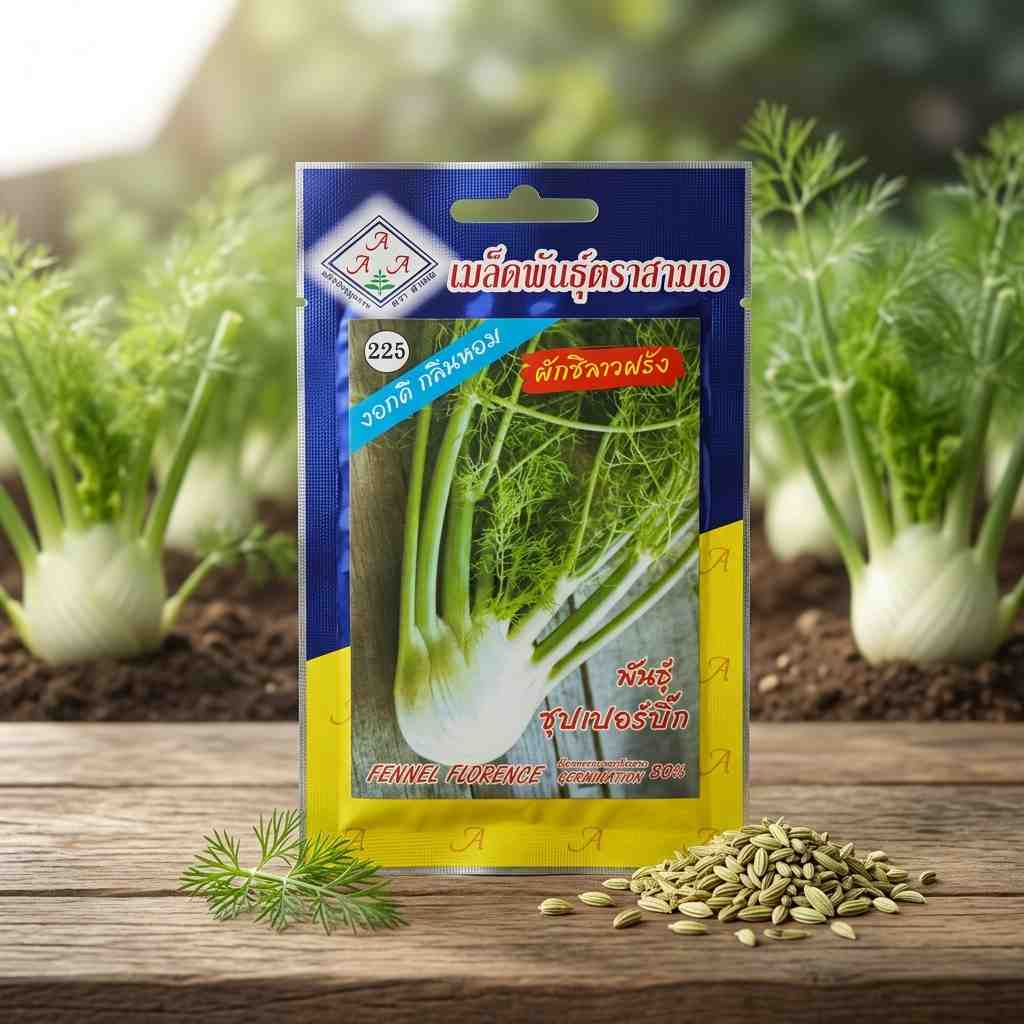
Fennel Florence – 2 gram seeds – AAA – Thai
Original price was: ৳ 280.00.৳ 160.00Current price is: ৳ 160.00.
Available on backorder
Description
FENNEL FLORENCE
Price: _160_ Taka per packet (sale price)
Quantity: 02 gram seeds
Brand: AAA (Chua Yong Seng Seed Co. Ltd)
Origin: Thailand
Germination Rate (Approx.): _80_%
Physical Purity (Min): 98%
Genetic Purity (Min): 98%
- Common Name: Florence Fennel, Bulb Fennel, Finocchio
- Scientific Name: Foeniculum vulgare var. azoricum (also classified as Foeniculum vulgare subsp. vulgare var. azoricum)
- Family: Apiaceae (Carrot family)
- Bengali Name: মৌরি শাক / বাল্ব মৌরি (Florence Fennel-এর জন্য নির্দিষ্ট সর্বজনস্বীকৃত বাংলা নাম প্রচলিত নয়)
- Plant Type: Cool-season annual vegetable
- Primary Edible Part: The enlarged, overlapping leaf bases, commonly called the fennel bulb. The leaves, stalks, flowers and seeds are also edible.
- Important distinction: Florence fennel is not the same as ordinary herb fennel. Ordinary fennel is primarily grown for its aromatic leaves and seeds, whereas Florence fennel is selected for its enlarged, tender, bulb-like leaf bases. The crop is harvested before flowering and seed formation.
Florence fennel is an excellent choice for cool-season vegetable gardening. Its attractive, feathery foliage and crisp, aromatic white bulbs make it suitable for both edible rooftop gardens and commercial vegetable production.
Growing recommendation for Bangladesh: Grow it during the relatively cool and dry winter season. High temperatures, particularly during the early vegetative stage, can encourage premature bolting and prevent proper bulb development.
Germination temperature and seedling establishment
| Parameter | Recommended range |
|---|---|
| Optimum germination temperature | 18–22°C |
| Practical acceptable range | 15–25°C |
| Expected germination time | 7–14 days; occasionally 21–30 days |
| Seed sowing depth | 0.5–1.5 cm (¼–½ inch) |
| Germination light requirement | Light is not essential; use a thin soil covering |
| Ideal seedling conditions | Bright light, steady moisture and good airflow |
The specialist seed supplier ReinSaat lists 20–22°C as the germination temperature for Florence fennel, while PROSEA describes good germination between 15–20°C, extending to around 25°C. University of New Hampshire Extension gives a broader 7–30-day germination window for fennel. These differences reflect seed quality, temperature and growing conditions.
Recommendation: Aim for 18–22°C for the most reliable results. In Bangladesh, sow during the cooler part of the season, preferably in a shaded nursery area that remains bright but not excessively hot.
Seed-sowing procedure
-
Fill a seed tray or small biodegradable pot with a fine, sterile, well-draining seed-starting mix.
-
Sow 2–3 seeds per station at a depth of 0.5–1 cm.
-
Cover lightly and mist until the mix is uniformly moist.
-
Keep the medium moist, never saturated.
-
Provide bright indirect light until seedlings emerge, then gradually introduce direct sunlight.
-
Thin to one strong seedling per pot when the seedlings have developed their first true leaves.
-
Prefer direct sowing in the final container because fennel develops a taproot and dislikes root disturbance.
Plant height, spread and spacing
| Characteristic | Recommended estimate |
|---|---|
| Mature plant height | 1.5–3 ft (45–90 cm) |
| Plant spread | 1–2 ft (30–60 cm) |
| In-row spacing | 10–12 inches (25–30 cm) |
| Row spacing | 12–18 inches (30–45 cm) for an intensive garden; 24–36 inches (60–90 cm) where access or cultivation requires it |
| Seed depth | 0.25–0.5 inch (0.6–1.3 cm) |
| Support or trellis | Not normally required |
These are practical planning ranges rather than fixed dimensions for every cultivar. Commercial recommendations differ: the Ontario Ministry of Agriculture gives 20–30 cm in-row spacing, while the RHS recommends 30 cm between mature plants and 30 cm between rows.
Rooftop tip: For full-sized bulbs, use a spacing of approximately 12 × 12 inches. For baby fennel harvested early, plants can be grown more closely, around 4–6 inches apart.
A trellis is unnecessary for bulb production. Protect tall flowering plants from strong rooftop winds if you intend to collect seeds.
Time to harvest and flowering
| Growth milestone | Approximate time from sowing |
|---|---|
| Germination | 7–14 days |
| Seedling establishment | 2–4 weeks |
| Baby fennel harvest | Around 6 weeks under suitable conditions |
| Mature bulb harvest | 60–120 days, commonly 75–100 days |
| Flowering | Usually around 90–150 days if allowed to mature, but highly variable |
| Seed harvest | Often 120–180 days or longer |
The timing varies significantly by cultivar, sowing season and temperature. Utah State University Extension reports maturity in 60–90 days for Florence fennel, while ReinSaat gives approximately 90–120 days. These are not contradictory so much as variety- and condition-dependent estimates.
For Bangladesh, expect the crop to take longer or produce smaller bulbs if daytime temperatures remain high, water supply fluctuates, or the plant bolts prematurely.
How to harvest a mature bulb
Harvest when:
-
The swollen leaf bases form a firm, compact, pale greenish-white bulb.
-
The bulb is approximately 3–5 inches (8–13 cm) across, depending on the cultivar.
-
The plant has not begun elongating its central flower stalk.
-
The bulb feels solid and tender rather than woody.
Cut just below the bulb with a clean knife. Do not wait for the plant to flower if your main objective is vegetable production. Once bolting begins, bulb quality often deteriorates.
Recommended container size
One mature plant per container
12–14 inches wide × 12–14 inches deep
Approximately 30–36 cm diameter and depth; about 15–25 litres, depending on shape.
-
Use a container with several unobstructed drainage holes.
-
Prefer a deeper pot because fennel develops a taproot.
-
A 16-inch-wide container can accommodate up to two plants if they are spaced adequately, but one plant per 12–14-inch pot is easier to manage.
-
Ensure the rooftop can safely support the weight of wet containers.
Soil type and pH
Florence fennel performs best in fertile, friable, well-drained loam with consistent moisture and sufficient organic matter.
-
Ideal pH: 6.0–7.0; a practical target is approximately 6.3–6.8.
-
Structure: Loose enough for roots to penetrate without compaction.
-
Moisture: Retains moisture but drains excess water quickly.
-
Avoid: Heavy clay, saline soil, waterlogged media and fresh, undecomposed manure.
Florence fennel requires more uniform moisture than ordinary herb fennel. Poor drainage promotes root disease, while repeated drying can encourage bolting and splitting.
Recommended rooftop potting mix
Recommended formulation by volume, not by weight. Percentages total 100%.
- Loamy soil 30%
- Coconut coir dust 20%
- Vermicompost 15%
- Mature cow-dung compost 10%
- Trichocompost 10%
- Perlite 10%
- Brown sand 5%
- Total 100%
For a 20-litre batch, measure approximately:
| Ingredient | Volume |
|---|---|
| Loamy soil | 6 L |
| Coconut coir dust | 4 L |
| Vermicompost | 3 L |
| Cow-dung compost | 2 L |
| Trichocompost | 2 L |
| Perlite | 2 L |
| Coarse river sand | 1 L |
| Total | 20 L |
Why these ingredients?
Loam provides mineral soil and structure; coir helps buffer moisture; composts provide organic matter and nutrients; perlite and coarse sand improve aeration and drainage.
-
Use only fully matured composts, with no foul smell or heating.
-
Wash and buffer coir if its salt content is uncertain.
-
Check the finished mix pH before planting.
-
Do not add lime or oyster shell automatically; first confirm that the pH needs raising.
This is a practical starting formula for a rooftop container, not a laboratory-validated universal recipe. Adjust it if your composts are unusually salty or your loam is heavy clay.
Sunlight, watering and temperature management
Sunlight requirements
-
Mature plant: 6–8 hours of direct sunlight daily, preferably morning sunlight in Bangladesh.
-
Seed germination: Light is not strictly necessary; lightly cover seeds and keep them moist.
-
Seedlings: Bright light immediately after emergence to prevent weak, elongated growth.
-
Hot weather: During unusually hot spells, provide light afternoon shade if plants show heat stress, but do not keep them in deep shade.
Water requirement by growth stage
The following figures are practical starting estimates for one plant in a 12–14-inch container. Actual requirements depend on temperature, wind, potting mix, plant size and drainage. They are not fixed physiological water-use measurements.
| Plant stage | Approximate water per plant | Suggested interval |
|---|---|---|
| Seed-sowing stage | 50–100 mL per watering | Check daily; mist or water when the surface begins drying |
| Small seedling, up to 4 inches | 100–250 mL | Every 1–2 days as needed |
| Young plant, 4–8 inches | 250–500 mL | Every 1–2 days as needed |
| Developing bulb, 8–16 inches | 500–900 mL | Daily in warm, dry weather; less often in cool weather |
| Mature plant, bulb developing rapidly | 700–1,200 mL | Daily during hot, windy weather if needed |
The correct rule is to water according to moisture, not the calendar. Insert a finger 1–2 inches into the mix. If it feels dry, water slowly until some water drains from the bottom. If it is still moist, wait and check again.
For Dhaka rooftops, inspect pots every morning during the dry season and again in the afternoon during hot weather. Water in the morning where possible. Never allow the root zone to alternate between severe dryness and saturation; Florence fennel needs even moisture for tender bulb development.
Temperature management
| Condition | Recommended approach |
|---|---|
| Germination | Aim for 18–22°C |
| Vegetative growth | Cool to mild weather; approximately 15–22°C is a useful target |
| Bulb development | Avoid prolonged heat, severe dryness and large moisture fluctuations |
| Bangladesh winter | Usually the best opportunity for bulb production |
| Hot, humid weather | Higher risk of bolting, weak bulb formation and root disease |
The growth-temperature figures are practical targets, not strict limits. Cultivars vary in heat and bolting tolerance.
Nutrient requirements and organic fertilizer programme
Florence fennel needs balanced nutrition, with nitrogen supporting healthy foliage, phosphorus supporting root development, and potassium helping regulate water balance and overall crop development. Too much nitrogen can produce excessive foliage without proportionate bulb development.
Essential nutrients
The percentages below describe the approximate nutrient composition of commonly used commercial fertilizer grades, not the percentage that Florence fennel requires in its tissue. Organic fertilizer composition varies substantially by source.
| Nutrient | Importance | Organic sources from your list |
|---|---|---|
| Nitrogen (N) | Leaf and stem growth; supports bulb formation | Vermicompost, cow-dung compost, trichocompost, horn meal, mustard cake |
| Phosphorus (P₂O₅) | Root establishment and energy transfer | Bone meal, vermicompost, mature compost |
| Potassium (K₂O) | Water regulation, plant strength and quality | Compost, vermicompost; actual content depends on analysis |
| Calcium (Ca) | Cell walls and growing-point health | Oyster shell powder, bone meal |
| Magnesium (Mg) | Chlorophyll and photosynthesis | Epsom salt, some composts |
| Sulfur (S) | Protein synthesis and plant metabolism | Mustard cake, Epsom salt |
| Iron (Fe) | Chlorophyll formation | Loam and composts, depending on pH |
| Manganese (Mn) | Photosynthesis and enzyme activity | Soil and composts |
| Zinc (Zn) | Enzyme function and growth regulation | Compost and soil |
| Boron (B) | Cell development and growing-point function | Trace quantities from soil and compost |
Useful fertilizer grades
| Material | Typical nutrient information |
|---|---|
| Horn meal | Often approximately 10–14% N; check supplier specifications |
| Bone meal | Commonly approximately 3–5% N and 10–20% P₂O₅, depending on processing |
| Neem cake | Often approximately 4–6% N; varies by manufacturer |
| Mustard cake | Often approximately 4–6% N, with variable P, K and sulfur |
| Vermicompost | Variable NPK; many products contain roughly 1–3% N, but a product label or lab analysis is preferable |
| Mature cow-dung compost | Highly variable NPK; generally a slow-release soil amendment |
| Trichocompost | Nutrient content depends on the base compost and production process |
| Epsom salt | Magnesium sulfate heptahydrate, approximately 9.8% Mg and 13% S |
Do not treat these ranges as guaranteed product specifications. A soil or compost analysis is the most reliable way to establish the actual nutrient content.
Organic fertilizer blend for one plant
For the recommended 12–14-inch container, use the following as a conservative starting dose for the entire growing cycle, assuming the potting mix already contains mature composts.
| Ingredient | Total per plant | Application method |
|---|---|---|
| Trichocompost | 40 g | Mix into the potting medium before planting |
| Vermicompost | 60 g | Mix into the medium before planting |
| Cow-dung compost | 50 g | Mix into the medium before planting |
| Horn meal | 5 g | Mix into the medium before planting |
| Bone meal | 5 g | Mix into the medium before planting |
| Neem cake powder | 5 g | Mix into the medium before planting |
| Mustard cake powder | 5 g | Mix into the medium before planting |
| Oyster shell powder | 0 g routinely | Use only if a soil test shows a need for calcium or pH correction |
| Epsom salt | 0 g routinely | Use only when magnesium deficiency is confirmed or strongly indicated |
The total routine amendment is 170 g per pot. This is an additional amendment, not a mandatory dose for every potting mix. If the compost blend is already nutrient-rich or has elevated electrical conductivity (EC), reduce the quantities or omit the additional fertilizer.
Application interval
-
At planting: Apply the initial blend evenly through the mix.
-
At 3–4 weeks: Add 15–20 g vermicompost as a light surface dressing if growth is healthy but additional nutrition is needed.
-
At 5–6 weeks: Reassess foliage and bulb development. If necessary, apply another 10–15 g mature vermicompost.
-
Stop adding concentrated organic fertilizers when the bulb is close to harvest.
Do not place concentrated mustard cake, horn meal or bone meal directly against the roots. Never use fresh cow dung. Excessive organic nitrogen or incompletely decomposed material can damage roots, increase salt levels or delay bulb development.
Chemical fertilizer programme
A chemical fertilizer programme can be useful when nutrient supply from compost is insufficient. Use soil testing where possible, and follow the actual nutrient grade on the product label.
A cautious starting programme for one 12–14-inch pot:
| Stage | Fertilizer | Starting application |
|---|---|---|
| At planting | Balanced granular fertilizer, such as 10-10-10 | 1–2 g per pot, only if the potting mix is not already well fertilized |
| 3–4 weeks after sowing | Water-soluble balanced fertilizer, such as 19-19-19 | 0.5–1 g in 1 litre of water |
| 5–6 weeks after sowing | Balanced fertilizer or a slightly potassium-forward formulation | 0.5–1 g in 1 litre of water, only if needed |
| During bulb formation | Avoid excessive nitrogen | Maintain even moisture and reassess plant growth before further feeding |
Apply dilute liquid fertilizer to already moist soil, not to a dry root zone. Do not apply every listed dose automatically on top of a rich compost blend. If plants are dark green with abundant leaves but little bulb swelling, avoid adding more nitrogen.
For commercial production, use a soil-test-based fertilizer recommendation rather than extrapolating these small-container doses directly to field scale.
Can Florence fennel be grown hydroponically?
Yes, it is possible, but Florence fennel is less commonly grown hydroponically than leafy herbs. It needs sufficient root volume and physical support from the growing medium to develop its swollen leaf bases. A small deep-water-culture basket intended for lettuce may not be suitable for a mature bulb crop.
A drip-irrigated substrate system or Dutch-bucket-style container filled with inert medium is more practical than a very shallow NFT channel.
Starting hydroponic solution
The following is a general starting target for a vegetable nutrient solution, not a Florence-fennel-specific formula validated by a commercial production trial.
| Parameter | Starting target |
|---|---|
| Solution pH | 5.8–6.3 |
| Electrical conductivity (EC) | 1.4–1.8 mS/cm initially |
| Water temperature | Preferably 18–24°C |
| Dissolved oxygen in recirculating solution | Maintain good aeration |
| Nitrogen | Predominantly nitrate-N; avoid excessive ammonium |
| Monitoring | Check pH and EC frequently and replace or rebalance solution as required |
Use a complete hydroponic fertilizer containing nitrogen, phosphorus, potassium, calcium, magnesium, sulfur and trace elements. Commercial two-part hydroponic nutrients are usually more reliable than trying to formulate a solution from organic composts, bone meal and mustard cake.
A precise gram-per-litre formula cannot safely be given without knowing the water’s initial mineral content and the exact fertilizer products. Calcium-containing concentrates also must not be mixed directly with concentrated phosphate or sulfate solutions, because precipitation can occur.
Bangladesh rooftop caution: Warm nutrient solution, poor aeration and high rooftop temperatures can cause rapid root stress. Protect reservoirs from direct sunlight and monitor water temperature. Start with a small trial before investing in a larger system.
Companion planting
Florence fennel is a somewhat unusual companion plant because its aromatic foliage may confuse some pests, but fennel can also compete strongly with nearby plants. It is not a universally beneficial companion for every vegetable.
Lettuce
A useful neighbour in a cool-season garden. Its shallow roots and compact growth can complement fennel when adequate spacing is maintained.
Spinach
A cool-season crop that can be grown in a separate nearby container. Avoid crowding the fennel’s root zone.
Bush beans
Can be grown nearby with adequate light and spacing. Do not assume that beans will improve fennel’s nutrition enough to replace fertilizer.
Marigold
Useful for garden diversity and aesthetics. It should not be treated as a guaranteed pest-control method.
Plants to separate from fennel: Keep it away from dill and other fennel plants intended for seed production when cross-pollination matters. Avoid planting it directly alongside sensitive crops if space is limited. Carrots, coriander, dill and parsley are members of the same family, Apiaceae, and can share some pests and diseases.
Pests and their management
The pests listed below can attack fennel or other related vegetables. Actual pest pressure in Bangladesh will depend on season, nearby crops and rooftop conditions.
| Pest | Signs of damage | Management options |
|---|---|---|
| Aphids | Clusters of small insects, curled leaves, sticky honeydew | Wash off with water; conserve ladybirds; use insecticidal soap where appropriate |
| Cutworms | Seedlings cut near soil level | Remove larvae manually; clear debris; use physical collars around seedlings |
| Caterpillars | Holes in leaves and chewed foliage | Hand-pick; use Bacillus thuringiensis (Bt) products labelled for the target caterpillar |
| Slugs and snails | Irregular holes and slime trails | Hand-pick at night; remove hiding places; use barriers or locally approved molluscicides |
| Spider mites | Fine webbing, stippled or bronzed leaves | Rinse leaf undersides; reduce plant stress; use labelled horticultural soap or oil if appropriate |
| Root-knot nematodes | Galled roots, weak growth, poor bulb formation | Use clean growing media, sanitize containers, remove badly affected plants |
| Leaf-mining larvae | Winding tunnels inside leaves | Remove affected leaves; use insect-proof mesh where practical |
Chemical control
For aphids, registered insecticidal soaps or appropriately labelled horticultural oils may be useful. For caterpillars, labelled Bacillus thuringiensis products can be a targeted option. For slugs, use only a product registered for the crop and follow its label.
Do not use a pesticide solely because its active ingredient is known to work on a related crop. Confirm that the product is registered for the intended use in Bangladesh, observe the pre-harvest interval, and protect pollinators and beneficial insects. Avoid spraying edible leaves immediately before harvest.
Diseases and their management
| Disease or disorder | Symptoms | Prevention and treatment |
|---|---|---|
| Damping-off | Seedlings collapse at soil level | Use clean trays and sterile seed-starting mix; avoid overwatering |
| Root rot | Brown, soft roots; wilting despite wet soil | Improve drainage, avoid waterlogging, discard badly affected plants |
| Powdery mildew | White powdery coating on foliage | Improve airflow; avoid dense planting; use a crop-labelled fungicide if necessary |
| Leaf blights | Brown or black lesions, sometimes with yellow margins | Remove infected leaves, avoid prolonged leaf wetness and overhead watering |
| Downy mildew | Yellowish patches and downy growth, especially in humid conditions | Improve airflow, remove infected material and avoid excessive humidity |
| Bacterial soft rot | Soft, wet, foul-smelling tissue | Remove infected plants, sanitize tools and avoid injury to bulbs |
| Premature bolting | Elongated central stem and declining bulb quality | Choose bolt-resistant varieties, sow at the right time and maintain consistent moisture |
Chemical disease management
-
Copper-based fungicides or bactericides: May be useful for certain labelled diseases, but copper does not cure every infection and excessive use can harm plants and accumulate in soil.
-
Sulfur-based fungicides: May help control powdery mildew where labelled; avoid inappropriate use in hot weather.
-
Other fungicides: Select a product specifically registered for the diagnosed disease and edible crop in Bangladesh.
Organic alternatives: Remove infected plant parts, use clean seed and media, improve drainage, sanitize tools and maintain airflow. Trichocompost may support a healthy root environment, but it is not a guaranteed cure for an established disease.
Expected yield and family requirements
Florence fennel yield varies substantially with cultivar, planting density, temperature, bolting resistance and bulb size. A reliable Bangladesh-specific yield figure for the exact variety was not available in the sources reviewed, so the following figures are planning estimates, not published local trial results.
| Production measure | Practical planning estimate |
|---|---|
| Typical marketable bulb weight | 150–300 g per plant |
| Yield per square foot per crop | Approximately 0.15–0.30 kg at one plant per square foot |
| Yield per 10 sq ft per crop | Approximately 1.5–3 kg |
| Approximate crop duration | 75–100 days under suitable conditions |
| Annual crops | Usually 2–3 well-timed crops are a reasonable planning goal, not a guarantee |
Actual yield per square foot can be lower if plants are spaced more widely, bulbs remain small, or heat causes bolting.
How much should a family of four grow?
For a Bangladeshi family that uses fennel bulb occasionally in salads, vegetable dishes, fish preparations or roasted dishes, a starting target of 2–4 kg of bulbs per month is reasonable if the family enjoys it regularly. This is a meal-planning estimate, not a nutritional requirement.
At 200 g per bulb, that is approximately 10–20 bulbs per month. To obtain a continuous supply, sow a small batch every 2–3 weeks during the suitable season instead of sowing everything at once.
Lifespan and propagation
-
Crop lifespan: Usually one growing season when grown for bulbs.
-
Time to edible bulb: Commonly around 2.5–4 months from sowing.
-
Propagation method: Seed propagation is the best practical method for Florence fennel.
-
Transplanting: Possible, but root disturbance may reduce growth or encourage bolting.
-
Vegetative propagation: Crown or root division is possible in some fennel types, but it is not the preferred commercial method for uniform Florence fennel bulbs.
For the best results, direct-sow into the final container or start individual seedlings in modules that can be transplanted with minimal disturbance.
Seed quantity and seed storage
A specialist Florence fennel supplier reports a thousand-seed mass of approximately 3–5 g. This corresponds to around 200–333 seeds per gram. Seed size and the actual batch may differ.
| Seed quantity | Approximate number of seeds |
|---|---|
| 1 g | 200–333 |
| 5 g | 1,000–1,665 |
| 10 g | 2,000–3,330 |
Actual germination will be lower than the total seed count if viability is poor. Store seeds in a cool, dry, airtight container away from sunlight and moisture. PROSEA reports fennel seed viability of approximately 2–3 years under suitable storage conditions; germination should be tested if seeds are older.
Harvesting, storage and culinary uses
Storing fresh bulbs
-
Harvest firm, undamaged bulbs.
-
Remove soil and damaged outer layers, but avoid washing until needed if storing for more than a short period.
-
Refrigerate in a perforated bag or suitable vegetable compartment.
-
Keep away from ethylene-producing fruits where practical.
-
Inspect regularly and discard any soft, slimy or mouldy pieces.
Expected storage life: Approximately 1–2 weeks in a normal household refrigerator, sometimes longer under consistently cold, humid commercial storage conditions. Exact storage life depends on temperature, humidity and bulb condition.
For longer storage, slice and blanch the bulb briefly before freezing. Frozen fennel is better for cooked dishes than for crisp raw salads. The leaves can be refrigerated for several days wrapped in a lightly damp paper towel, or chopped and frozen for cooking.
Popular recipe ideas
1. Bangladeshi fennel fish curry
Cook fish with onion, ginger, garlic, turmeric, chilli and a small quantity of sliced Florence fennel. The bulb adds a gentle sweetness and aromatic flavour.
2. Fennel and seasonal vegetable bhaji
Sauté thin fennel slices with potatoes, carrots or beans, using mustard oil, green chilli and a light seasoning.
3. Mediterranean roasted fennel
Roast wedges with olive oil, garlic, black pepper and herbs until tender and lightly caramelized.
4. Fennel and citrus salad
Thinly slice the raw bulb and combine with orange, lemon juice, olive oil and fresh greens for a crisp salad.
Taste ratings
These are subjective culinary ratings, not scientific measurements.
| Edible part | Taste description | Rating out of 10 |
|---|---|---|
| Bulb | Crisp, juicy, mildly sweet, lightly anise-like | 8/10 |
| Young leaves | Aromatic, herbal, stronger anise flavour | 7/10 |
| Seeds, if allowed to mature | Warm, sweet, licorice-like spice | 8/10 |
Florence fennel does not produce a culinary fruit comparable to tomato or chilli. Its main vegetable product is the swollen leaf base. Therefore, a fruit taste score or Scoville rating is not applicable.
Nutritional value of Florence fennel
The following values are based on USDA FoodData Central’s reference for raw fennel bulb. Actual nutritional values vary with variety, maturity and growing conditions.
| Nutrient | Approximate amount per 100 g |
|---|---|
| Energy | 31 kcal |
| Water | 90.2 g |
| Protein | 1.24 g |
| Total fat | 0.20 g |
| Carbohydrate | 7.30 g |
| Dietary fibre | 3.1 g |
| Total sugars | 3.93 g |
| Potassium | Approximately 414 mg |
| Calcium | Approximately 49 mg |
| Magnesium | Approximately 17 mg |
| Phosphorus | Approximately 50 mg |
| Vitamin C | Approximately 12 mg |
| Folate | Approximately 27 µg |
Note: Nutrient figures can differ between food-composition databases and sampling methods. The table is a reference profile, not a guaranteed analysis of bulbs harvested from your rooftop.
Potential health benefits
Florence fennel can contribute to a varied, balanced diet. The benefits below relate to its nutritional composition; they should not be interpreted as proof that eating fennel prevents or treats a disease.
-
Supports digestive health: Its dietary fibre contributes to normal bowel function and helps increase dietary fibre intake.
-
Supports normal muscle and nerve function: Potassium contributes to normal nerve transmission and muscle function.
-
Contributes to immune function: Vitamin C supports normal immune function and collagen formation.
-
Supports normal blood formation: Folate is needed for normal cell division and red blood cell formation.
-
Provides a low-energy vegetable option: The bulb can add volume, texture and flavour to meals without adding many calories.
Fennel is a food, not a substitute for prescribed treatment. Concentrated fennel oils and supplements have different safety considerations from ordinary culinary quantities.
Few specialties of Florence fennel
1. A bulb that is not a true bulb
Its familiar white bulb is actually formed by thickened, overlapping leaf bases. Botanically, it differs from a true bulb such as an onion.
2. A vegetable with a distinctive aromatic flavour
The bulb is crisp and mildly sweet with a subtle anise-like flavour. It can be eaten raw, roasted, grilled, steamed or braised.
3. A useful cool-season container crop
Compact varieties can fit into large containers, allowing gardeners to grow a less-common vegetable in a small rooftop space.
Three lesser-known facts
-
Bolting can ruin the bulb. When the plant shifts into flowering, the bulb may elongate, harden or become woody. Timely harvesting is therefore essential.
-
Fennel has multiple edible parts. Depending on the plant type and intended harvest, the bulb, leaves, stalks, flowers and mature seeds can all be used in food.
-
The variety matters. Some fennel varieties are selected primarily for seeds and foliage, while Florence fennel varieties are selected for bulb formation. Buying the correct seed type is crucial.
Native region, origin and botanical classification
-
Scientific name: Foeniculum vulgare Mill. var. azoricum (Miller) Thell. is a commonly used name for Florence fennel; taxonomic treatments differ.
-
Family: Apiaceae.
-
Genus: Foeniculum.
-
Common names: Florence fennel, bulb fennel, finocchio, Italian fennel.
-
Bengali descriptive name: বাল্ব মৌরি or মৌরি শাক. These are descriptive terms, not necessarily established regional names.
-
Native region: The wider fennel species is native to the Mediterranean region and adjacent parts of southwestern Asia. Florence fennel is a cultivated form selected for its swollen leaf bases.
-
Origin story: Fennel has been used as a food and aromatic herb since ancient times in the Mediterranean world. Florence fennel developed through cultivation and selection for its edible bulb-like base; there is no single universally credited discoverer or inventor.
Fennel’s botanical classification is described by the Ontario Ministry of Agriculture and the Royal Horticultural Society.
Best sowing month in Bangladesh
For Dhaka and similar areas, November is the best month to begin a trial crop, with December also suitable. Early January can work, but the crop should be monitored closely as temperatures rise.
The Japan Meteorological Agency’s Dhaka climate tables report mean temperatures of approximately 23.7°C in November and 19.6°C in December as climate normals. Its historical tables show January mean temperatures of 16.9°C in 2024 and 18.9°C in 2025, illustrating the seasonal cooling but also year-to-year variation.
Climate-normal values in °C, illustrating the cooler planting window.

Important climate qualification: These are climate-normal figures, not a complete analysis of every daily observation or a forecast for the coming season. Historical weather and future forecasts are different types of evidence. For the best outcome, use a thermometer to monitor the actual rooftop temperature and delay sowing during unusually hot periods.
Suggested Bangladesh sowing calendar
| Month | Recommendation |
|---|---|
| October | Possible in a cooler microclimate; greater heat risk |
| November | Preferred starting month |
| December | Very suitable for a trial crop |
| January | Suitable, but monitor rising temperatures as the crop matures |
| February | Increasing risk of heat-related bolting |
| March–September | Generally challenging for bulb production in exposed Dhaka rooftops |
Additional growing tips for Bangladesh
-
Use a raised, well-drained potting medium: Dhaka’s humidity and heavy rain spells can create root problems if drainage is poor.
-
Protect from excessive rooftop heat: Morning sun and good ventilation are valuable. Do not leave pots sitting in water.
-
Maintain consistent moisture: Avoid letting the medium dry out during bulb development.
-
Do not transplant unnecessarily: Root disturbance can delay growth and increase bolting risk.
-
Avoid excess nitrogen: Lush foliage does not necessarily mean a large, tender bulb.
-
Harvest promptly: Do not wait for the bulb to become oversized if it starts elongating or becoming woody.
-
Use a succession planting strategy: Sow a small number of seeds every 2–3 weeks during the suitable season to spread harvests over time.
Inspirational quotes
“A garden grows more than vegetables; it grows patience, care, and the joy of discovery.”
“From a tiny fennel seed comes a crisp, fragrant harvest—a reminder that good things flourish when nature receives the right care.”
These are original inspirational lines for gardening content, not historical quotations.
FAQs
Can Florence fennel grow in Bangladesh?
Yes, it can be trial-grown during the cooler season, especially in well-managed rooftop containers. Successful bulb formation will depend on the variety, temperature and consistent watering.
Can I grow it in a 10-inch pot?
A 10-inch pot may support a small plant or baby fennel, but a 12–14-inch-wide and deep container is preferable for one mature plant.
Can I eat the leaves?
Yes. The feathery leaves are aromatic and can be used in salads, fish dishes and soups. They have a stronger anise flavour than the bulb.
Does it need a trellis?
No. Bulb fennel ordinarily grows without a trellis.
Can I use ordinary fennel seeds from a spice shop?
Not reliably for bulb production. Buy seeds explicitly labelled Florence fennel, bulb fennel or finocchio.
Can I use only organic fertilizers?
Yes, provided the potting medium and organic fertilizers supply adequate nutrients. Because the nutrient content of compost varies, plant response and soil or media testing should guide additional feeding.
Reference websites and research sources
The following sources support the botanical information, cultivation recommendations, seed characteristics, climate context and nutritional data used in this guide.
-
Royal Horticultural Society — Florence fennel growing guide: How to Grow Florence Fennel.
-
Utah State University Extension — cultivation, watering, harvest and bulb production: How to Grow Fennel in Your Garden.
-
University of New Hampshire Extension — seed germination and planting: How to Grow Green Fennel.
-
Ontario Ministry of Agriculture, Food and Agribusiness — classification, crop spacing and production information: Florence Fennel Production Guide.
-
University of Wisconsin–Madison Extension — fennel cultivation and varieties: Fennel: Foeniculum vulgare.
-
University of Florida IFAS Extension — fennel types and general growing conditions: Fennel.
-
ReinSaat — Florence fennel seed supplier information, germination temperature, sowing depth and seed mass: Florence Fennel Seed Information.
-
PROSEA / Pl@ntUse — botanical and propagation information for Foeniculum vulgare: Foeniculum vulgare — PROSEA.
-
USDA Agricultural Research Service — reference nutrient composition of raw fennel bulb: USDA FoodData Central nutrient report.
-
Japan Meteorological Agency — Dhaka monthly climate data: Dhaka Climate Observations and Normals.
-
Bangladesh Meteorological Department — official climate information portal: Climate Data and Normals.
-
World Meteorological Organization — Dhaka climatological summary: World Weather Information Service: Dhaka.
Research limitations: The exact hydroponic nutrient formula, the organic fertilizer quantities, the family consumption estimate and the rooftop yield figures in this guide are practical recommendations or estimates, not results from a single validated Florence fennel trial in Bangladesh. The recommended soil pH and container dimensions should likewise be treated as growing targets rather than absolute biological limits.
*Note: It is recommended to prepare seedling in a small cup or pot for better success rate and keep the soil moist.
CLICK HERE TO LEARN MORE ABOUT GROWING TIPS
Accessories Required For Seedling Preparation:
OR
Seed Germination Disclaimer:
Successful germination depends on several factors, including temperature, growing medium, moisture, watering, sunlight, soil pH, sowing depth, seed age, and local weather conditions. Germination results may therefore vary depending on the growing environment and cultivation method.
Before reporting a seed as defective, please ensure that the recommended growing conditions and proper sowing methods have been followed. You may also search Google or YouTube for crop-specific seed-sowing guides and tutorials, e.g. “How to grow Bird Chili from seeds.”
For any product-related questions, please contact our support team by inbox, email, or phone. We will do our best to assist you.
Please read the product description carefully before sowing.
Seed Quantity: In rare cases, there may be a slight variation in the number of seeds inside a packet due to packaging or handling. If you notice a significant shortage, please inform us immediately with relevant photos. Our support team will review the matter and provide a solution where possible.
বীজের জার্মিনেশন সংক্রান্ত তথ্য:
বীজের সফল জার্মিনেশন তাপমাত্রা, রোপণ মিডিয়া, আর্দ্রতা, পানি, সূর্যালোক, মাটির pH, বীজ বপনের গভীরতা, বীজের বয়স এবং স্থানীয় আবহাওয়াসহ বিভিন্ন বিষয়ের উপর নির্ভর করে। তাই পরিবেশ ও চাষের পদ্ধতি অনুযায়ী জার্মিনেশনের ফলাফল ভিন্ন হতে পারে।
বীজের মান নিয়ে অভিযোগ করার আগে অনুগ্রহ করে সঠিক পরিবেশ ও বীজ বপনের পদ্ধতি নিশ্চিত করুন। প্রয়োজনীয় নির্দেশনার জন্য Google বা YouTube-এ ফসলের নাম দিয়ে সার্চ করতে পারেন, যেমন: “How to grow Bird Chili from seeds.”
পণ্য সম্পর্কিত কোনো প্রশ্ন থাকলে ইনবক্স, ইমেইল অথবা ফোনের মাধ্যমে আমাদের সাপোর্ট টিমের সাথে যোগাযোগ করুন। আমরা যথাসাধ্য সহযোগিতা করার চেষ্টা করব।
বীজ ব্যবহারের আগে অনুগ্রহ করে পণ্যের বিবরণ ভালোভাবে পড়ে নিন।
বীজের পরিমাণ: বিরল ক্ষেত্রে প্যাকেজিং বা হ্যান্ডলিংয়ের কারণে প্যাকেটে উল্লেখিত সংখ্যার তুলনায় সামান্য কম-বেশি হতে পারে। উল্লেখযোগ্য ঘাটতি থাকলে অনুগ্রহ করে দ্রুত ছবি সহ আমাদের জানান। আমাদের সাপোর্ট টিম বিষয়টি পর্যালোচনা করে সম্ভব হলে উপযুক্ত সমাধান প্রদান করবে।
#80T #fennel #florence #aaa #thai #thailand #Color #Plant #herb #herbs #Rooftop #How #to #grow #seeds #Balcony #online #store #my #garden #bd #mygardenbd #nature #ছাদ #বাগান #টব #গাছ # ফুল #বীজ #in #Dhaka #Bangladesh
#FlorenceFennel #Fennel #BulbFennel #Finocchio #FoeniculumVulgare #FennelPlant #FennelSeeds #FennelBulb #FennelLeaves #FennelVegetable #GrowFennel #FennelGardening #FennelCultivation #FennelGrowingGuide #FennelCare #FennelHarvest #FennelSeedsForSale #VegetableSeeds #VegetableGardening #OrganicGardening #OrganicVegetables #HomeGardening #RooftopGardening #UrbanGardening #ContainerGardening #KitchenGarden #EdibleGarden #BalconyGarden #GardeningBangladesh #BangladeshGardening #DhakaGardening #WinterVegetables #CoolSeasonVegetables #HealthyEating #FreshVegetables #HomegrownFood #GrowYourOwnFood #SustainableGardening #OrganicFarming #VegetableFarming #GardeningTips #GardenToTable #FarmToTable #SeedToHarvest #PlantLovers #GardenLovers #MyGardenBd #MyGardenBangladesh
#মৌরি #মৌরিশাক #বাল্বমৌরি #ফ্লোরেন্সমৌরি #মৌরিগাছ #মৌরিবীজ #মৌরিচাষ #মৌরিশাকচাষ #মৌরিরচারা #মৌরিরবীজ #সবজিচাষ #শীতকালীনসবজি #শীতকালীনচাষ #ছাদবাগান #ছাদেকৃষি #ছাদেকৃষিকাজ #ছাদেবাগান #বাগানকরুন #বাগানপ্রেমী #বাগানবিলাস #বাগানকরা #ঘরেবাগান #বারান্দাবাগান #কিচেনগার্ডেন #রান্নাঘরেরবাগান #নিজেরসবজিনিজেচাষ #নিজেরখাবারনিজেচাষ #জৈবচাষ #জৈবসার #জৈবসবজি #বিষমুক্তসবজি #নিরাপদখাদ্য #দেশিবাগান #বাংলাদেশেরবাগান #বাংলাদেশেকৃষি #সবজিবাগান #সবজিরবীজ #উন্নতমানেরবীজ #শখেরবাগান #গাছলাগান #গাছেরযত্ন #বাগানগাইড #চাষাবাদ #কৃষিতথ্য #মৌরিরউপকারিতা #স্বাস্থ্যকরখাবার #তাজাসবজি #মাটিরযত্ন #মাইগার্ডেনবিডি #MyGardenBd
Only logged in customers who have purchased this product may leave a review.


Reviews
There are no reviews yet.