
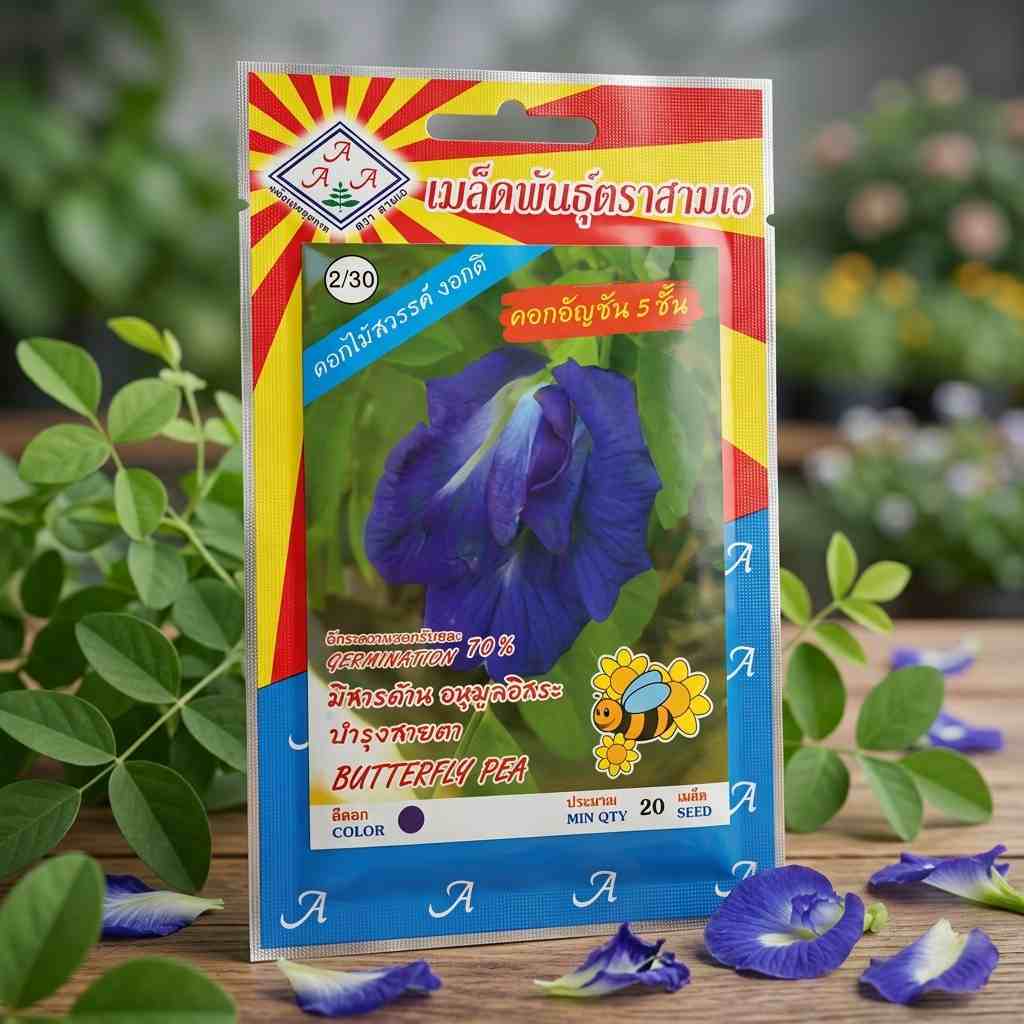
Butterfly Pea – 20 seeds – AAA – Thai
৳ 160.00
Available on backorder
Description
Butterfly Pea
Price: 160 Taka per packet
Quantity (approx.): 20 seeds
Brand: AAA (Chua Yong Seed Co. Ltd.)
Country: Thailand
Germination Rate (Approx.): 70%
Physical Purity (Min): 98%
Genetic Purity (Min): 98%
CULTIVATION GUIDE
Scientific classification
| Character | Information |
| Common name | Butterfly Pea |
| Other names | Blue Pea, Blue Vine, Asian Pigeonwings, Pigeon Wings, Bunga Telang, Aparajita |
| Scientific name | Clitoria ternatea L. |
| Family | Fabaceae (Leguminosae) |
| Subfamily | Faboideae/Papilionoideae |
| Genus | Clitoria |
| Life cycle | Perennial climbing/twining herb |
| Growth habit | Vine/climber |
| Chromosome number | 2n = 16 |
| Bangladesh status | Introduced/cultivated; now well adapted in warm regions |
Germination Temperature
Recommended range: 24–32°C
Practical Bangladesh target: 25–30°C
Research on C. ternatea reports good germination and establishment around 24–32°C. A controlled study examining 21, 24 and 27°C found germination at all three temperatures, while scarification greatly improved germination. (Frontiers)
Best target: 27–30°C substrate temperature.
Avoid allowing seed trays to become extremely hot (>35°C) on a Dhaka rooftop.
Germination Time
Normally: 3–6 days
The radicle can appear within approximately 48–72 hours, with visible seedling emergence generally taking 3–6 days under warm, moist conditions. (PROSEA)
However, hard-coated or untreated seed can germinate poorly or irregularly.
For commercial seed sowing
We recommend: Lightly nick/scratch the seed coat → soak in clean water for ~12–24 hours → sow.
Mechanical scarification has produced substantially better germination than untreated seed in research. (Academic Journals)
Do NOT recommend concentrated sulfuric acid treatment to ordinary home gardeners. Although research demonstrates its effectiveness, it is hazardous and unnecessary for rooftop gardeners.
Plant Height, Span & Seed Sowing Depth
Plant/vine height
Typical cultivated vine: 5–10 ft (1.5–3 m)
Under excellent conditions it can reach approximately 15 ft (4.5 m). (NC Extension Gardener Toolbox)
Natural spread
Approximately: 3–6 ft (0.9–1.8 m) depending on support and pruning.
Seed sowing depth: 1–2 inches (2.5–5 cm)
Research recommends approximately 2.5–5 cm. (Frontiers)
Our recommendation
For rooftop containers: 1 inch / 2.5 cm is sufficient.
Plant Spacing
- For individual container plants: 18–24 inches (45–60 cm) between plants.
- For open beds: 12–18 inches (30–45 cm) can work with a strong trellis.
Research commonly reports 20–30 cm (8–12 inches) spacing for field establishment, but I recommend wider spacing in a rooftop garden because the objective is a large, well-aerated flowering vine rather than maximum field density. (Frontiers)
Row Spacing
- For commercial/open-bed production: 24–36 inches (60–90 cm)
- For a dense commercial trellis: 24 inches can work.
- For a rooftop garden: 30–36 inches is preferable for ventilation and maintenance.
Trellis / Physical Support
YES — strongly recommended.
Butterfly pea is a twining climbing vine. It can scramble across the ground, but flowering and harvesting are substantially easier when trained vertically.
Suitable supports:
- Bamboo trellis
- Nylon/HDPE garden net
- Metal grid
- Balcony railing
- Pergola
- Wire frame
- A-frame trellis
- Vertical garden mesh
Recommended rooftop trellis: 5–7 ft high
For a mature plant, 6–8 ft is ideal.
The 2026 agronomic study used a 2-m bamboo stake and tied the plants progressively as they grew. (Springer)
Seed-to-Bloom Time
Typical: 7–11 weeks
Approximately: 50–80 days
PROSEA reports most tested lines flowering around 8–9 weeks after sowing, while a recent agronomic study recorded flowering around 81–91 days under its experimental conditions. (PROSEA)
Bangladesh rooftop expectation
With good seed treatment, sunlight, nutrition and support: ~55–75 days
How Long Does an Individual Bloom Stay?
This is one of Butterfly Pea’s interesting characteristics.
Individual flower: Approximately 1 day.
Recent phenological work found the anthesis/bloom phase lasted approximately one day, after which the flower entered post-anthesis/wilting. (ResearchGate)
So don’t confuse:
Flowering season = months
with: Individual flower life = approximately one day.
Because the plant produces flowers continuously, a mature vine can appear to be perpetually flowering.
Flower Color, Shape & Size
Shape: Distinctive papilionaceous/pea-like butterfly shape.
It consists of:
- Large standard/banner petal
- Two wing petals
- Two keel petals
Normal flower
Approximately: 1.2–2 inches (3–5 cm) diameter
Kew records the standard at approximately 4–4.5 cm, while NC State reports flowers up to approximately 2 inches. (Plants of the World Online)
Colors
Globally documented forms include:
- Deep blue
- Royal blue
- Light blue
- Violet
- Purple
- Mauve
- Pink
- White
- White with blue margins
- Double blue
- Double white
- Double pink
Research has documented both single and double forms and considerable color variation. (ResearchGate)
Life Span
Perennial
Under suitable tropical conditions: Several years
PROSEA specifically reports individual plants living for several years, while Singapore’s NParks also classifies it as perennial. (PROSEA)
Bangladesh
A healthy rooftop plant can potentially remain productive for: 2–4+ years with good pruning, drainage and nutrition.
Extreme neglect, root restriction, disease or prolonged waterlogging can shorten this considerably.
Recommended Pot / Container Size
For a serious flowering plant:
Minimum: 16 × 16 inches deep
Recommended: 20–24 inch diameter × 16–20 inch depth
Ideal rooftop container: 24 × 18–20 inches
Approximately 50–70+ litres.
For commercial flowering production, use:
One mature Butterfly Pea plant per 50–70 L container.
Don’t put several mature vines into a small 10–12 inch pot if the objective is maximum flowers.
Bed
Recommended minimum: 18–24 inches soil depth
with approximately: 18–24 inches spacing per plant.
Soil Type, pH & Potting Mix
Butterfly pea is unusually adaptable.
It can grow in:
- Loam
- Sandy loam
- Clay loam
- Alluvial soils
- Moderately alkaline soils
But for a rooftop container, the objective should be:
fertile + well aerated + moisture-retentive + extremely well drained.
It does not tolerate prolonged waterlogging. Its documented soil tolerance is broad, approximately pH 5.5–8.9, although fertile friable soil is preferred. (Management and Science University)
Ideal container pH
6.0–7.0
Best target:
pH 6.2–6.8
- Sunlight Requirement
Mature plant
6–8 hours of direct sunlight/day
Ideal:
7–8 hours
It can tolerate some shade, but insufficient sunlight generally means:
- More foliage
- Longer internodes
- Fewer flowers
- Weak stems
Full sun is recommended by horticultural sources. (Management and Science University)
Germinating seeds
Seeds do not need strong direct sunlight.
Provide:
Bright indirect light / partial shade
until emergence.
After emergence, gradually introduce the seedlings to direct sunlight.
Water Requirement
There is no scientifically fixed “litres per plant per day” because water demand changes dramatically with:
- Container size
- Temperature
- Wind
- Plant size
- Media composition
- Rainfall
- Sunlight
For your recommended 50–70 L rooftop container, use this practical schedule.
| Plant stage | Approx. water/application | Interval |
| Newly sown | 100–250 mL | As needed to maintain moisture |
| Seedling <6″ | 250–400 mL | Every 1–2 days |
| 6–18″ | 500–800 mL | Every 1–2 days |
| 18–36″ | 0.8–1.5 L | Every 1–2 days |
| Mature 3–6 ft | 1.5–2.5 L | Every 1–2 days |
| Large flowering vine, hot dry weather | 2–3 L | Usually daily |
| Rainy/humid weather | Reduce substantially | According to media moisture |
Important
Do not follow litres blindly.
Water when the upper 1–2 inches of media becomes noticeably dry.
The container must drain freely.
Never keep the pot sitting in stagnant water.
RECOMMENDED ROOFTOP POTTING MIX
From your supplied ingredient list, I would not use everything.
Adding every available amendment would actually make the mixture unnecessarily complicated and potentially cause excessive salts, phosphorus, nitrogen, alkalinity or poor physical structure.
Recommended 100% mix
| Ingredient | Percentage |
| Loamy Soil | 35% |
| Coconut Coir Dust | 20% |
| Vermicompost | 15% |
| Cow Dung Compost | 10% |
| Trichocompost | 5% |
| Wood Bark, well-aged | 5% |
| Perlite | 5% |
| Cinder, clean & porous | 5% |
| TOTAL | 100% |
Why this works
35% loamy soil
Provides mineral body and anchorage.
20% coir
Provides moisture retention without making the mix excessively heavy.
15% vermicompost
Provides organic nutrition and biological activity.
10% mature cow dung compost
Provides bulk organic matter and slow nutrient release.
5% Trichocompost
Useful microbial component.
5% aged wood bark
Improves structure and long-term aeration.
5% perlite
Improves air-filled porosity.
5% cinder
Excellent for rooftop drainage and heat-resistant structure.
I would NOT put these directly into the basic mix:
- Horn meal
- Bone meal
- Neem cake powder
- Mustard cake powder
- Oyster shell powder
- Epsom salt
- Turmeric
- Brown river sand
- Large stones
- Jhama
- Coconut husk
These can instead be used selectively as amendments/fertilizers.
Important rooftop note
Use clean, mature, pathogen-free compost.
Do not use fresh cow dung.
Companion Plants
Butterfly pea is not known for a rigorously proven “companion plant system”, so these should be regarded as compatible garden companions, rather than scientifically proven yield-enhancing combinations.
Good choices:
- Marigold
- Basil
- Lemongrass
- Coriander
- Mint — preferably in its own container
- Chili
- Rosemary
- Thyme
- Calendula
- Cosmos
For rooftop production, keep companion plants outside the Butterfly Pea’s root zone so they don’t compete for water and nutrients.
Fragrance
Does it have fragrance?
There is conflicting descriptive evidence.
Some pharmacognostic sources describe a characteristic odor, while botanical observations have recorded flowers as odorless. (Int. J. Pharm. Sci.)
Therefore I would classify it as:
Fragrance strength: 1–2 / 10
The flower is primarily valued for color and appearance, not fragrance.
Major Pests + Chemical & Organic Control
Commonly reported pests include:
- Spider mites
Symptoms:
- Fine webbing
- Yellow stippling
- Leaf bronzing
- Leaf drop
Chemical options:
- Abamectin
- Bifenazate
- Spiromesifen
Organic/IPM:
- Strong water spray
- Remove severely affected leaves
- Neem oil
- Insecticidal soap
- Increase humidity around foliage without causing prolonged leaf wetness
- Whiteflies
Chemical options:
- Acetamiprid
- Imidacloprid
- Pyriproxyfen
- Spiromesifen
Organic:
- Yellow sticky traps
- Neem oil
- Insecticidal soap
- Remove heavily infested leaves
- Encourage ladybirds/lacewings
- Aphids
Chemical:
- Acetamiprid
- Flonicamid
- Imidacloprid
Organic:
- Neem oil
- Potassium soap/insecticidal soap
- Water jet
- Ladybirds
- Caterpillars
Chemical:
- Spinosad
- Bacillus thuringiensis var. kurstaki (Bt)
Organic:
- Hand picking
- Bt
- Neem
Important for edible flowers
If flowers are intended for human consumption, avoid indiscriminate systemic pesticides and always follow the pesticide label, crop registration and pre-harvest interval applicable in Bangladesh.
NC State specifically lists spider mites and whiteflies among Butterfly Pea pests. (NC Extension Gardener Toolbox)
- Diseases
Anthracnose
Symptoms:
- Brown/black lesions
- Stem lesions
- Leaf spots
- Flower damage
Chemical
Depending on local registration:
- Mancozeb
- Copper oxychloride
- Copper hydroxide
Organic/IPM
- Remove infected leaves
- Improve air circulation
- Avoid overhead irrigation
- Avoid excessive nitrogen
- Sanitize pruning tools
- Apply appropriate biological fungicides such as Trichoderma
Bacterial soft rot
Symptoms:
- Water-soaked tissue
- Rapid tissue collapse
- Soft, foul-smelling plant material
Treatment
There is generally no reliable curative treatment once severe infection occurs.
Remove and destroy infected portions.
Improve:
- Drainage
- Sanitation
- Air circulation
Copper products may have preventative/surface value but are not a cure for advanced systemic bacterial rot.
NC State lists anthracnose and bacterial soft rot among the documented disease problems. (NC Extension Gardener Toolbox)
Root rot
Usually associated with:
Overwatering + poor drainage + oxygen-starved roots.
Management
- Improve drainage
- Remove damaged roots
- Repot
- Reduce watering
- Use Trichoderma
Where a registered fungicide is appropriate, active ingredients such as metalaxyl/mefenoxam combinations may be used according to the label and diagnosed pathogen.
Essential Nutrients
A useful tissue-analysis study of C. ternatea measured the following leaf concentrations around 86 days:
| Nutrient | Leaf concentration |
| Nitrogen | 3.69% |
| Potassium | 2.30% |
| Calcium | 0.85% |
| Magnesium | 0.43% |
| Phosphorus | 0.32% |
| Sulfur | 0.15% |
These are plant tissue concentrations, not fertilizer application percentages. (Portal de Revistas da USP)
Practical nutritional priority
For flowering:
N : moderate
P : moderate
K : moderately high
plus:
- Ca
- Mg
- S
- Fe
- Mn
- Zn
- B
- Mo
Organic sources:
| Nutrient | Useful organic sources |
| N | Vermicompost, cow dung compost, mustard cake, neem cake |
| P | Bone meal, vermicompost |
| K | Compost, plant-derived organic matter; chemical K is more predictable |
| Ca | Oyster shell, bone meal |
| Mg | Epsom salt |
| S | Mustard cake, Epsom salt |
| Micronutrients | Vermicompost, mature compost, Trichocompost |
Important:
Because Butterfly Pea is a legume and nitrogen-fixing plant, excessive nitrogen is counterproductive if your objective is flowers rather than foliage. Moderate N is preferable.
A 2026 study found moderate NPK fertilization around 40–80 kg/ha gave a better balance of vegetative growth, flower development and bioactive compounds than excessive fertilization. (Springer)
Organic Fertilizer Amount Per Plant
For the recommended 50–70 L container, I would use the following program.
At planting
Because the potting mix already contains substantial compost:
- Vermicompost: 150–250 g
- Cow dung compost: already incorporated
- Trichocompost: already incorporated
Do not overload the root zone.
Every 45–60 days
Vermicompost: 200–300 g/plant
Every 60–90 days
Cow dung compost: 300–500 g/plant
Trichocompost
50–100 g every 60–90 days
Bone meal
25–40 g every 3–4 months
Horn meal
15–25 g every 3–4 months
Neem cake powder
25–40 g every 45–60 days
Mustard cake powder
20–30 g every 45–60 days
Oyster shell powder
Only if pH/Ca is low:
20–30 g every 4–6 months
Epsom salt
Only where magnesium deficiency is suspected:
5–10 g dissolved in water every 6–8 weeks
Do not routinely apply all of these simultaneously.
Chemical Fertilizer Requirement
For a mature 50–70 L plant:
Vegetative growth
19-19-19
Use:
5–8 g/plant
every:
30–40 days
Flowering
A balanced fertilizer can continue, but excessive N should be avoided.
Use:
10–15 g of 16-16-16 per mature plant
every 30–45 days, divided into applications.
The 2026 study provides useful evidence that moderate NPK levels are preferable to excessive fertilizer loading. (Springer)
High-potassium support
Your 0-0-50 can be used during heavy flowering:
2–4 g/plant/application
every 30–45 days, if the plant is otherwise nutritionally balanced.
Do not use all fertilizer products together at maximum rates.
Health Benefits / Medicinal Uses
Butterfly Pea has considerable traditional medicinal use and scientific interest.
Flowers contain:
- Anthocyanins
- Ternatins
- Flavonoids
- Phenolic compounds
- Kaempferol derivatives
- Quercetin derivatives
- Myricetin derivatives
Research has reported potential:
- Antioxidant activity
- Anti-inflammatory activity
- Antidiabetic activity
- Antimicrobial activity
- Anti-obesity effects
- Hepatoprotective effects
- Potential neuroprotective effects
However, an important distinction:
Most of the evidence for therapeutic effects remains preclinical or laboratory-based; it should not be presented as a proven treatment for human disease.
The latest 2025 review specifically emphasizes that human clinical validation remains limited. (PubMed)
Is the Flower Edible?
YES.
Butterfly Pea flowers are widely consumed in Southeast Asian food traditions. (PubMed Central (PMC))
Examples:
Beverages
- Butterfly pea tea
- Blue herbal tea
- Iced tea
- Lemonade
- Cocktails/mocktails
Food
- Blue rice
- Desserts
- Jelly
- Ice cream
- Cakes
- Cookies
- Noodles
- Syrups
Natural colouring
Its anthocyanins are particularly valuable because they produce a striking blue color.
Special Characteristics
Three particularly important characteristics:
- Natural pH-responsive blue pigment
Its anthocyanins can change color according to acidity.
Blue → purple/pink under more acidic conditions.
Research identifies ternatins as major pigments. (PubMed Central (PMC))
- Nitrogen-fixing legume
Like other legumes, Butterfly Pea can form symbiotic relationships with nitrogen-fixing bacteria.
- Flowers can be harvested continuously
A single flower lasts about a day, but the vine continuously produces new flowers.
How to Encourage Maximum Flowering
- Give full sunlight
Target: 6–8 hours/day
- Provide trellis
Don’t allow the vine to become a tangled groundcover.
- Prune strategically
Once established, pinch/prune growing tips to encourage branching.
More branches = more potential flowering sites.
- Don’t overuse nitrogen
Too much:
N → leaves
Moderate N + adequate P/K:
better flowering balance
- Maintain consistent moisture
Avoid:
extreme drought → flooding → drought
- Harvest flowers frequently
Regular harvesting encourages continued production.
- Remove old/damaged growth
Maintain air circulation.
- Maintain root health
Butterfly Pea strongly dislikes chronically waterlogged container media.
Different Uses
Butterfly Pea has an unusually broad range of applications:
- Ornamental climber
- Natural blue food colour
- Herbal tea
- Desserts
- Rice colouring
- Beverage colouring
- Natural textile dye
- Nutraceutical research
- Cosmetic formulations
- Traditional medicine
- Fodder
- Cover crop
- Soil-improvement/nitrogen-fixing legume
- Landscaping
- Edible gardening
- Natural pH indicator
- Functional food research
Scientific reviews specifically identify food colourant, food ingredient, nutraceutical, cosmetic and agricultural applications. (PubMed Central (PMC))
- Best Month for Seed Germination in Bangladesh
This needs to be separated from “can it grow?”
It can grow for much of the year in Bangladesh.
But for natural rooftop seed germination, I would recommend:
March–April
Best window:
Late February through April
Why?
Dhaka’s recent climate data show:
2024
- March: ~31.1°C average high
- April: ~37.2°C average high
2025
- March: ~34.2°C average high
- April: ~34.4°C average high
These temperatures are within or near the warm conditions suitable for Butterfly Pea establishment. (Climate Yearbook)
However, March–April can become extremely hot on exposed rooftops.
Alternative excellent window
September–October
The 2024/2025 Dhaka data show warm temperatures during October, although rainfall varies significantly. (Climate Yearbook)
Bangladesh recommendation
Best: March–April
Second best: September–October
Possible with protection: November–February
Avoid for beginner seed sowing: extreme April rooftop heat without shade/moisture control.
Most Effective Propagation Methods
- Seed propagation — BEST
Most practical for commercial gardeners. However, seed dormancy can be significant. Mechanical scarification is highly recommended.
- Stem cuttings
Possible and useful for cloning desirable flower colors/forms.
- Tissue culture
Useful for:
- Commercial multiplication
- Genetic conservation
- Elite cultivars
- Research
Research confirms both seed and vegetative/in-vitro propagation approaches. (Frontiers)
For Recommendation:
- Seed → easiest commercial method
- Cuttings → fastest way to clone a known good plant
Native Climate & Region
It is fundamentally a:
warm tropical/subtropical plant
It performs well in:
- Tropical lowlands
- Humid tropics
- Seasonally dry tropics
- Warm subtropical regions
It is drought tolerant once established but performs best with adequate moisture. (Management and Science University)
The precise native region is debated because of extensive historical cultivation and naturalization.
Seed Germination Difficulty: 6/10
Why not lower?
The actual embryo germinates readily once the seed coat permits water entry.
The difficulty is primarily:
hard seed coat / physical dormancy
Research has demonstrated untreated germination as low as ~6.5% in some fresh-seed experiments, while mechanical scarification substantially improved germination. (FAO AGRIS)
With proper scarification:
Practical difficulty: 3/10
Growing Difficulty: 3/10
Once established, Butterfly Pea is comparatively easy.
The main challenges in Bangladesh are:
- Excess rooftop heat
- Waterlogging
- Insufficient sunlight
- Weak support
- Excessive nitrogen
- Spider mites/whiteflies
- Poor pruning
Top Six Commercial Uses
For a Bangladesh/MyGardenBd commercial perspective:
- Dried Butterfly Pea Flower Tea
Probably the strongest consumer product opportunity.
- Natural Blue Food Colour
Food manufacturers can use anthocyanin extracts.
- Beverage Industry
Blue tea, lemonade, mocktails and functional beverages.
- Natural Food Ingredient
Rice, desserts, bakery, confectionery and noodles.
- Cosmetic/Nutraceutical Ingredients
Extracts are being investigated for antioxidant and skin-related applications.
- Ornamental/Edible Landscaping
Live plants, seedlings, trellis vines and flowering garden plants.
The scientific literature specifically identifies food colouring, functional food, cosmetic and nutraceutical applications. (PubMed)
Global Colors & Varieties
Single-flower forms
- Single Blue
- Dark Blue
- Light Blue
- Violet
- Mauve
- Purple
- Pink
- White
- White with blue margin
Double-flower forms
- Double Blue
- Double White
- Double Pink
Scientific studies have documented both var. ternatea forms and var. pleniflora double-flowered forms. (ResearchGate)
Average Seeds Per Gram
This is one area where published values vary substantially.
PROSEA reports:
15–35 seeds/g
A Brazilian seed characterization study reported approximately:
8,000 seeds/kg = ~8 seeds/g
which is dramatically lower and probably reflects differences in seed size/lot/material or reporting methodology. (PROSEA)
A commercial seed-count reference lists approximately:
20 seeds/g. (Seedmart)
Practical commercial estimate
For ordinary Butterfly Pea seed:
~20 seeds/g
Use:
15–30 seeds/g
as a realistic commercial planning range.
For MyGardenBd product listings, I would avoid promising an exact number unless it is measured from your particular seed lot.
- Three Specialties
Specialty 1 — Natural blue-to-purple chemistry
The flower is one of the most visually striking edible natural blue pigments.
Specialty 2 — Nitrogen-fixing legume
It combines ornamental value with legume biology.
Specialty 3 — Daily flowers from a perennial vine
Individual flowers are short-lived, but the plant can flower repeatedly for months/years in suitable climates.
Two Beautiful Quotes
“A single Butterfly Pea may bloom for only a day, yet the vine teaches us that beauty can return again and again.”
“Where the Butterfly Pea climbs toward the sun, even a simple rooftop garden begins to feel like a living piece of sky.”
Three Lesser-Known Facts
- Its blue pigment is unusually chemically complex: The famous blue color comes largely from ternatins, polyacylated anthocyanins derived from delphinidin compounds. (PubMed Central (PMC))
- The plant has an interesting seed-dormancy problem: Fresh seed can have a strongly impermeable seed coat, which explains why apparently healthy seeds sometimes germinate poorly. Mechanical scarification can dramatically improve germination. (Academic Journals)
- The exact geographic origin is still debated: Its scientific name is associated with Ternate, but modern botanical analysis indicates that the actual ancestral range is difficult to establish because the plant has been moved and naturalized extensively throughout tropical regions. (Frontiers)
Native Region
This requires a scientific qualification.
Historically associated with
Ternate / Maluku, Indonesia
because Linnaeus’s material was associated with Ternate and the specific epithet ternatea is generally interpreted in connection with that locality.
But modern research
The exact native origin remains uncertain.
Kew currently gives a native range including:
Cape Verde, tropical & southern Africa and the Arabian Peninsula, while PROSEA describes its true origin as obscured and its present distribution as pantropical. (Plants of the World Online)
Therefore the scientifically safest description is:
Origin uncertain; probably an Old World tropical species with a long history of cultivation and naturalization across Africa, Arabia, South Asia and Southeast Asia.
Origin / Discovery Story
There isn’t a single “founder” of Butterfly Pea.
It is a naturally occurring plant species.
The accepted botanical name:
Clitoria ternatea L.
was formally published by Carl Linnaeus in 1753 in Species Plantarum, page 753. (International Plant Names Index)
The plant was already known and cultivated long before Linnaeus.
Its species name ternatea is traditionally connected with Ternate, an island in the Maluku region of Indonesia. (Frontiers)
So:
Linnaeus named/described it scientifically; he did not create the plant.
Scientific Name & Family
Clitoria ternatea L.
Family: Fabaceae / Leguminosae
Order: Fabales
Subfamily: Faboideae/Papilionoideae
The taxonomic identity is supported by Kew, IPNI, NCBI and GRIN. (International Plant Names Index)
⭐ Practical Specification
| Parameter | Recommended specification |
| Germination | 25–30°C |
| Germination | 3–6 days |
| Seed treatment | Nick/scratch + 12–24 h soaking |
| Sowing depth | 1 inch |
| First flowering | ~55–75 days |
| Mature height | 5–10 ft+ |
| Support | 6–8 ft trellis |
| Sun | 6–8 h/day |
| Ideal pH | 6.2–6.8 |
| Container | 20–24″ × 16–20″ |
| Container volume | 50–70 L |
| Spacing | 18–24″ |
| Water | ~1–3 L according to weather/plant size |
| Individual bloom | ~1 day |
| Life | Several years |
| Difficulty — seed | 6/10 untreated; ~3/10 treated |
| Difficulty — plant | 3/10 |
| Best Bangladesh sowing | March–April |
| Second window | September–October |
| Best propagation | Scarified seed; cuttings for cloning |
| Fragrance | Very weak, ~1–2/10 |
| Flower size | ~1.2–2″ |
| Best rooftop mix | 35% loam + 20% coir + 15% vermicompost + 10% cow compost + 5% trichocompost + 5% bark + 5% perlite + 5% cinder |
Most important commercial takeaway: Butterfly Pea is an unusually attractive crop for everyone because one plant simultaneously fits the ornamental + edible flower + herbal tea + natural food-colour + rooftop gardening markets. Its main technical weakness is not cultivation—it is irregular seed germination caused by hard seed coats. Once established, the perennial vine is comparatively easy to maintain and can flower repeatedly for a long period. (Academic Journals)
*Note: It is recommended to prepare seedling in a small cup or pot for better success rate and keep the soil moist.
Info References:
We used a mixture of botanical databases, horticultural extension resources, peer-reviewed research and agricultural literature rather than relying on a single gardening website.
Botanical / cultivation references
- Kew — Plants of the World Online: Clitoria ternatea
- PROSEA — Clitoria ternatea
- NC State Extension — Butterfly Pea
- NParks Singapore — Clitoria ternatea
- MSU Herbal Garden — Clitoria ternatea cultivation
- GRIN-Global — Clitoria ternatea taxonomy
- International Plant Names Index — Clitoria ternatea
Scientific research
- Frontiers in Plant Science — Butterfly Pea: cyclotides, agriculture and medicine
- Frontiers in Plant Science — Anthocyanins from Clitoria ternatea flower
- Plants/MDPI — 2025 review on food and health applications
- Journal of Crop Science and Biotechnology — 2026 NPK fertilization study
- Journal of Horticulture and Forestry — seed temperature/scarification study
- USP — Mineral nutrition of Clitoria ternatea
- ScienceDirect — Flower color/flavonoid composition
- PubMed — Extraction and biological activities review
- PubMed — Food applications and potential health benefits
Bangladesh/Dhaka climate reference
For the Bangladesh planting-window assessment I also checked recent Dhaka historical climate data for 2024 and 2025. (Climate Yearbook)
Disclaimer: In accordance with the universal custom of seed trade we give no warranty expressed or implied as to description, quality, productivity or any other matter of any way for the crop results beyond the purchased price especially under unsuitable season, abnormal weather, unsuitable soil and other unexpected conditions.
বীজ ব্যবসার সার্বজনীন প্রথা অনুযায়ী আমরা বিশেষত অনুপযুক্ত ঋতুতে, বিশেষত অনিয়মিত আবহাওয়া, অনুপযুক্ত মাটি এবং অন্যান্য ক্রয়মূল্যের বাইরে ফসলের ফলনের বর্ণনা, গুণমান, উৎপাদনশীলতা বা অন্য যে কোনও বিষয়ে বর্ণিত ওয়ারেন্টি প্রদান করি না অপ্রত্যাশিত শর্ত
#butterfly #pea #blue #AAA #Thai #thailand #Chua #Yong #Seed #Ltd #Flower #F1 #Hybrid #Color #Plant #Rooftop #seeds #Balcony #online #store #shop #company #my #garden #bd #mygardenbd #nature #ছাদ #বাগান #টব #গাছ #বীজ #in #price #of #near #me #in #Dhaka #Bangladesh
#ButterflyPea #ButterflyPeaFlower #ClitoriaTernatea #BluePea #BluePeaFlower #BlueTea #ButterflyPeaTea #AsianPigeonWings #PigeonWings #BlueVine #BungaTelang #Aparajita #AparajitaFlower #EdibleFlower #EdibleFlowers #EdibleGarden #FlowerGarden #FloweringVine #ClimbingPlant #FloweringPlants #TropicalGarden #TropicalFlowers #RooftopGarden #RooftopGardening #UrbanGardening #ContainerGardening #OrganicGardening #HomeGardening #GardeningBangladesh #BangladeshGardening #DhakaGardening #NaturalFoodColor #NaturalColour #NaturalDye #HerbalTea #HerbalFlower #MedicinalPlant #NitrogenFixing #PollinatorGarden #BeeFriendlyGarden #FlowerSeeds #GardenSeeds #GrowFromSeed #SeedStarting #GardeningTips #GardeningGuide #PlantCare #FlowerCare #OrganicFertilizer #MyGardenBd
#অপরাজিতা #অপরাজিতাফুল #অপরাজিতালতা #প্রজাপতিফুল #প্রজাপতিফুলগাছ #নীলফুল #নীলফুলেরগাছ #নীলচা #বাটারফ্লাইপিফুল #বাটারফ্লাইপি #বাগান #ছাদবাগান #ছাদবাগানবাংলাদেশ #ছাদবাগানকরুন #বাগানকরুন #বাগানপ্রেমী #বাগানপ্রেম #ফুলেরবাগান#ফুলগাছ #ফুলচাষ #ফুলেরচারা #ফুলেরবীজ #বীজথেকেগাছ #বীজবপন #গাছেরযত্ন #গাছেরপরিচর্যা #জৈবসার #জৈববাগান #প্রাকৃতিকবাগান #শহুরেবাগান #বারান্দাবাগান #ছাদেকৃষি #ছাদেকৃষিকাজ #বাংলাদেশেরবাগান #ঢাকাছাদবাগান #বাগানবাংলাদেশ #প্রকৃতিপ্রেমী #দেশীয়বাগান #খাদ্যযোগ্যফুল #ভোজ্যফুল #প্রাকৃতিকরং #হারবালচা
Only logged in customers who have purchased this product may leave a review.
Related products
-
-
Sale!

-Rock Melon Madhurima F1 Hybrid – 10 Seeds – MGS1134
Original price was: ৳ 130.00.৳ 50.00Current price is: ৳ 50.00. -

-

Reviews
There are no reviews yet.