
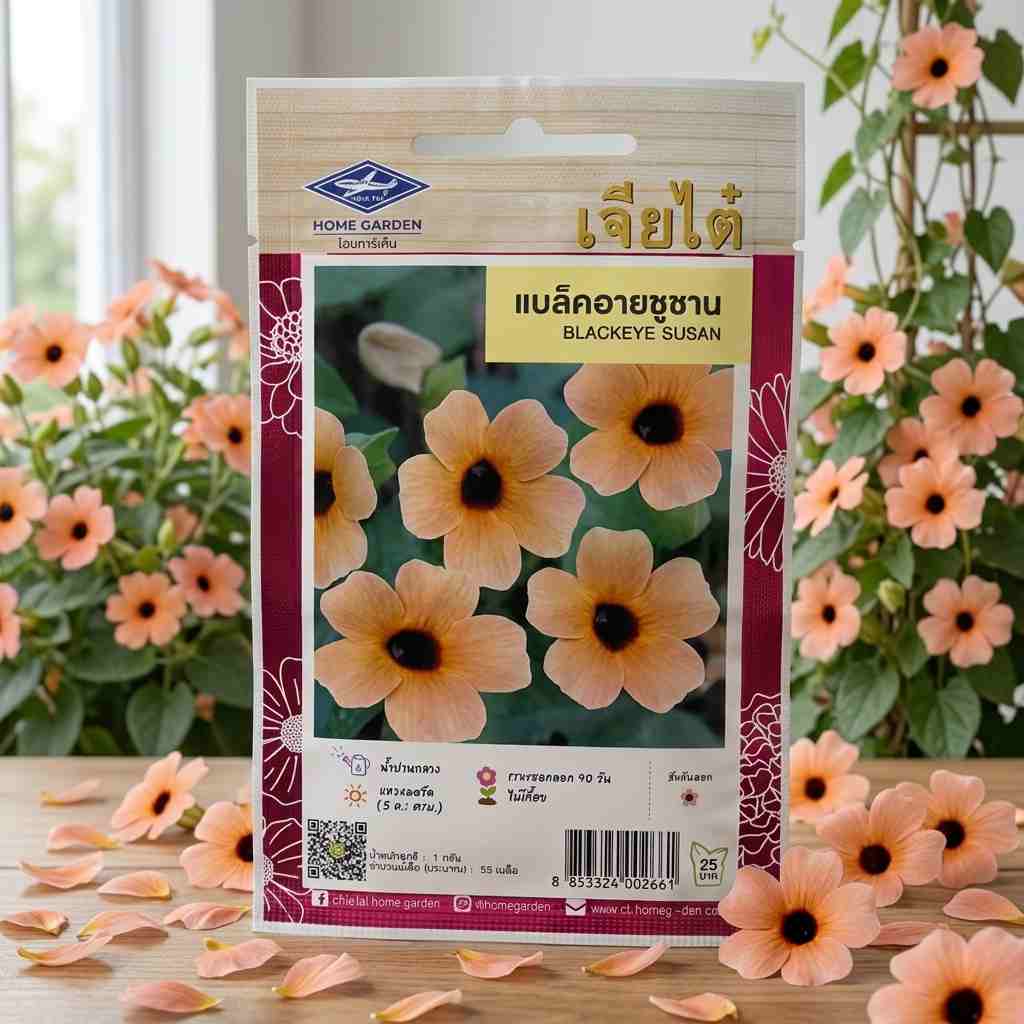
-Blackeye Susan – 50 seeds – Chia Tai – Thai
Original price was: ৳ 280.00.৳ 210.00Current price is: ৳ 210.00.
- Germination temperature: 20–25°C
- Germination period: 10–21 days
- Seed count: 40 seeds/g
- Seed-to-bloom: 60–90 days
- Container: 16 × 16 inches
- Container volume: 35–45 litres
- Soil pH target:2–6.8
- Sunlight: 6–8 hours
- Plant spacing: 18 inches
- Ideal sowing season: October–January
- Germination difficulty: 2/10
- Growing difficulty: 3/10
Available on backorder
Description
BLACKEYE SUSAN
Price: 210 Taka per packet (sale price)
Quantity: 50 seeds
Brand: Chia Tai
Country of Origin: Thailand
Germination Rate (Approx.): 50%
Physical Purity (Min): 98%
Genetic Purity (Min): 98%
Blackeye Susan – Complete Growing & Cultivation Guide
- Common names: Black-Eyed Susan Vine, Black-Eyed Clock Vine, Clock Vine, Bright Eyes
- Scientific name: Thunbergia alata Bojer ex Sims
- Family: Acanthaceae
- Plant category: Ornamental flowering climber / Tender perennial (often cultivated as an annual).
- Suitability for Bangladesh: Very good, particularly during the cooler and relatively dry months. It can also grow during the warmer months if provided with adequate moisture, drainage and protection from excessive afternoon heat.
Important research note: The recommendations below distinguish between published botanical and horticultural information and practical cultivation estimates. Exact fertilizer quantities, watering volumes and potting-mix percentages are proposed cultivation recommendations for rooftop gardening in Bangladesh, rather than experimentally established requirements for this particular species.
Germination and early growth
Germination temperature
Recommended: 20–25°C
| Temperature | Expected performance |
| 18–20°C | Germination possible, but slower |
| 20–25°C | Best practical range |
| 26–28°C | Generally suitable if moisture is controlled |
| Above 30°C | Avoid excessive heat in the seed tray |
Several commercial seed-growing references support this range:
- OSC Seeds recommends approximately 24°C.
- Ferri Seeds recommends 20–25°C.
- NE Seed specifies 21–24°C (70–75°F).
Our recommendation for Bangladesh: Maintain 23–25°C in a shaded, ventilated germination area. Avoid placing seed trays under direct rooftop sunlight.
Sources:
Germination time
10–21 days
- Expected germination: 10–14 days.
- Normal germination window: 10–21 days.
- Under less favourable conditions: Up to 25–30 days.
Recommended seed preparation:
- Soak seeds in room-temperature water for 8–12 hours.
- Prepare a light, sterile seed-starting medium.
- Sow seeds approximately 3–5 mm deep.
- Maintain consistent moisture without waterlogging.
- Keep the tray in a warm, bright location away from direct sunlight.
Overnight soaking is recommended by commercial seed suppliers and can help improve water uptake.
Plant height, span and seed sowing depth
| Parameter | Recommended measurement |
| Typical plant height | 5–8 feet |
| Height under favourable tropical conditions | 8–16 feet, occasionally more |
| Typical horizontal spread | 1.5–3 feet |
| Seed sowing depth | 0.12–0.20 inch |
| Mature growth habit | Twining climbing vine |
The RHS reports a typical height of 1.5–2.5 metres and a spread of 0.5–1 metre. Wisconsin Extension reports that the vine can reach 8 feet in a single growing season under favourable conditions.
Plant spacing
For individual plants in an outdoor garden:
- Recommended spacing: 14–18 inches
- For vigorous growth and better air circulation: 18–24 inches.
- For closely planted decorative screens: 12–14 inches, with additional pruning.
For rooftop containers, I recommend one plant per 14–16-inch pot.
Row spacing
For commercial cultivation:
| Purpose | Row spacing |
| Normal ornamental production | 24–30 inches |
| Commercial trellis cultivation | 30–36 inches |
| Dense decorative production | 24 inches |
Recommended commercial configuration:
- Plant-to-plant distance: 18 inches.
- Row-to-row distance: 30 inches.
These are practical spacing recommendations rather than a published Bangladesh-specific commercial spacing trial.
Trellis or physical support requirement
Thunbergia alata is a twining climber. Its stems wrap around structures rather than attaching themselves with tendrils or adhesive roots.
Suitable support structures:
- Bamboo tripod.
- Metal garden trellis.
- Nylon gardening net.
- Wooden pergola.
- Stainless-steel or plastic-coated wire.
- Vertical garden frames.
- Garden arches and fences.
Recommended rooftop support:
- Height: 5–7 feet.
- Width: 18–24 inches per plant.
- Mesh opening: 4–6 inches.
- Secure the structure against strong rooftop winds.
If a trellis is unavailable, the plant can cascade from a hanging basket.
Flowering, flower characteristics and lifespan
Seed-to-bloom time
Approximately 60–90 days
| Growth stage | Approximate duration |
| Seed germination | 10–21 days |
| Seedling establishment | 15–25 days |
| Vegetative growth | 20–30 days |
| First flowering | 60–90 days after sowing |
In Bangladesh, favourable temperatures, sufficient sunlight and moderate fertilizer application can encourage earlier flowering.
For planning purposes, allow approximately 2–3 months from sowing to the first flowers.
How long does each bloom stay?
An individual flower generally remains attractive for approximately 3–7 days, depending on temperature, sunlight, humidity and plant condition.
The flowering season is considerably longer:
- Individual flowers open successively.
- New flowers develop from leaf axils.
- A healthy plant can continue flowering for several months.
In Bangladesh, a well-maintained plant may flower for approximately 4–7 months, sometimes longer under favourable conditions.
This is a practical estimate; the exact lifespan of an individual bloom varies with environmental conditions.
Flower shape and size
| Characteristic | Description |
| Flower shape | Trumpet-shaped / Salver-shaped |
| Petal arrangement | Five overlapping petals |
| Typical diameter | 1.2–1.6 inches |
| Larger flowers | Approximately 1.6 inches |
| Flower centre | Dark brown, maroon or nearly black |
| Flower position | Usually solitary in leaf axils |
| Flower colours | Orange, yellow, cream, white and selected pinkish shades |
The botanical description records a flower diameter of approximately 3–4 cm (1.18–1.57 inches).
Plant lifespan
Thunbergia alata is botanically a tender perennial.
| Growing environment | Expected lifespan |
| Bangladesh, normal outdoor cultivation | Approximately 1–3 years, potentially longer |
| Warm, protected container cultivation | Several years possible |
| Seasonal cultivation | 6–12 months |
| Frost-prone climates | Usually grown as an annual |
In Bangladesh, it can potentially survive for multiple years because severe frost is uncommon. However, excessive monsoon moisture, root diseases and old woody growth can shorten its productive life.
Commercial recommendation: Treat it as a 1-year production crop for consistent flower quality, even though it can be perennial.
Container, soil and environmental requirements
Recommended pot/container/bed size
For one mature plant:
Recommended container: 16 × 16 inches
| Container specification | Measurement |
| Top diameter | 16 inches |
| Bottom diameter | 12–14 inches |
| Depth | 16 inches |
| Approximate capacity | 35–45 litres |
| Drainage holes | 4–6 holes |
| Plants per container | 1 |
Other suitable configurations:
- Minimum pot: 12 × 12 inches.
- Recommended pot: 14 × 14 inches.
- Premium rooftop cultivation: 16 × 16 inches.
- Rectangular planter: 24 × 12 × 12 inches for one plant.
For a garden bed:
- Minimum soil depth: 12 inches.
- Recommended soil depth: 15–18 inches.
- Allocate approximately 18 × 18 inches of ground area per plant.
A larger container is particularly useful in Bangladesh because rooftop temperatures can cause rapid moisture loss.
Soil type, composition and ideal pH
Thunbergia alata prefers:
- Fertile soil.
- Well-drained growing medium.
- Good moisture retention.
- Adequate aeration.
- High organic matter.
- No prolonged waterlogging.
Ideal soil pH: 6.0–7.0
A practical target is pH 6.2–6.8.
The RHS indicates that the plant can tolerate acidic, neutral and alkaline soil, provided the growing medium has suitable drainage.
Suitable soil characteristics:
| Soil characteristic | Recommended condition |
| Texture | Loamy |
| Drainage | Excellent |
| Water retention | Moderate |
| Organic matter | Moderate to high |
| Aeration | High |
| Compaction | Low |
| Salinity | Low |
Avoid heavy, compacted clay soil and excessive fresh manure.
- Daily sunlight requirement and seed germination light
5–7 hours of sunlight
| Growth stage | Light requirement |
| Seed germination | Bright indirect light |
| Seedling stage | 4–5 hours of gentle sunlight |
| Vegetative growth | 5–6 hours |
| Flowering stage | 6–8 hours |
| Extreme summer | Morning sun with afternoon protection |
Seed germination: Do not expose newly sown seeds to strong direct sunlight. Cover them lightly with growing medium and maintain consistent moisture.
Bangladesh rooftop recommendation:
- November–February: 5–7 hours of direct sunlight.
- March–April: 5–6 hours, preferably morning sunlight.
- May–September: 4–6 hours of sunlight with protection from extreme afternoon heat.
Insufficient light can cause excessive vegetative growth and fewer flowers.
Water requirement and watering intervals
Water consumption depends on plant size, potting medium, rooftop temperature, wind and rainfall.
The following are practical starting estimates for a 16 × 16-inch container.
| Plant size | Water per watering | Suggested interval |
| Newly germinated seedling | 50–100 ml | Check daily; mist if needed |
| 3–6 inches | 150–250 ml | Every 1–2 days |
| 6–12 inches | 300–500 ml | Every 1–2 days |
| 1–2 feet | 500–800 ml | Every 1–2 days |
| 2–4 feet | 800–1,200 ml | Every 1–2 days |
| 4–6 feet | 1.2–1.8 litres | Daily in hot weather |
| Above 6 feet | 1.5–2.5 litres | Daily when required |
These are not fixed daily quotas. Water only when the upper 1–2 inches of the medium starts drying.
Seasonal adjustments:
- Winter: Water approximately every 2–4 days.
- Summer: Check daily; watering may be necessary every day.
- Monsoon: Water only when required; avoid saturated soil.
- During flowering: Maintain consistent moisture.
Important: Water the root zone rather than repeatedly wetting the leaves. Ensure excess water drains freely.
The RHS specifically recommends keeping young plants moist but not soggy and allowing the surface of container-grown plants to dry slightly between waterings.
Rooftop potting mix – Bangladesh formulation
Recommended potting mix using your supplied ingredients
Recommended formulation – 100%
For Thunbergia alata, the primary objective is to create a growing medium that retains sufficient moisture while providing excellent drainage and root aeration.
We would avoid making the mixture excessively rich in concentrated organic fertilizers because excessive nitrogen can promote foliage at the expense of flowering.
Recommended rooftop potting mix
Percentage by volume, not by weight
- Loamy Soil 25%
- Coconut Coir Dust 15%
- Coconut Husk (Medium Size) 10%
- Perlite 10%
- Brown River Sand 8%
- Cow Dung Compost 8%
- Vermicompost 8%
- Wood Bark 5%
- Cinder 5%
- Wood Charcoal 3%
- Trichocompost 3%
- Total 100%
Why these ingredients?
| Ingredient | Main purpose |
| Loamy soil | Structural support and mineral nutrients |
| Coconut coir dust | Moisture retention |
| Coconut husk | Air circulation and drainage |
| Perlite | Root aeration and drainage |
| Brown river sand | Improves physical structure |
| Cow dung compost | Organic matter and nutrients |
| Vermicompost | Nutrient availability and microbial activity |
| Wood bark | Improves porosity |
| Cinder | Adds drainage and structural stability |
| Wood charcoal | Improves physical structure |
| Trichocompost | Beneficial microbial support |
Water: Add gradually during mixing until the medium is uniformly moist but not muddy.
Quantity required for one 40-litre container
| Ingredient | Approximate volume |
| Loamy soil | 10 litres |
| Coconut coir dust | 6 litres |
| Coconut husk | 4 litres |
| Perlite | 4 litres |
| Brown river sand | 3.2 litres |
| Cow dung compost | 3.2 litres |
| Vermicompost | 3.2 litres |
| Wood bark | 2 litres |
| Cinder | 2 litres |
| Wood charcoal | 1.2 litres |
| Trichocompost | 1.2 litres |
| Total | 40 litres |
Use mature, fully decomposed compost, washed coir, clean sand and horticultural-grade perlite. Cinder should be clean and free from industrial contaminants.
Do not create a thick stone layer at the bottom of the pot. Use unobstructed drainage holes and a mesh to prevent the growing medium from escaping.
Companion plants
Recommended companion plants
The best companions are plants that have compatible sunlight, water and growing requirements.
| Companion plant | Scientific name | Benefit |
| Blue Salvia | Salvia farinacea | Attractive colour contrast |
| Ageratum | Ageratum houstonianum | Blue flowers complement orange Thunbergia |
| Marigold | Tagetes erecta | Decorative combination |
| Zinnia | Zinnia elegans | Adds colour and attracts pollinators |
| Purple Heart | Tradescantia pallida | Attractive purple foliage |
| Celosia | Celosia argentea | Creates a tropical flower arrangement |
| Nasturtium | Tropaeolum majus | Suitable for cascading arrangements |
| Morning Glory | Ipomoea purpurea | Similar climbing habit; requires space management |
For rooftop gardening, we particularly recommend Ageratum, Salvia and Zinnia.
Avoid placing multiple aggressive climbing vines in one small container.
Flower fragrance
Fragrance: 1/10
Thunbergia alata is primarily grown for its attractive flowers rather than fragrance.
- Fragrance strength: Very weak to practically undetectable.
- Not suitable for perfume production.
- Not considered a fragrant ornamental flower.
Pest and disease management
Common pests and their management
Thunbergia alata is relatively trouble-free outdoors, but rooftop cultivation in Bangladesh can expose it to several common sucking and chewing pests.
| Pest | Symptoms | Chemical control (active ingredient) | Organic alternative |
| Aphids | Curled leaves, sticky honeydew | Imidacloprid or acetamiprid | Neem oil, insecticidal soap |
| Whiteflies | Tiny white insects, yellowing leaves | Acetamiprid or pyriproxyfen | Yellow sticky traps, neem oil |
| Spider mites | Fine webbing, stippled leaves | Abamectin or spiromesifen | Water spray, insecticidal soap |
| Mealybugs | White cotton-like deposits | Acetamiprid or spirotetramat | Cotton swab with diluted alcohol on isolated infestations; neem oil |
| Thrips | Silver patches and distorted flowers | Spinosad | Blue sticky traps, neem-based products |
| Caterpillars | Holes in leaves | Bacillus thuringiensis var. kurstaki (Bt) | Hand-picking, neem products |
Preferred integrated pest management approach:
- Inspect the underside of leaves twice a week.
- Remove heavily infested leaves.
- Use yellow or blue sticky traps where appropriate.
- Apply neem-based products according to their registered label.
- Use chemical insecticides only when necessary.
Important chemical precautions:
- These are possible active ingredients, not a recommendation to apply every chemical.
- Select products registered for the relevant pest and ornamental crop in Bangladesh.
- Follow label dosage, protective equipment and re-entry instructions.
- Avoid spraying open flowers when bees and butterflies are visiting.
- Do not mix multiple insecticides without compatibility guidance.
Common diseases and their management
| Disease | Symptoms | Chemical control (active ingredient) | Organic alternative |
| Powdery mildew | White powder-like coating | Sulfur, potassium bicarbonate or myclobutanil | Potassium bicarbonate products; remove affected leaves |
| Leaf spot | Brown or black spots | Copper hydroxide or mancozeb | Remove infected leaves and improve airflow |
| Root rot | Yellowing, wilting, brown roots | Appropriate products containing metalaxyl-M where oomycetes are involved | Improve drainage; use healthy compost and Trichoderma-based products |
| Botrytis / grey mould | Grey fungal growth on flowers and stems | Fenhexamid or other locally registered Botrytis fungicide | Remove affected flowers and improve ventilation |
| Damping-off | Seedlings collapse at soil level | Appropriate seedling disease treatment, where registered | Sterile seed medium, clean trays, careful watering |
Special advice for Bangladesh:
High humidity and frequent monsoon rainfall can encourage fungal problems.
Preventive measures are more important than routine chemical spraying:
- Maintain good plant spacing.
- Avoid waterlogging.
- Do not wet foliage late in the evening.
- Remove fallen flowers and infected leaves.
- Keep the trellis open to airflow.
- Avoid excessive nitrogen fertilization.
For suspected root rot, identify whether the pathogen is a true fungus or an oomycete before choosing a fungicide. Copper products are not a cure for every root disease.
Plant nutrition and fertilizer management
Essential nutrients and their percentages
There is no scientifically established species-specific tissue nutrient percentage for Thunbergia alata that can be treated as a universal optimum.
For practical ornamental cultivation, the following is a suggested balanced nutrient-management target for the growing medium, not a laboratory-verified leaf composition.
| Nutrient | Suggested nutrient balance | Main function |
| Nitrogen (N) | 1.0–1.5% in dry organic fertilizer blend | Vegetative growth |
| Phosphorus (P₂O₅) | 1.0–1.5% | Root development and flowering |
| Potassium (K₂O) | 1.5–2.0% | Flower quality and stress tolerance |
| Calcium (Ca) | 1.0–2.0% | Cell wall development |
| Magnesium (Mg) | 0.3–0.5% | Chlorophyll formation |
| Sulphur (S) | 0.2–0.4% | Protein formation |
Micronutrients required:
| Micronutrient | Function |
| Iron (Fe) | Chlorophyll formation |
| Zinc (Zn) | Enzyme activity and growth |
| Boron (B) | Flower development |
| Manganese (Mn) | Photosynthesis |
| Copper (Cu) | Enzyme function |
| Molybdenum (Mo) | Nitrogen metabolism |
Which organic fertilizers provide these nutrients?
| Organic fertilizer | Main nutrients supplied |
| Cow dung compost | N, P, K and micronutrients |
| Vermicompost | N, P, K, Ca, Mg and micronutrients |
| Trichocompost | Nutrients and beneficial microorganisms |
| Horn meal | Slow-release nitrogen |
| Bone meal | Phosphorus and calcium |
| Neem cake | Nitrogen, phosphorus, potassium and organic matter |
| Mustard cake | Nitrogen, phosphorus and potassium |
| Oyster shell powder | Calcium |
| Epsom salt | Magnesium and sulphur |
Important: Actual nutrient percentages vary substantially between manufacturers and batches. Use the guaranteed analysis printed on the fertilizer packaging.
Organic fertilizer quantity per plant
For one established plant growing in a 16 × 16-inch container:
Recommended feeding schedule
| Organic fertilizer | Quantity per application | Application interval |
| Vermicompost | 100–150 g | Every 30–45 days |
| Cow dung compost | 100–150 g | Every 45–60 days |
| Neem cake powder | 15–20 g | Every 60 days, if required |
| Mustard cake powder | 10–15 g | Every 45–60 days, if required |
| Bone meal | 10–15 g | Every 90–120 days, if required |
| Trichocompost | 30–40 g | Every 45–60 days |
| Horn meal | 5–10 g | Every 90–120 days, if required |
| Oyster shell powder | Only if pH/calcium requires it | Soil-test dependent |
| Epsom salt | Only if magnesium deficiency is confirmed | Soil-test dependent |
Do not apply all these fertilizers together. They are alternatives or supplementary amendments, not a compulsory combined feeding schedule.
Recommended routine
For rooftop cultivation, the feeding programme shall be simplified:
- Every 30–45 days: 100 g vermicompost.
- Every 45–60 days: 100 g mature cow dung compost.
- Every 45–60 days: 30 g Trichocompost.
- Every 60 days: 15 g neem cake, only if needed.
Alternate the applications rather than applying the full quantities on the same day.
For a flowering plant, avoid excessive nitrogen because it can produce abundant foliage with fewer flowers.
Application technique:
- Loosen the upper 1 inch of soil.
- Spread fertilizer around the pot, away from the main stem.
- Mix gently with the topsoil.
- Water lightly.
- Avoid applying concentrated organic fertilizer to dry roots.
Chemical fertilizer requirement
Chemical fertilizers can be useful for controlled flowering and rapid growth.
A balanced fertilizer such as NPK 19:19:19 is suitable during early vegetative development.
For flowering, a fertilizer with relatively higher potassium, such as NPK 12:12:17 or 15:15:30, can be used if required.
| Plant stage | Fertilizer | Suggested concentration |
| Seedling establishment | NPK 19:19:19 | 0.5 g/litre |
| Early vegetative growth | NPK 19:19:19 | 1 g/litre |
| Established plant | NPK 19:19:19 | 1 g/litre |
| Flower initiation | NPK 15:15:30 | 0.5–1 g/litre |
| Active flowering | NPK 12:12:17 or 15:15:30 | 0.5–1 g/litre |
Application intervals:
- Seedlings: Every 15–20 days, only after true leaves develop.
- Vegetative stage: Every 15 days.
- Flowering stage: Every 10–15 days if growth and nutrient demand justify it.
Start at half the manufacturer’s recommended concentration, particularly during hot weather.
Do not combine full-strength chemical fertilizer with a heavy organic feeding schedule. Flush the pot with clean water occasionally if salts accumulate.
Health benefits and medicinal uses
Thunbergia alata has been mentioned in traditional plant-use records and botanical databases.
Kew’s Plants of the World Online records uses of the species in medicine, food and other categories. However, these records do not establish clinically proven health benefits.
Potential areas of ethnobotanical and scientific interest include:
- Traditional medicinal applications.
- Phytochemical investigation.
- Investigation of plant extracts for biological activity.
Medical caution: There is insufficient reliable clinical evidence to recommend consuming its leaves, flowers, seeds or extracts for treating any disease.
Do not prepare homemade medicinal extracts from this plant.
Is the flower edible?
Not recommended for consumption
We would not classify Thunbergia alata as an edible flower for commercial food use.
Although Kew records food-related uses in its botanical database, this does not establish that every plant part or cultivated variety is safe to eat.
Some seed suppliers explicitly identify the plant as ornamental and warn that it may be poisonous.
Therefore:
- Do not recommend its flowers as salad garnishes.
- Do not use it for tea.
- Do not consume its seeds.
- Do not promote it as an edible flower without authoritative species-specific food-safety evidence.
Special characteristics
- Distinctive dark eye: The contrasting dark centre gives the plant its popular name, Black-Eyed Susan Vine.
- Continuous flowering: It produces flowers successively over an extended period under favourable conditions.
- Versatile growth habit: It can climb, trail or cascade depending on the support and planting arrangement.
- Attractive to pollinators: Bees, butterflies and other pollinators visit its flowers.
- Multiple flower colours: Orange, yellow, cream and white cultivars are available.
- Fast-growing foliage: It can cover fences and trellises relatively quickly.
How to encourage more flowers
This is particularly important for commercial ornamental production.
Follow these recommendations:
- Provide sufficient sunlight
Aim for 6–8 hours of sunlight where possible, with afternoon protection during extreme heat.
- Avoid excess nitrogen
Excessive nitrogen encourages leafy growth rather than flower production.
- Maintain consistent moisture
Avoid alternating between severe dryness and excessive watering.
- Deadhead regularly
Remove faded flowers before they develop mature seed capsules.
- Train the plant properly
Guide new stems along the trellis to distribute growth and improve light penetration.
- Pinch young growing tips
When the plant reaches approximately 8–12 inches, pinch the growing tip to encourage lateral branching.
- Provide potassium
Maintain balanced potassium availability during flowering.
- Maintain airflow
Avoid overcrowding and excessive foliage density.
- Monitor pests
Inspect buds and young leaves for thrips and aphids.
- Renew older plants when necessary
If an older plant becomes excessively woody and flowers poorly, take healthy cuttings or raise replacement plants from seed.
Different uses of this flower and plant
The plant has several ornamental and landscaping applications:
- Vertical garden decoration.
- Garden arches and pergolas.
- Balcony and rooftop gardening.
- Hanging baskets.
- Decorative fences.
- Privacy screens.
- Flowering green walls.
- Container gardening.
- Landscape borders.
- Decorative garden entrances.
- Nursery production.
- Pollinator-friendly gardens.
- Indoor conservatory decoration in sufficiently bright locations.
- Ornamental horticultural displays.
Bangladesh cultivation calendar and propagation
Best months for seed germination in Bangladesh
Best: October–February
For Dhaka and similar climatic regions, I recommend October to February, with November–January being particularly suitable for establishing plants.
The recommendation is based on the temperature and rainfall pattern, rather than a specific multi-year Thunbergia field trial.
Historical weather context
The Japan Meteorological Agency’s Dhaka station data provides useful observations for 2024–2026.
| Month | 2025 mean temperature | 2025 rainfall |
| January | 18.9°C | 0 mm |
| February | 22.8°C | 8 mm |
| March | 27.3°C | Not reported in the displayed record |
| April | 28.9°C | 76 mm |
| May | 29.1°C | 363 mm |
| June | 29.5°C | 200 mm |
| July | 28.5°C | 539 mm |
| August | 28.7°C | 366 mm |
| September | 29.4°C | 504 mm |
| October | 28.1°C | 193 mm |
| November | 24.3°C | 0 mm |
| December | 19.5°C | 0 mm |
The 2024 and 2025 climate records also show significant seasonal variation in rainfall, reinforcing the importance of selecting a period with suitable moisture and drainage conditions.
Recommended Bangladesh sowing calendar
| Month | Recommendation | Remarks |
| January | Excellent | Good for seedling establishment |
| February | Excellent | Suitable temperatures |
| March | Good | Protect from increasing heat |
| April | Moderate | Higher temperatures |
| May | Moderate | Rainfall and humidity management needed |
| June | Less suitable | Heavy rainfall |
| July | Less suitable | Waterlogging risk |
| August | Less suitable | High humidity |
| September | Moderate | Monsoon conditions may persist |
| October | Excellent | Good time to start |
| November | Excellent | Very suitable |
| December | Excellent | Suitable for establishment |
Our recommendation: Sow from October to January for the best opportunity to establish strong plants before the hotter months.
You can also sow in February and March, but protect seedlings from excessive heat.
Most effective propagation methods
There are two practical propagation methods.
Method 1: Seed propagation
Best overall method
Advantages:
- Economical.
- Suitable for commercial production.
- Easy to scale.
- Produces vigorous plants.
- Allows a range of flower colours when growing mixed seed varieties.
Procedure:
- Soak seeds for 8–12 hours.
- Sow 3–5 mm deep.
- Maintain 20–25°C.
- Keep the medium moist.
- Transplant after seedlings develop several true leaves.
Method 2: Stem cuttings
Advantages:
- Faster multiplication of selected plants.
- Preserves the characteristics of the parent plant.
- Useful for maintaining a particular colour or cultivar.
Procedure:
- Select a healthy, non-flowering stem.
- Take a 4–6-inch cutting with 2–3 nodes.
- Remove the lower leaves.
- Insert into a mixture of coco coir and perlite.
- Maintain moderate humidity.
- Keep in bright indirect light until roots develop.
RHS recommends seed propagation and semi-ripe cuttings for suitable protected plants. Wisconsin Extension also identifies softwood cuttings as an option.
Our recommendation: Use seeds for large-scale production and stem cuttings for maintaining desirable parent plants.
Botanical origin and taxonomy
Native climate and region
Blackeye Susan is native to tropical and southern Africa, including Madagascar.
Its natural habitats include:
- Tropical forest margins.
- Woodland.
- Bushland.
- Grassland.
- Disturbed vegetation.
- Seasonally dry tropical environments.
It is adapted to warm climates and can grow in a range of moisture conditions, provided drainage is suitable.
Seed germination difficulty
2/10 – Easy
Reasons:
- Seeds are relatively large and easy to handle.
- No complicated stratification is normally required.
- Soaking can improve water uptake.
- Germination is relatively fast.
- Suitable for beginner gardeners.
The most important factors are temperature, seed freshness and moisture management.
Growing difficulty
3/10 – Easy
Why it is relatively easy:
- Vigorous climbing growth.
- Adaptable to different soil types.
- Can grow in containers.
- Relatively low maintenance.
- Responds well to pruning and training.
- Produces flowers over a long period.
The main challenges in Bangladesh are excessive monsoon moisture, rooftop heat and occasional sucking-pest infestations.
Top six commercial uses
- Ornamental nursery production
Commercial production of flowering seedlings and mature climbing plants for garden centres and retail nurseries.
- Landscaping and garden decoration
Use in pergolas, fences, arches, vertical walls and commercial landscaping projects.
- Hanging basket production
Commercial production of ready-to-display flowering baskets for homes, offices, restaurants and hotels.
- Commercial seed production
Collection, processing and packaging of seeds for ornamental horticulture.
- Decorative screening and event installations
Temporary and permanent flowering screens for hotels, restaurants, resorts, weddings and event venues.
- Pollinator-friendly garden projects
Supply plants for biodiversity-focused ornamental landscapes and educational gardens.
Seed characteristics, specialties and interesting facts
Average number of seeds per gram
Approximately 40 seeds per gram
Commercial seed references provide the following information:
| Supplier | Reported seed quantity |
| OSC Seeds | Approximately 40 seeds/g |
| NE Seed | Approximately 1,260 seeds/oz |
| Other commercial listings | Variable packet counts |
The NE Seed figure converts to approximately 44.4 seeds/g, while OSC Seeds reports 40 seeds/g.
- Average: 40 seeds/gram.
- Practical planning range: 35–45 seeds/gram.
- Approximate 5 g packet: 200 seeds.
- Approximate 10 g packet: 400 seeds.
These are estimates; actual seed count varies with seed size, cultivar and processing.
Specialties of this plant
- Distinctive black eye: The dark central area contrasts beautifully with the bright petals.
- Fast vertical coverage: Its twining stems can quickly cover trellises, fences and garden structures.
- Extended flowering: A healthy plant can produce successive blooms over several months.
Beautiful quotes on Blackeye Susan (Thunbergia alata)
These are original quotes written for this plant.
- “Like a golden sunrise wrapped around a green vine, Thunbergia brings life to every corner it touches.”
- “Where its little dark eyes meet the sunshine, even an ordinary garden becomes a beautiful story.”
Lesser-known facts
Fact 1 – Its scientific name describes its leaves
The name alata refers to the winged appearance of its leaf stalks (petioles).
Fact 2 – Its fruits resemble tiny birds’ heads
The seed capsules have a rounded base and an elongated beak-like extension, making them look somewhat like miniature bird heads.
Native region of this species
The species is native to tropical and southern Africa, including:
- Kenya.
- Tanzania.
- Uganda.
- Ethiopia.
- Mozambique.
- Malawi.
- Zimbabwe.
- Botswana.
- South Africa.
- Madagascar.
It has subsequently become established in many tropical and subtropical regions, including Bangladesh. However, Bangladesh is an introduced distribution, not its native region.
Origin story – Who discovered or created it?
Thunbergia alata is a naturally occurring African plant species, not a modern hybrid created by a commercial seed company.
Its botanical history:
- The species was formally published in 1825.
- The accepted botanical authority is Bojer ex Sims.
- Its first publication appeared in Curtis’s Botanical Magazine, volume 52, plate 2591.
- The botanical description was associated with seeds obtained from Mauritius.
- Over time, horticultural selection and breeding produced cultivars with different flower colours, including white, yellow, orange and pinkish shades.
The botanical name should be written as: Thunbergia alata Bojer ex Sims.
There is no single modern breeder who can be credited with creating the original species.
Scientific classification
| Classification | Name |
| Kingdom | Plantae |
| Clade | Angiosperms |
| Clade | Eudicots |
| Order | Lamiales |
| Family | Acanthaceae |
| Genus | Thunbergia |
| Species | Thunbergia alata |
| Botanical authority | Bojer ex Sims |
| Common name | Black-Eyed Susan Vine |
Research references and website links
The following references were consulted for botanical identification, cultivation, propagation, flower morphology, seed characteristics, pest management and Bangladesh climate assessment.
Botanical and scientific references
- Kew Science – Plants of the World Online: Thunbergia alata
- Kew Science – Botanical distribution and ecology
- Colombian Plants – Botanical history and description
- Weeds of Australia – Thunbergia alata botanical fact sheet
- USDA SeedImages – Seed identification and measurements
Horticultural cultivation references
- Royal Horticultural Society – How to Grow Thunbergia
- Royal Horticultural Society – Thunbergia alata Plant Profile
- North Carolina State University Extension – Thunbergia alata
- University of Wisconsin Extension – Black-Eyed Susan Vine
- Kwantlen Polytechnic University – Plant Database
Seed germination and commercial seed references
- OSC Seeds – Black-Eyed Susan Vine Seed Specifications
- NE Seed – Black-Eyed Susan Vine Growing Information
- Ferri Seeds – Thunbergia alata Alba Oculata
- Sow Right Seeds – Growing Information
- Botanical Interests – Black-Eyed Susan Vine
Bangladesh climate references
- Bangladesh Meteorological Department – Climate Data
- Japan Meteorological Agency – Dhaka Climate Observations
- Japan Meteorological Agency – Historical Monthly Climate Data
- Dhaka Historical Weather – Climate Yearbook
- World Meteorological Organization – Dhaka Climate Information
Additional seed and cultivation references
- OSC Seeds – 2025 Seed Catalogue
- Pépinière – Black-Eyed Susan Vine Growing Guide
- Vermont Wildflower Farm – Black-Eyed Susan Vine
- Daiginu – Thunbergia alata Growing Specifications
Research limitation: Exact species-specific nutrient uptake percentages, individual flower longevity, fragrance intensity and Bangladesh commercial fertilizer trials are not sufficiently established in these sources. Those recommendations have therefore been identified as practical horticultural estimates rather than published experimental findings.
Final recommendation:
For commercial nursery production and rooftop gardening in Bangladesh, use a 16-inch container, one plant per pot, a strong 5–7-foot trellis and the recommended 100% potting mix. Start seed production in October–January and maintain balanced nutrition rather than excessive fertilization.
It has a distinctive black-centred flowers, fast climbing growth, long flowering period and suitability for rooftop gardens, hanging baskets and vertical landscaping.
*Note: It is recommended to prepare seedling in a small cup or pot for better success rate and keep the soil moist.
CLICK HERE TO LEARN MORE ABOUT GROWING TIPS
Accessories Required For Seedling Preparation:
OR
Seed Germination Disclaimer:
Successful germination depends on several factors, including temperature, growing medium, moisture, watering, sunlight, soil pH, sowing depth, seed age, and local weather conditions. Germination results may therefore vary depending on the growing environment and cultivation method.
Before reporting a seed as defective, please ensure that the recommended growing conditions and proper sowing methods have been followed. You may also search Google or YouTube for crop-specific seed-sowing guides and tutorials, e.g. “How to grow Bird Chili from seeds.”
For any product-related questions, please contact our support team by inbox, email, or phone. We will do our best to assist you.
Please read the product description carefully before sowing.
Seed Quantity: In rare cases, there may be a slight variation in the number of seeds inside a packet due to packaging or handling. If you notice a significant shortage, please inform us immediately with relevant photos. Our support team will review the matter and provide a solution where possible.
বীজের জার্মিনেশন সংক্রান্ত তথ্য:
বীজের সফল জার্মিনেশন তাপমাত্রা, রোপণ মিডিয়া, আর্দ্রতা, পানি, সূর্যালোক, মাটির pH, বীজ বপনের গভীরতা, বীজের বয়স এবং স্থানীয় আবহাওয়াসহ বিভিন্ন বিষয়ের উপর নির্ভর করে। তাই পরিবেশ ও চাষের পদ্ধতি অনুযায়ী জার্মিনেশনের ফলাফল ভিন্ন হতে পারে।
বীজের মান নিয়ে অভিযোগ করার আগে অনুগ্রহ করে সঠিক পরিবেশ ও বীজ বপনের পদ্ধতি নিশ্চিত করুন। প্রয়োজনীয় নির্দেশনার জন্য Google বা YouTube-এ ফসলের নাম দিয়ে সার্চ করতে পারেন, যেমন: “How to grow Bird Chili from seeds.”
পণ্য সম্পর্কিত কোনো প্রশ্ন থাকলে ইনবক্স, ইমেইল অথবা ফোনের মাধ্যমে আমাদের সাপোর্ট টিমের সাথে যোগাযোগ করুন। আমরা যথাসাধ্য সহযোগিতা করার চেষ্টা করব।
বীজ ব্যবহারের আগে অনুগ্রহ করে পণ্যের বিবরণ ভালোভাবে পড়ে নিন।
বীজের পরিমাণ: বিরল ক্ষেত্রে প্যাকেজিং বা হ্যান্ডলিংয়ের কারণে প্যাকেটে উল্লেখিত সংখ্যার তুলনায় সামান্য কম-বেশি হতে পারে। উল্লেখযোগ্য ঘাটতি থাকলে অনুগ্রহ করে দ্রুত ছবি সহ আমাদের জানান। আমাদের সাপোর্ট টিম বিষয়টি পর্যালোচনা করে সম্ভব হলে উপযুক্ত সমাধান প্রদান করবে।
#Blackeye #Susan #BlackeyeSusan #chia #tai #chiatai #thai #thailand #good #top #quality #summer #flower #seed #seeds #Color #Plant #Rooftop #Balcony #online #store #my #garden #bd #mygardenbd #nature #ছাদ #বাগান #টব #গাছ # ফুল #বীজ #buy #purchase #store #online #shop #office #supply #supplies #wholesale #bulk #retail #outlet #price #cost #of #near #me #in #Dhaka #Bangladesh
#ThunbergiaAlata #BlackEyedSusan #BlackEyedSusanVine #BlackEyedClockVine #ClockVine #BrightEyes #Thunbergia #FloweringVine #ClimbingFlower #OrnamentalPlant #FloweringPlant #GardenFlowers #TropicalFlowers #ExoticFlowers #BeautifulFlowers #FlowerGarden #FlowerLovers #GardenLovers #PlantLovers #Gardening #ThunbergiaGrowing #ThunbergiaSeeds #FlowerSeeds #FlowerSeedlings #SeedGermination #SeedStarting #SeedPropagation #HomeGardening #RooftopGardening #ContainerGardening #VerticalGardening #BalconyGardening #UrbanGardening #OrganicGardening #GardeningTips #GardenCare #PlantCare #GardenInspiration #TrellisGarden #ClimbingPlants #LandscapeDesign #GardenLandscaping #GardenDecoration #VerticalGarden #GardenTrellis #HangingBasket #PergolaGarden #GardenArch #GardenNursery #NurseryPlants #OrnamentalHorticulture #CommercialNursery #FlowerProduction #PollinatorGarden #ButterflyGarden #BeeFriendlyGarden #TropicalGarden #GardenDesign #GardenIdeas #GardenDecor
#থানবার্জিয়া #থানবার্জিয়াআলাটা #ব্ল্যাকআইডসুসান #ঘড়িলতা #ফুলগাছ #ফুলেরগাছ #বিদেশিফুল #বাগানেরফুল #শোভাবর্ধকগাছ #লতানোফুল #ফুলেরবাগান #রঙিনফুল #বাগানপ্রেমী #গাছপ্রেমী #ফুলপ্রেমী #ছাদবাগান #ছাদবাগানকরুন #বাড়িরবাগান #বারান্দাবাগান #টবেরগাছ #টবেবাগান #বাগানকরুন #বাগানচর্চা #গাছেরযত্ন #ফুলেরচাষ #বীজথেকেগাছ #বীজঅঙ্কুরোদগম #জৈববাগান #ভার্টিক্যালগার্ডেন #লতানোগাছ #বাগানসজ্জা #বাগানপরিকল্পনা #বাগানল্যান্ডস্কেপ #নার্সারি #ফুলেরনার্সারি #ফুলেরবীজ #উন্নতমানেরবীজ #বাগানসামগ্রী #ছাদকৃষি #শখেরবাগান #প্রকৃতিপ্রেমী #সবুজবাংলাদেশ #সবুজবাগান #বাগানকরুনসবুজথাকুন
Only logged in customers who have purchased this product may leave a review.


Reviews
There are no reviews yet.