
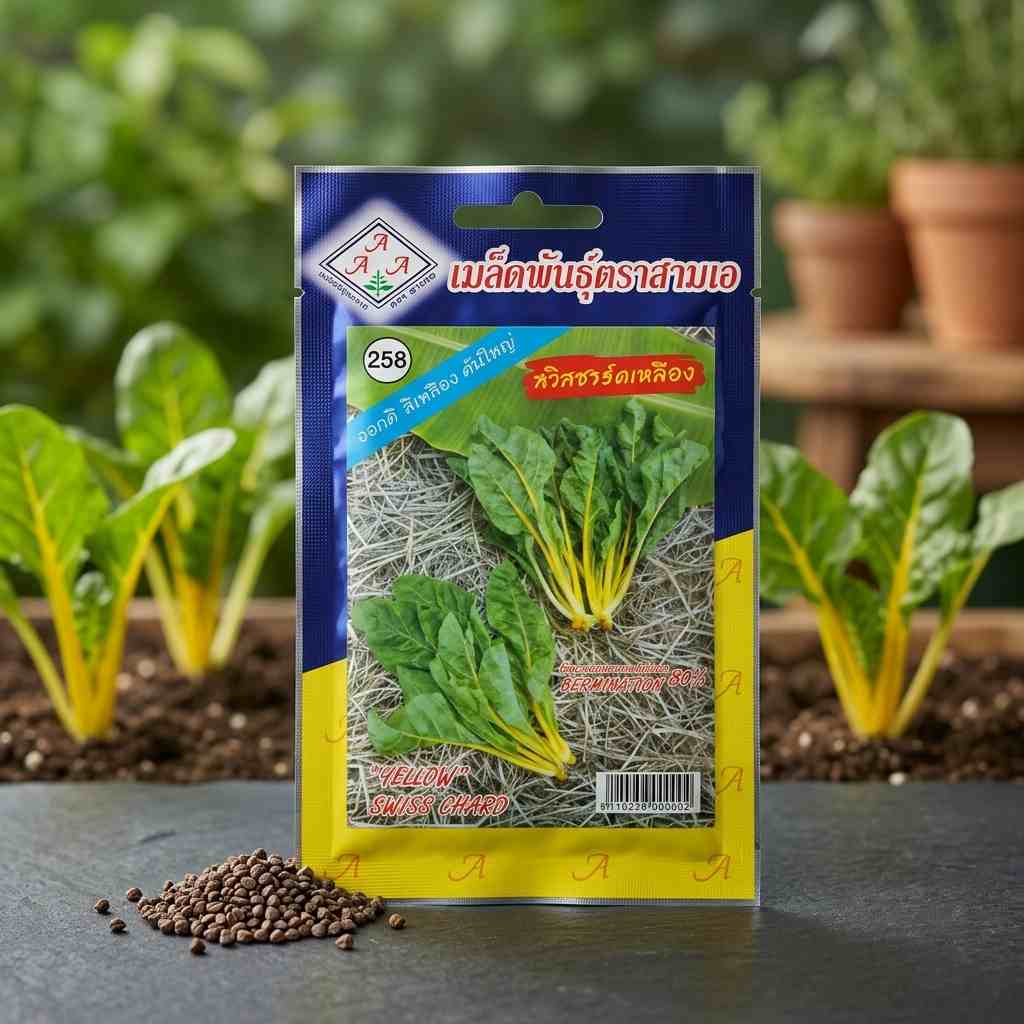
Yellow Swiss Chard – 3 gram Seeds – AAA – Thai
Original price was: ৳ 280.00.৳ 160.00Current price is: ৳ 160.00.
Available on backorder
Description
YELLOW SWISS CHARD – Seeds
Price: 160 Taka per packet (sale price)
Quantity: 3 gram seeds (approx, 600 to 1050 seeds)
Brand: AAA (Chua Yong Seed Co., Ltd)
Country of origin: Thailand
Germination Rate (Approx.): 80%
Physical Purity (Min): 98%
Genetic Purity (Min): 98%
Swiss Chard (Green, Red & Yellow): Complete Growing Guide for Bangladesh
Swiss chard is a leafy vegetable suitable for rooftop gardens, raised beds and containers. Its green leaves and colourful stems make it both an edible crop and an ornamental plant. The green, red and yellow forms generally belong to the same species, although cultivars differ in leaf shape, stem colour, vigour and heat tolerance.
For rooftop gardening in Bangladesh, the most important considerations are growing during the cooler months, using a well-drained growing medium, maintaining consistent moisture and harvesting outer leaves regularly. Swiss chard can tolerate some heat, but prolonged Dhaka summer heat and high humidity can reduce leaf quality and increase disease pressure.
This guide distinguishes between established horticultural recommendations, practical starting estimates for Bangladesh and figures that depend on the cultivar or growing conditions. Fertilizer rates are recommendations for container cultivation, not laboratory-tested prescriptions for every soil or seed variety.
Germination and growth requirements
- Germination Temperature: 15–25°C (Practical target: 18–22°C)
- Germination Time: 5–14 days (Sometimes up to 21 days)
- First Harvest: 30–60 days (Baby leaves to mature leaves)
- Preferred Soil: pH 0–7.0 (Slightly acidic to neutral)
| Parameter | Recommended specification |
| 1. Germination temperature | Approximately 10–29°C is a workable range. Aim for 18–22°C for reliable, even germination. Hot growing media may reduce germination uniformity. |
| 2. Germination time | Usually 5–14 days under favourable conditions; allow up to 21 days if conditions are less favourable. |
| 3. Mature plant height | Approximately 30–60 cm; vigorous cultivars can exceed this. |
| Mature plant span | Around 30–60 cm, depending on cultivar and leaf-harvesting practice. |
| Seed sowing depth | 1–1.5 cm; avoid burying seeds too deeply. |
| 4. Plant spacing | 20–30 cm (8–12 inches) for full-sized plants. Baby leaves can be grown more closely. |
| 5. Row spacing | 30–45 cm (12–18 inches); allow more room for large plants and airflow. |
| 6. Physical support | Not normally required. No trellis is needed. Support may be useful only for unusually tall, top-heavy plants or exposed rooftops. |
| 7. Seed-to-harvest time | Baby leaves: approximately 25–35 days. Larger leaves: 40–60 days. Exact maturity depends on cultivar. |
| 8. Seed-to-bloom time | Typically flowers during its second growing season after winter chilling or other suitable flowering conditions. In Bangladesh, bolting can occur earlier under stress or cultivar-specific conditions; do not rely on a fixed number of days. |
The University of Maryland Extension gives 50–70 days to maturity, while the University of Florida reports approximately 40–60 days for harvest. These figures refer to different harvest sizes and growing conditions.
Pot and container dimensions
For a rooftop container, we recommend one mature plant per medium-sized pot or several plants in a long planter.
| Container | Suitable planting arrangement |
| 10 × 10 × 10 inches | One plant; workable minimum |
| 12 × 12 × 12 inches | One vigorous plant; recommended minimum |
| 14 × 14 × 12 inches | One large plant with a useful root zone |
| 24 × 8 × 8 inches | Two plants, spaced about 10–12 inches apart |
| 36 × 12 × 10 inches | Three plants, spaced about 10–12 inches apart |
| Raised bed | At least 8–12 inches of usable growing-medium depth |
For your rooftop garden in Bangladesh, a 12–14-inch-deep container with adequate drainage is a good starting point. Larger pots buffer moisture and temperature fluctuations better than shallow pots.
Soil type and pH
Swiss chard grows best in a fertile, moisture-retentive but well-drained loam rich in organic matter.
Ideal characteristics:
- Texture: loose loam or sandy loam, with enough fine material to retain water.
- Drainage: excess monsoon rain must drain quickly; roots should never remain waterlogged.
- Organic matter: mature compost, vermicompost and other fully decomposed organic materials.
- pH: approximately 6.0–7.0, with 6.2–6.8 a useful target.
- Structure: porous enough for oxygen to reach the roots, but not so coarse that the container dries out several times a day.
- Salinity: avoid salty compost, saline irrigation water and excessive fertilizer concentrations.
A pH outside the preferred range does not automatically make the crop impossible, but it can reduce nutrient availability. Swiss chard also has a substantial taproot, so deep, uncompacted media help it establish well.
Sunlight and germination light
| Growth stage | Light requirement |
| Seed germination | Light is not essential; sow seeds under a thin layer of growing medium. |
| Seedling stage | Bright light immediately after emergence to prevent stretching. |
| Mature plant | Ideally 6–8 hours of sunlight daily. |
| Hot Bangladeshi weather | Morning sun with some afternoon shade can help maintain leaf tenderness. |
| Indoor or shaded rooftop | Use bright grow lights if natural light is inadequate. |
Swiss chard tolerates partial shade, but insufficient light usually means slower growth and lower leaf yield. Full sun is ideal in cool weather; afternoon protection can be beneficial in hotter weather.
Water requirements and intervals
There is no universally correct number of litres per plant: water demand varies with pot size, leaf area, temperature, wind, rainfall and growing-medium composition.
The following are starting estimates for a 12–14-inch container, not fixed daily quotas.
| Plant stage | Approximate water per plant per watering | Starting interval |
| Newly sown seeds | 100–200 mL, applied gently | Check daily; keep the surface evenly moist |
| Seedling, 2–4 leaves | 200–350 mL | Every 1–2 days |
| Young plant, 10–20 cm tall | 300–600 mL | Every 1–2 days |
| Established plant, 20–40 cm tall | 500–900 mL | Daily in hot, dry weather; less often in cool weather |
| Large mature plant | 700–1,200 mL | Daily during hot weather if the root zone dries quickly |
Best watering method: water slowly over the entire root zone until a little excess drains out, then allow the upper 2–3 cm of the medium to dry slightly before watering again. The quantities in the table may need to be increased or reduced accordingly.
- During Dhaka’s hot, dry periods, check pots every morning and again in the afternoon.
- During monsoon weather, check moisture before watering; rainfall may supply the entire requirement.
- Avoid frequent shallow watering that leaves the lower root zone dry.
- Do not allow the pot to sit in a saucer of standing water.
A general outdoor crop guideline is around 25–50 mm of water per week, including rainfall, with higher demand possible in warm, windy conditions.
Nutrients and fertilizer programme
Swiss chard is grown primarily for its leaves and petioles, so it benefits from balanced nutrition, with particular attention to nitrogen, potassium and magnesium. There is no single scientifically established percentage formula that is ideal for every Swiss chard plant in every container.
The table below lists useful nutrients and the approximate nutrient analyses of common fertilizer materials. These percentages describe the fertilizer, not the required percentage of each nutrient in the plant.
| Nutrient | Role | Organic source and approximate composition |
| Nitrogen (N) | Leaf and chlorophyll development | Horn meal: often 10–14% N; mustard cake: commonly 4–6% N |
| Phosphorus (P₂O₅) | Root development and energy transfer | Bone meal: often 10–16% P₂O₅ |
| Potassium (K₂O) | Water regulation and stress tolerance | Compost materials contain variable amounts; use a labelled potassium source if testing shows a deficiency |
| Calcium (Ca) | Cell walls and growing-point health | Oyster shell powder: predominantly calcium carbonate; commonly about 35–38% elemental Ca |
| Magnesium (Mg) | Central component of chlorophyll | Epsom salt (magnesium sulphate heptahydrate): approximately 9.8% Mg |
| Sulphur (S) | Protein synthesis and enzyme function | Epsom salt: approximately 13% S; mustard cake can also contribute sulphur |
| Iron (Fe) | Chlorophyll formation and electron transfer | Mature compost and vermicompost provide variable trace amounts |
| Manganese (Mn) | Photosynthesis and enzyme activity | Compost and other organic amendments |
| Zinc (Zn) | Enzyme function and growth regulation | Compost and trace-mineral-containing amendments |
| Boron (B) | Cell-wall development and growing-point function | Compost may supply small quantities; deficiency or excess should be diagnosed carefully |
| Copper (Cu) | Enzyme activity | Compost and trace-mineral-containing amendments |
| Molybdenum (Mo) | Nitrogen metabolism | Usually needed in very small quantities; availability depends on pH |
Important: these nutrient analyses vary considerably by supplier, raw material, moisture content and processing. Check the guaranteed analysis on each product. Trichocompost is useful mainly as a mature compost and biological amendment; do not assume it has a fixed NPK percentage.
Organic fertilizer blend for one container-grown plant
The following is a conservative starting programme for one established plant in a 12 × 12 × 12-inch container. It deliberately limits slow-release animal-derived fertilizers and concentrated oil cakes to reduce the risk of root burn and excessive salts.
Initial amendment per container
| Ingredient | Quantity per plant |
| Trichocompost | 100 g |
| Vermicompost | 150 g |
| Well-rotted cow-dung compost | 100 g |
| Horn meal | 5 g |
| Bone meal | 5 g |
| Neem cake powder | 5 g |
| Mustard cake powder | 5 g |
| Oyster shell powder | 0 g unless soil pH or calcium testing indicates a need |
| Epsom salt | 0 g unless magnesium deficiency is established |
Mix the composts and small quantities of meals evenly through the growing medium before sowing or transplanting. Do not place concentrated fertilizer directly against seeds or roots.
Follow-up feeding
- Begin approximately 3–4 weeks after transplanting, or when the plant has established several healthy true leaves.
- Apply 20–30 g vermicompost per plant as a light top-dressing every 3–4 weeks.
- If growth is weak and the plant is not waterlogged, root-bound or diseased, add 20–30 g of mature compost.
- Avoid adding all the meals and cake powders again at every feeding; their nutrients can accumulate as they decompose.
- Do not use Epsom salt routinely. It is not a general-purpose growth booster and may increase salt stress when magnesium is already adequate.
- Do not add oyster shell powder merely to supply calcium if the medium is already sufficiently alkaline or calcium-rich.
This is a practical starting schedule, not a laboratory-validated optimum. The correct rate depends on the nutrient concentration of your composts, irrigation water and existing potting medium.
Chemical fertilizer requirements
For a container crop, a complete fertilizer is usually easier to manage than applying individual nutrients without knowing the medium’s nutrient status.
| Plant stage | Suggested approach |
| Seed germination | No chemical fertilizer required |
| Seedling stage | Use a weak complete soluble fertilizer only after true leaves appear, if the seed-starting medium contains little nutrition |
| Established vegetative growth | A balanced soluble fertilizer such as NPK 19:19:19 can be used at a reduced label rate |
| Regular leaf production | A complete fertilizer with nitrogen and potassium, applied according to label directions, is suitable |
| Deficiency symptoms | Diagnose the likely deficiency before using a single-nutrient fertilizer |
For a small container, a cautious starting concentration for a complete water-soluble fertilizer is 0.5–1.0 g/L, provided the product label permits this concentration. Apply to already moist growing medium and monitor for leaf-edge burn, white salt deposits and stunted growth. Do not combine this automatically with the full organic programme above.
For field-scale production, fertilizer recommendations should ideally be based on a soil test and local agricultural guidance. There is no defensible universal chemical fertilizer dose per Swiss chard plant without knowing the product analysis and the existing nutrient supply.
Recommended rooftop potting mix for Bangladesh
For Swiss chard, I would prioritise moisture retention, drainage, root aeration and moderate fertility rather than making the mix excessively rich in fertilizer.
Use the proportions below and mix thoroughly.
- Loamy soil 30%
- Coconut coir dust 20%
- Mature cow-dung compost 15%
- Vermicompost 10%
- Trichocompost 5%
- Coconut husk, medium size 8%
- Perlite 5%
- Wood bark, aged and composted 3%
- Wood charcoal, clean and crushed 2%
- Brown river sand, washed and coarse 2%
Total 100%
How to prepare it
- Use mature, odour-free cow-dung compost and vermicompost. Avoid fresh manure.
- Pre-moisten the coir dust and let excess water drain away.
- Use aged, composted bark rather than fresh bark, which may temporarily tie up nitrogen.
- Use clean, coarse sand rather than fine construction sand.
- Use clean horticultural charcoal, not ash or charcoal contaminated with chemicals.
- Mix everything uniformly and allow the mix to settle for a few days before planting.
Why the other ingredients are omitted
- Horn meal, bone meal, neem cake and mustard cake: unnecessary in the base mix when the compost fraction is already substantial. They can be used sparingly as separate amendments if required.
- Oyster shell powder: omit unless a soil test indicates a need for calcium or pH correction.
- Epsom salt: omit unless magnesium deficiency is identified.
- Turmeric powder: omit; it is not a reliable substitute for a tested disease-control product.
- Small stones, cinder and jhama: omit from the main growing medium. Large particles occupy root volume, and a coarse layer at the bottom of a pot does not reliably improve drainage. Perlite and coarse organic particles distributed throughout the mix are more useful.
These percentages are by volume, not weight. The formula is a practical starting mix for Bangladesh, not a published Swiss chard-specific experimental optimum. Monitor drainage and moisture after the first few waterings and adjust the coir fraction if the mix dries too quickly.
Hydroponic cultivation
Can Swiss chard be grown hydroponically?
Yes. Swiss chard is suitable for hydroponics, including nutrient-film technique (NFT), deep-water culture and substrate-based systems. University of Minnesota Extension lists Swiss chard among leafy crops that can perform well in NFT systems.
Swiss Chard – Hydroponic Growing Guide
Small-scale hydroponics | UMN Extension
Der Wassergarten: Fisch- und Gemüseproduktion im Aquaponik-System
Hydroponic Red-stem Chard in Pipes
Это вам не просто «цветочки» – Непермские новости
Plant Chicago | Chicago Studies | The University of Chicago
File:Lufa Farms Rainbow Chard Growing in NFT System.jpg – Wikimedia Commons
数字乡村知本论丨全国人大代表吕妙霞:数字化驱动乡村振兴_经济民生_湖南红网新闻频道
A practical starting specification for a small hydroponic system is:
| Parameter | Starting target |
| Nutrient solution pH | 5.8–6.5 |
| EC during early growth | 0.8–1.2 mS/cm |
| EC for established plants | 1.4–2.0 mS/cm |
| Solution temperature | Preferably around 18–24°C |
| Light | 6–8 hours or more of suitable sunlight; otherwise use appropriate grow lighting |
| Root-zone oxygen | Continuous aeration in deep-water culture |
| Water quality | Low-salinity water with known alkalinity |
These EC ranges are practical starting targets, not a universally validated Swiss chard prescription. Cultivar, water quality, climate and production system affect the optimum. Keep the nutrient solution cooler where possible in Bangladesh, since overheated solution holds less dissolved oxygen.
Example complete nutrient solution
A commercial two-part hydroponic nutrient product designed for leafy greens is the simplest and safest option. Use its A/B components according to the manufacturer’s directions, adjusting the final solution to the target EC and pH.
A complete solution must provide nitrogen, phosphorus, potassium, calcium, magnesium, sulphur and trace elements including iron, manganese, boron, zinc, copper and molybdenum.
Do not mix concentrated calcium nitrate directly with concentrated phosphate or sulphate solutions; precipitation can occur. Do not use compost tea, mustard-cake tea or other unfiltered organic fertilizer mixtures in NFT channels, because they can clog the system and deplete oxygen.
Check pH and EC frequently, top up with suitable water as needed, and periodically replace the solution based on the system’s condition and nutrient monitoring.
Companion planting and harvest planning
Companion plants
Young carrots grow in vegetable garden
Carrot
Different growth habit and a relatively small canopy make it a possible companion in a large bed. Keep adequate root space.
Growing a Low-Maintenance, High-Yielding Garden | Tools & Guides | Deer Creek Seed
Lettuce
A useful cool-season crop that can be grown nearby. Avoid overcrowding and excessive competition for water.
Grow Green Onions at Home: A Simple Container Gardening Guide
Spring onion
Its upright form makes it convenient for mixed planting, provided both crops receive adequate light.
Tips for where to plant marigolds in a vegetable garden | Homes and Gardens
Marigold
Can attract beneficial insects, but should not be treated as guaranteed pest protection.
Other possible neighbours include radish, coriander and dill. Avoid treating companion-planting claims as proven pest control: sufficient spacing, crop sanitation and appropriate watering are more reliable.
Fruit taste and Leaf taste
- Fruit taste: Not applicable. Swiss chard is cultivated for its leaves and fleshy leaf stalks, not for fruit.
- Leaf taste: Approximately 7/10 for people who enjoy leafy greens. Young leaves are mild, earthy and slightly sweet; mature leaves may taste stronger or slightly bitter.
- Stalk taste: Approximately 7/10. The stalks are juicy, mildly earthy and sometimes reminiscent of beet stems or celery.
These taste ratings are subjective, not laboratory measurements. The crop has no Scoville rating because it is not a chilli or pepper.
Pests and their control
| Pest | Typical signs | Recommended management |
| Leafminers (Pegomya spp.) | Pale, winding or blotchy tunnels within leaves | Remove mined leaves, use insect-proof netting and remove host weeds. |
| Aphids | Clusters of soft-bodied insects, curling leaves and sticky honeydew | Wash off with water; use insecticidal soap labelled for edible crops if needed. |
| Flea beetles | Numerous small, round holes | Use fine insect netting, remove weeds and protect young seedlings. |
| Cutworms | Seedlings cut at soil level | Inspect at night, remove larvae and use collars around young plants. |
| Slugs and snails | Ragged holes and slime trails | Hand-pick at night, remove damp hiding places and use appropriate physical barriers. |
| Root-knot nematodes | Swollen root galls, stunting and wilting | Use clean growing medium, remove infected plants and avoid reusing contaminated soil. |
Chemical control options
- For aphids and some soft-bodied insects: insecticidal soap or labelled horticultural oil.
- For leafminers: spinosad may be an option where the product is specifically registered for the crop and pest. It is generally less effective against larvae already protected inside leaf tissue.
- For chewing insects: use a crop-labelled product only after identifying the pest and confirming that the product is authorised for edible leafy vegetables.
Use the least hazardous effective method first. Do not use an insecticide solely because it is effective on another crop. Follow the Bangladesh label, pre-harvest interval, personal protective equipment instructions and pollinator precautions. Wash produce appropriately before consumption.
Diseases and their control
| Disease or disorder | Symptoms | Management |
| Cercospora leaf spot | Brown or grey spots with reddish-purple margins | Remove infected leaves, improve spacing and avoid overhead watering. |
| Downy mildew | Yellowish patches on upper surfaces, greyish growth underneath in humid conditions | Improve airflow, keep foliage dry and remove infected material. |
| Powdery mildew | White powdery growth on leaf surfaces | Remove badly infected leaves and improve airflow; use a labelled biological or fungicidal product if necessary. |
| Root rot | Wilting, yellowing and dark, damaged roots | Improve drainage, avoid overwatering and replace contaminated medium. |
| Damping-off | Seedlings collapse at soil level | Use clean containers and seed-starting medium; avoid saturation and overcrowding. |
Chemical options, where appropriate: copper-based fungicides or registered products containing azoxystrobin or another labelled fungicide may help manage specific fungal diseases. They are not universal cures, and resistance management is important. Downy mildew is caused by a fungus-like organism, so a product effective against ordinary powdery mildew may not work.
For edible leaves, verify the exact crop and disease on the product label and comply with the pre-harvest interval. For a small rooftop garden, removing infected leaves, improving airflow and watering at soil level should be the first response.
How to identify leaves ready for harvest
Swiss chard does not produce a conventional edible fruit. Harvest the leaves and stalks when:
- Outer leaves reach about 15–25 cm long, or the size preferred for cooking.
- The leaf blade is healthy, green or true to its cultivar colour, and reasonably tender.
- The stalk has developed enough thickness for convenient handling.
- The central growing point remains intact.
Cut or snap the outer leaves approximately 2–5 cm above the crown without damaging the central growing point. Harvest only a few outer leaves at a time, leaving enough healthy foliage for continued growth.
Monthly yield for a family of four
For a family that uses leafy greens regularly in Bangladeshi meals, a reasonable planning target is 2–4 kg of Swiss chard per month, assuming it supplements other vegetables rather than replacing them entirely.
That equates to approximately 500–1,000 g per week for the family.
This is a planning estimate, not a dietary requirement. Swiss chard availability and local cooking preferences vary, and it should be rotated with other leafy vegetables for dietary variety.
Average yield per square foot
Yield depends on cultivar, plant spacing, harvest method and season. A cautious planning estimate for a well-managed rooftop crop is:
- Approximately 0.5–1.5 kg per square foot over a productive 2–4-month harvest period, under favourable conditions.
- Actual yield may be lower in hot, humid weather or when plants are grown in small containers.
Do not treat this as a guaranteed commercial yield. A dependable Bangladesh-specific figure would require local trial data using the same cultivar, planting density and harvest period.
Average lifespan
Swiss chard is botanically a biennial plant, usually completing its life cycle over two growing seasons. In a rooftop garden, it is commonly grown as an annual crop.
Under favourable conditions, a plant may provide repeated harvests for several months. In Dhaka, heat stress, leaf diseases, root restrictions and bolting may shorten the productive period. Replace plants when leaf production declines substantially or the crown becomes diseased.
Nutritional value, health benefits and cooking
Nutritional values
Approximate nutrition per 100 g of raw Swiss chard:
| Nutrient | Amount |
| Energy | 19 kcal |
| Water | 92.7 g |
| Protein | 1.8 g |
| Carbohydrates | 3.74 g |
| Dietary fibre | 1.6 g |
| Total fat | 0.2 g |
| Vitamin K | 830 µg |
| Vitamin C | 30 mg |
| Vitamin A (RAE) | Approximately 306 µg |
| Folate | Approximately 14 µg |
| Potassium | 379 mg |
| Magnesium | 81 mg |
| Calcium | 51 mg |
| Iron | 1.8 mg |
| Sodium | 213 mg |
Source: USDA-derived nutrient data for raw Swiss chard. Values vary with cultivar, maturity and growing conditions.
Health benefits
- Supports normal blood clotting and bone health. Vitamin K is essential for normal clotting and participates in bone metabolism.
- Provides antioxidant vitamins. Vitamins C and A-related carotenoids contribute to normal immune function and protection of cells.
- Contributes to digestive health. Dietary fibre supports normal bowel function as part of a balanced diet.
- Supplies potassium and magnesium. These minerals contribute to normal muscle, nerve and cardiovascular function.
- Adds nutrient density without many calories. Swiss chard provides several micronutrients for relatively little energy.
These are nutritional contributions, not claims that eating Swiss chard prevents or cures specific diseases.
Important dietary consideration: Swiss chard contains oxalates, and its vitamin K content is high. People with a history of calcium-oxalate kidney stones may need individual dietary advice, while people taking warfarin should maintain consistent vitamin K intake and consult their clinician before making substantial dietary changes.
Recipe ideas
- Bangladeshi Swiss Chard Shak Bhaji
Ingredients: chopped leaves and stalks, onion, garlic, green chilli, mustard oil and salt.
Sauté the onion, garlic and chilli, add chopped stalks first, then the leaves. Cook until tender and serve with rice and dal.
- Swiss Chard Dal
Ingredients: masoor or moong dal, Swiss chard, turmeric, garlic, onion and cumin.
Cook the lentils until soft, add chopped chard near the end and finish with a light garlic-and-cumin tempering.
- Mediterranean Garlic and Lemon Chard
Sauté chopped stalks in olive oil with garlic, add the leaves and finish with lemon juice and black pepper. Serve with bread, fish or grilled chicken.
- Swiss Chard and Feta Pie
Cook and drain chopped chard, mix with feta, egg and herbs, then bake in pastry until golden. Red and yellow stems make an attractive filling.
Bangladesh-specific planting calendar
Best months for natural seed germination
Best sowing window: November–January
Dhaka and much of central Bangladesh
For the best balance of germination, leaf quality and manageable watering, begin with November or early December. A second sowing in January can extend the harvest.
The World Meteorological Organization’s Dhaka climate information gives historical monthly mean daily maximum temperatures of around 29.6°C in November and 26.4°C in December, compared with about 31.6°C in October. The Japan Meteorological Agency’s 1991–2020 normals also show much cooler mean temperatures in November and December than in the monsoon months.
| Month | Suitability | Practical advice |
| September | Fair to poor | Rain and humidity can increase disease risk. |
| October | Fair | Sow late in the month if temperatures are declining. |
| November | Excellent | Strong first choice for rooftop sowing. |
| December | Excellent | Good for steady growth and tender leaves. |
| January | Very good | Sow another batch for continuous harvest. |
| February | Fair | Watch for increasing heat and faster drying. |
| March–April | Poor to fair | Try a heat-tolerant cultivar with afternoon shade. |
| May–September | Generally challenging | Heat, monsoon rain and humidity can reduce quality and increase disease pressure. |
Weather-data limitation: these are planting recommendations based on published climate normals and recent historical summaries, not a day-by-day analysis of every weather observation from 2024 and 2025. A particular year’s temperature, rainfall and rooftop microclimate may shift the ideal sowing date.
Average number of seeds per gram
A commercial seed reference catalogue lists Swiss chard at approximately 50 seeds per gram, with other seed references and lots varying substantially.
For planning, use 40–60 seed units per gram as a working estimate until you check your supplier’s specific seed lot.
Swiss chard seeds are commonly seed clusters containing multiple embryos, not necessarily single seeds. Therefore, one seed unit may produce more than one seedling, and thinning is often required.
Propagation, storage and interesting facts
Best propagation method
Direct sowing is the simplest and most reliable method.
- Fill a seed tray or final container with fine, moist, well-drained growing medium.
- Sow the seed clusters about 1–1.5 cm deep.
- Maintain consistent moisture without waterlogging.
- Keep the medium around 18–22°C where possible.
- Once seedlings develop true leaves, thin crowded clusters, retaining the strongest seedling in each planting position.
- If transplanting, move young plants carefully to minimise root disturbance.
Swiss chard can be transplanted successfully, but direct sowing avoids some root disturbance. Seed propagation is the normal method; division or cuttings are not practical methods for routine crop production.
Best storage methods for harvested leaves
How to Store Swiss Chard – The Kitchen Community
Refrigeration: about 3–7 days
Keep unwashed leaves in a breathable or perforated produce bag in the refrigerator crisper. Wash just before use where possible, and remove damaged leaves. Quality depends on freshness and refrigerator conditions.
Freezing: up to 10–12 months for good quality
Wash thoroughly, separate stalks from leaves, blanch leaves for about 2 minutes and stalks for about 3 minutes, cool quickly in ice water, drain and freeze in airtight portions.
Family Style Sides & Salads (10 to 12 Servings) – Fresh Food Generation
Cooked chard: about 3–4 days refrigerated
Refrigerate promptly in a clean, covered container. Reheat only the portion needed.
Blanching before freezing helps preserve quality by slowing enzyme activity. Frozen chard leaves generally retain their texture better than the stalks, which may become softer.
University of Maryland Extension+2
Three special features
- Colourful edible stalks: green, red, yellow, orange and white-stemmed cultivars can make a rooftop vegetable garden visually striking.
- Repeated harvesting: taking mature outer leaves while protecting the central growing point allows continued leaf production.
- Useful in mixed cuisines: leaves can substitute for spinach in curries, dal, stir-fries, soups, pies and other dishes.
Fun Quotes
“Grow Swiss chard for the colour of its stems, and keep it for the goodness of its leaves.”
“A rooftop garden becomes a living rainbow when green leaves meet red and golden stems.”
Lesser-known facts
- Each seed cluster may contain several embryos. This explains why multiple seedlings can emerge from one planted unit.
- It is related to beetroot. Both belong to the same species complex, but Swiss chard has been selected mainly for its leaves and fleshy stalks rather than a swollen storage root.
- The name “Swiss” is misleading geographically. Chard has Mediterranean roots, and the prefix is thought to have been popularised by seed merchants to distinguish it from other spinach-like vegetables.
Botanical identity, origin and history
Native region
Swiss chard is a cultivated descendant of wild sea beet, native to coastal areas around the Mediterranean and adjoining regions of Europe, North Africa and western Asia. Its ancestry is not limited to modern Switzerland.
Origin story
Swiss chard was not created or discovered by a single known individual. It developed through generations of cultivation and selection of leafy forms of sea beet (Beta vulgaris subsp. maritima).
- Ancient Mediterranean: beet relatives were valued for their edible leaves.
- Classical antiquity: leafy beet crops were known in Greek and Roman food traditions.
- Later cultivation: growers selected plants with larger leaves and prominent, fleshy stalks.
- Modern varieties: plant breeders developed cultivars with improved leaf texture, productivity, disease tolerance and striking stem colours.
The prefix “Swiss” became popular much later and is generally associated with seed-trade naming rather than the plant’s original homeland. The precise origin and timeline of modern Swiss chard remain uncertain.
Scientific name, family and Bengali name
- Beta vulgaris
- Swiss chard / leaf beet
- Cultivated group: Beta vulgaris subsp. vulgaris, Cicla Group; also commonly written Beta vulgaris var. cicla.
- Family: Amaranthaceae
- Older family classification: Chenopodiaceae
- English names: Swiss chard, silverbeet, leaf beet, spinach beet
- Bengali name: Swiss chard (সুইস চার্ড); পাতাজাতীয় বিট
There is no universally established, widely used traditional Bengali name specific to Swiss chard. In Bangladesh, using “Swiss chard” alongside a descriptive Bengali name is likely to be clearer to gardeners and customers. The botanical family Amaranthaceae is the current classification; older horticultural references may list Chenopodiaceae.
Info References:
The following sources support the growing recommendations, history, climate interpretation and nutrition figures used in this guide. University extension publications are particularly useful for practical cultivation, while botanical and research sources provide additional background.
Cultivation and growing requirements
- University of Delaware Cooperative Extension — Swiss chard growing information, light, soil, harvest and common problems. Open growing guide
- University of Maryland Extension — sowing, spacing, maturity, harvesting, storage and plant biology. Open growing guide
- Utah State University Extension — plant spacing, temperature, water and cultivation. Open growing guide
- University of Florida IFAS Extension — sunlight, harvest timing and recommended cultivars. Open growing guide
- University of Wisconsin–Madison Extension — seed clusters, sowing depth and plant spacing. Open growing guide
- Michigan State University Extension — germination temperature and time, seed facts and planting distances. Open PDF
- Colorado State University — food handling and pre-harvest information. Open article
- Royal Horticultural Society — growing chard, varieties, history and interesting facts. Open article
- Veseys Seeds — growing guide with temperature, soil pH and sowing information. Open PDF
Pests and diseases
- University of Minnesota Extension — insect pests, leafminers, leaf spots and other problems. Open article
- University of Minnesota Extension — diagnostic guide for leaf spots and blotches. Open diagnostic guide
- University of Maryland Extension — leafminer identification and control options. Open article
- University of Maryland Extension — Cercospora leaf spot and management. Open disease guide
- University of Connecticut Integrated Pest Management — pest scouting and biological controls. Open guide
Hydroponics
- University of Minnesota Extension — suitable hydroponic crops and system management. Open guide
- University of Missouri Extension — nutrient solution pH and electrical conductivity. Open publication
- University of New Hampshire Extension — nutrient management and solution replacement. Open guide
- Journal of Horticultural Research — research on pH modifiers and nutrient content in hydroponic leafy greens. Read research paper
- Plants — research on nutrient-solution flow rates and root morphology, including Swiss chard. Read research paper
Nutrition, history and seed information
- USDA-derived Swiss chard nutrient data. View nutrient profile
- PROSEA — origin, distribution and uses of Beta vulgaris. Open botanical reference
- Frontiers in Plant Science — research on the historical development of beet and chard forms. Read research paper
- FAO EcoCrop — crop description, growth cycle and geographic information. Open crop database
- Commercial seed reference catalogue — Swiss chard seed count and variety information. Open seed catalogue
- University of Alaska Fairbanks Cooperative Extension — freezing and home preservation. Open preservation guide
Bangladesh climate sources
- World Meteorological Organization — Dhaka climatological information. View Dhaka climate
- Japan Meteorological Agency — Dhaka monthly temperature and rainfall normals. View climate normals
- Bangladesh Meteorological Department — official climate data and meteorological information. Open climate portal
Final recommendation
For Swiss chard in Bangladesh, start with a small trial of green, red and yellow cultivars in November. Use 12–14-inch-deep containers, the potting mix described above, morning sunlight and consistent moisture. Start with modest organic feeding and adjust based on plant growth rather than automatically adding every available fertilizer.
Keep records of germination percentage, days to first harvest, monthly leaf weight and disease incidence for each colour. After one complete growing season, those records will provide a more dependable Bangladesh-specific growing guide than generic international yield estimates.
CLICK HERE TO LEARN MORE ABOUT GROWING TIPS
Accessories Required For Seedling Preparation:
OR
Seed Germination Disclaimer:
Successful germination depends on several factors, including temperature, growing medium, moisture, watering, sunlight, soil pH, sowing depth, seed age, and local weather conditions. Germination results may therefore vary depending on the growing environment and cultivation method.
Before reporting a seed as defective, please ensure that the recommended growing conditions and proper sowing methods have been followed. You may also search Google or YouTube for crop-specific seed-sowing guides and tutorials, e.g. “How to grow Bird Chili from seeds.”
For any product-related questions, please contact our support team by inbox, email, or phone. We will do our best to assist you.
Please read the product description carefully before sowing.
Seed Quantity: In rare cases, there may be a slight variation in the number of seeds inside a packet due to packaging or handling. If you notice a significant shortage, please inform us immediately with relevant photos. Our support team will review the matter and provide a solution where possible.
বীজের জার্মিনেশন সংক্রান্ত তথ্য:
বীজের সফল জার্মিনেশন তাপমাত্রা, রোপণ মিডিয়া, আর্দ্রতা, পানি, সূর্যালোক, মাটির pH, বীজ বপনের গভীরতা, বীজের বয়স এবং স্থানীয় আবহাওয়াসহ বিভিন্ন বিষয়ের উপর নির্ভর করে। তাই পরিবেশ ও চাষের পদ্ধতি অনুযায়ী জার্মিনেশনের ফলাফল ভিন্ন হতে পারে।
বীজের মান নিয়ে অভিযোগ করার আগে অনুগ্রহ করে সঠিক পরিবেশ ও বীজ বপনের পদ্ধতি নিশ্চিত করুন। প্রয়োজনীয় নির্দেশনার জন্য Google বা YouTube-এ ফসলের নাম দিয়ে সার্চ করতে পারেন, যেমন: “How to grow Bird Chili from seeds.”
পণ্য সম্পর্কিত কোনো প্রশ্ন থাকলে ইনবক্স, ইমেইল অথবা ফোনের মাধ্যমে আমাদের সাপোর্ট টিমের সাথে যোগাযোগ করুন। আমরা যথাসাধ্য সহযোগিতা করার চেষ্টা করব।
বীজ ব্যবহারের আগে অনুগ্রহ করে পণ্যের বিবরণ ভালোভাবে পড়ে নিন।
বীজের পরিমাণ: বিরল ক্ষেত্রে প্যাকেজিং বা হ্যান্ডলিংয়ের কারণে প্যাকেটে উল্লেখিত সংখ্যার তুলনায় সামান্য কম-বেশি হতে পারে। উল্লেখযোগ্য ঘাটতি থাকলে অনুগ্রহ করে দ্রুত ছবি সহ আমাদের জানান। আমাদের সাপোর্ট টিম বিষয়টি পর্যালোচনা করে সম্ভব হলে উপযুক্ত সমাধান প্রদান করবে।
#80T #Yellow #Swiss #Chard #Plant #Herb #Rooftop #বীজ #seeds #Balcony #online #store #shop #near #me #my #garden #bd #mygardenbd #nature #ছাদ #বাগান #টব #গাছ #in #Dhaka #Bangladesh
#SwissChard #GreenSwissChard #RedSwissChard #YellowSwissChard #RainbowChard #BrightLightsChard #Silverbeet #LeafBeet #SpinachBeet #BetaVulgaris #LeafyGreens #EdibleGreens #ColorfulVegetables #VegetableSeeds #ChardLeaves #Gardening #RooftopGardening #UrbanGardening #ContainerGardening #HomeGardening #KitchenGarden #OrganicGardening #VegetableGardening #GardeningBangladesh #DhakaGardening #GrowYourOwnFood #GardenToTable #SeedStarting #SeedGermination #Hydroponics #HydroponicGardening #Compost #PottingMix #OrganicFertilizer #HarvestYourOwn #HealthyEating #LeafyVegetables #HealthyFood #FreshVegetables #FarmToTable #HomegrownFood #VegetableRecipes #PlantBasedFood #Nutrition #VitaminRich #FreshHarvest #EdibleGarden #CookWithGreens #SwissChardRecipes #ShakBhaji
#সুইসচার্ড #সুইসশাক #পাতাজাতীয়বিট #বিটশাক #শাকসবজি #শাক #সবজি #সবজিচাষ #বাড়িরবাগান #ছাদবাগান #ছাদেকৃষি #ছাদকৃষি #বারান্দাবাগান #টবেবাগান #জৈববাগান #জৈবসার #সবজিবাগান #বাগানপ্রেমী #বাগানকরুন #নিজেরখাবারনিজেচাষকরুন #ঘরেবাগান #বাড়িতেসবজিচাষ #তাজাশাক #স্বাস্থ্যকরখাবার #পুষ্টিকরখাবার #রঙিনশাক #শাকচাষ #বীজথেকেগাছ #বীজবপন #গাছেরযত্ন #কৃষি #কৃষিকাজ #বাংলাদেশেরকৃষি #ঢাকাছাদবাগান #রুফটপগার্ডেনিং #সবজিবীজ #গাছলাগান #প্রকৃতিপ্রেমী
Only logged in customers who have purchased this product may leave a review.


Reviews
There are no reviews yet.