
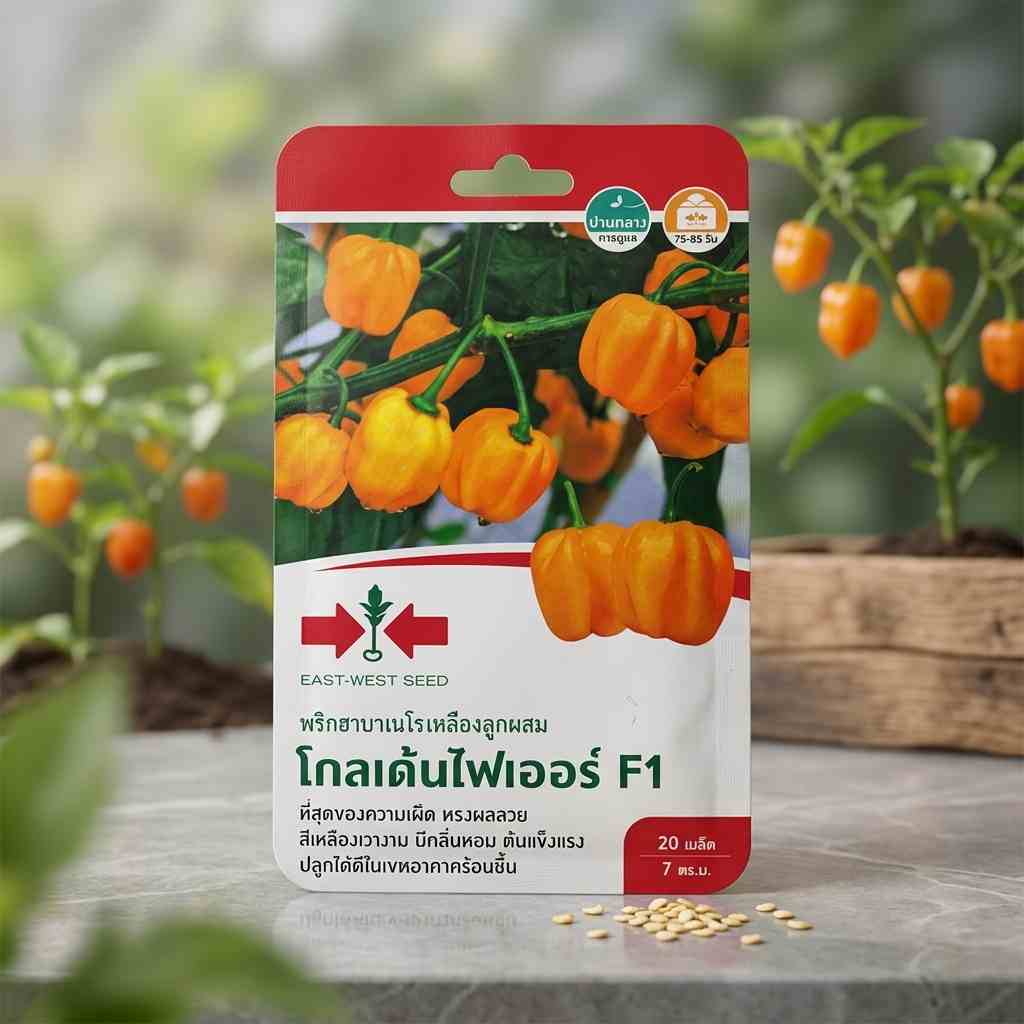
Yellow Habanero Golden Fire F1 Hybrid – 20 Seeds – East West Seed – Thai
৳ 290.00
Available on backorder
Description
Yellow Habanero Golden Fire F1 Hybrid
Price: 290 Taka per packet
Quantity: 20 seeds
Brand: East-West Seed
Country: Thailand
| Type | Name |
| English Name | Yellow Habanero Pepper |
| Bengali Name | হলুদ হাবানেরো মরিচ |
| Local Names | Golden Habanero, Yellow Hot Pepper |
| Trade Names | Golden Fire F1, Golden Habanero F1, Yellow Habanero Hybrid |
Scientific Classification
| Item | Details |
| Scientific Name | Capsicum chinense Jacq. |
| Family | Solanaceae |
| Genus | Capsicum |
| Species | C. chinense |
| Cultivar | Golden Fire F1 Hybrid |
Native Region
- Amazon Basin
- Northern South America
- Caribbean region
Major Cultivation Regions
- Mexico
- Belize
- Jamaica
- USA
- India
- Thailand
- Bangladesh
- Vietnam
- China
- Netherlands (greenhouse production)
Origin & Breeding History
Yellow habaneros originated from traditional Caribbean and Mexican habanero populations.
Golden Fire F1 was developed through controlled hybridization to obtain:
- Uniform fruit size
- Improved yield
- Better disease tolerance
- Consistent yellow color
- Earlier harvest
Status
✔ F1 Hybrid
✘ Heirloom
✘ Open Pollinated
Special Characteristics
- Extremely high pungency
- Fruity tropical aroma
- Attractive golden-yellow fruits
- High productivity
- Suitable for containers
- Long harvest season
- Excellent hot-sauce variety
Average Seeds per Gram
Research average:
| Source Range |
| 140–220 seeds/g |
Practical average: 180 seeds/g
Seed Viability
- 3–5 years under ideal storage
- Best viability within 2 years
Germination Temperature
| Condition | Temperature |
| Minimum | 18°C |
| Optimum | 28–32°C |
| Maximum | 38°C |
Germination Time
- 7–21 days
- Usually 10–14 days at 30°C
Germination Percentage
Good quality F1 seed:
- 85–98%
Light Requirement
- Light not required
- Darkness preferred until emergence
- Cover lightly
Moisture Requirement
- Uniform moisture
- Never waterlogged
Best Propagation Method
| Method | Rating |
| Seed | Excellent |
| Cuttings | Moderate |
| Grafting | Rare |
| Tissue Culture | Commercial only |
Plant Type
- Short-lived perennial in tropics.
- Grown as annual commercially.
Growth Habit
✔ Bushy
✔ Compact
✔ Upright
Plant Height: 60–100 cm
Plant Spread: 50–80 cm
Root Characteristics
- Fibrous root system
- Medium deep
- Extensive feeder roots
Stem Characteristics
- Semi-woody
- Strong branching
Leaf Characteristics
- Dark green
- Smooth
- Oval-lanceolate
Suitable Climate
- Tropical & Subtropical
- Ideal for Bangladesh.
Temperature
| Stage | Temperature |
| Minimum | 15°C |
| Optimum | 24–32°C |
| Maximum | 38°C |
Relative Humidity: 60–80%
Heat Tolerance: 9/10
Rain Tolerance: 6/10
Drought Tolerance: 7/10
Frost Tolerance: 0/10
Seed Sowing Depth: 0.5 cm
Plant Spacing: 18–24 inches (45–60 cm)
Row Spacing: 24–36 inches (60–90 cm)
Raised Bed Spacing
2 rows/bed
45 cm × 60 cm
Stake Requirement
Recommended
Especially during heavy fruiting.
Pruning Requirement
Moderate
Remove:
- Dead branches
- Interior overcrowding
Container Size
| Type | Volume |
| Minimum | 15 L |
| Ideal | 25–35 L |
| Commercial | 40–50 L |
Ideal Soil: Sandy loam
Texture: Loam to sandy loam
Drainage: Excellent
Organic Matter: High (>3%)
Soil pH: 6.0–6.8
EC Tolerance: 1.5–2.5 mS/cm
Rooftop Potting Mix
| Ingredient | % |
| Loamy Soil | 25 |
| Coconut Coir | 20 |
| Brown River Sand | 10 |
| Perlite | 8 |
| Cow Dung Compost | 10 |
| Vermicompost | 8 |
| Trichocompost | 5 |
| Wood Bark | 3 |
| Coconut Husk | 3 |
| Wood Charcoal | 2 |
| Neem Cake | 2 |
| Mustard Cake Powder | 1 |
| Bone Meal | 1 |
| Horn Meal | 0.5 |
| Oyster Shell Powder | 0.5 |
| Small Stones/Jhama/Cinder | 1 |
Properties
Water retention:
★★★★☆
Aeration:
★★★★★
Drainage:
★★★★★
Suitable for Dhaka rooftops.
Water Requirement
- Seedling: 100–200 ml/day
- Vegetative: 1–1.5 L every 2 days
- Flowering: 1.5–2 L/day
- Fruiting: 2–3 L/day
Hot rooftop: Daily irrigation often required.
Overwatering Symptoms
- Yellow leaves
- Root rot
- Flower drop
- Wilting despite wet soil
Underwatering Symptoms
- Leaf curl
- Blossom drop
- Small fruits
- Sunscald
Nutrient Ratio
Approximate tissue demand:
|
Nutrient |
% |
|
N |
3.5 |
|
P |
0.4 |
|
K |
4.5 |
|
Ca |
1.5 |
|
Mg |
0.4 |
|
S |
0.3 |
Micronutrients: B, Zn, Mn, Cu, Fe, Mo
Organic Fertilizer Program
Per plant:
Monthly
- Vermicompost 150 g
- Trichocompost 100 g
- Cow dung compost 200 g
Every 45 days:
- Bone meal 20 g
- Horn meal 10 g
- Neem cake 20 g
- Mustard cake 15 g
Every 30 days:
- Oyster shell 10 g
- Epsom salt 5 g
Chemical Program
Per plant/month
| Fertilizer | Amount |
| Urea | 10–15 g |
| TSP | 8–10 g |
| MOP | 12–15 g |
| Gypsum | 10 g |
| Zinc Sulphate | 1 g |
| Boron | 0.5 g |
Split into 2 applications.
Deficiency Symptoms
| Nutrient | Symptom |
| N | Yellow lower leaves |
| P | Purple leaves |
| K | Leaf edge burn |
| Ca | Blossom end rot |
| Mg | Interveinal chlorosis |
| B | Deformed fruits |
Flowering & Fruiting
- First Flower: 50–70 days
- Full Bloom: 70–90 days
- Flower to Fruit: 7–14 days
- Fruit Set to Maturity: 35–50 days
- Seed to First Harvest: 90–120 days
- Seed to Final Harvest: 180–300 days
- Fruiting Duration: 4–8 months
Pollination
- Self-pollinated
- Cross-pollination: 10–40%
Fruit Characteristics
Shape: Lantern shaped
Size:
- 4–6 cm long
- 3–5 cm wide
Weight: 8–20 g
Color Progression: Green → Light Yellow → Golden Yellow
Wall Thickness: 2–4 mm
Fruits per Plant: 50–200+
Depending on season.
- Taste Rating: 9/10
- Sweetness: 3/10
- Aroma: 10/10
- SHU: 200,000–350,000 SHU
- Some selections exceed 400,000 SHU. (Hot Sauce Club)
Capsaicin Content
Approximately 0.8–2.0%
Culinary Uses
- Hot sauce
- Pickles
- Chili powder
- Salsa
- Chutney
- Meat dishes
Yield Analysis
- Yield per Plant: 0.8–2.5 kg
- Yield per Container: 1–3 kg
- Yield per Square Foot: 0.3–0.8 kg
- Yield per m²: 3–8 kg
- Yield per Hectare: 15–30 tons
Family Requirement
Family of 4: 0.5–1 kg/year usually sufficient because of extreme heat.
COMMON PESTS:
Aphids
- Curling leaves
- Neem oil
- Imidacloprid
Thrips
- Silver streaking
- Spinosad
Whiteflies
- Virus transmission
- Yellow traps
Spider Mites
- Webbing
- Wettable sulfur
Fruit Borers
- Holes in fruit
- Bt spray
Cutworms
- Seedling cutting
- Soil treatment
DISEASES:
Anthracnose
- Fruit spots
- Copper fungicide
Damping Off
- Seedling collapse
- Trichoderma
Powdery Mildew
- White coating
- Sulfur spray
Bacterial Wilt
- Sudden wilting
- Remove plants
Mosaic Virus
- Distorted leaves
- Control vectors
Phytophthora Blight
- Stem rot
- Improve drainage
Harvest & Storage
Harvest Maturity
- Green Harvest: Firm green fruit
- Fully Ripe: Deep golden yellow
Harvesting
- Use scissors
- Avoid pulling.
Post-Harvest
- Shade cooling
- Sorting
- Drying surface moisture
Storage
| Method | Duration |
| Fresh | 5–10 days |
| Refrigerated | 2–4 weeks |
| Frozen | 8–12 months |
| Dried | 1–2 years |
| Powder | 1 year |
Companion Planting
Best Companions
- Basil
- Marigold
- Onion
- Garlic
- Coriander
- Carrot
Avoid
- Fennel
- Large Brassicas nearby
Nutrition (100 g Fresh)
| Nutrient | Amount |
| Calories | 40 kcal |
| Carbs | 9 g |
| Protein | 2 g |
| Fiber | 1.5 g |
| Vitamin A | 530 IU |
| Vitamin C | 140–240 mg |
| Vitamin E | 0.7 mg |
| Vitamin K | 14 µg |
| Potassium | 320 mg |
| Calcium | 18 mg |
| Iron | 1 mg |
| Magnesium | 23 mg |
Health Benefits
- Rich in Vitamin C
- Antioxidant
- Improves circulation
- Supports metabolism
- Anti-inflammatory
- Supports immunity
- Helps digestion
- May reduce pain perception
- Rich in carotenoids
- Supports heart health
Culinary Uses
Bangladeshi
- Habanero Beef Bhuna
- Habanero Chicken Roast
- Habanero Bhorta
- Habanero Pickle
- Habanero Shutki Curry
International
- Caribbean Hot Sauce
- Jamaican Jerk Marinade
- Mango Habanero Salsa
- Habanero Jelly
- Habanero Chili Oil
Best Sowing Months
Dhaka:
- October–January (best)
- July–August (possible)
- Best Harvest Season
January–May
Challenges
- Monsoon diseases
- High summer heat
- Mites
- Whiteflies
- Waterlogging
Rooftop Suitability: 9.5/10
Excellent for rooftop containers.
Commercial Potential
- Market Demand: High and increasing.
Export Potential:
- Moderate to High
- Specialty chili market.
Fresh Market Suitability: Excellent
Processing Suitability
| Product | Rating |
| Dry Chili | Excellent |
| Powder | Excellent |
| Sauce | Excellent |
| Pickle | Excellent |
Shelf-Life Rating: 8/10
Interesting Facts
- Habaneros are among the hottest commercial peppers.
- Yellow types often have stronger fruity aromas than red types.
- One plant can produce hundreds of peppers.
Lesser-Known Facts
- Heat increases under mild drought stress.
- Capsaicin is concentrated mainly in placental tissue.
- F1 seeds do not produce true-to-type offspring.
Quotes
- “A single habanero can teach respect faster than a hundred lectures.”
- “Great peppers reward patience with fire and fragrance.”
Seed Saving
Not recommended from Golden Fire F1.
Saved seed will segregate in F2 generation and lose uniformity. Use fresh F1 seed each season.
Info Reference List:
Research & Universities
- University of Florida IFAS Pepper Production Guide
- Cornell University Vegetable Program
- Texas A&M Pepper Production Manual
- AVRDC – World Vegetable Center
- FAO Capsicum Production Manuals
Government Publications
- USDA Pepper Production Guide
- Bangladesh Agricultural Research Institute (BARI)
- Indian Institute of Horticultural Research (IIHR)
Seed Companies
- Johnny’s Selected Seeds (Helios F1 Habanero) (johnnyseeds.com)
- Holmes Seed Company (Super Habanero F1)
- Thai Garden Design (Golden Fire F1)
Horticultural References
- Chile Pepper Institute
- World Vegetable Center
- Royal Horticultural Society
- Capsicum chinense cultivar databases
#150T #east #west #young #yellow #habanero #golden #fire #f1 #hybrid #chili #chilli #pepper #morich #thai #thailand #spicy #jhal #hot #seed #mgbd #my #garden #bd #mygardenbd
Only logged in customers who have purchased this product may leave a review.
Related products
-

-

-
Sale!


Thai Yellow Pepper – 70 seeds – MGS1366
Original price was: ৳ 280.00.৳ 160.00Current price is: ৳ 160.00. -

Reviews
There are no reviews yet.