
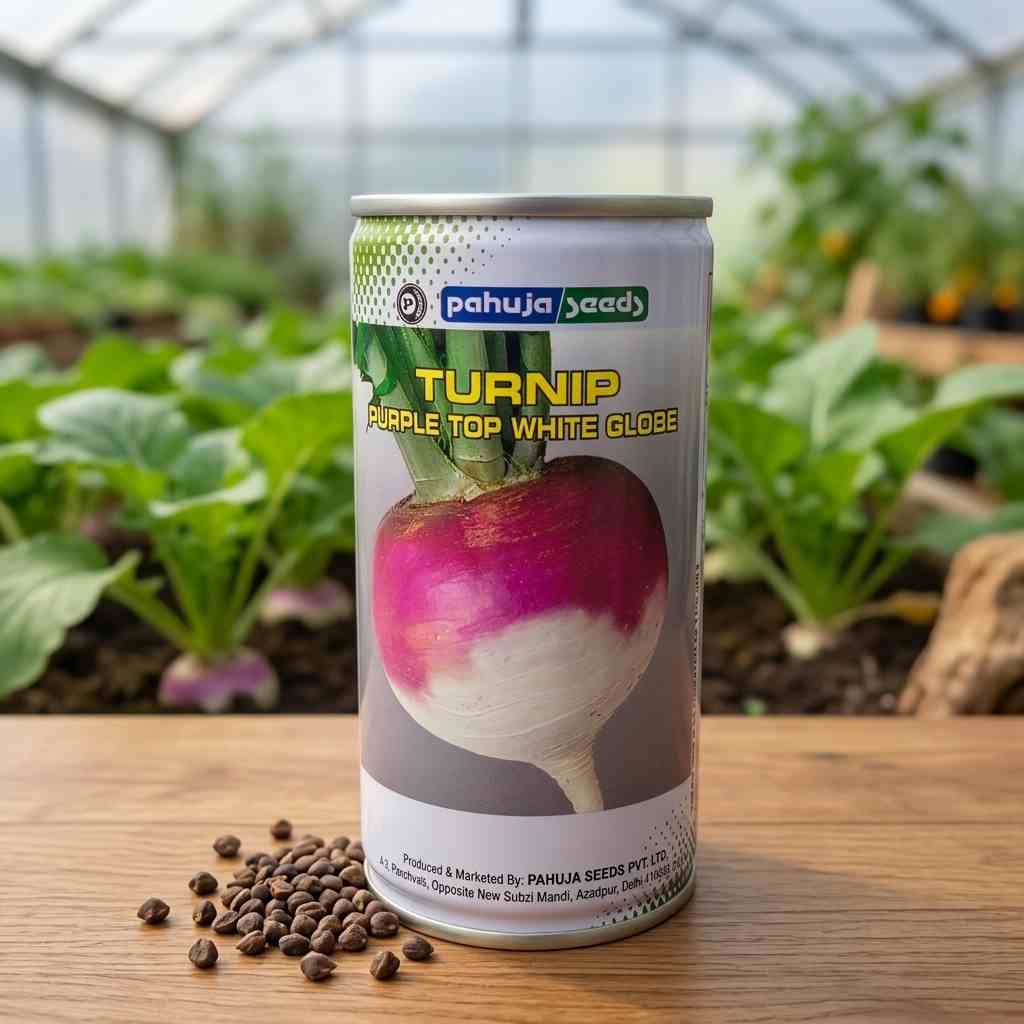
-Turnip – 100g Seed – Pahuja – Indian
৳ 450.00
General recommendation: For the best chance of success, sow this turnip in Dhaka in November or early December, use one plant per 12-inch-deep container, keep the medium evenly moist and well-drained, and harvest the root while it is still young and tender. The combination of cool weather, consistent moisture and loose soil will matter more than adding large amounts of fertiliser.
Description
TURNIP (Purple Top white Globe) – Seeds
Price: 450 Taka
- Note: Prices may vary. Please contact our support team to confirm the latest rates
Quantity: 100 gram seeds
Brand: Pahuja Seed
Country: India
Germination Rate: 80%
Physical Purity (Min): 98%
Genetic Purity (Min): 98%
Important research distinction: The information below describes the Purple Top White Globe cultivar type using established turnip cultivation research. Pahuja Seeds is the seed supplier, but we would not attribute specific germination percentages, yield guarantees, or proprietary breeding history to Pahuja without a verifiable technical datasheet for its particular seed lot. Cultivation figures are therefore presented as practical ranges rather than unsupported brand-specific claims.
Germination, growth and planting requirements
Germination temperature 15–25°C
Practical target: 18–22°C
Germination time 3–7 days
Allow up to 10 days in cooler conditions
Root harvest 45–60 days
Some lots may take 60–70 days
Ideal soil pH 6.0–6.5
Acceptable range roughly 5.5–7.0
| No. | Requirement | Recommendation |
|---|---|---|
| 01 | Germination temperature | Approximately 15–25°C is a good practical range. Seeds can germinate at lower temperatures, but more slowly. The INRAE reference records germination at 10°C in about 5 days and 20°C in about 2 days under its test conditions. |
| 02 | Germination time | Usually 3–7 days under favourable conditions; allow 7–10 days if the growing medium is cool or conditions are less favourable. |
| 03 | Plant height and span | Leaves typically reach about 20–35 cm (8–14 inches) high. Mature foliage may spread 25–40 cm (10–16 inches). These are planning estimates, not a verified Pahuja-specific specification. |
| Root dimensions | Typically about 5–10 cm (2–4 inches) in diameter, depending on spacing, temperature and harvest age. | |
| Seed sowing depth | 0.6–1.3 cm (¼–½ inch). Use approximately 1 cm for rooftop containers. | |
| 04 | Plant spacing | 10–15 cm (4–6 inches) between plants for roots. Use the wider end for larger globes. |
| 05 | Row spacing | 25–45 cm (10–18 inches) in a garden bed; approximately 30 cm (12 inches) is convenient for rooftop beds. |
| 06 | Trellis/support | Not required. Turnips are compact, non-climbing plants. Provide drainage and wind protection instead. |
| 07 | Seed-to-harvest time | Usually 45–60 days for roots; approximately 30–45 days for tender leaves. Allow longer if the weather remains warm. |
| 08 | Seed-to-bloom time | Commonly around 90–150 days or longer if the plant survives its first growing season and experiences suitable cool conditions. Flowering time varies substantially. Turnips are biennial, and root production is normally prioritised over flowering. |
The cultivar is commonly listed as maturing in approximately 50 days, while other turnip guides give a broader 40–60-day window.
Container, soil, sunlight and watering
Recommended container or bed size
Best container for one mature root
-
Top diameter: 12 inches (30 cm)
-
Depth: 10–12 inches (25–30 cm)
-
Drainage holes: at least 4–6, appropriately sized
-
Growing medium: approximately 15–20 litres, depending on pot shape
-
Plant count: one plant per container
A rectangular planter approximately 24 × 12 × 10 inches can accommodate 4–6 plants, depending on final spacing. Leave adequate depth for root expansion.
For rooftop gardening, use lightweight containers where possible, keep them stable in strong winds, and ensure water cannot pool beneath them. Do not add a thick stone layer at the bottom; use unobstructed drainage holes and a uniformly well-drained medium.
Soil type and pH
Turnips perform best in a loose, fertile, friable sandy loam or loam with good drainage and consistent moisture.
Ideal characteristics:
-
pH: 6.0–6.5; a broader workable range is approximately 5.5–7.0.
-
Texture: fine enough to maintain root contact but loose enough for globes to expand without deformity.
-
Organic matter: mature compost for nutrient supply and moisture buffering.
-
Drainage: fast enough to prevent prolonged saturation, particularly during humid Bangladeshi weather.
-
Avoid: heavy clay, fresh manure, large stones in the root zone, compacted media and excessive soluble salts.
Soil compaction and stones can produce misshapen roots. Overly acidic conditions can increase the risk of clubroot, while excessive nitrogen can encourage leafy growth at the expense of well-formed roots.
Sunlight and germination light
| Growth stage | Requirement |
|---|---|
| Seed germination | Light is not normally essential. Sow into moist medium and cover lightly. |
| Seedling establishment | Approximately 4–6 hours of direct sun, if necessary to avoid excessive rooftop heat. |
| Root development | Aim for 6–8 hours of direct sunlight daily. |
| Hot-weather protection | Provide light afternoon shade if the container overheats, but avoid deep shade. |
Full sun supports root development. However, sustained high temperatures can make roots woody, pungent or bitter.
Water requirement
There is no universal litres-per-day figure for a turnip: water use depends on pot volume, temperature, wind, plant size, humidity and the growing medium. The following is a starting estimate for a 12-inch container, not a fixed prescription.
| Growth stage | Approximate water per plant per day | Checking interval |
|---|---|---|
| Sowing to emergence | 0.1–0.25 L | Check morning and evening |
| Small seedlings, 1–2 weeks | 0.2–0.4 L | Check daily |
| Leaf growth, 2–4 weeks | 0.3–0.6 L | Check daily |
| Root enlargement, 4–8 weeks | 0.4–0.9 L | Check daily; sometimes twice daily in hot, windy weather |
How to water correctly
-
Check the top 2–3 cm of the medium each morning.
-
Water when the surface begins to dry and the medium below is only slightly moist, rather than saturated.
-
Apply water slowly until a little drains from the bottom, then empty the saucer.
-
In cooler December–January conditions, watering may be needed less frequently. In warm, windy weather, it may be needed more often.
-
Maintain even moisture during root enlargement. A severe dry period followed by heavy watering can cause splitting.
Use the table as an initial estimate and adjust it according to actual moisture, not the calendar alone.
Nutrients and organic fertilisation
Essential nutrients and their roles
The percentages below are approximate plant-tissue concentrations on a dry-matter basis, not a recipe for fertiliser. Actual concentrations vary with cultivar, plant age, soil and analytical method.
| Nutrient | Approximate concentration in plant dry matter | Main function | Organic sources from your list |
|---|---|---|---|
| Nitrogen (N) | 2–5% | Leaf growth, chlorophyll and enzymes | Vermicompost, cow-dung compost, trichocompost, mustard cake |
| Phosphorus (P) | 0.2–0.5% | Root establishment and energy transfer | Bone meal, composts |
| Potassium (K) | 2–5% | Water regulation, stress tolerance and root quality | Composts; some wood-derived materials |
| Calcium (Ca) | 0.5–2% | Cell walls and growing tissues | Oyster shell powder, bone meal |
| Magnesium (Mg) | 0.2–0.5% | Chlorophyll | Epsom salt, composts |
| Sulphur (S) | 0.2–0.5% | Proteins and characteristic Brassica compounds | Mustard cake, Epsom salt |
| Iron (Fe) | 50–200 mg/kg | Chlorophyll formation and enzymes | Compost, vermicompost |
| Manganese (Mn) | 20–200 mg/kg | Photosynthesis and enzymes | Compost |
| Zinc (Zn) | 20–100 mg/kg | Enzymes and growth regulation | Compost, manure |
| Boron (B) | 20–60 mg/kg | Growing points and tissue development | Compost, trace amounts in organic materials |
| Copper (Cu) | 5–20 mg/kg | Enzymes and photosynthesis | Compost |
| Molybdenum (Mo) | 0.1–1 mg/kg | Nitrogen metabolism | Trace quantities in compost |
These are indicative agronomic ranges, not laboratory targets for every turnip plant. Boron is especially important to root-crop quality, but excess boron is toxic. Do not add borax or concentrated micronutrient products without a justified diagnosis or soil/media test.
Organic fertiliser blend for one 12-inch container
Use mature, low-salinity composts and small amounts of concentrated amendments. The following is a conservative starting recipe for one plant, rather than a laboratory-validated optimum for Pahuja seed.
Organic nutrient blend — per container
Mix into approximately 15–20 L of potting medium before sowing.
| Ingredient | Weight |
| Trichocompost | 150 g |
| Vermicompost | 250 g |
| Well-rotted cow-dung compost | 150 g |
| Horn meal | 5 g |
| Bone meal | 10 g |
| Neem cake powder | 10 g |
| Mustard cake powder | 5 g |
| Oyster shell powder | 5 g |
| Epsom salt | 0 g initially |
Total added amendments: 585 g. Epsom salt is omitted initially because the need for additional magnesium depends on the source water and medium.
Application schedule:
-
Before sowing: Mix the composts and meal amendments evenly through the medium. Do not leave concentrated fertiliser against the seed.
-
Day 14–21: If growth is pale or weak and the roots are developing normally, top-dress with 20–30 g vermicompost per plant.
-
Day 28–35: If necessary, add another 20–30 g vermicompost. Avoid high-nitrogen feeding late in root enlargement.
-
Epsom salt: Do not apply routinely. If magnesium deficiency is confirmed, use a conservative dose based on a soil/media or water analysis and the product label.
Why not use all ingredients in large quantities? Horn meal and mustard cake release nutrients at different speeds; bone meal and oyster shell may alter pH and release nutrients slowly. Combining high doses can cause salt stress, excess nitrogen, pH drift or nutrient imbalance.
For a rooftop container, this measured approach is safer than adding large quantities of every organic product. If the medium already contains fertiliser or compost, reduce the initial blend accordingly.
Chemical fertiliser requirements
Turnips do not require an elaborate feeding programme if the potting medium is fertile. Commercial recommendations vary with soil tests and production systems. For a container, use a complete, soluble vegetable fertiliser according to its label rather than directly scaling field rates without adjustment.
A cautious programme for a 12-inch pot:
| Stage | Suggested management |
|---|---|
| Before sowing | Use the organic blend above, or a balanced granular vegetable fertiliser at the lowest label rate suitable for container vegetables. Do not apply both full rates. |
| 2–3 weeks after emergence | If needed, apply a balanced fertiliser such as 10-10-10 at approximately one-quarter to one-half of its container-label rate. |
| 4–5 weeks after emergence | Continue only if growth and leaf colour indicate a need. Avoid excess nitrogen as roots approach harvest. |
| Final 10–14 days | Avoid heavy fertilisation; maintain even moisture. |
For field production, one extension guide gives a generalised nitrogen range of approximately 35–80 lb/acre, with phosphorus and potassium adjusted to soil test results. This is not a direct recommendation for a rooftop pot.
Important: Do not combine full chemical-fertiliser rates with the full organic recipe automatically. Excess salts can burn roots and damage seedlings. If the goal is a chemical-free crop, use the organic programme alone and accept that nutrient release may be slower.
Rooftop potting mix for Bangladesh
This mix prioritises drainage during humid weather, adequate moisture retention during dry winter days, root expansion and moderate weight on the roof. Percentages are by volume, not weight.
Turnip rooftop potting mix
100% mix by volume — suitable for a 15–20 L container.
- Loamy soil 30%
- Coconut coir dust 20%
- Vermicompost 15%
- Trichocompost 10%
- Cow-dung compost 10%
- Coconut husk (medium) 10%
- Perlite 5%
For a 20 L batch: 6 L loam, 4 L coir dust, 3 L vermicompost, 2 L trichocompost, 2 L cow-dung compost, 2 L medium coconut husk and 1 L perlite.
Why these ingredients?
-
Loamy soil: Provides mineral structure and stability.
-
Coir dust: Holds moisture without requiring frequent watering.
-
Vermicompost and mature composts: Supply organic matter and nutrients.
-
Medium coconut husk: Improves aeration and reduces compaction.
-
Perlite: Improves drainage and oxygen availability around the roots.
If your loamy soil is heavy or clay-rich, reduce it to 20–25% and increase coir and husk accordingly, keeping the total at 100%. If it is already sandy and drains rapidly, retain the stated 30% loam and monitor moisture more closely.
Hydroponic cultivation
Can turnips be grown hydroponically?
Yes. Turnips can be grown hydroponically, and a published study of Japanese turnip found that roots could develop in nutrient solution. However, the study used a different cultivar and does not validate a particular nutrient formula for Pahuja’s Purple Top White Globe.
For rooftop cultivation, a deep-water culture or recirculating system is possible, but a loose, well-aerated substrate with drip irrigation is usually easier for producing uniform globe-shaped roots.
Suggested starting targets for a general leafy/root Brassica hydroponic solution:
| Parameter | Starting target |
|---|---|
| pH | 5.8–6.3 |
| EC during establishment | 0.8–1.2 mS/cm |
| EC during active growth | 1.4–2.0 mS/cm |
| Nitrogen (N) | 140–180 mg/L |
| Phosphorus (P) | 30–45 mg/L |
| Potassium (K) | 180–240 mg/L |
| Calcium (Ca) | 120–160 mg/L |
| Magnesium (Mg) | 35–50 mg/L |
| Sulphur (S) | 45–70 mg/L |
These are starting ranges for experimentation, not a validated cultivar-specific recipe. Use a complete hydroponic fertiliser that supplies micronutrients, including iron, manganese, boron, zinc, copper and molybdenum. Do not simply mix Epsom salt, bone meal, compost or other solid organic amendments into a recirculating reservoir; they can clog equipment, consume oxygen or create unstable nutrient availability.
Maintain adequate dissolved oxygen, protect the reservoir from direct sunlight, and replace or rebalance the solution according to EC, pH and water-quality readings. A solution should not be considered balanced solely because its EC is correct.
Companion plants and culinary characteristics
Companion plants
Suitable neighbours include:
-
Lettuce
-
Spinach
-
Coriander
-
Dill
-
Onion
-
Garlic
-
Spring onion
-
Radish, provided adequate spacing is maintained
Avoid overcrowding. Turnip, cabbage, cauliflower, broccoli, mustard and radish are all Brassicaceae, so repeatedly growing these crops together or one after another can encourage shared pests and diseases. Rotate to a different plant family where possible.
Root taste rating
Mild, slightly sweet, crisp and sometimes pleasantly peppery. Young roots tend to be sweeter and more tender; older or heat-stressed roots may become strong-flavoured, fibrous or bitter.
SHU does not apply; turnip is not a chilli or pepper variety.
Leaf taste rating
Tender leaves have a mildly mustard-like, earthy flavour. Mature leaves are stronger and can be slightly bitter. They are well suited to bhaji, dal, soups and mixed vegetable dishes.
Pest management
Common turnip pests and their control
The correct treatment depends on identifying the pest first. Brassica crops commonly suffer from flea beetles, aphids, caterpillars and root maggots.
| Pest | Signs of attack | Chemical control options | Organic / non-chemical alternative |
|---|---|---|---|
| Flea beetles | Numerous tiny holes in leaves | A locally registered product containing spinosad or another approved insecticide, if the label lists the pest and crop | Fine insect-proof netting, crop rotation, removal of infested weeds |
| Aphids | Clusters of small insects, curling leaves, sticky honeydew | Insecticidal soap or a locally registered aphicide such as acetamiprid, only if permitted on turnip | Water spray, removal of heavily infested leaves, insecticidal soap labelled for edible crops |
| Diamondback moth caterpillars | Small green caterpillars and irregular holes | Bacillus thuringiensis (Bt) products labelled for caterpillars; registered spinosad where necessary | Insect netting, hand-picking, regular inspection of leaf undersides |
| Cabbage white butterfly caterpillars | Large holes and green droppings | Label-approved Bt formulation | Hand-picking eggs and larvae; exclusion netting |
| Cutworms | Seedlings cut near soil level | Registered treatment only after confirming the pest and label directions | Remove weeds before sowing, inspect soil at night, use collars around young seedlings |
| Cabbage root fly / maggots | Tunnels or damaged roots; plants wilt despite moist soil | Only a currently registered soil treatment specifically approved for this crop and pest | Crop rotation, insect-proof mesh, removal of affected roots, clean growing medium |
| Slugs and snails | Ragged holes, slime trails | Iron-phosphate bait labelled for edible vegetable gardens | Hand-picking, removal of hiding places, improved drainage |
Chemical-use rules for Bangladesh
-
Verify that the exact formulation is registered by Bangladesh’s Department of Agricultural Extension for the crop and pest.
-
Follow the label for dose, protective equipment, pre-harvest interval (PHI) and re-entry interval.
-
Do not use a pesticide simply because it is recommended for cabbage or another related crop; confirm that turnip is covered by the label.
-
Avoid spraying open flowers or when pollinators are active. Never mix products unless the label permits it.
For rooftop growing, insect-proof mesh, crop hygiene and regular inspection are usually the best first-line measures.
Diseases and treatment
Common turnip diseases
| Disease | Symptoms / cause | Chemical management | Organic and preventive management |
|---|---|---|---|
| Clubroot | Swollen, distorted roots; stunted plants. Caused by Plasmodiophora brassicae. | No reliable curative spray for an infected plant. Soil pH management may reduce risk, but lime should only be used based on testing. | Use clean medium, avoid contaminated soil, improve drainage and rotate out of Brassicaceae. |
| Alternaria leaf spot | Dark circular spots, often with concentric rings | A registered fungicide labelled for the disease and crop, such as an appropriate mancozeb formulation where permitted | Remove affected leaves, improve airflow and avoid overhead watering late in the day |
| Downy mildew | Yellow patches on upper leaves, greyish growth underneath in humid conditions | A registered oomycete-active product such as a suitable metalaxyl-containing formulation, if specifically labelled | Improve ventilation, remove affected leaves, avoid leaf wetness and excessive crowding |
| Black rot | Yellow V-shaped lesions at leaf margins; vascular darkening. Caused by Xanthomonas campestris pv. campestris. | No dependable curative chemical treatment for infected plants | Use clean seed, sanitise tools, remove infected plants and avoid overhead irrigation |
| Damping-off | Seedlings collapse at soil level; often associated with Pythium, Rhizoctonia or Fusarium | A registered seed treatment or fungicide specifically labelled for the causal organism | Use clean containers and medium, avoid overwatering, and sow at the correct depth |
| Powdery mildew | White powdery growth on leaves | A labelled fungicide, such as a suitable sulphur product, if approved for the crop and conditions | Improve airflow, remove badly affected leaves and avoid excessive nitrogen |
| Soft rot | Soft, watery, foul-smelling root tissue | No reliable cure once the root is rotting | Remove infected roots, improve drainage, avoid root injury and sanitise tools |
Extension guidance identifies Alternaria, black rot and clubroot among important turnip problems.
Important: The chemical examples above are active ingredients or product classes to investigate, not a recommendation to spray them indiscriminately. Product registration and permitted uses can change. Organic methods are particularly important for a short-duration edible crop.
Harvesting, yield and lifespan
How to identify a mature root
Harvest when the exposed shoulders are roughly 5–8 cm (2–3 inches) across, depending on the cultivar and your preferred size.
Look for:
-
A firm, smooth, rounded root.
-
A visible purple shoulder above the soil.
-
Healthy green leaves without severe yellowing.
-
A root that has not become excessively large or woody.
-
A crop age of roughly 45–60 days under favourable conditions.
Loosen the soil gently and pull the root without damaging neighbouring plants. Do not wait for the roots to become oversized; large turnips can be fibrous or pungent.
Leaves can be harvested earlier, usually once the plant has enough established foliage. Take a few outer leaves at a time and leave the growing centre intact if you want the root to continue enlarging.
Monthly yield required for a family of four
For a family of four following a varied Bangladeshi diet, turnips are best treated as one vegetable among several, rather than the only vegetable consumed.
A reasonable planning estimate is:
-
Root consumption: 2–4 kg per month for occasional curries, mixed vegetables and soups.
-
Leaf consumption: 0.5–1.5 kg per month, if the family regularly eats turnip greens.
These are meal-planning estimates, not official dietary recommendations. Individual requirements depend on portion sizes, age and food preferences.
To obtain a continuous harvest, sow a small batch every 2–3 weeks during the cool season rather than planting all the seeds at once.
Average crop yield per square foot
A practical home-garden planning range is approximately 0.3–0.8 kg of roots per square foot per crop cycle under good growing conditions.
The actual yield depends on plant density, cultivar, temperature, root size and the proportion of marketable roots. Field guides report substantially different yields because they use different varieties and planting systems.
For example, a 10-square-foot growing bed might produce approximately 3–8 kg of roots in a successful crop. This is a planning estimate, not a guaranteed yield.
Average lifespan
Turnip is botanically a biennial plant:
-
First growing season: leaves and edible storage root develop.
-
Second growing season: after suitable cool conditions, the plant may flower, set seed and eventually die.
For rooftop vegetable production, it is generally grown as an annual crop and harvested within about 45–60 days. The practical productive life of the root crop is therefore around 1.5–2 months, although the individual plant can live longer if left in place.
Nutrition and health benefits
Nutritional values of raw turnip root
Approximate values per 100 g of raw root:
| Nutrient | Amount |
|---|---|
| Energy | 28–35 kcal |
| Water | Approximately 91% |
| Carbohydrates | 6–7.3 g |
| Dietary fibre | 1.8–2 g |
| Protein | 0.9–1 g |
| Fat | Approximately 0.1 g |
| Vitamin C | Approximately 20–27 mg |
| Potassium | Approximately 230–262 mg |
| Calcium | Approximately 30–40 mg |
| Magnesium | Approximately 10 mg |
| Phosphorus | Approximately 30 mg |
| Folate | Approximately 15–60 µg, depending on dataset |
These are approximate values: different food-composition databases and samples produce slightly different results.
Turnip greens have a different nutritional profile and can provide useful quantities of vitamins A, C and K, folate and minerals. The values depend on the maturity and preparation of the leaves.
Health benefits
-
Supports normal immune function: Vitamin C contributes to normal immune function and collagen formation.
-
Supports digestive health: Dietary fibre helps maintain regular bowel movements as part of a fibre-rich diet.
-
Contributes to normal blood-pressure regulation: Potassium is involved in normal muscle function and blood-pressure regulation.
-
Provides useful micronutrients with few calories: Turnip can add volume and variety to meals without contributing much energy.
-
Adds variety to a vegetable-rich diet: Turnips and their leaves contain different plant compounds and micronutrients, helping diversify the diet.
These are nutritional contributions, not claims that turnips prevent or cure specific diseases. They should complement a balanced diet rather than replace medical treatment.
Interesting recipes using Purple Top White Globe turnip
1. Bangladeshi Shalgom Bhaji
Bangladesh · Root and leaves
Slice turnip and tender leaves. Cook with onion, garlic, green chilli, turmeric, salt and a little oil. Add a small splash of water, cover and cook until tender. Finish with coriander leaves.
2. Shalgom Diye Macher Jhol
Bangladesh · Root
Cook turnip wedges with a light onion, ginger, turmeric and cumin gravy. Add fish and simmer gently until both the fish and turnip are cooked. Serve with steamed rice.
3. Herb-Roasted Turnips
International · Root
Cut into wedges, coat lightly with olive oil, black pepper, garlic and herbs, then roast at approximately 200°C until golden and tender. Smaller roots are particularly suitable.
4. Creamy Turnip and Potato Soup
International · Root
Simmer diced turnip, potato, onion and vegetable stock until soft. Blend until smooth, then add milk or an unsweetened dairy alternative. Season with pepper and herbs.
Best sowing month in Bangladesh
Ideal month for germination under natural conditions
Recommended sowing window for Dhaka: late October through December, with November as the preferred starting month.
Bangladesh sowing calendar
Oct
Late October – Possible early sowing when temperatures begin to fall; watch for warm afternoons.
Nov
Preferred starting month – Generally a good compromise between cooling weather and adequate growing time.
Dec
Excellent winter option- Cooler conditions generally favour root quality; protect containers from drying winds.
Jan
Late sowing – Often possible, but the crop may encounter warming temperatures before harvest.
Climate evidence and limitations: Bangladesh Meteorological Department material describes December–February as the winter season. Japan Meteorological Agency climate normals for Dhaka show mean temperatures of approximately 23.7°C in November, 19.6°C in December and 18.2°C in January. These seasonal patterns support winter sowing.
Approximate number of seeds per gram
A useful planning range is 350–500 seeds per gram for turnip, although seed size and cultivar vary.
The INRAE Ephytia turnip reference gives this range directly.
For example:
-
1 g: approximately 350–500 seeds
-
2 g: approximately 700–1,000 seeds
-
5 g: approximately 1,750–2,500 seeds
These are estimates, not a guaranteed count for the Pahuja packet. For precise seed inventory, weigh a representative sample and count it.
Propagation, storage and distinctive features
Best propagation method
Direct sowing into the final container is the preferred method.
-
Fill the container with the prepared, pre-moistened potting mix.
-
Sow 2–3 seeds at each intended planting position, approximately 1 cm deep.
-
Water gently so the seeds are not displaced.
-
Maintain consistent moisture without waterlogging.
-
After emergence, retain the strongest seedling and cut the weaker seedlings at soil level rather than pulling them out beside the retained plant.
-
Thin to one plant per 12-inch container.
Turnips are generally less suited to transplanting than many leafy vegetables because disturbing the taproot can impair root shape. Direct sowing is simpler and reduces that risk.
Best storage methods
Roots
-
Twist or cut off the leaves, leaving a short neck.
-
Brush off excess soil; avoid storing damaged or rotting roots.
-
Refrigerate in a perforated bag or suitable vegetable drawer.
-
Expected home refrigerator storage: roughly 2–4 weeks, sometimes longer with excellent conditions.
-
For longer storage, commercial cold storage near 0°C and 90–95% relative humidity can preserve sound roots for several months.
Leaves
-
Remove damaged leaves and keep them dry until washing.
-
Refrigerate in a clean bag or container lined with a paper towel.
-
Best quality is generally within 3–5 days.
-
For longer storage, blanch briefly, cool rapidly, drain and freeze in sealed portions; quality is generally best within about 8–12 months in a freezer maintained at −18°C.
For roots, commercial storage guidance recommends approximately 0°C and 90–95% relative humidity. Home refrigerators fluctuate more, so shorter storage periods are sensible.
Some specialties of Purple Top White Globe
-
Distinctive two-colour root: The upper shoulder exposed to light develops a purple colour while the lower root remains predominantly white.
-
Dual-purpose crop: Both the root and the leaves can be eaten, making the crop useful for home kitchens.
-
Short growing cycle: Roots can often be harvested in approximately 45–60 days, enabling successive sowings through the cool season.
Two original quotes about turnips
“Beneath a crown of purple, a quiet white globe gathers the sweetness of winter.”
“A small seed, a patient season, and a harvest that brings the garden to the family table.”
These are original quotes written for this guide, not quotations attributed to historical authors.
Few lesser-known facts
-
The purple colour is light-dependent. The exposed shoulder develops its colour in response to light; the underground portion remains pale.
-
Turnips are botanically biennial. The familiar root is harvested in the first growing season, while flowering and seed production usually follow after the plant experiences suitable seasonal conditions.
-
Roots can become less pleasant when left too long. A larger turnip is not necessarily a better turnip: overmaturity and heat stress can increase pungency and fibrousness.
Botanical identity and origin
Native region
Turnip is an old cultivated crop with a complex history of domestication. Its deeper ancestry is associated with Eurasian cultivation, and its early domestication history is not established precisely enough to assign one universally accepted birthplace to every modern turnip cultivar.
Purple Top White Globe is a cultivated turnip type, rather than a wild species native exclusively to India.
Origin story of the cultivar
The turnip has been cultivated for centuries in Europe and Asia. Purple Top White Globe became established as a named garden and agricultural cultivar because growers valued its rounded white root, purple shoulder and dual-purpose leaves and roots.
I could not verify a reliable primary source naming the individual breeder, exact year of creation or original breeding location of the Purple Top White Globe cultivar. Nor is there sufficient evidence here to attribute its creation to Pahuja Seeds. It is more accurate to describe Pahuja as the seed supplier and Purple Top White Globe as the cultivar type.
Scientific name, family and Bengali name
- Scientific name: Brassica rapa subsp. rapa
- Family: Brassicaceae (mustard or cabbage family)
- English name: Turnip – Purple Top White Globe
- Bengali name: শালগম (Shalgom)
- Common description in Bangladesh: বেগুনি মাথা সাদা শালগম
The botanical reference used by INRAE lists the crop as Brassica rapa subsp. rapa. Older agricultural literature may use Brassica campestris var. rapa or related historical naming conventions.
Info References and research sources:
The following sources support the cultivation ranges, soil requirements, harvesting advice, hydroponic discussion, nutritional information and Bangladesh seasonal recommendations in this guide.
Cultivation and cultivar information
-
University of Florida IFAS – Turnips — Purple Top White Globe, germination, sunlight, spacing and maturity.
-
University of Delaware Cooperative Extension – Turnips — Cultivar characteristics and common pests and diseases.
-
India National Horticulture Board – Turnip PDF — Soil, climate and pH requirements.
-
INRAE Ephytia – Turnip — Scientific name, seed count per gram, germination, crop cycle and storage conditions.
-
Virginia Tech Extension – Root Crops — Soil, pH, temperature, spacing, harvest and yield.
-
University of Minnesota Extension – Turnips and Rutabagas — Cultivation, pests, diseases, fertilisation and harvest.
-
University of California IPM – Growing Turnips — Soil preparation and cultural pest management.
-
Mississippi State University Extension – Turnips and Rutabagas — Root spacing and common growing problems.
-
British Columbia Government – Turnip Production Guide — Commercial seeding, nutrition, pest and disease management, and storage.
-
LSU AgCenter / Texas A&M – Turnip Production Guide PDF — Soil, seed depth, plant density and fertilisation.
-
University of Massachusetts Amherst – Rutabaga and Turnip — Nutrient recommendations and spacing.
-
J. Parker’s Seeds – Purple Top White Globe Growing Guide PDF — Cultivar description and harvest guidance.
-
University of Arkansas Cooperative Extension – Vegetable Production Guide PDF — Cultivar maturity and yield information.
Hydroponics and scientific research
-
Journal of Applied Horticulture – Effect of nutrient levels on anthocyanin and nitrate-N in hydroponic turnips — Experimental hydroponic research on Japanese turnip.
-
Wyndham City – Seed Growing Instructions PDF — General Purple Top White Globe growing information.
Nutrition and food composition
-
USDA FoodData Central – Turnips, raw, Foundation Foods — Official food-composition database; search for “Turnips, raw.”
-
FoodData Explorer – Turnips, raw — Nutritional data derived from USDA Foundation Foods.
-
GetFoodFacts – Turnips, raw — Nutrient values per 100 g.
Bangladesh climate references
-
Bangladesh Meteorological Department – Climate — Official climate normals, rainfall and temperature information.
-
Japan Meteorological Agency – Dhaka monthly climate normals — Monthly mean temperature and precipitation.
-
Bangladesh Meteorological Department – Winter 2025–26 climate material — Seasonal climatological data.
Research limitation: The sources establish general turnip cultivation practices, not a verified proprietary specification sheet for Pahuja Seeds’ particular seed lot. The container fertiliser recipe, rooftop potting mix, watering volumes and hydroponic solution are practical starting recommendations developed from general horticultural principles; they have not been validated by a controlled trial of this exact cultivar in Dhaka.
CLICK HERE TO LEARN MORE ABOUT GROWING TIPS
Accessories Required For Seedling Preparation:
OR
Seed Germination Disclaimer:
Successful germination depends on several factors, including temperature, growing medium, moisture, watering, sunlight, soil pH, sowing depth, seed age, and local weather conditions. Germination results may therefore vary depending on the growing environment and cultivation method.
Before reporting a seed as defective, please ensure that the recommended growing conditions and proper sowing methods have been followed. You may also search Google or YouTube for crop-specific seed-sowing guides and tutorials, e.g. “How to grow Bird Chili from seeds.”
For any product-related questions, please contact our support team by inbox, email, or phone. We will do our best to assist you.
Please read the product description carefully before sowing.
Seed Quantity: In rare cases, there may be a slight variation in the number of seeds inside a packet due to packaging or handling. If you notice a significant shortage, please inform us immediately with relevant photos. Our support team will review the matter and provide a solution where possible.
বীজের জার্মিনেশন সংক্রান্ত তথ্য:
বীজের সফল জার্মিনেশন তাপমাত্রা, রোপণ মিডিয়া, আর্দ্রতা, পানি, সূর্যালোক, মাটির pH, বীজ বপনের গভীরতা, বীজের বয়স এবং স্থানীয় আবহাওয়াসহ বিভিন্ন বিষয়ের উপর নির্ভর করে। তাই পরিবেশ ও চাষের পদ্ধতি অনুযায়ী জার্মিনেশনের ফলাফল ভিন্ন হতে পারে।
বীজের মান নিয়ে অভিযোগ করার আগে অনুগ্রহ করে সঠিক পরিবেশ ও বীজ বপনের পদ্ধতি নিশ্চিত করুন। প্রয়োজনীয় নির্দেশনার জন্য Google বা YouTube-এ ফসলের নাম দিয়ে সার্চ করতে পারেন, যেমন: “How to grow Bird Chili from seeds.”
পণ্য সম্পর্কিত কোনো প্রশ্ন থাকলে ইনবক্স, ইমেইল অথবা ফোনের মাধ্যমে আমাদের সাপোর্ট টিমের সাথে যোগাযোগ করুন। আমরা যথাসাধ্য সহযোগিতা করার চেষ্টা করব।
বীজ ব্যবহারের আগে অনুগ্রহ করে পণ্যের বিবরণ ভালোভাবে পড়ে নিন।
বীজের পরিমাণ: বিরল ক্ষেত্রে প্যাকেজিং বা হ্যান্ডলিংয়ের কারণে প্যাকেটে উল্লেখিত সংখ্যার তুলনায় সামান্য কম-বেশি হতে পারে। উল্লেখযোগ্য ঘাটতি থাকলে অনুগ্রহ করে দ্রুত ছবি সহ আমাদের জানান। আমাদের সাপোর্ট টিম বিষয়টি পর্যালোচনা করে সম্ভব হলে উপযুক্ত সমাধান প্রদান করবে।
#Turnip #Turnips #PurpleTopWhiteGlobe #PurpleTopTurnip #WhiteGlobeTurnip #TurnipRoot #TurnipGreens #TurnipLeaves #BrassicaRapa #BrassicaRapaRapa #Brassicaceae #RootVegetables #WinterVegetables #CoolSeasonCrops #EdiblePlants #TurnipGrowing #GrowingTurnips #TurnipSeeds #TurnipSeedlings #TurnipHarvest #VegetableGardening #HomeGardening #RooftopGardening #ContainerGardening #UrbanGardening #KitchenGarden #OrganicGardening #OrganicFarming #SustainableGardening #GardeningTips #GardeningGuide #SeedStarting #SeedGermination #PottingMix #SoilHealth #Composting #OrganicFertilizer #PlantNutrition #Hydroponics #WinterGardening #TurnipRecipes #TurnipBhaji #TurnipCurry #TurnipSoup #RoastedTurnips #TurnipGreens #HealthyEating #HealthyVegetables #VegetableRecipes #FarmToTable #FreshHarvest #HomegrownFood #EdibleGarden #NutritiousFood #SeasonalEating #BangladeshGardening #GardeningBangladesh #DhakaGardening #BangladeshFarming #BangladeshAgriculture #BangladeshiGarden #RooftopGardenBD #UrbanFarmingBD #OrganicFarmingBD #HomeGardenBD #WinterVegetablesBD #Shalgom #MyGardenBd
#শালগম #বেগুনিমাথাসাদাশালগম #সাদাশালগম #শালগমগাছ #শালগমপাতা #শালগমচাষ #শালগমবীজ #শীতকালীনসবজি #মূলজাতীয়সবজি #দেশিসবজি #তাজাসবজি #পুষ্টিকরসবজি #ছাদবাগান #ছাদেকৃষি #ছাদেকৃষিকাজ #বাড়িরবাগান #বারান্দাবাগান #টবেবাগান #শখেরবাগান #সবজিবাগান #জৈবচাষ #জৈবসার #কম্পোস্ট #ভার্মিকম্পোস্ট #বাগানকরুন #বাগানপ্রেমী #বাগানটিপস #বীজথেকেগাছ #বীজবপন #শীতকালীনচাষ #সবজিচাষ #নিরাপদখাদ্য #নিজেরখাবারনিজেচাষকরুন #শালগমভাজি #শালগমতরকারি #শালগমদিয়েমাছ #শালগমপাতা #সবজিরান্না #পুষ্টিকরখাবার #স্বাস্থ্যকরখাবার #তাজাখাবার #ঘরোয়াখাবার #মৌসুমিসবজি #বাংলাদেশেরকৃষি #বাংলাদেশেরবাগান #বাংলাদেশেরছাদবাগান #ঢাকাছাদবাগান #বাংলারকৃষি #কৃষিপ্রযুক্তি #কৃষিউদ্যোক্তা #বাগানপ্রেমীবাংলাদেশ #আমারবাগান #মাইগার্ডেনবিডি #MyGardenBd
Only logged in customers who have purchased this product may leave a review.


Reviews
There are no reviews yet.