
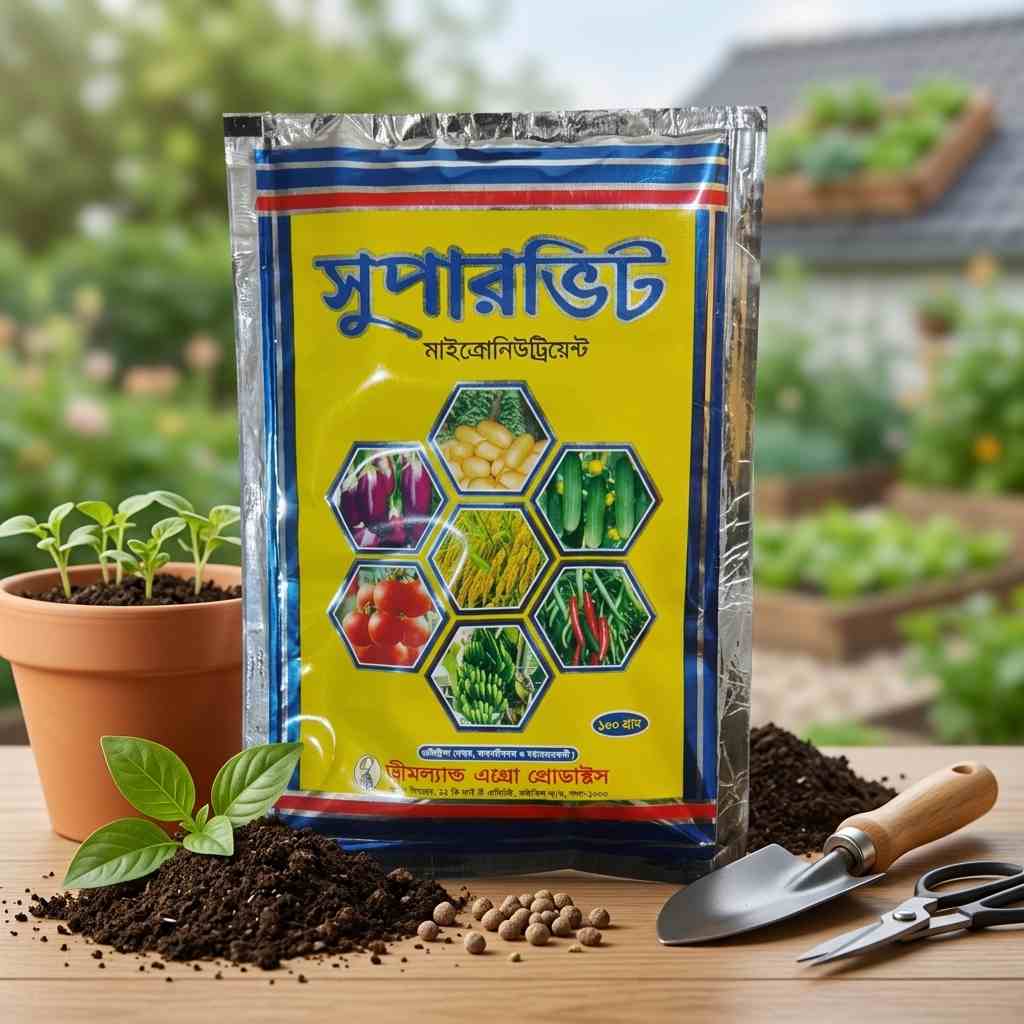
Supervit – 100g – Micronutrient
৳ 170.00
Available on backorder
Description
Supervit – Micronutrient
Price: _170_ Taka
Quantity: 100 gram pack
Brand: Dreamland Agro Products
Detailed Technical Guide
Quick identification
| Item | Information |
| Product | Supervit Micronutrient |
| Manufacturer/brand | Dreamland Agro Products, Bangladesh |
| Pack size | 100 g |
| Product type | Micronutrient fertilizer/supplement |
| Main use | Foliar micronutrient supplementation |
| Recommended foliar concentration found | 2 g/L water |
| Alternative soil application found | 200 g/bigha |
| Foliar field rate found | 100 g/bigha |
| Physical form | Powder |
| N-P-K | Not declared in the available product information |
| Organic fertilizer? | No — it is a mineral/micronutrient fertilizer |
Dreamland Agro Products is a registered Bangladeshi chemical-industry establishment, and trade records also show the company importing agricultural chemical products. (Lima)
Benefits in gardening/agriculture
The manufacturer/product listings attribute the following benefits to Supervit:
🌱 Vegetative growth
- Helps maintain greener foliage.
- Supports normal leaf development.
- Helps increase leaf size where micronutrient deficiency is limiting growth.
- Supports chlorophyll-related physiological processes indirectly through adequate Mg and other nutrients.
🌸 Flowering
- Supports flowering when micronutrient deficiency is present.
- Boron is particularly important for reproductive development and pollen viability.
- Adequate boron can improve flower/fruit set in deficient plants.
🍅 Fruit development
- Supports fruit development and quality.
- Calcium contributes to cell-wall and tissue integrity.
- Boron contributes to reproductive development and movement of photosynthetic sugars.
- The product is marketed as helping reduce fruit cracking.
🍎 Fruit appearance
The product listing claims improved fruit appearance. This should be interpreted as a nutritional benefit under deficiency conditions, rather than assuming Supervit itself is a fruit-colouring or size-enhancing PGR.
🌾 Grain crops
The seller claims reduced “chita”/unfilled grain in cereal crops. Nutrient sufficiency can certainly influence grain formation, but this particular claim has not been independently quantified for Supervit in the sources I found.
🛡️ Stress/disease tolerance
The product is marketed as reducing susceptibility to pest/disease attack. I would phrase this carefully for customers:
Adequate micronutrient nutrition can improve overall plant physiological health, but Supervit should not be considered an insecticide, fungicide or disease-control product.
This distinction is important because Bangladesh’s fertilizer guidance identifies Zn, B, S, Mg, Ca and other nutrients as having specific physiological roles, but nutrient supplementation is not equivalent to pesticide treatment. (BARC Web Apps)
Suitable crops and application rates
Supervit can potentially be used across a very broad range of crops because the product supplies several essential/beneficial mineral nutrients rather than targeting one crop.
Suitable crops
Vegetables
- Tomato
- Chili
- Capsicum
- Eggplant
- Cucumber
- Bottle gourd
- Bitter gourd
- Ridge gourd
- Pumpkin
- Melon
- Watermelon
- Beans
- Okra
- Cabbage
- Cauliflower
- Broccoli
- Leafy vegetables
Fruit crops
- Mango
- Guava
- Papaya
- Pomegranate
- Citrus
- Banana
- Strawberry
- Melons
Flowers/ornamentals
- Rose
- Marigold
- Zinnia
- Petunia
- Dahlia
- Chrysanthemum
- Gerbera
- Hibiscus
- Bougainvillea
- Orchids
- Other flowering ornamentals
Field crops
- Rice
- Wheat
- Maize
- Jute
- Pulses
- Oilseed crops
Product-specific rate I could verify
Foliar spray:
2 g Supervit / 1 L water
The same source also reports:
100 g/bigha as foliar spray
and
200 g/bigha for soil application. (SeedsMate)
For Bangladesh, where 1 bigha is commonly treated as approximately 33 decimal, the 100-g/bigha rate is consistent with a relatively low-concentration micronutrient program.
Important
I would not recommend automatically increasing the dose for large plants. Micronutrients—especially boron—have relatively narrow ranges between deficiency and excess.
Best method/practice to use it
⭐ Recommended method: foliar application
For home/rooftop gardening, I would primarily use Supervit as a foliar spray, because:
- micronutrients can be delivered directly to foliage;
- the required quantity is very small;
- distribution is easier to control;
- it avoids unnecessarily accumulating micronutrients in a limited-volume container.
Mixing
2 g Supervit + 1 litre clean water
For smaller quantities:
| Water | Supervit |
| 250 mL | 0.5 g |
| 500 mL | 1 g |
| 1 L | 2 g |
| 2 L | 4 g |
| 5 L | 10 g |
| 10 L | 20 g |
Use an accurate small digital scale rather than a teaspoon.
Application
- Measure the required quantity.
- Dissolve in a small amount of water first.
- Add the remaining water.
- Mix thoroughly.
- Spray the upper and lower surfaces of leaves.
- Spray until foliage is evenly wetted, not dripping heavily.
Bangladesh agricultural guidance also recommends foliar micronutrient application according to crop requirements and advises avoiding strong sunlight. (Ais)
Best time of day
Late afternoon/evening is preferable.
Alternatively:
Early morning, provided strong sunlight and high heat will not immediately follow.
Avoid:
- midday;
- very hot rooftop conditions;
- spraying before heavy rain;
- spraying drought-stressed/wilted plants.
Bangladesh Agricultural Information Service specifically recommends avoiding strong sunlight for foliar zinc application and recommends late-afternoon spraying. (Ais)
Rooftop-gardening application according to planter size
This needs an important distinction:
The manufacturer’s verified rate is based on water volume, not planter volume.
Therefore, the safest way to adapt it to rooftop gardening is to maintain 2 g/L of spray water, rather than trying to convert the product directly into grams per litre of soil.
Practical rooftop schedule
| Planter | Approx. volume | Suggested spray water | Supervit |
| 6″ × 6″ | ~3–4 L | 50–75 mL | 0.10–0.15 g |
| 8″ × 8″ | ~7–10 L | 75–125 mL | 0.15–0.25 g |
| 10″ × 10″ | ~15–20 L | 100–150 mL | 0.20–0.30 g |
| 12″ × 10″ | ~20–25 L | 150–200 mL | 0.30–0.40 g |
| 12″ × 12″ | ~25–35 L | 200–300 mL | 0.40–0.60 g |
| 14″ × 12″ | ~35–45 L | 250–350 mL | 0.50–0.70 g |
| 16″ × 12″ | ~45–55 L | 300–450 mL | 0.60–0.90 g |
| 18″ × 14″ | ~60–80 L | 400–600 mL | 0.80–1.20 g |
| 20″ × 16″ | ~90–110 L | 500–750 mL | 1.00–1.50 g |
| 24″ × 18″ | ~140–170 L | 750–1,000 mL | 1.50–2.00 g |
| 30″ × 18″ | ~200–240 L | 1–1.5 L | 2–3 g |
| 55-L drum | ~55 L | 350–500 mL | 0.7–1.0 g |
These are practical rooftop spray-volume estimates, not manufacturer-prescribed pot-specific doses. The actual quantity should be based on how much spray is required to wet the foliage.
Frequency
For general rooftop use:
Every 3–4 weeks when supplementation is actually needed.
For actively fruiting/flowering plants with demonstrated micronutrient deficiency, a second application can be considered after approximately 10–15 days, followed by a longer interval.
For fruit trees, Bangladesh agricultural guidance describes micronutrient sprays around flowering/fruiting and after harvest, with another spray around 15 days after the first where recommended. (Ais)
For Bangladesh’s climate
During April–June, Dhaka rooftop temperatures can become very high. Use:
Late afternoon + relatively cool/cloudy weather + no rain expected for several hours.
During the June–September monsoon, avoid spraying immediately before rain.
During November–February, foliar applications can generally be performed more comfortably because temperatures are lower.
Nutrient contents
The product page gives the following composition: (My Garden Bd)
| Nutrient | Declared percentage |
| Sulphur (S) | 3.40% |
| Zinc (Zn) | 0.50% |
| Boron (B) | 0.25% |
| Sodium (Na) | 0.18% |
| Magnesium (Mg) | 0.45% |
| Calcium (Ca) | 0.75% |
| Declared total | 5.53% |
Therefore, in a 100-g packet, the declared elemental quantities are approximately:
- S = 3.40 g
- Zn = 0.50 g
- B = 0.25 g
- Na = 0.18 g
- Mg = 0.45 g
- Ca = 0.75 g
Total declared nutrients = 5.53 g/100 g.
The remaining approximately 94.47% is not identified in the publicly available product information I found.
That means I would not claim that the remaining material is a particular chemical, carrier, filler or chelate without the manufacturer’s technical data sheet.
Effectiveness — percentage and 0–10 rating
There is an important scientific limitation here.
I could not find a manufacturer-published controlled trial giving a percentage such as “Supervit increases yield by 35%” or “95% effective.”
Therefore, assigning a precise effectiveness percentage would be misleading.
My practical assessment
| Situation | Expected usefulness |
| Confirmed micronutrient deficiency | High |
| Mild suspected deficiency | Moderate–high |
| Nutritionally balanced plant | Low–moderate |
| Plant suffering from fungal disease | Low as a treatment |
| Plant suffering from insect infestation | Low as a treatment |
| Severe NPK deficiency | Low as a primary fertilizer |
Overall practical rating
7/10 — as a micronutrient supplement
This is not a laboratory efficacy score. It is a practical-use rating based on its declared nutrient profile and the fact that Zn, B, S, Mg and Ca all have recognized plant functions. BARC’s current fertilizer guide describes, for example, sulfur’s role in amino acids, zinc’s role in enzyme activity/protein synthesis and boron’s role in sugar transport, pollen viability and seed formation. (BARC Web Apps)
Effectiveness percentage
No scientifically defensible percentage can be assigned from the available evidence.
For customer-facing MyGardenBd content, I strongly recommend not writing “90% effective” or similar.
Officially verified shelf life
For a mineral powder of this type, the practical storage life is primarily affected by:
- moisture;
- humidity;
- heat;
- packaging integrity;
- contamination;
- repeated opening.
Storage
Keep:
- tightly sealed;
- completely dry;
- away from direct sunlight;
- away from excessive heat;
- away from children and food/feed;
- preferably in the original package.
When should I use it?
Don’t use Supervit simply because the plant is growing.
Use it when there is a reasonable nutritional reason.
Good situations
- Before/around flowering
Particularly relevant for:
- tomato;
- chili;
- eggplant;
- cucumber;
- gourds;
- melons;
- flowering plants;
- fruit trees.
Boron is particularly important for reproductive development. (BARC Web Apps)
- During active fruit development
Especially when plants are heavily flowering/fruiting.
- When micronutrient deficiency is suspected
For example:
- abnormal young growth;
- poor flowering;
- poor fruit set;
- unusual chlorosis;
- distorted new growth;
- poor overall development despite adequate NPK.
But symptoms can overlap between different deficiencies, so diagnosis is preferable.
- After prolonged heavy rainfall
Heavy rain can contribute to nutrient loss/leaching in container media.
- In intensively used rooftop containers
Because the root volume is restricted and nutrients can be depleted faster than in natural soil.
Don’t use it as a cure-all
If the plant has:
- root rot;
- severe waterlogging;
- insect infestation;
- fungal infection;
- viral disease;
- severe nitrogen deficiency;
Supervit will not solve the underlying problem.
Chemical formula
Supervit does not have one chemical formula.
This is a multi-component fertilizer mixture, not a single chemical compound.
For example:
- elemental sulfur → S
- zinc compounds → potentially Zn-containing salts
- boron compounds → B-containing compounds
- magnesium compounds → Mg-containing salts
- calcium compounds → Ca-containing salts
But the publicly available product information does not disclose the exact chemical form of each nutrient.
Therefore it would be incorrect to give something like:
“Chemical formula = X”
for the entire Supervit product.
Chemical contents
The only chemically identifiable composition I could verify publicly is:
| Component | Declared concentration |
| Sulphur | 3.40% |
| Zinc | 0.50% |
| Boron | 0.25% |
| Sodium | 0.18% |
| Magnesium | 0.45% |
| Calcium | 0.75% |
| Other/undeclared material | 94.47% |
The important distinction is that these figures appear to represent elemental nutrient concentrations, not necessarily the percentage of the chemical salts used to manufacture the product.
For example, 0.50% Zn does not tell us whether the source is zinc sulfate, zinc oxide, zinc chelate, etc.
That information requires the manufacturer’s label/TDS/SDS.
How is it made/produced?
The exact Dreamland manufacturing process is not publicly disclosed in the sources I found.
At a general industrial level, a micronutrient powder of this type would typically involve:
- Selecting appropriate mineral/chemical nutrient sources.
- Processing or purifying the raw materials.
- Measuring the ingredients according to the formulation.
- Mixing them homogeneously.
- Milling/sieving to obtain suitable particle size.
- Quality-control testing.
- Packaging in moisture-resistant containers/packets.
However, I would not state that Dreamland definitely uses this exact process without their manufacturing documentation.
This is especially important because the product’s public listing does not identify the chemical form of each nutrient.
Organic alternatives/approaches
There is no single organic material that exactly reproduces the Supervit composition.
Instead, use an organic nutrient-management approach.
For calcium
- Crushed eggshell
- Oyster shell powder
- Agricultural lime where appropriate
- Bone meal provides some Ca but is primarily used as a phosphorus source
For magnesium
- Compost/manure contributes some Mg
- Certain mineral amendments can supply Mg
- Dolomite supplies both Ca + Mg
For sulfur
- Compost
- Well-managed manure
- Sulfur-containing organic materials
- Gypsum is mineral rather than organic, but is a useful Ca + S source
For zinc
- Compost/manure can provide small amounts
- Poultry manure contains several micronutrients, including Zn. (Ais)
- Zinc-enriched organic amendments can be used where appropriate.
For boron
Boron is more difficult to replace organically at a predictable concentration.
Compost and organic manures can supply some B, but their concentration varies considerably.
Best organic strategy for rooftop gardening
For container gardening, we would prefer:
quality compost/vermicompost + mature manure/organic fertilizer + appropriate mineral amendments + occasional micronutrient supplementation when necessary.
The goal should be balanced nutrition, rather than trying to make an organic material behave exactly like Supervit.
Other uses apart from gardening
Because Supervit is a plant micronutrient fertilizer, its intended use is agricultural/horticultural.
Potential agricultural uses include:
- field crops;
- vegetable production;
- fruit orchards;
- flower production;
- nursery plants;
- container plants;
- greenhouse crops;
- commercial horticulture.
What we would NOT recommend
Do not use it for:
- human consumption;
- animal feed;
- aquarium treatment;
- household cleaning;
- drinking water;
- cosmetic purposes;
- pharmaceutical purposes.
It should be treated as an agricultural input, not a general-purpose mineral supplement.
Infor Sources
- Bangladesh Agricultural Research Council (BARC) – Fertilizer Recommendation Guide 2024 — scientific functions of S, Zn, B and other nutrients. BARC Fertilizer Recommendation Guide 2024
- Bangladesh Agricultural Information Service – Fruit crop fertilizer management — micronutrient spraying practices and timing for fruit crops. AIS – Fruit crop fertilizer management
- Bangladesh Agricultural Information Service – Zinc fertilizer — foliar zinc application and spraying precautions. AIS – Zinc fertilizer guidance
- Bangladesh Agricultural Information Service – Boron deficiency and management — boron foliar application and precautions. AIS – Boron deficiency and management
- DIFE Bangladesh – Dreamland Agro Products — registration/industrial information for Dreamland Agro Products. DIFE – Dreamland Agro Products
- NBD Trade Data – Dreamland Agro Products — publicly indexed import/trade information. NBD – Dreamland Agro Products trade data
#60T #ছাদ #বাগান #গাছ #Supervit #Micronutrient #Dreamland #Agro #Products #spider #mites #pesticide #fungicide #insecticide #fungus #insect #killer #repellent #mgbd #my #garden #bd #mygarden #mygardenbd #gardening #essentials #item #supplies #fertilizer #online #store #shop #price #of #in #dhaka #bangladesh #Supervit #SupervitMicronutrient #DreamlandAgroProducts #MicronutrientFertilizer #PlantNutrition #PlantNutrients #Micronutrients #Fertilizer #PlantFertilizer #FoliarFertilizer #FoliarSpray #Zinc #Boron #Sulphur #Magnesium #Calcium #RooftopGardening #RoofGarden #ContainerGardening #UrbanGardening #HomeGardening #BangladeshGardening #GardeningBangladesh #DhakaGardening #VegetableGardening #OrganicGardening #FruitGardening #FlowerGardening #GardeningTips #PlantCare #MyGardenBd #MyGardenBD #GardeningEssentials #BangladeshAgriculture #BangladeshiGardener #সুপারভিট #সুপারভিট_মাইক্রোনিউট্রিয়েন্ট #মাইক্রোনিউট্রিয়েন্ট #মাইক্রোনিউট্রিয়েন্ট_সার #উদ্ভিদপুষ্টি #গাছেরপুষ্টি #গাছেরসার #সার #পাতায়স্প্রে #ফলন #ফুল #ফল #সবজি #ছাদবাগান #ছাদেকৃষি #ছাদবাগান_বাংলাদেশ #বাংলাদেশের_বাগান #বাংলাদেশের_কৃষি #বাগান #বাগানকরুন #বাগানপ্রেমী #গাছেরযত্ন #গাছেরপরিচর্যা #সবজিবাগান #ফুলেরবাগান #ফলেরবাগান #কন্টেইনারগার্ডেনিং #শহুরেবাগান #ঢাকাবাগান #মাইগার্ডেনবিড #মাইগার্ডেন #MyGardenBd
Additional information
| Weight | 0.1 kg |
|---|
Only logged in customers who have purchased this product may leave a review.
Related products
-

-


-
Sale!


-Vermicompost – MGSS3013
Price range: ৳ 50.00 through ৳ 1,275.00Select options This product has multiple variants. The options may be chosen on the product page -

Reviews
There are no reviews yet.