
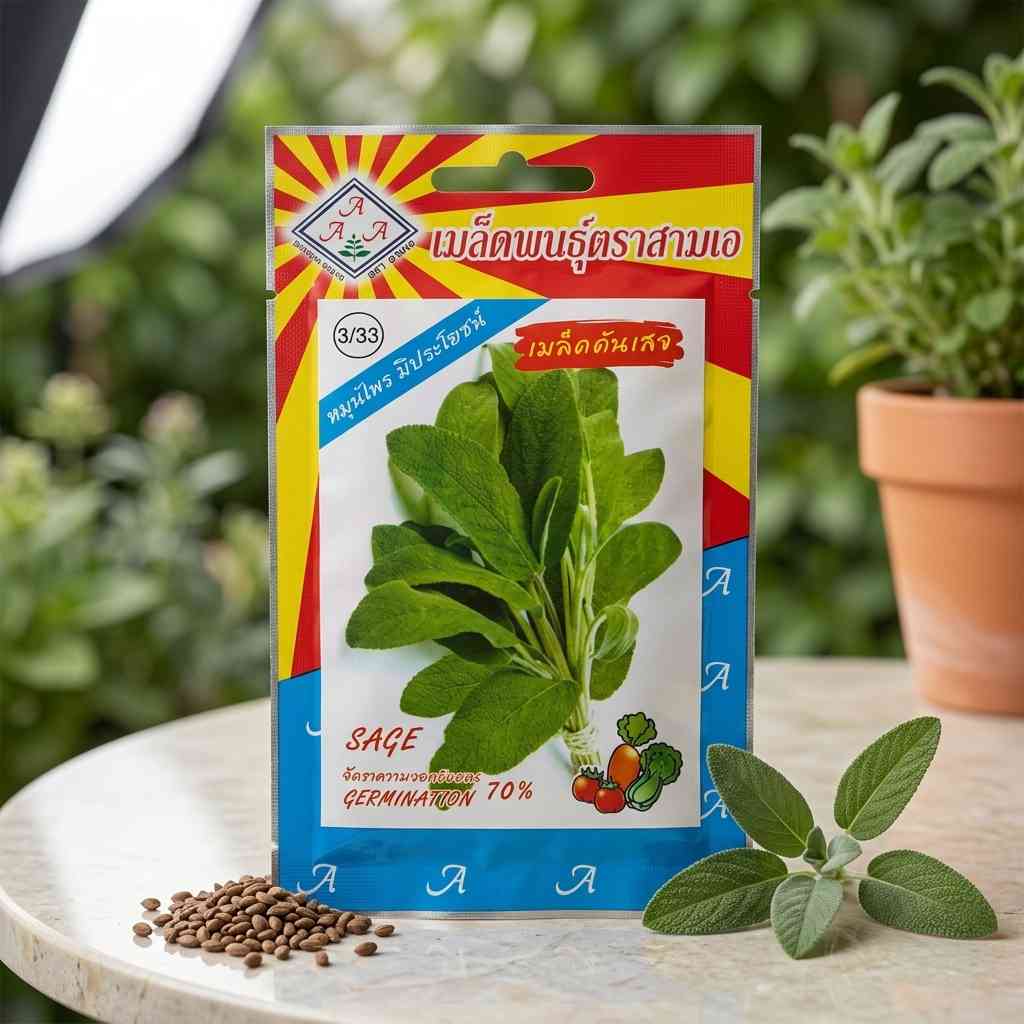

Sage – (40 to 50 seeds) – AAA – Thai
Original price was: ৳ 280.00.৳ 160.00Current price is: ৳ 160.00.
Sorry!
Item out of stock. Contact support for assistance.
Available on backorder
Description
SAGE – Seeds
Price: 160 Taka per packet (sale price)
Quantity: 40 to 50 seeds (approx.)
Brand: AAA (Chua Yong Seed Co., Ltd)
Country: Thailand
Germination Rate (approx.): 70%
Physical Purity (Min): 90%
Genetic Purity (Min): 98%
| Temperature | Practical assessment |
|---|---|
| 15–18°C | Germination may be slower |
| 20–25°C | Preferred range for seed starting |
| 25°C | Supported by a published germination study as particularly suitable |
| 26–30°C | Can work, but performance depends on seed lot and moisture |
| Above 30°C | Avoid prolonged exposure; use a cooler, shaded seed-starting area |
For Bangladesh, aim for a seed-tray temperature of approximately 22–25°C. During hotter months, sow indoors in a bright, ventilated place rather than allowing trays to overheat on a rooftop.
Germination time
-
Expected: 7–21 days under favourable conditions.
-
Allow up to 28 days before declaring a seed lot unsuccessful.
-
Use fresh, reputable seeds and a clean, fine-textured seed-starting medium.
-
Keep the medium consistently moist, never saturated.
Height, spacing, sowing depth and support
| Requirement | Recommendation |
|---|---|
| Mature height | 12–36 inches |
| Mature spread | 12–36 inches |
| Seed sowing depth | Surface sow or cover with only ⅛ inch (about 3 mm) of fine medium |
| Plant spacing | 18–24 inches between plants |
| Row spacing | 24–30 inches for field cultivation |
| Physical support | Not normally required |
Seedling tip: Sage seeds benefit from light during germination. Press them gently against the moist surface and cover only very lightly. Keep the tray bright but out of direct, scorching midday sunlight.
Support is unnecessary for a healthy plant. If a tall flower stalk leans, use a small bamboo stake and soft plant tie.
Time from seed to harvest and flowering
| Milestone | Approximate time |
|---|---|
| First light leaf harvest | 75–100 days |
| More substantial leaf harvest | 4–6 months, depending on growth |
| First flowering | Approximately 4–8 months under favourable conditions; sometimes the following growing season |
| Well-established productive plant | Usually from its second year |
These are planning estimates for Bangladesh, not fixed maturity dates. Heat stress, cultivar, sunlight and root health can delay establishment. Sage is primarily a leaf crop, and harvesting before flowering can be useful when the aim is aromatic foliage. Commercial production references also report stronger yields after the first year.
Recommended container size
For rooftop gardening, we recommend a container that is wider than it is tall.
| Plant stage | Recommended container |
|---|---|
| Germination | Seed tray or 3–4 inch nursery pot |
| Young seedling | 5–6 inch pot |
| Established plant | 12–14 inch diameter × 10–12 inch deep |
| Long-term, vigorous plant | 14–16 inch diameter × 12–14 inch deep |
| Multiple plants in a raised bed | 18–24 inches between plants |
Use one mature sage plant per 12–14 inch pot. The 12-inch option is a practical starting size, while a 14-inch pot gives more room for roots and provides a useful buffer against rapid drying.
Ensure that the container has several unobstructed drainage holes. Avoid a permanently water-filled saucer.
Soil type and pH
Sage performs best in well-drained sandy loam or gritty loam, rather than heavy, water-retaining clay.
Recommended characteristics:
-
pH: 6.0–7.5; a range approaching 8 can be tolerated by some plants.
-
Texture: loose, granular and well aerated.
-
Organic matter: moderate, not excessively rich.
-
Drainage: water should pass through the pot freely.
-
Salinity: low; avoid concentrated fertilizer solutions and salty irrigation water.
-
Root environment: moist after watering but able to re-aerate rapidly.
In Dhaka’s humid climate, the biggest soil-related risk is prolonged root-zone wetness, especially during the monsoon. A high proportion of fine compost or coir dust can hold too much water unless balanced with coarse, stable materials.
Sunlight and germination light
| Stage | Light recommendation |
|---|---|
| Seed germination | Bright indirect light; do not bury deeply |
| Seedling establishment | About 4–6 hours of gentle sunlight, gradually increasing |
| Mature plant | 6–8 hours of direct sunlight when temperatures allow |
| Hot rooftop in April–June | Prefer morning sun and some protection from harsh afternoon heat |
| Rainy season | Maximise light and airflow; shelter from prolonged rain |
Sage needs enough light to maintain compact growth and strong aroma. Excessive shade can produce weak, elongated shoots and less satisfactory leaf production.
Water requirement by plant size
There is no universal litre-per-plant prescription for sage. Water use depends on pot volume, temperature, wind, rainfall, plant size and the moisture-retention characteristics of the mix.
The following are starting estimates for a 12–14 inch container, not mandatory daily quotas.
| Plant stage | Approx. water per watering | Typical interval in dry weather |
|---|---|---|
| Newly germinated seedlings | 20–60 mL, applied gently | Check daily; mist or lightly water as needed |
| Small plant, under 6 inches | 100–250 mL | Every 2–4 days |
| Established plant, 6–12 inches | 250–500 mL | Every 2–4 days |
| Mature plant, 12–24 inches | 400–800 mL | Every 2–4 days |
| Large plant, 24–36 inches | 500–1,000 mL | Every 2–4 days; adjust to root-zone dryness |
These amounts may need to be increased or decreased substantially. During hot, windy weather, a container may dry sooner; during rainy weather, it may need no additional watering for several days.
The better method is to check the soil, not follow the calendar blindly.
-
Insert a finger about 1 inch into the medium.
-
If the surface layer is dry, check slightly deeper.
-
Water when the upper 1–2 inches have dried and the root zone is no longer wet.
-
Water slowly until a little drains from the bottom.
-
Empty the saucer and ensure the drainage holes are clear.
For Bangladesh’s monsoon, move containers beneath a transparent rain shelter or covered rooftop section where possible. Frequent light watering of already wet soil is more dangerous than a brief, controlled drying of the upper layer.
Nutrients and fertiliser programme
Essential nutrients and organic sources
Plants need several essential nutrients, but there is no single scientifically established NPK percentage that is ideal for every sage plant. Nutrient demand depends on growth rate, substrate, harvesting frequency and existing fertility.
The percentages below describe approximate nutrient composition of common fertiliser materials, not the percentages that sage itself requires. Actual composition varies by supplier and processing.
| Nutrient | Role in sage | Potential organic source |
|---|---|---|
| Nitrogen (N) | Leaf and shoot growth | Vermicompost, cow-dung compost, mustard cake, horn meal |
| Phosphorus (P) | Root development and flowering | Bone meal, vermicompost, compost |
| Potassium (K) | Water regulation, stress tolerance and overall growth | Compost; some mustard cakes and plant-derived amendments |
| Calcium (Ca) | Cell walls and growing points | Oyster shell powder, compost |
| Magnesium (Mg) | Central component of chlorophyll | Small amounts of Epsom salt if deficient |
| Sulphur (S) | Protein synthesis and enzyme function | Mustard cake, Epsom salt |
| Iron (Fe) | Chlorophyll formation and enzyme function | Compost and available micronutrients in the medium |
| Manganese (Mn) | Photosynthesis and enzyme function | Compost and trace mineral sources |
| Zinc (Zn) | Enzyme activity and growth regulation | Compost and trace mineral sources |
| Boron (B), copper (Cu), molybdenum (Mo), chlorine (Cl), nickel (Ni) | Essential in small quantities | Normally supplied in traces by a balanced growing medium |
A useful nutritional target: use a mild, balanced supply rather than trying to make the soil extremely rich. Sage is an aromatic Mediterranean herb and can become overly lush, less compact or less aromatic when excessively fertilised with nitrogen.
Organic fertiliser blend for one mature plant
For the recommended 12–14 inch container, prepare the following blend for incorporation into the growing medium. Amounts are per plant, per potting cycle, not a monthly dose.
Organic amendment blend
For one 12–14 inch container · Approximately 500 g total
- Vermicompost: 200 g
- Trichocompost: 125 g
- Cow-dung compost: 100 g
- Neem cake powder: 25 g
- Bone meal: 20 g
- Horn meal: 10 g
- Mustard cake powder: 10 g
- Oyster shell powder: 10 g
Total: 500 g
Epsom salt: Add it only if a magnesium deficiency is suspected and preferably confirmed.
How to apply
-
At initial potting, mix the composts and other amendments thoroughly into the potting medium. Do not place concentrated meals against bare roots.
-
For an established plant, begin with a much smaller top-dressing: approximately 100–150 g of the compost portion, distributed over the soil surface and kept away from the woody stem.
-
Reassess plant growth before feeding again. A modest top-dressing every 8–12 weeks during active growth is a reasonable starting schedule if the plant is producing frequent harvests.
-
Do not repeatedly apply the entire 500 g blend every 8–12 weeks. That would accumulate phosphorus, salts and slowly released nutrients.
-
Use only fully matured, clean composts. Avoid raw manure and incompletely decomposed mustard or neem cake in an edible-herb container.
The blend is a conservative starting formulation, not a laboratory-validated recipe for every product sold in Bangladesh. Organic materials can vary widely in nutrient content. In particular, horn meal and bone meal release nutrients gradually, while oyster shell powder may raise pH. Excessively alkaline soil can make iron and other micronutrients less available.
Chemical fertiliser requirements
Chemical fertiliser is optional when the potting mix is reasonably fertile. If the plant is growing slowly despite adequate light, correct watering and healthy roots, a low-dose complete fertiliser can be useful.
| Plant stage | Suggested approach |
|---|---|
| Seedling | Do not fertilise until true leaves appear; then use a complete soluble fertiliser at ¼ of the label rate if necessary |
| Young plant | A balanced NPK such as 10-10-10 or 19-19-19 at approximately ¼ label strength |
| Established plant | Apply a dilute complete fertiliser about every 4–6 weeks during active growth only if needed |
| Monsoon or stressed plant | Reduce or suspend feeding until roots are healthy and active growth resumes |
For a soluble fertiliser, follow the manufacturer’s dilution rate rather than using a generic gram-per-pot figure. Products differ in formulation, salt concentration and label directions. Apply to already moist soil, never to a severely dehydrated root ball.
Avoid excessive nitrogen and frequent high-strength feeding. For a small culinary sage plant, an overfed, soft plant is not necessarily a better plant.
Rooftop potting mix for Bangladesh
For Dhaka’s heat, humidity and heavy monsoon rain, the mix should prioritise rapid drainage, root aeration, moderate fertility and enough moisture retention to avoid constant watering.
The following blend used are measured in percentage by volume, not by weight; this is more useful for mixing substrates because compost, sand, coir and stones have very different bulk densities.
Reccomended Rooftop Mix
100 L finished mix · Scale up or down proportionally
- Loamy soil 25%
- Cinder, clean and stable 20%
- Coconut coir dust 15%
- Mature vermicompost 15%
- Trichocompost 10%
- Coconut husk, medium-sized 10%
- Brown river sand, coarse and washed 5%
Total 100%
How to mix it?
-
Sieve the loamy soil to remove debris and large clods.
-
Wash the coarse river sand and allow it to drain.
-
Pre-moisten the coir dust and allow excess water to drain.
-
Combine all components thoroughly.
-
Check the mixture by wetting a handful: it should hold together lightly when squeezed but break apart easily and should not remain muddy.
-
Check pH if possible; aim for approximately 6.0–7.5.
-
Fill the container without compressing the mix excessively.
This is a practical starting formulation, not a scientifically established “perfect” mixture. Test it in a small batch first, because local loam, cinder and compost properties can differ substantially.
Companion plants
- Rosemary (Salvia rosmarinus): Similar preference for sunlight and free-draining soil. Give each plant its own pot where possible.
- Thyme (Thymus vulgaris): Shares the preference for a relatively dry root zone and sunny conditions.
- Oregano (Origanum vulgare): A compatible culinary herb when drainage and sunlight are adequate.
- Lavender (Lavandula angustifolia): Has broadly similar sun and drainage preferences, although it may be challenging in Bangladesh’s humid climate.
Note: These are plants with broadly compatible growing conditions, not proof that interplanting them increases sage yield. For rooftop cultivation, separate pots are usually easier to manage than a mixed planter.
Fruit taste
Not applicable. Culinary sage is grown for its leaves, not its fruit.
The plant produces small dry fruits that split into four seed-like nutlets. These are not a culinary fruit crop.
Leaf taste
Leaf flavour rating 8/10
Subjective culinary rating, not a scientific measurement.
Sage has an intense, earthy, resinous, slightly peppery and somewhat bitter flavour. Its aroma is often described as warm and savoury. It is generally better used in small quantities, especially when freshly harvested.
Pests and management
Sage usually has relatively few serious pest problems, but warm, humid weather and crowded plants can increase pest pressure.
| Pest | Signs | Management |
|---|---|---|
| Aphids | Clusters on tender shoots; sticky honeydew | Wash off with water; use insecticidal soap labelled for edible herbs if needed |
| Whiteflies | Small white insects on leaf undersides; yellowing | Yellow sticky cards, removal of heavily infested leaves, insecticidal soap |
| Spider mites | Fine stippling, bronzing or webbing | Improve monitoring and airflow; rinse leaf undersides; use a labelled miticide only if necessary |
| Leafhoppers | Speckled leaves and small jumping insects | Remove weeds, use insect-proof mesh where practical, monitor leaf undersides |
| Mealybugs | White waxy clusters on stems | Remove by hand or use labelled insecticidal soap |
| Slugs and snails | Irregular holes and damaged young growth | Hand-pick at night, remove hiding places and keep the growing area tidy |
| Root-knot nematodes | Stunting and root galls | Use clean growing medium, clean containers and healthy planting material |
Chemical options: insecticidal soaps containing potassium salts of fatty acids can help with soft-bodied pests. Neem-based products may also be useful if registered and labelled for the intended crop and pest. More specialised products, including abamectin-based miticides, should be considered only when appropriate for the identified pest and permitted for edible herbs.
Always follow the local product label, pre-harvest interval and protective-equipment requirements. Do not spray an unlabelled pesticide on leaves intended for consumption. A pesticide that controls one pest may not control another.
Diseases and treatment
| Disease or disorder | Common symptoms | Management and possible treatment |
|---|---|---|
| Root rot, often associated with Pythium or Phytophthora | Wilting despite wet soil; brown, damaged roots | Improve drainage, remove affected plants and replace contaminated medium. A labelled oomycete-targeting fungicide may be appropriate after diagnosis |
| Powdery mildew | White powdery patches on leaves | Increase airflow, remove affected leaves and avoid overcrowding. Use a labelled potassium bicarbonate product if necessary |
| Downy mildew | Yellow or angular leaf lesions; growth may appear on leaf undersides | Reduce leaf wetness, improve ventilation and remove infected material. A suitable labelled fungicide may be needed |
| Leaf spot | Brown or black spots, sometimes with yellow margins | Remove affected foliage, avoid overhead watering and use clean tools |
| Botrytis grey mould | Grey fuzzy growth on damaged tissue | Improve airflow, remove dead material and avoid persistent humidity |
| Rust | Rust-coloured pustules or spots | Remove infected leaves and avoid wet foliage; diagnose before selecting a fungicide |
Chemical treatment should be based on correct diagnosis. Depending on the pathogen and local registration, products containing copper compounds or specific fungicidal active ingredients may have a role in some foliar diseases. They are not universal cures; copper products can injure foliage and may accumulate in the environment.
For rooftop sage in Bangladesh, prevention is the first-line treatment: use a rain shelter, free-draining mix, adequate plant spacing, clean tools and careful watering. These measures address many of the conditions that favour disease.
How to identify maturity and harvest readiness
Sage has no edible fruit to assess for maturity. Harvest the leaves when:
-
The plant is well established and producing several healthy shoots.
-
The leaves have developed their characteristic grey-green colour and strong aroma.
-
Stems are sufficiently developed to tolerate light pruning.
-
There is enough foliage left to maintain continued growth.
Harvest in the morning after surface moisture has dried. Use clean scissors and take only a portion of the plant at a time; as a general rule, avoid removing more than about one-third of the leafy growth in a single harvest.
For the strongest aroma, harvest healthy foliage before or around flowering. Commercial sage references also describe cutting leafy shoots shortly before flowering.
Monthly yield required for a family of four
Sage is a seasoning herb, not a bulk vegetable in most Bangladeshi cuisines. Its requirements depend on how often the family cooks recipes that use it.
| Household usage | Fresh sage leaves per month |
|---|---|
| Occasional use, 1–2 recipes weekly | 20–50 g |
| Regular use, 3–4 recipes weekly | 50–100 g |
| Frequent use or drying for storage | 100–200 g |
These are suggested household planning quantities, not measured dietary requirements. Sage is potent, so a few leaves may flavour an entire dish.
Growing target: aim for around 50–100 g of fresh leaves monthly once a healthy plant is established. One mature plant may or may not meet that target consistently in Bangladesh; maintaining two or three plants provides a useful buffer.
Average yield per square foot
There is no reliable universal yield figure for a single rooftop sage plant in Bangladesh. Published commercial yields are usually reported as dried leaves per hectare, and results depend on climate, cultivar, plant density and harvest schedule.
One production reference reports approximately 1.2–2 tonnes of dried leaves per hectare in the second and third years under certain production conditions, with some reports reaching higher yields.
For practical rooftop planning, consider the following provisional planning range, not a published Bangladesh field average:
| Yield measure | Planning estimate |
|---|---|
| Fresh harvest from an established container plant | Approximately 0.2–0.6 kg per year |
| Annual fresh-leaf yield per occupied square foot, including plant spacing | Approximately 0.1–0.3 kg |
| Approximate dried-leaf equivalent | Often around 20–30% of fresh weight, depending on moisture and drying method |
These estimates are for preliminary planning and should be validated against actual harvest records. Do not use them as a guaranteed commercial yield.
Average lifespan
Common sage is a perennial, semi-woody subshrub. It can survive for several years, but its productive life depends strongly on drainage, pruning and disease pressure.
-
Typical useful garden life: approximately 3–5 years.
-
Longer survival is possible in favourable conditions.
-
In hot, humid, rain-exposed rooftops, plants may decline sooner because of root rot, woody growth or repeated heat stress.
Replace plants when the centre becomes excessively woody, new growth declines despite proper care, or disease repeatedly returns.
Nutritional values
Fresh sage leaves contain aromatic essential oils, dietary fibre, vitamins, minerals and plant polyphenols. However, the amount consumed as a seasoning is usually small, so the contribution to a person’s daily nutrient requirements is limited.
The following are approximate values for 100 g of fresh sage leaves. Actual values vary with variety, growing conditions and moisture content.
| Nutrient | Approximate amount |
|---|---|
| Energy | 70 kcal |
| Protein | 3.3 g |
| Carbohydrates | 12.0 g |
| Dietary fibre | 7.0 g |
| Fat | 2.5 g |
| Calcium | 165 mg |
| Iron | 4.7 mg |
| Magnesium | 70 mg |
| Potassium | 1,070 mg |
| Vitamin C | 32 mg |
| Vitamin A | 590 µg RAE, approximately |
| Vitamin K | 170 µg, approximately |
These figures are reference estimates, not a laboratory analysis of a specific seed variety. Fresh and dried sage have very different nutrient concentrations per 100 g because dried leaves contain much less water. For nutrition calculations, consult USDA FoodData Central and select the correct fresh or dried entry.
Health benefits
1. Provides antioxidant compounds
Sage contains polyphenols and other compounds that demonstrate antioxidant activity in laboratory studies. This does not mean that eating sage prevents a particular disease.
2. Being studied for cognitive effects
Some small human studies have investigated sage extracts and aspects of memory or cognition. The evidence is preliminary and does not establish sage as a treatment for dementia.
A small quantity can provide a strong savoury flavour without adding much energy, helping diversify home cooking.
4. Contains compounds with antimicrobial activity in laboratory studies
Sage extracts and essential-oil components have shown antimicrobial effects under experimental conditions. This does not make sage a substitute for antibiotics or food-safety measures.
5. Contributes micronutrients
Sage provides vitamin K, calcium, iron and other nutrients, although typical seasoning portions contribute far less than a 100 g serving.
Safety: Culinary quantities of sage are generally different from concentrated sage extracts or essential oils. Some sage essential oils contain thujone, which can be toxic at sufficiently high exposures. Avoid ingesting concentrated essential oil or using medicinal doses without professional advice. Sage should not be presented as a proven treatment for diabetes, infection, memory disorders or other diseases.
Rcipes using sage
1. Bangladeshi-style sage chicken bhuna
Use chicken, onion, ginger, garlic, turmeric, cumin, coriander, chilli and a small amount of chopped sage. Fry the spices and onions, add the chicken, and cook until tender. Add sage near the end so its aroma remains noticeable without overpowering the traditional spices.
2. Pumpkin bhaji with sage
Sauté pumpkin cubes with onion, green chilli, garlic and a little turmeric. Add one or two finely chopped sage leaves, cover and cook until tender. The earthy flavour of sage complements the sweetness of pumpkin.
3. Italian brown butter and sage pasta
Melt butter over medium heat and cook fresh sage leaves until fragrant. Toss with cooked pasta, black pepper, a little pasta water and Parmesan cheese. Serve immediately.
4. Garlic, lemon and sage roasted chicken
Rub chicken with garlic, lemon zest, black pepper, olive oil and chopped sage. Roast until the chicken reaches a safe internal temperature of 74°C in the thickest part. Rest before serving.
These are suggested recipe adaptations. The first two are Bangladeshi-inspired combinations rather than established traditional Bangladeshi dishes.
Best month for sowing in Bangladesh
Recommended starting window
November–February
For Dhaka rooftops, start with November to January as the main trial window, extending into February if seed trays can be kept cool enough.
Sage is adapted to Mediterranean conditions, not Bangladesh’s hot, humid monsoon. The goal is to establish a healthy plant during the cooler, relatively drier months.
| Month | Recommendation |
|---|---|
| November | Excellent trial period for seed starting |
| December | Suitable; protect seedlings from cool drafts and overwatering |
| January | Suitable for seed starting and transplant establishment |
| February | Good, but rising temperatures require closer moisture management |
| March | Possible under controlled, ventilated conditions |
| April–May | Higher heat stress; avoid overheated trays |
| June–September | Generally unfavourable for exposed outdoor seed starting because of heavy rain and humidity |
| October | Potential second window, preferably under a rain shelter |
About the two-year weather requirement: Bangladesh Meteorological Department climate resources provide rainfall, humidity and temperature records, but a national climate summary is not the same as a day-by-day analysis of the last two years. I have not verified every daily observation for October 2024–October 2026, so I would not claim that the calendar above is a statistical result of those two years. It is a horticultural recommendation based on the country’s seasonal climate and sage’s growing requirements. See the official Bangladesh Meteorological Department climate portal and the Dhaka monthly climate normals.
Average number of seeds per gram
A published germination study reported a 1,000-seed weight of 8.03 g for Salvia officinalis.
Using that measured seed weight:
Estimated seed count: approximately 125 seeds per gram.
This is a calculated estimate from one study, not a universal seed count. Seed size, cultivar, maturity, cleaning and supplier seed lots can change the result. For commercial packaging, weigh and count a sample from the actual lot before stating a guaranteed seed count.
Best propagation method
Method A — Seed propagation
Best for starting multiple plants at low cost.
-
Sow on a clean, lightly moist seed-starting medium.
-
Cover very lightly, approximately 3 mm.
-
Maintain about 20–25°C and bright light.
-
Keep the medium moist, not saturated.
-
Transplant when seedlings have several true leaves and are sturdy enough to handle.
Often preferable when the parent plant has desirable flavour, leaf colour or growth habit.
-
Take healthy, non-flowering shoots.
-
Remove leaves from the lower section.
-
Place in a clean, airy rooting medium.
-
Keep in bright indirect light with moderate humidity and ventilation.
-
Pot up after roots have developed.
Best storage methods for sage leaves
Sage is harvested for its leaves, so these are the most useful storage options.
| Method | Procedure | Approximate storage time |
|---|---|---|
| Fresh in refrigerator | Wrap unwashed leaves loosely in a dry paper towel and place in a breathable bag or container | Around 1–2 weeks, depending on condition |
| Refrigerated stems | Place stem ends in a small amount of water and cover loosely; monitor for decay | Several days to about a week |
| Air-drying | Tie small bunches or spread leaves in a shaded, dry, well-ventilated area | Until fully dry; drying time varies |
| Dehydrator | Dry at a low temperature according to the appliance instructions | Often several hours |
| Airtight dry storage | Store fully dried leaves in a clean, dry, airtight container away from heat and sunlight | Best quality commonly within 6–12 months |
| Freezing | Wash if needed, dry thoroughly and freeze whole leaves or chopped leaves in a suitable container | Several months; quality varies |
In Bangladesh, high humidity makes air-drying more difficult. Use a clean dehydrator or another controlled drying method if leaves are not drying quickly. Do not seal leaves while damp, because trapped moisture encourages mould.
For the strongest aroma, store whole dried leaves and crumble them only when cooking. Discard leaves with mould, unusual odours or signs of spoilage.
Few specialties of sage
1. Distinctive aromatic foliage
Its textured, grey-green leaves contain aromatic compounds that give it a strong, recognisable savoury flavour.
2. Culinary and ornamental value
It can be harvested as a seasoning herb while also producing attractive blue-violet flowers that can attract pollinators.
3. Drought tolerance
Once established in a well-drained root zone, sage can tolerate relatively dry conditions better than many leafy culinary herbs.
Fun quotes about sage
“A handful of sage can turn an ordinary harvest into a fragrant memory.”
“Grow sage where the morning sun falls, and let every leaf remind you that flavour begins in the garden.”
Few lesser-known facts
1. The name has a healing-related linguistic origin. The genus name Salvia is linked to the Latin salvare, meaning to save or heal. The name reflects historical beliefs and traditional uses, not proof that the plant cures illness.
2. Sage belongs to an exceptionally diverse genus. Salvia contains roughly 1,000 species, including plants grown for culinary use, ornamental flowers and other purposes. Not every plant called “sage” is suitable for eating.
3. The flowers have a specialised pollination mechanism. In many Salvia species, the stamens are positioned so that visiting bees trigger pollen transfer as they enter the flower.
Common culinary sage is native to parts of southern Europe and the northern Mediterranean region, especially the western Balkans and areas extending into Italy and neighbouring countries. Kew’s Plants of the World Online lists its accepted native range as southwestern Germany to southern Europe, with specific native-country records across parts of the Mediterranean and Balkan region.
Origin story
Sage was not invented or created by a modern breeder. It is a naturally occurring plant that people gradually adopted for culinary, ornamental and traditional medicinal use.
-
Its roots lie in the Mediterranean and Balkan region.
-
Historical Mediterranean cultures valued sage as an aromatic and traditional medicinal herb.
-
It spread through cultivation across Europe and later to other regions.
- Carl Linnaeus formally described the species as Salvia officinalis in Species Plantarum, published in 1753.
The species name officinalis is associated with the historical use of plants in herbal shops or pharmacies. There is no single known founder of culinary sage cultivation.
Scientific classification
| Classification | Name |
|---|---|
| Kingdom | Plantae |
| Order | Lamiales |
| Family | Lamiaceae |
| Genus | Salvia |
| Species | Salvia officinalis L. |
| Common name | Common sage, garden sage, culinary sage |
| Life form | Evergreen or semi-evergreen perennial subshrub |
Info sources
1. Kew Science — Plants of the World Online: Salvia officinalis
2. Royal Botanic Gardens, Kew — Garden sage
3. PROSEA / Pl@ntUse — Salvia officinalis
4. American Herbal Products Association — Herbs in History: Sage
6. Royal Horticultural Society — How to Grow Sage
7. Royal Horticultural Society — How to Grow Salvias
8. University of Delaware Cooperative Extension — Sage
9. North Carolina State Extension — Common Sage
10. Iowa State University Extension — All About Sage
11. Clemson Cooperative Extension — Sage: The Wisest Herb
12. University of Florida IFAS Extension — Sage
13. PubMed — Study on characteristics of seed germination of Salvia officinalis
14. ScienceDirect — Salvia officinalis overview
15. ScienceDirect — Economic botany of Salvia officinalis, with emphasis on essential oil
16. North Carolina State Extension — Salvia genus and common problems
17. Bangladesh Meteorological Department — Climate data
18. Bangladesh Meteorological Department — Normal monthly rainfall
19. Japan Meteorological Agency — Dhaka monthly climate normals
Research limitations: The strongest evidence available here concerns the plant’s identity, general cultivation, seed germination and commercial dried-leaf production. Exact irrigation volumes, the proposed organic amendment blend, monthly household yield and the rooftop yield-per-square-foot estimates are practical recommendations or planning estimates, not Bangladesh-specific controlled trial results. Seed counts and nutritional values also vary by source and sample.
Disclaimer: In accordance with the universal custom of seed trade we give no warranty expressed or implied as to description, quality, productivity or any other matter of any way for the crop results beyond the purchased price especially under unsuitable season, abnormal weather, unsuitable soil and other unexpected conditions
বীজ ব্যবসার সার্বজনীন প্রথা অনুযায়ী আমরা বিশেষত অনুপযুক্ত ঋতুতে, বিশেষত অনিয়মিত আবহাওয়া, অনুপযুক্ত মাটি এবং অন্যান্য ক্রয়মূল্যের বাইরে ফসলের ফলনের বর্ণনা, গুণমান, উৎপাদনশীলতা বা অন্য যে কোনও বিষয়ে বর্ণিত ওয়ারেন্টি প্রদান করি না। অপ্রত্যাশিত শর্ত
#130T #sage #thailand #thai #AAA #Chua #Yong #MyGardenBd #MyGarden #herb #Herbs #online #shop #store #office #near #me #Price #in #Dhaka #Bangladesh #Garden #HomeGrown #RooftopGarden #Green #Healthy #Benefits #Seeds #garden.com.bd #gardenbd #Bonayon #Bonayon.com #Gardeniac #RecallGreen #BrikkhoBazar.com #BrikkhoBazar #BDGardenersLtd #Gardeners #GardenFreshBangladesh #আমার #সাঁজঘর #BrandSeed #Edenic #ecogrower #SeedsBD #GardeningEssentials-BD #Khatighor #Nagarkrishi #নগরকৃষি
#Sage #CommonSage #GardenSage #CulinarySage #SalviaOfficinalis #Salvia #SagePlant #SageLeaves #FreshSage #SageHerb #AromaticHerbs #CulinaryHerbs #HerbGarden #HerbGardening #GrowYourOwnHerbs #SageSeeds #SageSeedlings #SagePropagation #SageCuttings #SeedGermination #SeedStarting #PlantPropagation #GrowingSage #OrganicGardening #HomeGardening #ContainerGardening #RooftopGardening #UrbanGardening #BalconyGarden #KitchenGarden #PottingMix #WellDrainedSoil #OrganicCompost #Vermicompost #Trichocompost #SoilHealth #PlantNutrition #HerbCare #GardenTips #GardeningTips #SustainableGardening #GardeningEducation #PlantCare #GardenHarvest #GrowFoodAtHome #FreshHerbs #HerbRecipes #SageRecipes #HomeCooking #ItalianHerbs #MediterraneanHerbs #FarmToTable #GardenToKitchen #EdibleGarden #EdiblePlants #CulinaryGarden #HerbHarvest #DriedHerbs #HerbSeasoning #GardenFresh #BangladeshGardening #DhakaGardening #BangladeshRooftopGarden #RooftopGardenBD #GardeningBangladesh #UrbanFarmingBD #GardeningBD #MyGardenBd #MyGardenBDPlants #MyGardenBDSeeds #PlantLoversBD #GardenLoversBD #BangladeshGardeners #DhakaRooftopGarden #GrowInBangladesh
#সেজ #সেজগাছ #সেজপাতা #সেজচারা #সেজবীজ #ভেষজগাছ #ভেষজউদ্ভিদ #সুগন্ধিগাছ #সুগন্ধিপাতা #রান্নারভেষজ #ভেষজবাগান #ঔষধিগাছ #পাতাবাহার #খাদ্যউপযোগীগাছ #ছাদবাগান #ছাদেবাগান #বাড়িরবাগান #বারান্দাবাগান #শখেরবাগান #বাগানকরুন #বাগানপ্রেমী #গাছপ্রেমী #গাছলাগান #গাছেরযত্ন #বীজথেকেগাছ #বীজবপন #চারাতৈরি #টবেবাগান #জৈববাগান #টবেরমাটি #মাটিতৈরি #জৈবসার #ভার্মিকম্পোস্ট #কম্পোস্টসার #গাছেরসার #মাটিরউর্বরতা #গাছেরপরিচর্যা #গাছেরখাবার #জৈবচাষ #পরিবেশবান্ধবচাষ #বাগানপরামর্শ #চাষাবাদ #কৃষিপ্রযুক্তি #সবুজবাংলাদেশ #বাংলাদেশেরবাগান #ঢাকাছাদবাগান #বাংলাদেশেরছাদবাগান #ছাদকৃষি #নগরকৃষি #শহুরেবাগান #বাংলাদেশকৃষি #বাগানপ্রেমীবাংলাদেশ #গাছেরদোকান #বাগানেরসামগ্রী #মাইজার্ডেনবিডি #মাইগার্ডেনবিডি #MyGardenBd
Only logged in customers who have purchased this product may leave a review.
Related products
-

-


-

-
Sale!

-Rock Melon Madhurima F1 Hybrid – 10 Seeds – MGS1134
Original price was: ৳ 130.00.৳ 50.00Current price is: ৳ 50.00.
Reviews
There are no reviews yet.