
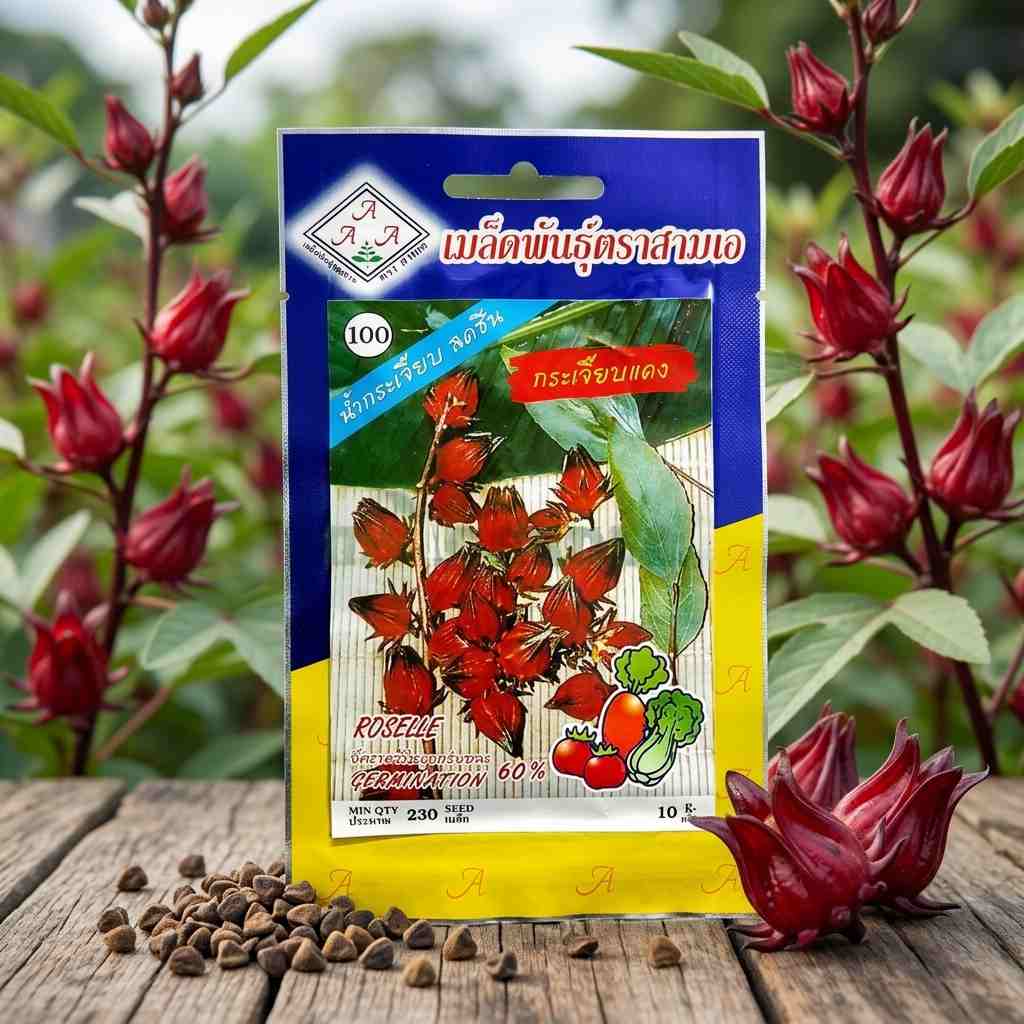

Roselle – 230 seeds – AAA – Thai
Original price was: ৳ 280.00.৳ 160.00Current price is: ৳ 160.00.
Available on backorder
Description
ROSELLE – seeds
Price: 160 Taka per packet (sale price)
Quantity: 230 seeds
Brand: AAA (Chua Yong Seed Company Ltd)
Country: Thailand
Germination Rate (Approx.): 60%
Physical Purity (Min): 98%
Genetic Purity (Min): 98%
Roselle is an excellent multipurpose crop for Bangladeshi rooftop gardens. It produces attractive red fleshy calyces (commonly used to make herbal drinks, jams and preserves), edible sour leaves, and seeds containing valuable vegetable oil.
It is particularly interesting for Bangladesh because it is already cultivated in South Asia, including Bangladesh, and tolerates tropical temperatures and humidity.
One important distinction before starting: the fleshy red part commonly called the roselle fruit is actually the enlarged fleshy calyx surrounding the true seed capsule. The botanical fruit is the capsule inside it. This distinction matters when determining harvest maturity and yield.
Botanical classification:
-
Scientific name: Hibiscus sabdariffa L.
-
Family: Malvaceae
-
Bengali names: মেস্তা শাক, টক শাক, রোসেল; also known regionally by other names.
-
English names: Roselle, Red Sorrel, Jamaican Sorrel, Florida Cranberry.
-
Plant type: Tropical annual shrub.
Important research note: Recommendations below distinguish between published field research, general horticultural guidance and practical rooftop-growing estimates. In particular, the Bangladesh Agricultural University spacing experiment is especially useful because it evaluates roselle under local subtropical conditions. Field yields should not be interpreted as guaranteed rooftop yields.
Germination requirements
| Parameter | Recommended value |
|---|---|
| Optimum germination temperature | 25–30°C |
| Acceptable temperature range | 20–35°C |
| Germination time | 5–10 days |
| Occasionally required | 14 days |
| Seed sowing depth | 0.5–1 inch (1.3–2.5 cm) |
| Germination light | Not essential; indirect light is sufficient |
| Germination medium | Moist, aerated, well-draining medium |
Our recommendation: Maintain approximately 27–30°C during germination. Avoid keeping the seed tray in direct afternoon sunlight.
Rutgers Cooperative Extension reports germination in approximately 5–10 days. The FAO production guide recommends sowing approximately 2.5 cm deep.
Germination procedure
-
Select mature, healthy seeds.
-
Soak seeds in room-temperature water for 8–12 hours (optional).
-
Sow approximately 1–1.5 cm deep in a seedling tray.
-
Maintain consistent moisture without waterlogging.
-
Keep the tray in a warm location.
-
Transplant when seedlings have 3–4 true leaves and are approximately 4–6 weeks old.
Scarification is not normally necessary for fresh, viable seeds, although lightly nicking the seed coat can sometimes help older or hard-coated seeds.
Plant height and growth characteristics
| Characteristic | Expected measurement |
|---|---|
| Average plant height | 4–6 ft |
| Potential height | 6–8 ft |
| Plant spread | 3–5 ft |
| Sowing depth | 0.5–1 inch |
| Growth habit | Upright, bushy and branched |
| Root system | Deep taproot with lateral roots |
A Bangladesh field experiment published in 2026 recorded a maximum plant height of approximately 196.87 cm (6.46 ft) under wider spacing.
For rooftop cultivation, regular harvesting of young shoots can encourage branching and a bushier plant.
Plant spacing and row spacing
For commercial field production, spacing depends on the variety and whether the crop is grown primarily for leaves, calyces or fibre.
| Cultivation purpose | Plant spacing | Row spacing |
|---|---|---|
| Leaf production | 12–18 inches | 18–24 inches |
| Calyx production | 24 inches | 24–36 inches |
| Larger individual plants | 24–36 inches | 30–36 inches |
Bangladesh research recommendation: A 60 × 60 cm (approximately 24 × 24 inches) arrangement produced the highest fresh and dry calyx yields among the seven spacings tested in a Bangladesh subtropical experiment.
For rooftop containers, grow one plant per container.
Trellis and physical support
Trellis requirement: Not necessary.
Roselle develops a strong central stem and branches, so it normally grows without trellising.
However, support is recommended when:
-
The plant grows taller than 5 ft.
-
The rooftop receives strong winds.
-
The plant has heavy branches carrying many calyces.
-
The container is relatively narrow or top-heavy.
Use a 5–6 ft bamboo or fibreglass stake and soft plant ties. Avoid tightly binding the main stem.
Harvesting and flowering timeline
| Growth stage | Approximate time from sowing |
|---|---|
| Germination | 5–10 days |
| Seedling establishment | 20–30 days |
| Vegetative growth | 30–100 days |
| Flower bud development | 90–110 days |
| First flowering | 100–150 days |
| First calyx harvest | 115–170 days |
| Seed capsule maturity | Approximately 150–210+ days |
These figures are approximate and depend heavily on cultivar and photoperiod.
The Bangladesh 2026 spacing study recorded 50% flowering at approximately 115–117 days and 90% maturity at approximately 148–154 days.
An important biological characteristic: Roselle is a short-day plant. Flowering is strongly influenced by day length, and many cultivars flower when daylight becomes shorter. Consequently, sowing date can significantly change flowering and harvest dates.
The PROSEA crop reference reports a flowering duration of approximately 150–210 days for some types, demonstrating why cultivar differences must be considered.
Pot size and container requirements
Roselle develops a substantial taproot and a large branching canopy. Small containers restrict root development, water availability and calyx production.
Recommended container for one mature plant:
- Container diameter 20–24″
- Container depth 18–24″
- Approximate volume 50–70 litres
- Plants per container 1 plant
| Container size | Suitability |
|---|---|
| 10 × 10 inches | Not recommended |
| 12 × 12 inches | Temporary seedling growth |
| 16 × 16 inches | Restricted growth |
| 18 × 18 inches | Acceptable, but not ideal |
| 20 × 20 inches | Good |
| 24 × 24 inches | Excellent |
For maximum production, I recommend a 24-inch-wide, approximately 20–24-inch-deep container.
Rooftop consideration: A 50–70-litre container can become very heavy when wet. Check the roof’s load-bearing capacity, and use drainage holes with feet beneath the pot.
Soil type and ideal pH
Roselle grows well in deep, fertile, well-drained sandy loam and loamy soil.
| Soil parameter | Ideal condition |
|---|---|
| Soil type | Sandy loam / loamy soil |
| Soil texture | Loose, friable |
| Drainage | Excellent |
| Water retention | Moderate |
| Organic matter | 2–4% is a useful target |
| Ideal pH | 5.5–6.8 |
| Preferred pH | 6.0–6.5 |
| Soil salinity | Low |
Avoid:
-
Heavy clay soil with poor drainage.
-
Highly compacted soil.
-
Excessively alkaline soil.
-
Soil that remains saturated for several days.
-
Fresh, incompletely decomposed cow dung.
Rutgers Extension recommends sandy loam to loamy sand with a pH of 5.5–6.8.
Sunlight requirements
| Growth stage | Light requirement |
|---|---|
| Seed germination | Light not essential |
| Seedling | 4–6 hours of indirect/filtered light initially |
| Vegetative growth | 6–8 hours direct sunlight |
| Flowering | 7–9 hours preferred |
| Calyx production | Full sunlight |
Recommendation for Bangladesh: Position the container where it receives at least 6–8 hours of direct sunlight.
Avoid placing the plant in a permanently shaded corner. Insufficient light can result in weak stems, reduced branching and lower calyx production.
Water requirement and watering intervals
Roselle is relatively drought-tolerant once established, but regular watering is important for good vegetative growth and calyx development.
The following quantities are practical starting estimates for a 50–70-litre rooftop container, not fixed physiological water requirements.
| Plant size | Water per application | Approximate interval |
|---|---|---|
| 0–4 inches | 0.1–0.2 L | Every 1–2 days |
| 4–8 inches | 0.2–0.4 L | Every 1–2 days |
| 8–12 inches | 0.4–0.7 L | Every 1–2 days |
| 12–18 inches | 0.7–1.0 L | Every 1–2 days |
| 18–24 inches | 1.0–1.5 L | Every 1–2 days |
| 24–36 inches | 1.5–2.5 L | Every 1–2 days |
| 36–48 inches | 2–3 L | Daily in hot weather |
| Above 48 inches | 2.5–4 L | Daily in hot weather |
Adjustments for Bangladesh
-
March–May: Check moisture daily; watering may be necessary every day.
-
June–September: Reduce watering according to rainfall and drainage.
-
October–November: Water when the upper 1–2 inches of soil becomes dry.
-
December–February: Usually every 2–3 days, depending on temperature and container moisture.
The best practice is to check the soil before watering rather than follow a rigid schedule.
Water thoroughly until a little water drains from the bottom. Never allow the container to remain standing in collected water.
Essential nutrients and organic fertilizer sources
Roselle needs macronutrients, secondary nutrients and micronutrients throughout its life cycle.
The following percentages are practical target ranges for nutrient composition of dry plant biomass, not a guaranteed soil fertilizer prescription. Actual tissue requirements vary with cultivar, plant age and growth stage.
| Nutrient | Indicative concentration in dry biomass | Importance | Organic source |
|---|---|---|---|
| Nitrogen (N) | 2.0–3.5% | Leaf and stem development | Vermicompost, mustard cake |
| Phosphorus (P) | 0.2–0.5% | Root and flower development | Bone meal |
| Potassium (K) | 2.0–3.0% | Flowering, calyx and water regulation | Vermicompost, compost |
| Calcium (Ca) | 1.0–2.0% | Cell-wall strength | Oyster shell powder |
| Magnesium (Mg) | 0.3–0.6% | Chlorophyll formation | Epsom salt |
| Sulphur (S) | 0.2–0.5% | Protein synthesis | Mustard cake, Epsom salt |
| Iron (Fe) | 50–200 ppm | Chlorophyll formation | Compost |
| Zinc (Zn) | 20–50 ppm | Enzyme activity | Compost |
| Manganese (Mn) | 30–100 ppm | Photosynthesis | Compost |
| Boron (B) | 20–50 ppm | Flower development | Mature compost |
| Copper (Cu) | 5–20 ppm | Enzyme activity | Mature compost |
| Molybdenum (Mo) | 0.1–1 ppm | Nitrogen metabolism | Compost |
These are indicative horticultural tissue ranges, not measured Bangladesh roselle-specific deficiency thresholds.
A hydroponic roselle study identified the relative nutrient extraction pattern as N greater than K, followed by Ca, Mg and P. Its measured biomass nutrient concentrations were approximately 2.86% N, 2.80% K, 1.71% Ca, 0.54% Mg and 0.50% P.
Which of your organic fertilizers are most useful?
| Fertilizer | Main contribution |
|---|---|
| Trichocompost | Organic matter, beneficial microbes |
| Vermicompost | N, P, K and micronutrients |
| Cow-dung compost | Organic matter and balanced nutrients |
| Horn meal | Slow-release nitrogen |
| Bone meal | Phosphorus and calcium |
| Neem cake powder | Organic nitrogen and soil-health support |
| Mustard cake powder | Nitrogen, phosphorus and sulphur |
| Oyster shell powder | Calcium and gradual pH buffering |
| Epsom salt | Magnesium and sulphur |
The nutrient composition of these organic materials varies significantly by manufacturer and production method. Use product-label analysis wherever available.
Recommended organic fertilizer blend for one plant
For a single mature roselle plant, I recommend a moderate organic fertilizer programme rather than applying large quantities of all available fertilizers.
A. Initial fertilizer mix
Mix the following into approximately 50–70 litres of potting medium before planting.
| Ingredient | Quantity per plant |
|---|---|
| Trichocompost | 400 g |
| Vermicompost | 700 g |
| Cow-dung compost | 700 g |
| Horn meal | 40 g |
| Bone meal | 100 g |
| Neem cake powder | 100 g |
| Mustard cake powder | 50 g |
| Oyster shell powder | 50 g |
| Epsom salt | 5 g |
| Total | 2,145 g |
Application instructions:
-
Use completely decomposed compost.
-
Mix everything evenly with the potting medium.
-
Do not allow concentrated fertilizer to touch the seed or young roots.
-
Moisten the medium and allow it to settle for 5–7 days before transplanting.
-
Do not add additional lime unless a soil pH test indicates that it is required.
B. Subsequent fertilizer application
| Plant stage | Fertilizer | Quantity |
|---|---|---|
| 30 days after transplanting | Vermicompost | 150 g |
| 30 days after transplanting | Trichocompost | 100 g |
| 45 days after transplanting | Cow-dung compost | 150 g |
| 45 days after transplanting | Neem cake | 20 g |
| 60 days after transplanting | Vermicompost | 150 g |
| 60 days after transplanting | Mustard cake | 15 g |
| 75 days after transplanting | Vermicompost | 150 g |
| 75 days after transplanting | Bone meal | 25 g |
| 90 days after transplanting | Vermicompost | 100 g |
| 90 days after transplanting | Trichocompost | 100 g |
For mustard cake, pre-composted or properly fermented material is preferable to concentrated raw cake. Do not pour concentrated mustard-cake liquid onto the roots.
After the first harvest: Apply 100–150 g vermicompost every 30–45 days if the plant remains healthy and continues producing.
Do not apply Epsom salt routinely. Apply it only when magnesium deficiency is suspected or confirmed. Similarly, oyster shell powder should be used cautiously because excessive calcium can raise the medium’s pH.
Chemical fertilizer requirements
Bangladesh Agricultural Research Council’s Fertilizer Recommendation Guide 2024 includes a specific recommendation for mesta (Hibiscus sabdariffa).
The recommended nutrient dose depends on soil-test interpretation.
| Soil fertility | N (kg/ha) | P (kg/ha) | K (kg/ha) | S (kg/ha) |
|---|---|---|---|---|
| Optimum | 0–27 | 0–4 | 0–20 | 0–6 |
| Medium | 28–54 | 5–8 | 21–40 | 7–12 |
| Low | 55–81 | 9–12 | 41–60 | 13–18 |
| Very low | 82–108 | 13–16 | 61–80 | 19–24 |
Source: Bangladesh Agricultural Research Council, Fertilizer Recommendation Guide 2024, Mesta section.
Practical chemical fertilizer programme for one 24-inch container
For rooftop cultivation, use the following conservative programme if you are not using the full organic blend above.
| Plant age | Fertilizer | Quantity |
|---|---|---|
| 20–25 days after transplanting | NPK 19:19:19 | 1 g |
| 40–45 days | NPK 19:19:19 | 1.5 g |
| 60–65 days | NPK 19:19:19 | 1.5 g |
| 80–85 days | NPK 13:13:21 or similar higher-K formula | 1.5 g |
| Flowering and calyx production | NPK 13:13:21 | 1–1.5 g |
Apply each dose diluted in approximately 1 litre of water, on already moist soil. Follow the product label if it specifies a lower concentration.
Important: This is a conservative container-feeding schedule, not the BARC field fertilizer rate converted directly into pot quantities. Do not use it in addition to the complete organic fertilizer programme without adjusting the total nutrient supply.
Avoid excessive nitrogen during flowering because it can encourage vegetative growth at the expense of reproductive growth.
Ideal potting mix for Bangladesh rooftop gardening
For Bangladesh, the main challenges are:
-
Heavy monsoon rainfall.
-
High humidity.
-
Hot rooftop surfaces.
-
Rapid moisture loss during summer.
-
Root diseases caused by poor drainage.
-
Compaction of organic growing media over time.
Therefore, we recommend a relatively lightweight, moisture-retentive but freely draining potting medium.
Recommended potting mix – 100%
Roselle rooftop potting mix
Volume basis · 100% total
- Loamy soil 25%
- Coconut coir dust 15%
- Coconut husk (medium) 10%
- Vermicompost 12%
- Trichocompost 10%
- Cow-dung compost 8%
- Brown river sand 8%
- Perlite 5%
- Wood bark 3%
- Wood charcoal 2%
- Small stones (5–22 mm) 2%
Total 100%
Why these ingredients?
| Ingredient | Purpose |
|---|---|
| Loamy soil | Mineral structure and stability |
| Coconut coir dust | Moisture retention |
| Coconut husk | Aeration and structural support |
| Vermicompost | Available nutrients |
| Trichocompost | Organic matter and microbial support |
| Cow-dung compost | Slow nutrient supply |
| Brown river sand | Improves drainage and structure |
| Perlite | Air pockets and drainage |
| Wood bark | Long-term aeration |
| Wood charcoal | Porosity and structural support |
| Small stones | Improves drainage around the bottom layer if used appropriately |
Mixing instructions
-
Sieve loamy soil to remove large debris.
-
Wash and buffer salty coconut coir if its source is uncertain.
-
Use aged, composted coconut husk and wood bark.
-
Use fully mature compost.
-
Mix all components thoroughly.
-
Add the initial organic fertilizer blend separately.
-
Fill the container without excessively compressing the medium.
-
Water thoroughly before transplanting.
Important rooftop adjustment: Do not create a thick layer of stones at the bottom of the container. This does not reliably improve drainage and can create a perched water zone. Use unobstructed drainage holes and a free-draining medium instead.
The formulation above is a practical starting mix. If the rooftop receives exceptionally heavy monsoon rain, increase the mineral aeration fraction slightly and reduce coir accordingly.
Can roselle be grown hydroponically?
Roselle can be grown hydroponically. Research has evaluated nutrient-solution concentration and calyx production in Hibiscus sabdariffa.
A Mexican study found that a Steiner nutrient solution with an osmotic potential of approximately −0.072 MPa produced the highest dry calyx yield among the treatments tested.
However, roselle is a relatively large plant with a long growing period and extensive root development. For rooftop gardening, a large container with soil-based growing media is generally simpler and less expensive.
Recommended hydroponic parameters
| Parameter | Starting target |
|---|---|
| pH | 5.8–6.3 |
| EC | 1.8–2.5 mS/cm |
| Water temperature | 20–28°C |
| Dissolved oxygen | Above 5 mg/L |
| System | Dutch bucket / large DWC |
| Container/reservoir | 50–100 litres per plant |
These are practical starting targets, not a validated roselle-specific optimum.
Suggested full-strength Steiner-style nutrient profile
| Element | Target concentration |
|---|---|
| Nitrogen | 170 mg/L |
| Phosphorus | 50 mg/L |
| Potassium | 320 mg/L |
| Calcium | 183 mg/L |
| Magnesium | 50 mg/L |
| Sulphur | 148 mg/L |
| Iron | 3–4 mg/L |
| Manganese | 1–2 mg/L |
| Boron | 1–2 mg/L |
| Zinc | 0.2 mg/L |
| Copper | 0.1 mg/L |
| Molybdenum | 0.1 mg/L |
This is a general Steiner-style full-strength solution profile, not a recipe proven superior for roselle.
Practical recommendation: Begin young plants at approximately 50–60% strength, then gradually increase concentration according to EC, growth and leaf condition.
Use separate calcium and phosphate/sulphate stock solutions to prevent precipitation. Never add the concentrated stock solutions directly together.
For rooftop Bangladesh conditions, soil-based cultivation is my preferred method.
Companion plants
Roselle can be intercropped with suitable short-duration plants, particularly legumes.
| Companion plant | Potential benefit |
|---|---|
| Basil | Attracts beneficial pollinators |
| Marigold | Can support beneficial insect diversity |
| French bean | Legume; potentially useful in intercropping |
| Cowpea | Nitrogen-fixing legume |
| Coriander | Attracts beneficial insects when flowering |
| Garlic | Useful aromatic companion, although pest-control effects are not guaranteed |
| Spring onion | Low-growing companion |
Avoid planting vigorous companions too close to roselle in a small container. For a 24-inch pot, I recommend growing roselle alone.
PROTA reports improved calyx yields in some intercropping systems, particularly with legumes planted after roselle establishment.
Taste of roselle
Calyx / fleshy red part: 8.5/10
Taste: Sour, tangy, fruity, cranberry-like
Leaves: 7.5/10
Taste: Sour, slightly mucilaginous, spinach-like
These are subjective culinary ratings, not laboratory measurements.
The red calyces are particularly popular for making drinks, jams, jellies and sauces. The young leaves are eaten cooked in many South Asian and African cuisines.
Common pests and their management
| Pest | Symptoms / damage | Chemical control option | Organic alternative |
|---|---|---|---|
| Aphids (Aphis gossypii) | Curling leaves, sticky honeydew | Flonicamid or acetamiprid | Neem oil, insecticidal soap |
| Whiteflies (Bemisia tabaci) | Yellowing, honeydew, sooty mould | Pyriproxyfen or buprofezin | Yellow sticky traps, neem oil |
| Mealybugs (Maconellicoccus hirsutus) | White cotton-like clusters | Spirotetramat | 70% alcohol on localized colonies, neem oil |
| Leafhoppers (Empoasca spp.) | Leaf curling and yellowing | Acetamiprid | Neem oil, insect exclusion |
| Red cotton stainer (Dysdercus cingulatus) | Damage to calyces and capsules | Lambda-cyhalothrin, where registered | Hand-picking and removal |
| Cutworms | Seedling stems cut near soil | Chlorantraniliprole, where registered | Manual removal, collars around seedlings |
| Spider mites | Fine webbing and stippling | Abamectin | Water spray, horticultural soap |
| Root-knot nematodes (Meloidogyne spp.) | Root galls, stunted growth | No routine chemical treatment recommended for home pots | Neem cake, clean growing medium, crop rotation |
Organic pest-control programme
For a rooftop garden, I recommend:
-
Inspect the underside of leaves twice weekly.
-
Remove heavily infested leaves.
-
Spray neem-based insecticide according to the registered product label.
-
Use yellow sticky traps for whiteflies and flying aphids.
-
Maintain good airflow.
-
Avoid excessive nitrogen fertilization.
Neem spray: A commercially formulated azadirachtin product is preferable to homemade concentrated neem mixtures. Follow its label for dilution, frequency and pre-harvest interval.
Chemical pesticide safety
The chemicals above are active ingredients, not blanket recommendations for every roselle cultivar or pest. Use only products registered for the target pest and edible crop in Bangladesh. Observe the pre-harvest interval, PPE requirements and pollinator precautions. Avoid spraying flowering plants with broad-spectrum insecticides.
Common diseases and their management
| Disease | Symptoms | Chemical treatment option | Organic / preventive method |
|---|---|---|---|
| Collar rot (Phytophthora spp.) | Blackened stem base, sudden wilting | Metalaxyl-M based fungicide, where registered | Improve drainage, remove infected plants |
| Fusarium wilt | Yellowing and progressive wilting | No reliable curative soil drench | Clean soil, resistant varieties, crop rotation |
| Anthracnose | Dark sunken lesions on leaves and stems | Copper hydroxide or azoxystrobin, where registered | Remove infected tissue, improve airflow |
| Cercospora leaf spot | Brown or grey leaf spots | Mancozeb or copper-based fungicide | Sanitation and avoiding overhead watering |
| Powdery mildew | White powdery growth | Sulphur or potassium bicarbonate formulations | Remove affected leaves, improve ventilation |
| Root rot | Brown, soft roots and stunted growth | Depends on pathogen; diagnose before treatment | Reduce watering, improve drainage |
| Stem canker | Dark lesions and stem deterioration | Copper-based protectant where appropriate | Prune infected branches and disinfect tools |
Roselle is particularly susceptible to collar rot caused by Phytophthora species. This is one of the most important diseases to prevent in humid tropical environments.
Disease prevention for Dhaka rooftops
-
Never allow water to accumulate inside the pot.
-
Avoid using fresh cow dung.
-
Use sterilized or clean growing media.
-
Maintain spacing between containers.
-
Avoid wetting leaves late in the evening.
-
Remove fallen leaves and infected plant debris.
-
Disinfect pruning tools between plants.
For chemical control, identify the pathogen before selecting a fungicide. Fungicides that control one group of pathogens may be ineffective against another.
How to identify mature fruits and the correct harvesting stage
This is particularly important because roselle is harvested at different stages depending on the intended use.
A. Harvesting for edible calyces
Harvest when:
-
The calyx becomes fully developed and fleshy.
-
The calyx has reached its characteristic red colour (for red varieties).
-
The calyx is plump and firm.
-
The seed capsule inside is still immature or not completely hardened.
-
The petals have fallen or are beginning to fall.
Usually, this is approximately 15–20 days after flowering, depending on the cultivar and temperature.
B. Harvesting for seeds
If your objective is seed production:
-
Allow the calyx to remain on the plant.
-
The capsule becomes dry and brown.
-
The capsule starts splitting when mature.
-
Harvest before the seeds scatter.
Important: If you wait until the seed capsule is completely dry, the fleshy calyx becomes less suitable for fresh culinary use.
Monthly yield requirement for a family of four
Roselle is generally consumed as a supplementary vegetable, souring ingredient, beverage and preserve rather than as a staple vegetable.
For a family of four, I would suggest the following approximate monthly requirements.
| Intended use | Fresh calyx requirement |
|---|---|
| Occasional drinks | 0.5–1 kg |
| Regular drinks and cooking | 1–2 kg |
| Frequent cooking and drinks | 2–3 kg |
| Jam, juice and preservation | Additional 1–2 kg |
Recommended household target: 2–3 kg fresh calyces per month.
For leaves, approximately 0.5–1 kg per month would be a reasonable supplementary vegetable target.
These are proposed consumption-planning quantities, not official Bangladesh dietary recommendations.
For a single plant, monthly production will not be uniform. Roselle is seasonal, and the harvest is usually concentrated over a relatively short period. Growing 3–4 plants with staggered sowing dates can provide a more consistent supply.
Average crop yield per square foot
A Bangladesh subtropical field experiment provides particularly useful yield information.
The study recorded the following at 60 × 60 cm spacing:
| Yield parameter | Field yield |
|---|---|
| Fresh fruit/capsule yield | 36.77 tonnes/ha |
| Dry fruit/capsule yield | 2.25 tonnes/ha |
| Fresh calyx yield | 17.15 tonnes/ha |
| Dry calyx yield | 0.69 tonnes/ha |
Converted to square feet:
| Yield parameter | Approximate yield per sq. ft. |
|---|---|
| Fresh fruit/capsules | 0.342 kg |
| Dry fruit/capsules | 0.021 kg |
| Fresh calyces | 0.159 kg |
| Dry calyces | 0.0064 kg |
These are experimental field yields, not a guaranteed yield per rooftop floor area. Rooftop container yield will vary with plant population, variety, pot volume, sunlight and growing conditions.
Average lifespan
| Characteristic | Duration |
|---|---|
| Normal cultivation type | Annual |
| Typical crop duration | 4–7 months |
| Potential life under favourable conditions | 8–12 months |
| Commercially useful period | Usually one growing season |
Roselle is usually cultivated as an annual crop, although it can behave as a short-lived perennial in suitable frost-free tropical environments.
For Bangladesh rooftop gardening, we recommend treating it as an annual crop and raising fresh plants for each season.
Nutritional values
Roselle is a nutritious multipurpose plant. Its nutritional composition varies considerably between the leaves, calyces and seeds.
A. Fresh leaves
Approximate nutritional composition per 100 g edible portion, according to PROSEA:
| Nutrient | Amount |
|---|---|
| Water | 85 g |
| Protein | 3.3 g |
| Fat | 0.3 g |
| Carbohydrate | 9 g |
| Fibre | 1.6 g |
| Calcium | 213 mg |
| Phosphorus | 93 mg |
| Iron | 4.8 mg |
| Vitamin C | 54 mg |
| Vitamin B1 | 0.17 mg |
| Vitamin B2 | 0.45 mg |
| Niacin | 1.2 mg |
| Beta-carotene | 4.1 mg |
B. Fresh calyces
Fresh roselle calyces contain approximately 80–85% moisture, depending on cultivar and maturity.
They contain:
-
Anthocyanins.
-
Vitamin C.
-
Organic acids, particularly citric and malic acids.
-
Polyphenols.
-
Flavonoids.
-
Dietary fibre.
-
Small amounts of minerals.
One study measured approximately 66.52 mg vitamin C per 100 g fresh calyces, although values differ across varieties and analytical methods.
C. Seeds
Roselle seeds are also valuable.
-
Protein: approximately 13–35%.
-
Oil: approximately 17–22%.
-
Fibre: approximately 18–43%.
The oil contains unsaturated fatty acids and can be used as an edible vegetable oil after appropriate processing.
Five potential health benefits
Roselle is widely used as a functional food. The following are potential health benefits supported to varying degrees by nutritional and clinical research.
1. Antioxidant activity: Roselle calyces contain anthocyanins, flavonoids and polyphenols that demonstrate antioxidant activity in laboratory studies.
2. Supports normal blood pressure: Some human clinical trials suggest that roselle tea may modestly reduce blood pressure. It should not replace prescribed hypertension medication.
3. Provides vitamin C: Fresh calyces contain vitamin C, which contributes to normal immune function, collagen formation and iron absorption.
4. Supports digestive health: The leaves provide dietary fibre, while their organic acids contribute to their characteristic sour flavour.
5. May support healthy blood lipid levels: Some clinical studies suggest potential improvements in cholesterol and lipid profiles, although findings are not consistent enough to consider roselle a treatment.
Health precaution: Concentrated roselle extracts or large amounts of medicinal tea may interact with blood-pressure or blood-glucose medication. Pregnant and breastfeeding individuals should avoid using concentrated medicinal preparations without professional advice. Ordinary culinary consumption is a different exposure from concentrated extracts.
Four popular roselle recipes
1. Bangladeshi Roselle Leaf Bhaji (মেস্তা শাক ভাজি)
-
Fresh roselle leaves: 250 g
-
Onion: 1 medium
-
Garlic: 3 cloves
-
Green chillies: 2–3
-
Mustard oil: 1–2 tbsp
-
Salt to taste
Chop and wash the leaves. Fry onion and garlic in mustard oil, add chillies and leaves, then cook until tender. Serve with steamed rice.
2. Roselle Tok Chutney (রোসেল টক চাটনি)
-
Fresh roselle calyces: 200 g
-
Sugar or jaggery: 100–150 g
-
Ginger: 1 tsp
-
Panch phoron: ½ tsp
-
Dried chilli: 1
-
Salt to taste
Cook the calyces with a little water. Add jaggery, ginger and spices. Simmer until thick and glossy. Adjust sweetness according to the natural acidity.
3. Mexican Agua de Jamaica
-
Dried roselle calyces: 30 g
-
Water: 1 litre
-
Sugar: 50–80 g
-
Lime juice: 1 tbsp
Steep the dried calyces in hot water for 10–15 minutes. Strain, sweeten, add lime juice and refrigerate. Serve chilled.
4. Roselle Jam
-
Fresh roselle calyces: 500 g
-
Sugar: 350–400 g
-
Lemon juice: 1 tbsp
-
Water: 250 ml
Simmer the calyces until soft. Add sugar and lemon juice, then cook until the mixture thickens. Transfer to clean, sterilized jars and refrigerate. For room-temperature storage, use a tested, appropriate canning recipe.
Best sowing month in Bangladesh
This is one of the most important factors for successful roselle cultivation in Bangladesh.
Roselle is a short-day crop. Its flowering is affected by photoperiod, temperature and cultivar. Bangladesh has a tropical monsoon climate with hot summers, heavy monsoon rainfall and a relatively dry winter.
Recommended sowing calendar
| Month | Suitability | Recommendation |
|---|---|---|
| January | Moderate | Possible, but flowering may be delayed |
| February | Good | Suitable for early-season trials |
| March | Good | Protect young plants from heat |
| April | Moderate | Hot weather and watering challenges |
| May | Moderate | Possible with good drainage |
| June | Moderate | Heavy rainfall and root-rot risk |
| July | Moderate | Suitable with monsoon protection |
| August | Good | Suitable for selected cultivars |
| September | Excellent | Good establishment period |
| October | Excellent | Recommended |
| November | Good | Suitable for early flowering types |
| December | Moderate | Cooler conditions can slow establishment |
September–October for calyx production, with August–September also worth testing depending on cultivar and desired harvest timing.
The FAO guide explains the importance of sowing date and photoperiod, while the WMO Dhaka climatology confirms that rainfall generally decreases substantially during November compared with the monsoon months.
Considering the last two years
I would distinguish between historical climate averages and observed weather in 2024–2025. The WMO table is a 1971–2000 climatological baseline, not a record of the last two years. Therefore, I would not claim that it independently verifies the weather conditions of 2024 and 2025.
For a practical rooftop growing schedule, September–October is the best general recommendation because it allows seedlings to establish as the monsoon withdraws.
Average number of seeds per gram
PROSEA reports a 1000-seed weight of approximately 15–25 g.
Using that range:
| 1000-seed weight | Seeds per gram |
|---|---|
| 15 g | 67 |
| 20 g | 50 |
| 25 g | 40 |
For commercial calculations, we would use approximately 50 seeds per gram as a preliminary estimate, then conduct an actual seed-count test for each seed lot.
Best propagation methods
Method 1: Seed propagation – Best method
This is the easiest and most reliable method for commercial and home cultivation.
-
Select healthy mature seeds.
-
Soak for 8–12 hours if desired.
-
Sow 0.5–1 inch deep.
-
Maintain 25–30°C.
-
Keep the medium moist.
-
Germination normally occurs within 5–10 days.
-
Transplant after approximately 4–6 weeks.
Method 2: Stem cuttings
Roselle can also be propagated through stem cuttings, although it is less commonly used.
-
Select healthy semi-hardwood stems.
-
Take approximately 6–8-inch cuttings.
-
Remove the lower leaves.
-
Place them in a clean, aerated rooting medium.
-
Maintain humidity without waterlogging.
Rooting success varies by cultivar and environmental conditions.
Method 3: Direct sowing
Direct sowing is possible when the final container is ready.
Sow 2–3 seeds in the container and thin to the strongest seedling after establishment.
My recommendation: Use seed propagation for MyGardenBd cultivation and seed production.
Best methods to store roselle
A. Fresh calyces
| Storage method | Expected storage period |
|---|---|
| Room temperature | 1–2 days |
| Refrigerator at 0–4°C | Approximately 5–10 days as a practical target |
| Frozen at −18°C | Approximately 6–12 months for good quality |
Storage life varies with initial freshness, moisture and handling. A 2024 study found that low-temperature storage at 0–4°C maintained the appearance of fresh calyces better than storage at higher temperatures.
B. Dried calyces
This is my preferred method for long-term storage.
-
Separate the fleshy calyx from the seed capsule.
-
Wash thoroughly.
-
Remove excess surface moisture.
-
Dry using a food dehydrator or controlled solar dryer.
-
Aim for moisture content around 10–12%.
-
Cool completely.
-
Store in an airtight food-grade container.
| Storage condition | Practical storage target |
|---|---|
| Airtight container, cool and dry | 6–12 months |
| Properly dried and protected from light | Potentially 12–24 months |
A storage study at Bogor Agricultural University estimated shelf life based on vitamin C retention of approximately 24 months for dried calyces in craft-paper packaging at 25°C. This is a model-based quality estimate, not a universal guarantee of food safety.
C. Fresh leaves
| Storage method | Approximate period |
|---|---|
| Refrigerator | 3–5 days |
| Blanched and frozen | 6–8 months |
| Properly dried leaves | 6–12 months |
For Dhaka’s humidity, ensure dried leaves and calyces are completely moisture-free before sealing.
Few specialties of roselle
1. Edible calyces: Produces colourful, sour calyces used in drinks and preserves.
2. Multipurpose vegetable: Both young leaves and calyces can be consumed.
3. Fibre-producing crop: Certain varieties produce useful bast fibre comparable to jute.
Beautiful quotes about roselle
“From a humble green leaf to a crimson jewel, Roselle turns the garden into a celebration of nature’s colours and flavours.”
“Plant a Roselle today, and tomorrow your garden may offer a flower, a fruit, a refreshing drink and a nourishing meal.”
Few lesser-known facts about roselle
1. Its flowers are remarkably short-lived: Individual flowers generally open in the morning and may close by around midday. They are not long-lasting ornamental flowers.
2. It is related to jute: Roselle and jute belong to different genera but both produce useful bast fibre. Roselle has historically been cultivated for fibre in South Asia, including Bangladesh.
Native region and origin
Probable native region: Tropical Africa, particularly western and central Africa.
However, the exact origin is not conclusively established. Some historical accounts suggest an association with India and Southeast Asia.
PROSEA considers tropical Africa the most probable origin and suggests that the plant was originally domesticated for its seeds. Its use for edible leaves and fleshy calyces developed later.
Origin and historical development
-
Roselle was domesticated in ancient times in Africa.
-
Its cultivation subsequently spread into Asia and other tropical regions.
-
It was introduced to India and parts of Asia centuries ago.
-
It became established in Bangladesh, India, Thailand and other South Asian countries.
-
Today it is cultivated for food, beverages, fibre and traditional medicinal uses.
There is no known single person who discovered or created roselle. It is an ancient cultivated species developed through human selection over many generations.
The botanical name Hibiscus sabdariffa was formally published by Carl Linnaeus in 1753.
Scientific classification and Bengali names
Family: Malvaceae
Genus: Hibiscus
Common English names:
-
Roselle
-
Red Sorrel
-
Jamaican Sorrel
-
Indian Sorrel
-
Florida Cranberry
Names used in Bangladesh:
-
মেস্তা (Mesta)
-
মেস্তা শাক
-
টক শাক (regional/common culinary usage)
-
রোসেল
Important distinction: Mesta is a familiar Bangladeshi name, particularly in the context of fibre-producing varieties. Not every variety of mesta is necessarily the preferred edible-calx type. When buying seeds, select a vegetable/calyx-producing Hibiscus sabdariffa cultivar rather than a fibre-dominant type.
Research references and website links
The following are the principal references used in preparing this guide. I have prioritized government agricultural recommendations, university extension publications, scientific research and established botanical databases.
A. Cultivation and production
-
Rutgers University – Roselle Production and Marketing Guide — Germination, spacing, soil and cultivation.
-
FAO – Post-Harvest Operations: Hibiscus — Crop duration, sunlight, planting depth, spacing and harvest.
-
Madras Agricultural Journal – Bangladesh Roselle Spacing Experiment, 2026 — Plant height, flowering, maturity and actual field yields.
-
PROSEA – Hibiscus sabdariffa — Plant biology, flowering and growth characteristics.
-
PROSEA – Roselle Ecological Requirements — Temperature, rainfall, photoperiod and soil.
-
PROSEA – Roselle Uses and Nutritional Composition — Leaves, calyces, seeds and nutritional values.
-
PROTA – Hibiscus sabdariffa — Pest and crop management.
-
ECHO Asia – Roselle Seed Fact Sheet — Production, planting and harvest.
-
MapMyCrop – Roselle Crop Guide — Additional production information.
-
Roselle Farming Practical Guide — Additional planting and harvest guidance.
B. Bangladesh agricultural recommendations
-
Bangladesh Agricultural Research Council – Fertilizer Recommendation Guide 2024 — Official mesta fertilizer recommendations.
-
World Meteorological Organization – Dhaka Climate — Dhaka monthly climate averages.
-
Bangladesh Climate Hazards and Seasonal Information — Monsoon and post-monsoon season characteristics.
C. Scientific journals and research papers
-
Nutrient Solution and Nutrient Extraction in Roselle — Hydroponic nutrient solution and crop nutrient uptake.
-
Effect of Stand Density and NPK Fertilizer on Roselle — Fertilizer and plant-density response.
-
Vermicompost and Fertilizer Management in Roselle — Organic nutrient management.
-
Physicochemical Properties of Fresh and Dried Roselle Calyces — Vitamin C and antioxidant composition.
-
FAO AGRIS – Fresh Roselle Calyx Storage Study — Refrigerated storage.
-
Bogor Agricultural University – Shelf Life of Dried Roselle Calyces — Dried calyx storage.
-
Hibiscus sabdariffa – Phytochemical and Pharmacological Review — Nutritional and medicinal research.
-
Foods – Dehydrated Roselle Calyces and Anthocyanin Stability — Drying and storage.
-
State and Contours of Research on Roselle — History, origin and research overview.
-
USDA GRIN – Hibiscus sabdariffa — Botanical classification and distribution.
-
Steiner Nutrient Solution Composition — Reference for hydroponic solution composition.
Final cultivation recommendations for Bangladesh
For easy reference, here are our final recommendations for growing one productive roselle plant on a Dhaka rooftop.
Our recommended growing specification
- Sowing season September–October
- Germination 5–10 days
- Temperature 25–30°C
- Sunlight 6–8 hours
- Container 24 × 20–24 inches
- Growing medium 50–70 litres
- Soil pH 6.0–6.5
- Plant spacing 24 inches
- First flowering 100–150 days
- First harvest 115–170 days
Growing priorities
-
Choose an edible-calxy-producing cultivar.
-
Use a large, well-draining container.
-
Avoid excessive nitrogen.
-
Provide full sunlight.
-
Maintain consistent soil moisture.
-
Harvest fleshy calyces before the seed capsules mature.
Our final assessment
Roselle is a particularly worthwhile addition to a Bangladeshi rooftop garden because it combines vegetable production, fruit-like edible calyces, ornamental flowers and potential fibre production.
The most important recommendation: Start with 3–4 plants in separate 50–70-litre containers, stagger their sowing dates by approximately 2–3 weeks, and record fresh calyx yield separately from leaf yield. This will give you much more reliable production data for future cultivation or commercial seed recommendations.
Reference Tutorial Link:
CLICK HERE TO LEARN MORE ABOUT GROWING TIPS
Accessories Required For Seedling Preparation:
OR
Seed Germination Disclaimer:
Successful germination depends on several factors, including temperature, growing medium, moisture, watering, sunlight, soil pH, sowing depth, seed age, and local weather conditions. Germination results may therefore vary depending on the growing environment and cultivation method.
Before reporting a seed as defective, please ensure that the recommended growing conditions and proper sowing methods have been followed. You may also search Google or YouTube for crop-specific seed-sowing guides and tutorials, e.g. “How to grow Bird Chili from seeds.”
For any product-related questions, please contact our support team by inbox, email, or phone. We will do our best to assist you.
Please read the product description carefully before sowing.
Seed Quantity: In rare cases, there may be a slight variation in the number of seeds inside a packet due to packaging or handling. If you notice a significant shortage, please inform us immediately with relevant photos. Our support team will review the matter and provide a solution where possible.
বীজের জার্মিনেশন সংক্রান্ত তথ্য:
বীজের সফল জার্মিনেশন তাপমাত্রা, রোপণ মিডিয়া, আর্দ্রতা, পানি, সূর্যালোক, মাটির pH, বীজ বপনের গভীরতা, বীজের বয়স এবং স্থানীয় আবহাওয়াসহ বিভিন্ন বিষয়ের উপর নির্ভর করে। তাই পরিবেশ ও চাষের পদ্ধতি অনুযায়ী জার্মিনেশনের ফলাফল ভিন্ন হতে পারে।
বীজের মান নিয়ে অভিযোগ করার আগে অনুগ্রহ করে সঠিক পরিবেশ ও বীজ বপনের পদ্ধতি নিশ্চিত করুন। প্রয়োজনীয় নির্দেশনার জন্য Google বা YouTube-এ ফসলের নাম দিয়ে সার্চ করতে পারেন, যেমন: “How to grow Bird Chili from seeds.”
পণ্য সম্পর্কিত কোনো প্রশ্ন থাকলে ইনবক্স, ইমেইল অথবা ফোনের মাধ্যমে আমাদের সাপোর্ট টিমের সাথে যোগাযোগ করুন। আমরা যথাসাধ্য সহযোগিতা করার চেষ্টা করব।
বীজ ব্যবহারের আগে অনুগ্রহ করে পণ্যের বিবরণ ভালোভাবে পড়ে নিন।
বীজের পরিমাণ: বিরল ক্ষেত্রে প্যাকেজিং বা হ্যান্ডলিংয়ের কারণে প্যাকেটে উল্লেখিত সংখ্যার তুলনায় সামান্য কম-বেশি হতে পারে। উল্লেখযোগ্য ঘাটতি থাকলে অনুগ্রহ করে দ্রুত ছবি সহ আমাদের জানান। আমাদের সাপোর্ট টিম বিষয়টি পর্যালোচনা করে সম্ভব হলে উপযুক্ত সমাধান প্রদান করবে।
#Roselle #flower #seed #thailand #thai #AAA #Color #Plant #Rooftop #Flower #seeds #Balcony #online #store #my #garden #bd #mygardenbd #nature #ছাদ #বাগান #টব #গাছ # ফুল #বীজ #in #Dhaka #Bangladesh #MGS1377
#Roselle #RosellePlant #HibiscusSabdariffa #RedSorrel #IndianSorrel #JamaicanSorrel #FloridaCranberry #Gongura #Mesta #MestaShak #Hibiscus #EdibleHibiscus #TropicalPlants #EdiblePlants #VegetablePlants #Gardening #HomeGardening #RooftopGardening #UrbanGardening #ContainerGardening #OrganicGardening #KitchenGardening #VegetableGardening #GardeningTips #PlantLovers #GardenLovers #GardenHarvest #GrowYourOwnFood #SustainableGardening #HomeGrownVegetables #TropicalGardening #SeedStarting #PlantPropagation #GardenCare #GardeningBangladesh #RoselleTea #HibiscusTea #HibiscusDrink #RoselleJuice #RoselleJam #RoselleRecipes #HealthyDrinks #HerbalTea #NaturalAntioxidants #VitaminC #Superfood #EdibleLeaves #NaturalFood #HealthyEating #FarmToTable #FreshHarvest #OrganicFood #FunctionalFood #HealthyLifestyle #CommercialFarming #CommercialGardening #RoselleFarming #RoselleCultivation #Agriculture #Agribusiness #Farmers #CropProduction #OrganicFarming #SustainableAgriculture #SeedBusiness #VegetableProduction #HighYieldCrops #AgroBusiness #FarmingBangladesh #AgricultureBangladesh #MyGardenBd #MyGarden #MyGardenBDShop #MyGardenBDSeeds #BangladeshGardening #GardeningBD #RooftopGardenBD #OrganicGardenBD #BuySeedsOnline #OnlineSeedShop #GardeningStore #GardenSupplies #BangladeshAgriculture
#রোসেল #মেস্তা #মেস্তাশাক #টকশাক #হিবিস্কাস #রোসেলগাছ #মেস্তাগাছ #ভেষজউদ্ভিদ #খাদ্যউদ্ভিদ #দেশীয়গাছ #উপকারীউদ্ভিদ #সবজিগাছ #ছাদবাগান #বাগান #বাগানকরুন #বাগানপ্রেমী #ছাদেকৃষি #শখেরবাগান #সবজিচাষ #জৈবচাষ #জৈববাগান #বাড়িরবাগান #টবেরগাছ #গাছলাগান #গাছেরযত্ন #বাগানপরিচর্যা #নিজেরখাবারনিজেচাষকরুন #বাংলাদেশেরকৃষি #কৃষিকাজ #মেস্তাশাকভাজি #টকশাক #রোসেলচা #হিবিস্কাসচা #রোসেলজুস #প্রাকৃতিকপানীয় #পুষ্টিকরখাবার #স্বাস্থ্যকরখাবার #তাজাশাকসবজি #নিজেরবাগানেরফসল #জৈবখাদ্য #প্রাকৃতিকখাদ্য #ভিটামিনসি #পুষ্টিগুণ #ঘরোয়াখাবার #বাণিজ্যিককৃষি #বাণিজ্যিকচাষাবাদ #কৃষিউদ্যোক্তা #কৃষিপণ্য #কৃষিব্যবসা #উন্নতবীজ #সবজিরবীজ #বীজকিনুন #কৃষকেরসফলতা #আধুনিককৃষি #বাংলাদেশেরকৃষি #মাইগার্ডেনবিডি #মাইগার্ডেন #অনলাইনবীজদোকান #ছাদবাগানবাংলাদেশ
Only logged in customers who have purchased this product may leave a review.



Reviews
There are no reviews yet.