
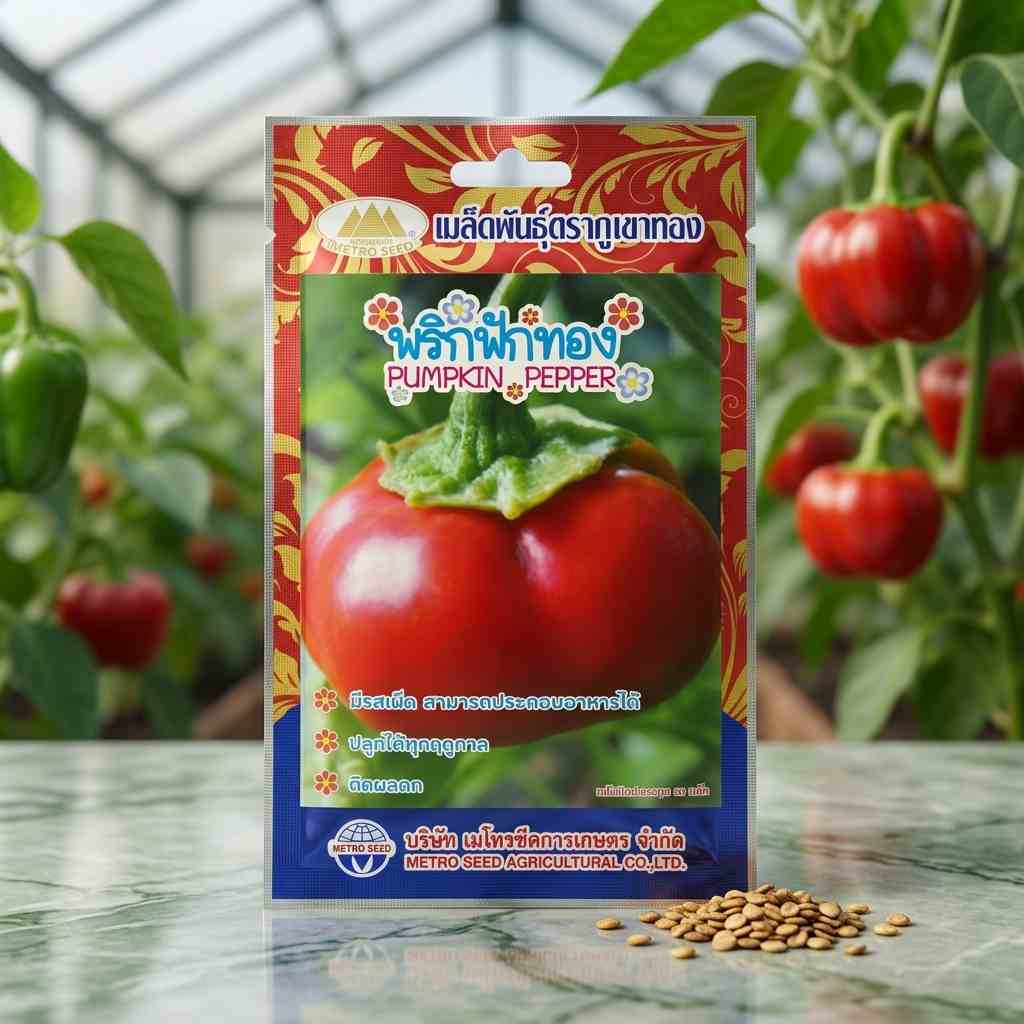
Pumpkin Pepper Seed – Metro Seed – Thai
৳ 250.00
5 in stock (can be backordered)
Description
PUMPKIN PEPPER – Seeds
Price: 250 Taka per packet
Brand: Metro Seed Agricultural Co., Ltd
Quantity: approx. 35 seeds
Seed’s Origin: Thailand
Germination Rate (approx.): 85%
Purity (approx.): 98%
First, an important clarification about the variety
The name Pumpkin Pepper refers to a distinctive pepper cultivar whose fruits resemble miniature pumpkins. It is not an ordinary pumpkin or squash.
A seed catalogue describes a pumpkin-shaped Capsicum annuum cultivar with small, ribbed fruits that change from green to red, mild heat, and ornamental appeal. The catalogue gives approximately 110 days to maturity. However, I could not independently verify that the cultivar described in that catalogue is genetically identical to the particular seed packet sold by Metro Seed Agricultural Co., Ltd., Thailand. Reimer Seeds lists a cultivar under the same name.
For this guide, we will use the documented pumpkin-shaped pepper characteristics where available and standard Capsicum annuum cultivation research for the remaining parameters. Estimates for plant size, yield, taste and maturity should be treated as provisional until the Thai seed packet or a trial plant confirms them.
Crop identity
- Scientific name: Capsicum annuum L. — provisional identification
- Family: Solanaceae
- Common English name: Pumpkin Pepper
- Bengali descriptive name: কুমড়া আকৃতির মরিচ
- Crop type: Warm-season, fruit-bearing herb; potentially ornamental
- Likely use: Ornamental display and culinary use, subject to confirming its heat and edibility
Seed germination and establishment
| Parameter | Recommended value for Pumpkin Pepper |
| 1. Germination temperature | 25–30°C optimum; approximately 20–32°C is a practical working range |
| 2. Germination time | Usually 7–14 days under good conditions; allow 21–28 days if temperatures or seed vigour are suboptimal |
| 3. Mature plant height | Estimate 30–90 cm (12–35 inches); variety-specific confirmation needed |
| Mature plant spread | Estimate 30–60 cm (12–24 inches) |
| Seed sowing depth | 0.5–1 cm (¼–⅜ inch) |
| 4. Plant spacing | 18–24 inches for container-grown plants with adequate airflow |
| 5. Row spacing | 30–36 inches between row centres; use 36–48 inches for wider access and airflow in humid conditions |
| 6. Physical support | A small stake or cage is advisable if the plant becomes top-heavy or carries many fruits; heavy trellising is generally unnecessary |
The World Vegetable Center’s pepper guide reports that emergence may take around 8 to 12 days at 25–35°C, but its cited temperature table indicates that germination can fail at extreme temperatures. For reliable rooftop sowing, aim for 25–30°C rather than deliberately exposing seeds to the hottest possible conditions.
How to germinate the seeds successfully
- Step 1 — Sow
Sow one seed per cell or small pot at 0.5–1 cm depth. Use a clean, fine-textured seed-starting mix.
- Step 2 — Maintain moisture
Keep the medium evenly moist, never saturated. Use a fine spray so seeds are not displaced.
- Step 3 — Give light after emergence
Seeds do not require direct sunlight to germinate. Once seedlings emerge, provide bright light and gradually introduce them to outdoor sunlight.
- Step 4 — Transplant
Transplant when seedlings have 4–6 true leaves and are sturdy, usually around 4–6 weeks after sowing under warm conditions. Harden them gradually before exposing them to strong rooftop sun and wind.
Flowering, harvesting and expected life cycle
| Parameter | Practical estimate |
| Seed to first harvest | Approximately 90–120 days; the same-name catalogue lists 110 days, but its precise counting convention should be confirmed |
| Seed to first bloom | Approximately 50–75 days under suitable conditions; not verified for the exact Thai cultivar |
| Container size | One plant per 12–16 inch diameter pot, preferably 12–14 inches deep or deeper |
| Minimum practical pot volume | Approximately 15–20 litres; 20–30 litres offers better buffering against rooftop heat and moisture fluctuations |
| Soil pH | Target 5.8–6.6, with approximately 5.5–6.8 generally acceptable |
| Soil type | Fertile, loose, well-drained loam with good moisture retention and abundant oxygen around the roots |
| Sunlight | Aim for 6–8 hours of direct sunlight daily; protect plants from extreme afternoon heat if flowering declines |
| Light during germination | No direct light is necessary before emergence; provide light promptly after seedlings appear |
These values draw on standard pepper production guidance, rather than a verified Metro Seed variety sheet. Pepper roots need good drainage, and prolonged waterlogging is especially risky in Bangladesh’s humid, rainy weather.
Watering requirements for a rooftop container
Pepper plants need consistent soil moisture, especially during flowering and fruit development. A fixed daily litre allowance is less reliable than checking the moisture in the actual pot: rooftop wind, pot material, plant size, temperature and rainfall all change water demand. University of Connecticut guidance gives approximately 1–2 inches of water per week as a general field-growing reference, with adjustments required for containers.
The following are starting estimates for a 15–30 litre container, not measured water requirements for this cultivar.
| Growth stage | Approximate water per plant | Initial watering schedule |
| Seedling, 0–10 cm | 50–150 mL | Check daily; water when the upper surface begins drying |
| Young plant, 10–25 cm | 150–400 mL | Usually every 1–2 days in warm weather |
| Vegetative plant, 25–45 cm | 300–700 mL | Often daily in hot weather; adjust to moisture |
| Flowering and fruiting | 500–1,200 mL | Daily checks; water more during heat and heavy fruiting |
| Mature plant, hot rooftop conditions | 700–1,500 mL or more | Sometimes twice daily during extreme heat, but only if needed |
Correct watering method
- Water slowly around the root zone until a little water drains from the bottom.
- Never allow the pot to remain standing in drainage water.
- Check moisture 2–4 cm below the surface before watering again.
- Reduce watering after substantial rain and during cool, cloudy weather.
- Prefer morning watering. Avoid routinely wetting leaves and flowers late in the day.
- Use mulch to reduce evaporation, leaving a small gap around the stem.
If a 20-litre pot is drying out within a few hours, check whether it has become root-bound, whether the medium contains too much coarse material, and whether the plant is exposed to intense reflected heat.
Essential nutrients and their organic sources
Pepper plants need all essential plant nutrients, not just nitrogen, phosphorus and potassium. The table below separates the nutrients from the approximate fertiliser grades; the percentages shown for NPK are target grades, not the guaranteed composition of your organic ingredients.
| Nutrient | Practical role | Potential sources from your list |
| Nitrogen (N) | Leaf growth, chlorophyll and plant vigour | Vermicompost, tricho-compost, cow-dung compost, mustard cake |
| Phosphorus (P) | Root growth, flowering and energy transfer | Bone meal, vermicompost, compost |
| Potassium (K) | Fruit development, water regulation and stress tolerance | Compost, vermicompost; actual concentration varies |
| Calcium (Ca) | Cell walls, growing points and fruit development | Oyster shell powder, bone meal |
| Magnesium (Mg) | Central component of chlorophyll | Epsom salt; compost contributes smaller variable amounts |
| Sulphur (S) | Protein synthesis and enzyme function | Epsom salt, mustard cake, organic matter |
| Iron (Fe) | Chlorophyll formation and electron transfer | Soil and compost; availability depends on pH |
| Manganese (Mn) | Photosynthesis and enzyme activity | Soil and compost |
| Zinc (Zn) | Enzymes and growth regulation | Compost and soil |
| Boron (B) | Cell development, pollen function and fruit set | Trace amounts in soil and compost |
| Copper (Cu) | Enzyme activity | Soil and organic matter |
| Molybdenum (Mo) | Nitrogen metabolism | Soil and organic matter |
| Chlorine (Cl) and nickel (Ni) | Essential in very small amounts | Usually supplied through soil and water |
What NPK percentage should be targeted?
For a general-purpose chemical fertiliser, a balanced grade such as 10:10:10 or 15:15:15 can be used cautiously during early growth. During flowering and fruiting, a fertiliser with relatively more potassium, such as 12:12:17 or 15:5:20, may be useful if the plant actually needs additional potassium.
These are examples of fertiliser grades, not exact prescriptions for Pumpkin Pepper. Excess nitrogen can promote leafy growth at the expense of flowers and fruit. Do not apply a high-phosphorus or high-potassium product merely because the plant is flowering; soil fertility and the fertiliser label should guide the decision.
Bangladesh’s Fertilizer Recommendation Guide 2024 includes a sweet-pepper recommendation based on yield target and soil-test category, illustrating why the correct field rate depends on existing soil nutrients.
Organic fertiliser blend for one Pumpkin Pepper plant
For the proposed 20-litre container, use the following conservative organic amendment plan. The amounts are practical starting rates, not laboratory-derived requirements for this specific cultivar.
Initial amendments at pot preparation
| Ingredient | Quantity per plant | Main purpose |
| Tricho-compost | 200 g | Organic matter and potential beneficial microbial activity |
| Vermicompost | 250 g | Nutrients and improved growing-medium structure |
| Fully matured cow-dung compost | 200 g | Slow-release nutrients and organic matter |
| Horn meal | 10 g | Slow-release nitrogen |
| Bone meal | 15 g | Phosphorus and calcium |
| Neem cake powder | 15 g | Organic nutrients; may contribute to suppression of certain soil pests |
| Mustard cake powder | 10 g | Organic nitrogen and other nutrients |
| Oyster shell powder | 5 g | Calcium, subject to its fineness and composition |
| Epsom salt | Omit initially | Add magnesium sulphate only if deficiency or a genuine need is established |
Mix the solid organic amendments thoroughly into the potting medium before planting. Use only mature, well-composted manure and commercially prepared amendments with known ingredients. Fresh manure and concentrated oilseed cakes can damage roots.
Important: Do not assume that tricho-compost contains a particular viable Trichoderma strain or concentration unless the product label confirms it. Likewise, bone meal, horn meal, oyster shell and organic cakes differ substantially in nutrient content among manufacturers.
Organic top-dressing schedule
| Growth stage | Application per plant | Interval |
| 2–3 weeks after transplanting | Vermicompost 30–40 g + tricho-compost 20–30 g | Once |
| Early flowering | Vermicompost 30 g + mature cow-dung compost 20–30 g | Once |
| Active fruiting | Vermicompost 30–40 g | Every 3–4 weeks, if growth warrants it |
| Continued fruit production | Reassess growth, leaf colour and flowering before repeating | Avoid automatic heavy applications |
Keep top-dressings away from the stem and lightly incorporate them into the top layer. Water afterward.
Do not add all the ingredients at every application. A 20-litre pot can accumulate salts and excess nutrients surprisingly quickly, particularly if drainage is poor.
Chemical fertiliser schedule
Chemical fertiliser can supplement organic matter, but it should not be layered indiscriminately on top of the full organic programme.
For one established plant in a 15–30 litre pot, a cautious starting schedule is:
| Stage | Example product | Starting application |
| 2 weeks after transplanting | Balanced NPK 10:10:10 or 15:15:15 | 1–2 g per plant |
| Active vegetative growth | Same balanced fertiliser | 1–2 g every 2–3 weeks |
| Flowering and fruiting | Label-approved fruiting fertiliser with adequate potassium | 1–2 g every 2–3 weeks, only if needed |
| Suspected magnesium deficiency | Magnesium sulphate | Only after checking symptoms and other causes |
These are deliberately conservative starting quantities. Follow the specific product’s label, reduce the dose for a heavily amended medium, and do not apply fertiliser to severely dry or heat-stressed roots.
For liquid fertilisers, follow the manufacturer’s dilution instructions. Avoid mixing concentrated calcium products with phosphate- or sulphate-containing fertilisers in the same stock solution, because precipitation can occur.
Rooftop potting mix for Bangladesh
For Dhaka’s hot conditions, heavy monsoon rainfall and humid weather, the goal is a medium that drains freely while retaining enough water for the plant to survive hot afternoons.
Recommended Pumpkin Pepper potting mix
By volume • 100% total • Suitable starting blend for a 20-litre container
- Loamy soil: 25%
- Coconut coir dust: 20%
- Vermicompost: 15%
- Tricho-compost: 10%
- Fully matured cow-dung compost: 10%
- Medium coconut husk: 8%
- Perlite: 5%
- Brown river sand: 3%
- Wood charcoal: 2%
- Wood bark: 2%
Quantities for a 20-litre batch
| Ingredient | Volume |
| Loamy soil | 5 L |
| Coconut coir dust | 4 L |
| Vermicompost | 3 L |
| Tricho-compost | 2 L |
| Cow-dung compost | 2 L |
| Medium coconut husk | 1.6 L |
| Perlite | 1 L |
| Brown river sand | 0.6 L |
| Wood charcoal | 0.4 L |
| Wood bark | 0.4 L |
| Total | 20 L |
The blend should feel moist and springy rather than sticky or muddy. Use clean, low-salt coir, mature compost, and a container with several unobstructed drainage holes. Check the pH of the finished mix if possible; target approximately 5.8–6.6.
For rooftop use, a lightweight plastic or fabric container is often easier to handle than a heavy masonry pot. Ensure that the roof can safely support the container’s saturated weight.
Companion plants
Pumpkin Pepper can share a rooftop growing area with other plants, provided its pot remains large enough and companions do not shade it or compete heavily for water.
- Basil — তুলসী / বাসিল
A practical nearby herb. It has similar warmth and sunlight preferences, although it is better grown in a separate pot to avoid root competition.
- Marigold — গাঁদা
Adds flowers and can support beneficial insects. Do not assume it will automatically control nematodes or other pests.
- Spring onion — পেঁয়াজ পাতা
A compact companion in a nearby container. Keep it from crowding the pepper’s root zone.
- Coriander — ধনেপাতা
Useful as a separate cool-season pot. In Bangladesh’s hottest months it may bolt quickly and is not a permanent companion.
Avoid planting tomatoes, eggplants or other peppers immediately beside a crowded Pumpkin Pepper if doing so will compromise airflow or increase the spread of shared pests and diseases. Rotate plants from the Solanaceae family when growing in the same soil.
Taste, edible leaves and fruit use
| Question | Assessment |
| Fruit taste rating | 4/10 as a provisional culinary rating; not a laboratory or taste-panel result |
| Heat / Scoville units | Described as mildly hot in the same-name seed catalogue, but no verified SHU value was found for the Metro Seed packet |
| Leaf taste rating | 2/10 as a provisional culinary rating; the leaves are not a standard culinary product for this cultivar |
| Edibility | Confirm the variety and intended use before eating. Start with a very small quantity only if its identity and safe cultivation are established |
The distinctive appearance makes the fruit potentially attractive for garnishing, pickling and decorative food presentation. Nevertheless, ornamental peppers can vary considerably in pungency. Do not infer their heat from colour or appearance alone.
Pest management: chemical and organic options
The following pests can affect peppers generally. Their actual presence must be confirmed by inspecting the plant.
| Pest | Signs to look for | Chemical options* | Alternative organic/IPM methods |
| Aphids | Colonies on tender shoots, curled leaves, sticky honeydew | Label-approved insecticidal soap or acetamiprid | Water spray, remove heavily infested shoots, conserve ladybirds |
| Whiteflies | Tiny white insects flying up when leaves are disturbed | Label-approved products containing an appropriate active ingredient such as acetamiprid | Yellow sticky traps, insect-proof netting, remove infested leaves |
| Thrips | Silvery scars, distorted new growth, damaged flowers | Spinosad or another locally registered thrips product | Blue sticky traps, sanitation, remove badly damaged flowers |
| Spider mites | Fine webbing, stippling and bronzed leaves | A suitable labelled miticide, such as abamectin where registered | Rinse leaf undersides, reduce dust and plant stress, use predatory mites where practical |
| Caterpillars / fruit borers | Holes, frass and damaged fruit | Bacillus thuringiensis for susceptible larvae, or a locally registered insecticide if needed | Hand-pick larvae, remove damaged fruits, use insect-proof netting |
| Cutworms | Seedlings cut at the soil surface | A locally registered product only if justified | Remove debris, inspect soil at night, use protective collars |
*Active ingredients are examples for identifying possible products, not a recommendation to spray every plant prophylactically. Use only products registered for the crop and pest in Bangladesh, at the label rate and pre-harvest interval. Avoid spraying flowering plants when pollinators are active. Do not use household insecticides on edible crops.
Diseases: identification and management
| Disease | Typical symptoms | Possible chemical treatment* | Organic or preventive approach |
| Damping-off | Seedlings collapse at the soil line | Registered seedling fungicide when indicated | Clean seed-starting mix, clean trays, avoid waterlogging |
| Anthracnose | Sunken dark lesions on fruit | A registered fungicide such as a copper-based product or another labelled option | Remove infected fruit, avoid overhead irrigation, improve airflow |
| Bacterial leaf spot | Water-soaked spots that become dark or necrotic | Copper-based bactericides may suppress spread; they do not reliably cure established infection | Clean seed, remove infected plants, avoid handling wet foliage |
| Phytophthora root or crown rot | Wilting despite wet soil, dark roots or crown | A crop-labelled oomycete treatment such as a registered phosphonate or other appropriate product | Excellent drainage, avoid contaminated soil and standing water |
| Powdery mildew | White powder-like patches on leaves | A labelled sulphur or other appropriate fungicide | Improve airflow, remove badly affected leaves, avoid plant crowding |
| Viral diseases | Mottling, mosaic patterns, distorted leaves or stunted growth | No curative pesticide | Remove infected plants, control insect vectors, disinfect tools |
| Blossom-end rot | Dark, sunken patch at the blossom end of fruit | Not a fungal disease; fungicides are ineffective | Maintain even moisture, check pH and calcium availability, avoid excess salts |
*The suitable active ingredient depends on the confirmed pathogen, formulation, crop registration and local label. Fungicides do not all treat the same organisms; for example, a product effective against a true fungus may not control an oomycete such as Phytophthora.
A practical integrated pest-management routine
- Inspect leaf undersides and new shoots at least twice weekly.
- Remove diseased leaves and fallen fruit promptly.
- Water the soil rather than routinely wetting foliage.
- Disinfect cutting tools between diseased plants.
- Avoid excess nitrogen, which can encourage soft, pest-prone growth.
- If spraying is necessary, identify the pest or pathogen first and follow the label’s protective-equipment, re-entry and harvest instructions.
How to identify mature fruit
The same-name Pumpkin Pepper listing describes fruits that change from green to red when mature, with some becoming burnt orange if left longer on the plant.
Look for these signs:
- The fruit has developed its characteristic miniature-pumpkin shape and pronounced ribs.
- The green colour has changed to the mature red or orange shade expected for the cultivar.
- The skin is firm and glossy, without soft rot or expanding lesions.
- The fruit has reached its typical full size, approximately 1½ × 2½ inches according to the same-name listing, although the Thai strain may differ.
- The stem can be cut cleanly with scissors or pruning shears.
Harvest regularly rather than allowing every fruit to remain on the plant until it dries. Use clean scissors to avoid tearing branches.
Average life span
Pumpkin Pepper is expected to behave like a perennial-capable Capsicum annuum grown as an annual crop in many production systems.
- Productive growing cycle: roughly 4–8 months after establishment, depending on weather and care.
- Possible life in a frost-free container: 1–3 years under favourable conditions, but productivity may decline and pests or diseases may accumulate.
- For practical rooftop cultivation in Bangladesh, plan for a seasonal crop and replace plants when vigour or yield declines.
The actual longevity of the Metro Seed strain has not been documented in the sources located.
Nutritional value
The exact nutritional profile of Pumpkin Pepper has not been published in the sources I found. The following table uses raw red hot chilli pepper as a general Capsicum reference, not a direct analysis of this variety.
| Nutrient | Approximate amount per 100 g |
| Energy | 40 kcal |
| Water | 88 g |
| Carbohydrate | 8.8 g |
| Protein | 1.9 g |
| Fat | 0.4 g |
| Dietary fibre | 1.5 g |
| Vitamin C | 144 mg |
| Vitamin B6 | 0.51 mg |
| Vitamin A | 48 µg RAE |
| Potassium | 322 mg |
| Magnesium | 23 mg |
| Iron | 1.03 mg |
| Folate | 23 µg |
Source: USDA-derived raw red chilli nutrition data. Cultivar, ripeness and preparation can substantially affect the actual values.
Health benefits
- Supports normal immune function
Vitamin C contributes to normal immune function and helps the body absorb non-haem iron from plant foods.
- Provides antioxidant nutrients
Vitamin C and carotenoids contribute to the body’s antioxidant defence systems.
- Contributes to eye health
Provitamin A carotenoids in some peppers support normal vision and vitamin A functions.
- Adds flavour with relatively few calories
Chilli can make meals more flavourful without requiring large quantities of added fat or sugar.
- Supplies small amounts of minerals and B vitamins
Peppers contribute potassium, magnesium, vitamin B6 and folate to an otherwise balanced diet.
These are benefits of nutrients found in peppers generally. They do not demonstrate that Pumpkin Pepper treats or prevents any particular disease. If its pungency is high, people with reflux or sensitivity to spicy food may need to limit intake.
Recipe ideas
- Stuffed miniature peppers
Fill edible, sufficiently large fruits with seasoned rice, herbs, minced meat or cheese, then bake. The small size of Pumpkin Pepper may make it better for garnish than for stuffing.
- Pickled peppers
Prepare a vinegar-based refrigerator pickle with garlic and spices. Use a tested preservation recipe if storing at room temperature; do not improvise low-acid canning methods.
Best sowing month in Bangladesh
October–November (Preferred starting window for rooftop cultivation in Dhaka)
The second practical window is February, extending into early March when temperatures are suitable and the rooftop is not excessively hot.
This recommendation is based on Bangladesh’s seasonal pattern and the thermal requirements of Capsicum annuum, not a cultivar-specific two-year sowing experiment.
The Bangladesh Agro-Meteorological Information Service identifies September–October as a suitable period for chilli cultivation in its general pepper guidance. Historical climate records from the Japan Meteorological Agency also show a substantial seasonal cooling from October to November in Bangladesh. For example, its Bogra record lists mean temperatures of 27.0°C in October 2024 and 22.5°C in November 2024; the precise conditions in Dhaka and on an exposed rooftop will differ.
Practical rule: Sow when the seed-starting medium stays around 25–30°C. Protect seedlings from heavy rain, waterlogging and harsh midday heat. For a late-season crop, make sure the plant has enough time to establish and fruit before extreme summer heat reduces flowering and fruit set.
Seeds per gram
The World Vegetable Center’s sweet-pepper production guide reports approximately 130 seeds per gram. Other pepper production guidance reports around 250 seeds per gram, demonstrating that seed size, variety, processing and counting methods can produce a wide range.
For Pumpkin Pepper, use the following provisional estimate:
- Planning range: approximately 130–250 seeds per gram.
- Practical midpoint: about 180 seeds per gram.
- Confidence for the Metro Seed packet: low until the seeds are weighed and counted.
If you have 20 seeds, weigh them together on a suitable precision scale. The approximate count per gram is:
For small seed lots, counting 20–50 seeds will give a better estimate than weighing a single seed.
Best propagation method
The preferred method is seed propagation.
- Sow fresh seeds in a clean, well-drained medium.
- Maintain 25–30°C and steady moisture.
- Transplant healthy seedlings after they develop several true leaves.
- Harden plants gradually before moving them to full rooftop sunlight.
- Retain seed only if the plant’s identity and reproductive characteristics are confirmed.
If the variety is open-pollinated, saved seed may reproduce similar characteristics, but cross-pollination with other peppers can alter the next generation. The same-name US catalogue identifies its cultivar as open-pollinated, but that status has not been verified for the Metro Seed Thai product.
Storing the fruit and leaves
Fresh fruit
Store dry, unwashed fruit in the refrigerator’s vegetable drawer in a breathable bag or container. Use within approximately 1–2 weeks for best quality, checking regularly for decay.
Drying
Dry whole or sliced fruits thoroughly using a food dehydrator or another controlled method. Store fully dry fruit in an airtight container away from heat and light. Quality is often best within 6–12 months, provided it remains completely dry.
Freezing
Wash and dry the fruit, then freeze it whole or sliced in a freezer-safe bag. Best quality is generally maintained for approximately 6–12 months at −18°C.
Leaves
Pumpkin Pepper leaves are not established as a standard food ingredient. Do not recommend storing or eating them until the exact plant and culinary safety are confirmed.
The durations above are general household quality estimates, not guaranteed safe-storage periods. Discard fruit with mould, slime or an unusual smell.
Specialties of Pumpkin Pepper
- Pumpkin-like appearance
Its unusual ribbed fruit resembles a miniature pumpkin, making it visually distinctive among conventional chilli varieties.
- Ornamental value
The colourful fruits can add interest to a rooftop garden or decorative edible-plant collection.
- Colour transition
The documented same-name cultivar changes from green to red, with fruits potentially becoming burnt orange if left longer on the plant.
Fun Quotes
- “A little fruit can hold a whole garden’s worth of wonder.”
- “Where the pumpkin shape meets the pepper’s fire, the rooftop becomes a living work of art.”
Few lesser-known facts
- The fruit is botanically a berry. Although it looks like a tiny pumpkin, a pepper fruit develops from a flower’s ovary and is botanically classified as a berry.
- Colour does not reveal the exact heat level. Capsaicin concentration varies among cultivars and fruits, so the appearance alone cannot establish a Scoville rating.
- Pepper flowers are usually self-fertile. A single plant can produce fruit, although pollination conditions and temperature can influence fruit set. Insects can also transfer pollen between different pepper plants.
These facts apply to peppers generally; they have not been independently tested on the specific Thai seed lot.
Native region, origin story and botanical identity
Native region
The species Capsicum annuum originated in the Americas and was domesticated in Mesoamerica. It subsequently spread around the world through trade and cultivation.
The precise native range and ancestry of the Pumpkin Pepper cultivar sold by Metro Seed have not been verified.
Origin story
The same-name US catalogue describes Pumpkin Pepper as an open-pollinated cultivar, but I found no reliable documentation identifying its original breeder, founder or date of creation.
It would be misleading to claim that Metro Seed Agricultural Co., Ltd. created the cultivar simply because it sells or distributes the seeds. A Thai seed packet’s company name establishes the commercial association, not necessarily the breeding origin.
Scientific name, family and Bengali name
| Field | Information |
| Scientific name | Capsicum annuum L. — provisional cultivar identification |
| Family | Solanaceae |
| Genus | Capsicum |
| Common English name | Pumpkin Pepper |
| Bengali descriptive name | কুমড়া আকৃতির মরিচ |
| Related familiar Bengali names | মরিচ, লঙ্কা |
| Crop classification | Fruit-bearing herb; often cultivated as an annual |
Reference websites and research sources
The following are the main references used for the botanical identity, cultivation parameters, Bangladesh seasonality, nutrition and fertiliser guidance. General pepper research has been used where exact Pumpkin Pepper data were unavailable.
Variety-specific information
Reimer Seeds — Pumpkin Pepper Seeds — fruit shape, colour transition, description and approximate maturity.
Germination and cultivation
- World Vegetable Center — Suggested Cultural Practices for Sweet Pepper — seed germination, temperature, seed count and seedling management.
- University of Massachusetts Amherst — Pepper — growing conditions and seedling care.
- Michigan State University Extension — How to Grow Peppers — general pepper growth and harvest information.
- University of Minnesota Extension — Growing Peppers — spacing, transplanting and climate considerations.
- Penn State Extension — Pepper Production — soil pH, drainage, spacing and production.
- Oklahoma State University Extension — Pepper Production — transplanting and spacing.
- University of Connecticut — Peppers — watering, temperature and plant care.
- PROSEA — Capsicum — tropical and subtropical pepper ecology and soil conditions.
- Iowa State University Extension — Germination Requirements — seed germination temperatures, light and timing.
Bangladesh climate and agriculture
- Bangladesh Agro-Meteorological Information Service — Pepper — local pepper sowing periods.
- Bangladesh Agro-Meteorological Information Service — Pumpkin — general pumpkin cultivation; not used as the botanical identity for Pumpkin Pepper.
- Bangladesh Meteorological Department — Climate — official climate information.
- Japan Meteorological Agency — Bogra climate records — historical temperature and rainfall data.
- Japan Meteorological Agency — Cox’s Bazar climate records — additional Bangladesh climate records.
Fertiliser and plant health
- Bangladesh Agricultural Research Council — Fertilizer Recommendation Guide 2024 — sweet-pepper nutrient recommendations.
- University of Delaware Extension — Peppers — general pepper pests and disorders.
- Starke Ayres — Sweet & Hot Pepper Production Guideline — seedling production and germination temperatures.
Nutrition
- USDA-derived nutritional data — Hot red chilli peppers, raw — reference nutrition values.
- USDA-derived nutritional data — Raw hot red chilli peppers — additional nutrient data.
The linked sources cover general pepper cultivation extensively, but they do not establish a verified cultivar profile for the exact Metro Seed product. In particular, the cultivar’s exact height, heat rating, yield, life span, seed count and origin remain unconfirmed.
Final recommendation: For rooftop cultivation in Bangladesh, start with one Pumpkin Pepper plant in a 20-litre, well-drained container, sow during October–November, and use the balanced potting mix above. Monitor flowering, fruit colour, pests and actual yield before expanding the crop. The most important unresolved question is whether the Metro Seed Thai packet is the same cultivar documented by the US seed catalogue; confirming that would make future recommendations for maturity, heat level, plant size and yield much more reliable.
*Note: It is recommended to prepare seedling in a small cup or pot for better success rate and keep the soil moist. Keeps the seeds under water overnight before sowing.
Disclaimer:
Successful germination of seeds depends on lot of variables like, germination temperature, planting media, present weather condition of the area where you are planning to grow that particular item, soil pH, watering, sunlight, process and validity. So before complaining about the quality of seeds of any particular brand, kindly try all possible methods maintaining all conditions. Any negligence might disrupt whole germination.
If you have any query regarding our products, kindly inbox us or send an email mentioning all your queries. We will try our level best to give feedback on it. You can also directly make a phone call to our support.
Read the product description carefully.
In accidental cases, you might find the quantity of seeds lesser than as mentioned in the label of the packet. We seek for apology in advance for such cases and kindly inform us immediately about the situation. Our support team will try to give you solution for that if possible.
সাধারণত বীজের সফল জার্মিনেশন অনেকগুলো ভেরিয়েবলের উপর নির্ভর করে যেমন জার্মিনেশনের তাপমাত্রা, রোপণ মিডিয়া, সেই অঞ্চলের বর্তমান আবহাওয়া, মাটির পিএইচ, জল সরবরাহ, সূর্যালোক, প্রক্রিয়া এবং বীজের মেয়াদ । সুতরাং কোনও নির্দিষ্ট ব্র্যান্ডের বীজের গুণমান সম্পর্কে অভিযোগ করার আগে দয়া করে সমস্ত শর্ত বজায় রাখার জন্য সম্ভাব্য সমস্ত পদ্ধতি ব্যবহার করে দেখুন।
বীজ থেকে চারা তৈরী করার নির্দেশাবলী বা ভিডিও টিউটোরিয়াল দেখার জন্য গুগল বা ইউটিউবে অনুসন্ধান করুন। উদাহরণস্বরূপ, ‘How to grow bird chili from seeds’ টাইপ করুন (চেরি টমেটোর জায়গায় আপনি যেই আইটেমের প্রক্রিয়া দেখতে চাচ্ছেন সেই আইটেমের নাম লিখুন) । আপনি চেষ্টা করার জন্য অসংখ্য পদ্ধতি পাবেন।
#pumpkin #pepper #halloween #110TMANIK #metroseed #thai #thailand #MyGardenBd #MyGarden #chili #Chilli #F1 #Hybrid #Price #Dhaka #Bangladesh #Garden #HomeGrown #RooftopGarden #Balcony #Green #Healthy #Benefits #seed #Seeds #Black #Capsicum #Red #Pepper #Jhal #Bird #Thai #Thailand
#PumpkinPepper #PumpkinPepperPlant #PumpkinPepperSeeds #CapsicumAnnuum #PepperPlant #PepperSeeds #ChiliPepper #ChilliPepper #HotPepper #OrnamentalPepper #MiniaturePepper #RarePepper #UniquePepper #EdibleGarden #EdiblePlants #HomeGardening #RooftopGardening #ContainerGardening #UrbanGardening #BalconyGarden #TerraceGarden #KitchenGarden #OrganicGardening #OrganicFarming #GardeningTips #GardeningGuide #SeedGermination #SeedStarting #SeedlingCare #PlantCare #PlantNutrition #OrganicFertilizer #Compost #Vermicompost #Trichocompost #SoilMix #PottingMix #GardenSoil #PlantGrowth #FloweringPlants #FruitBearingPlants #HarvestTime #GardenHarvest #PepperHarvest #HomegrownFood #GrowYourOwnFood #SustainableGardening #SustainableLiving #GardeningBangladesh #BangladeshGardening #DhakaGardening #RooftopGardenBD #GardeningBD #MyGardenBd #MetroSeed #ThaiSeeds #SeedCollection #PlantLovers #GardenLovers #GreenLiving #PlantPropagation #PepperCultivation #VegetableGardening #NaturalGardening #HealthyFood #FreshProduce #GardenInspiration #UrbanFarming #OrganicProduce #GardenToTable #GrowAtHome #PlantEnthusiast #RareSeeds #ExoticPlants #GardeningCommunity
#কুমড়ামরিচ #কুমড়াআকৃতিরমরিচ #মরিচগাছ #মরিচেরবীজ #মরিচচাষ #মরিচগাছেরযত্ন #মরিচউৎপাদন #দেশিবিদেশিবীজ #থাইল্যান্ডেরবীজ #বিরলবীজ #বিরলগাছ #শোভাবর্ধকগাছ #শোভাবর্ধকমরিচ #ছাদবাগান #ছাদেকৃষি #ছাদেকৃষিকাজ #ছাদবাগানবাংলাদেশ #বারান্দাবাগান #বাড়িরবাগান #বাড়িতেবাগান #টবেবাগান #টবেচাষ #কন্টেইনারগার্ডেনিং #রুফটপগার্ডেনিং #শহুরেবাগান #সবজিবাগান #সবজিচাষ #জৈবকৃষি #জৈবসার #ভার্মিকম্পোস্ট #ট্রাইকোকম্পোস্ট #গোবরসার #মাটিতৈরি #পটিংমিক্স #বীজঅঙ্কুরোদগম #বীজথেকেগাছ #চারাগাছ #গাছেরযত্ন #গাছেরখাদ্য #গাছেরপুষ্টি #ফলন #ফসলতোলা #বাগানকরুন #গাছলাগান #সবুজবাংলাদেশ #পরিবেশবান্ধবচাষ #প্রাকৃতিকচাষ #নিরাপদখাদ্য #নিজেরখাবারনিজেচাষ #ছাদেকৃষি #বাগানপ্রেমী #গাছপ্রেমী #কৃষিপ্রযুক্তি #কৃষি #উদ্যানচর্চা #মরিচেরজাত #অর্নামেন্টালপেপার #মাইগার্ডেনবিডি #MyGardenBd
Only logged in customers who have purchased this product may leave a review.


Reviews
There are no reviews yet.