
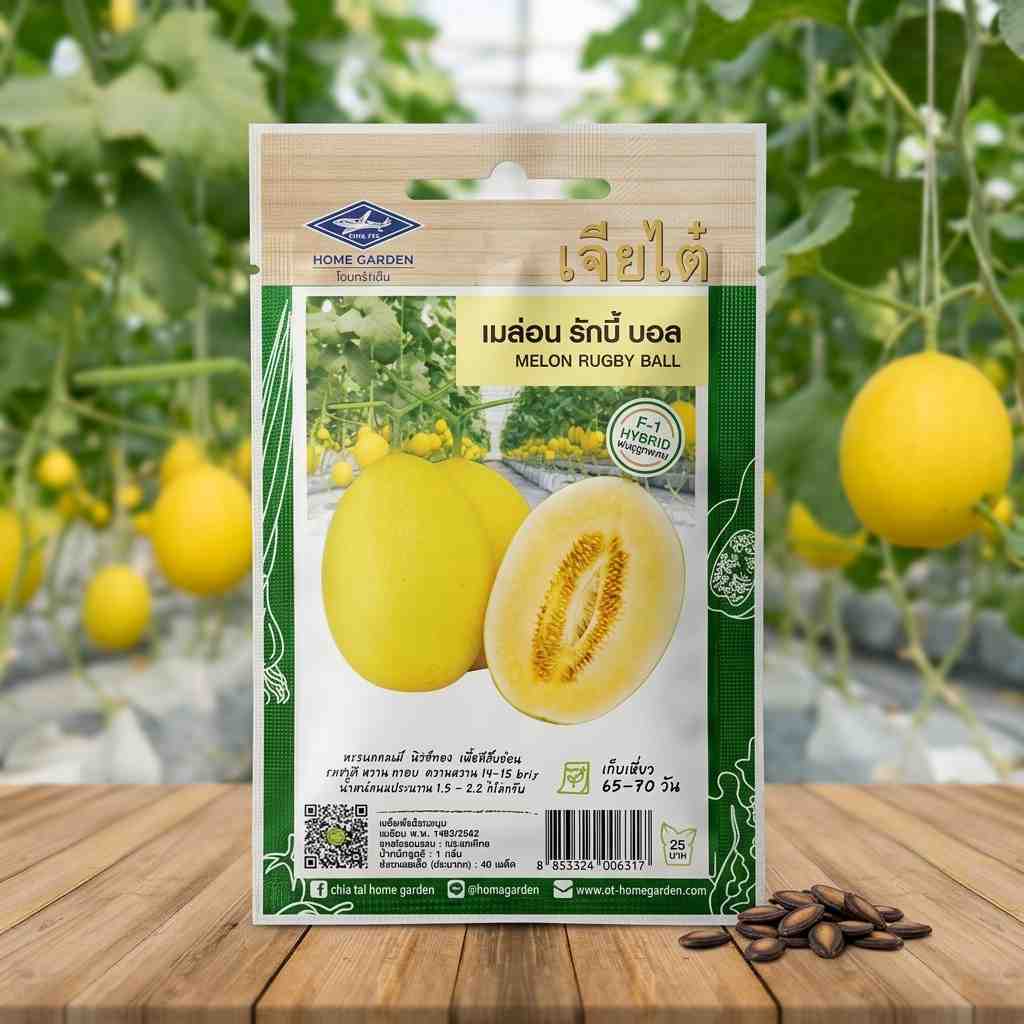
Melon Rugby Ball F1 Hybrid – 40 seeds – ChiaTai – Thai
৳ 230.00
1 in stock (can be backordered)
Description
Melon Rugby Ball F1 Hybrid
Price: 230 Taka
Quantity: 40 seeds
Quantity: ChiaTai
Country of Origin: Thailand
Germination Rate (approx.): 90%
Physical Purity (Min): 98%
Genetic Purity (Min): 98%
Germination and plant characteristics
Germination: 27–30°C ideal target
Allow approximately 3–10 days for emergence under warm, consistently moist conditions. Cooler soil can delay emergence.
Growth and flowering
Sprawling annual vine
Plan for several metres of vine growth. First flowers commonly appear around 30–45 days after sowing, but temperature and cultivar influence this.
Harvest: Approximately 75–100 days
A reasonable planning estimate from sowing for many muskmelons, although this hybrid’s actual maturity date needs confirmation from its seed packet or supplier.
Germination temperature and time
| Parameter | Recommended starting point |
| Optimum germination temperature | 27–30°C |
| Practical acceptable range | Approximately 21–35°C |
| Expected emergence | 3–10 days |
| Sowing depth | 1–2 cm |
| Light during germination | Not essential; warmth and moisture are more important |
| After emergence | Bright sunlight, with gradual exposure to full outdoor sun |
The Punjab Agricultural University muskmelon guide specifies an optimum germination temperature of 27–30°C. Commercial melon growing guides also recommend warm soil and direct sowing or careful transplanting.
Practical method: Sow one seed about 1.5 cm deep in an individual 8–10 cm nursery pot. Keep the medium moist but not saturated. Transplant with the root ball intact when the seedling has two or three true leaves, typically about 10–18 days after emergence.
In Dhaka, avoid leaving seed trays in extreme afternoon heat, particularly when the medium is in small black plastic containers.
Plant height, span, spacing and support
| Parameter | Recommended guidance |
| Vine length | Approximately 4–10 ft or more, depending on growing conditions |
| Natural spread | About 6–10 ft or more if unrestricted |
| Plant spacing in a field | 24–36 inches within rows for many muskmelons |
| Row spacing in a field | 60–72 inches for a compact conventional layout; wider systems also used |
| Rooftop container | One plant per container |
| Support | Optional on the ground; strongly useful in limited rooftop space |
| Fruit support on trellis | Required for heavy fruit; use breathable slings or netting |
These are general muskmelon planning values, not measured dimensions for Rugby Ball F1. Conventional field spacing is reported by the University of Maryland Extension and other production guides.
For rooftop gardening in Dhaka: Train the vine up a sturdy trellis approximately 5–6 ft tall, or allow it to spread horizontally if sufficient space is available. Use a strong frame anchored independently of a lightweight plastic pot. Support each developing fruit individually so that the stem does not bear its full weight.
Seed-to-harvest and seed-to-flower time
| Stage | Approximate days after sowing |
| Germination | 3–10 |
| First true leaves | 7–15 |
| Vine establishment | 15–30 |
| First flowers | 30–45 |
| Fruit set, if pollination succeeds | 35–55 |
| Fruit development | Approximately 30–45 days after fruit set |
| First harvest | Often 75–100 days |
These stages overlap and vary with cultivar, pollination, heat, humidity and plant health. The exact hybrid may mature earlier or later. The University of Maryland reports 80–100 days from transplanting for common melons, so always check whether a seed supplier’s maturity figure is counted from sowing or transplanting.
Container, soil, sunlight and irrigation
Recommended container size
Minimum practical size
18 × 18 × 18 inches (about 50 litres gross volume, depending on shape).
Possible for one compact vine, but water and nutrient management become more demanding.
Preferred for reliable fruiting
24 × 24 × 18 inches or larger, with approximately 60–90 litres of usable growing medium.
Use one plant per container, generous drainage holes and a stable base.
Container dimensions do not translate to an exact volume unless the shape and internal dimensions are known. A rectangular 24 × 24 × 18 inch container holds about 170 litres geometrically before allowing for tapering, freeboard or reduced fill depth; a round pot with those nominal dimensions holds considerably less. For the recipe below, I use a 60-litre finished potting mix as the calculation basis.
Soil type and pH
Muskmelon prefers fertile, well-drained sandy loam or loam, rich in organic matter. The growing medium must retain enough water for fruit development without becoming waterlogged.
- Ideal pH: approximately 6.0–7.0.
- Good aeration is essential because prolonged root-zone saturation encourages root diseases.
- Avoid compacted clay, fresh manure, salty compost and poorly drained rooftop containers.
- Keep the root zone evenly moist, especially during flowering, fruit set and fruit enlargement.
The Punjab Agricultural University guide specifies pH 6.0–7.0, while Tamil Nadu Agricultural University gives a slightly broader 6.5–7.5 range for its production recommendations. For a container, targeting pH 6.2–6.8 is a sensible compromise.
Sunlight and germination light
| Growth stage | Light requirement |
| Germination | Light is not required; temperature and moisture are the priorities |
| Seedling | Bright light immediately after emergence |
| Vegetative growth | At least 6 hours of direct sun |
| Flowering and fruiting | Ideally 8–10 hours of direct sunlight daily |
A shaded rooftop often produces excessive vine growth with fewer flowers or poorly developed fruit. The University of Maryland Extension recommends full sun, preferably 8–10 hours per day.
Water requirement and intervals
The following are starting estimates for a single plant in a 60–90 L container, not fixed physiological requirements. Rain, humidity, wind, pot material, vine size and fruit load can change the amount substantially.
| Plant stage | Approximate water per day | Suggested interval |
| Seed before emergence | 0.05–0.15 L to moisten the small seed zone | Check daily; keep moist |
| Small seedling | 0.15–0.35 L | Daily or when the top 2–3 cm begins drying |
| Established vine | 0.4–0.8 L | Daily in warm weather; adjust to soil moisture |
| Flowering and fruit set | 0.7–1.5 L | Daily, sometimes split into two applications |
| Large vine with expanding fruit | 1.0–2.5 L | Daily in hot, sunny weather; more only if needed |
In peak Dhaka heat, a large vine may need more than 2.5 L on some days; during cloudy or rainy weather it may need much less.
Best irrigation method: Water slowly around the root zone in the morning until the medium is evenly moist and a little water begins draining out. Empty standing water from trays. Check moisture 3–5 cm below the surface before watering again. Avoid frequent heavy wetting of foliage because humid conditions favour several melon diseases.
During fruit enlargement, do not allow severe drying followed by sudden overwatering. Moisture fluctuations can reduce fruit quality and contribute to cracking in susceptible cultivars.
Nutrient requirements and fertilizer programme
Essential nutrients and their functions
The percentages below describe the approximate elemental composition of the nutrients required by the plant, not the percentage that should be mixed into the pot. Exact nutrient demand changes during the crop cycle and depends on soil fertility and yield.
| Nutrient | General importance | Organic source from your list |
| Nitrogen (N) | Leaf, stem and vine growth | Vermicompost, tricho-compost, cow-dung compost, horn meal, mustard cake |
| Phosphorus (P) | Root growth, flowering and energy transfer | Bone meal, vermicompost, composts |
| Potassium (K) | Fruit development, water regulation and quality | Vermicompost, mature composts; quantities vary considerably |
| Calcium (Ca) | Cell walls, root growth and fruit tissue | Oyster shell powder, bone meal |
| Magnesium (Mg) | Chlorophyll and photosynthesis | Epsom salt, composts |
| Sulphur (S) | Protein formation and enzyme activity | Epsom salt, mustard cake, composts |
| Iron (Fe) | Chlorophyll formation and electron transfer | Compost, vermicompost and trace minerals |
| Manganese (Mn) | Photosynthesis and enzyme activity | Compost and trace minerals |
| Zinc (Zn) | Enzyme activity and growth regulation | Compost, vermicompost |
| Boron (B) | Pollen function and fruit set | Compost and trace minerals |
| Copper (Cu) | Enzyme activity | Compost and trace minerals |
| Molybdenum (Mo) | Nitrogen metabolism | Trace minerals in suitable composts |
Approximate plant-tissue nutrient concentrations
Healthy melon leaves often contain macronutrients at approximately these orders of magnitude on a dry-weight basis; actual diagnostic ranges depend on leaf age and sampling stage.
| Element | Indicative dry-leaf concentration |
| Nitrogen | 3–5% |
| Phosphorus | 0.2–0.5% |
| Potassium | 2–4% |
| Calcium | 1–3% |
| Magnesium | 0.3–0.8% |
| Sulphur | 0.2–0.5% |
| Iron | 50–200 mg/kg |
| Manganese | 30–200 mg/kg |
| Zinc | 20–60 mg/kg |
| Boron | 20–60 mg/kg |
| Copper | 5–20 mg/kg |
| Molybdenum | 0.1–2 mg/kg |
These are broad diagnostic guide values, not a prescription for fertilizer composition. A plant’s tissue concentration is different from the quantity of nutrients that must be applied to its pot. In particular, compost nutrient percentages vary substantially with source, maturity, moisture and processing.
Commercial melon production guides emphasize soil testing and balanced N-P-K nutrition, with particular care to avoid excessive nitrogen late in the crop cycle.
Organic fertilizer blend for one 60-litre pot
The following is a conservative starting recipe for one plant, assuming mature, reasonably fertile composts and a well-drained 60-litre medium. It deliberately limits concentrated meals and salts to reduce the risk of root injury.
Pre-plant organic amendment blend
Per plant
Amounts are by weight. They are amendments added to the growing medium, not the entire potting mix.
| Fertilizer | Initial quantity |
| Tricho-compost | 200 g |
| Vermicompost | 300 g |
| Cow-dung compost | 250 g |
| Horn meal | 10 g |
| Bone meal | 20 g |
| Neem cake powder | 20 g |
| Mustard cake powder | 15 g |
| Oyster shell powder | 10 g |
| Epsom salt | 0 g initially |
Total initial organic amendments: 825 g per pot, excluding Epsom salt. The actual nutrient contribution depends on product analysis.
Application intervals
| Crop stage | Application |
| Pot preparation, 7–14 days before sowing | Mix the initial composts, meals and oyster shell powder evenly through the medium |
| 15–20 days after emergence | Apply 50–75 g vermicompost as a thin surface dressing |
| 30–35 days after emergence, before flowering | Apply 50–75 g vermicompost and 50 g mature compost if growth is weak or the medium is depleted |
| 45–55 days after emergence, after fruit set | Apply 50–75 g vermicompost only if the plant needs feeding |
| During fruit enlargement | Avoid large nitrogen-rich doses; maintain even moisture and use a balanced feed only if needed |
Important adjustments
- Do not add the full blend repeatedly. The pre-plant recipe is not a weekly fertilizer dose.
- Use only fully decomposed cow-dung compost and mature tricho-compost. A microbial product labelled Trichoderma is not necessarily the same thing as finished tricho-compost.
- Horn meal releases nitrogen slowly. Bone meal and oyster shell powder also release nutrients slowly, depending on pH and processing.
- Do not add oyster shell powder automatically if the medium is already alkaline or calcium-rich.
- Epsom salt is magnesium sulphate, not a complete fertilizer. Use it only when magnesium deficiency is plausible or confirmed. If required, dissolve 1 g in 1 L water and trial a small amount first; do not apply concentrated salt directly to roots.
- Do not use turmeric powder as a routine fertilizer ingredient. It has no established role as a meaningful source of crop nutrients at this dose.
Why not use more fertilizer?
A container holds a limited root-zone volume. Excess manure, mustard cake, horn meal, bone meal or soluble salts can raise electrical conductivity, damage roots, delay flowering or produce excessive foliage. The recipe is intentionally less aggressive than some field production schedules.
Chemical fertilizer programme
A chemical fertilizer programme can be more predictable than relying entirely on compost, but exact rates should be adjusted to the potting medium, irrigation water and product label.
A general muskmelon field recommendation reported by Apni Kheti is about 50 kg N, 25 kg P and 25 kg K per acre, while Penn State provides a different recommendation expressed in fertilizer units and emphasizes soil testing. These differences demonstrate why field rates should not be copied directly into a rooftop container.
For one established plant in a 60-litre pot, use the following cautious starting programme only if the pre-plant medium has not already been heavily fertilized.
| Growth stage | Fertilizer | Starting rate per plant |
| At planting | Balanced granular NPK, such as 10-10-10 | 5 g mixed evenly into the medium |
| 15–20 days after emergence | Water-soluble NPK 19-19-19 | 1 g/L irrigation water, 0.5–1 L of solution |
| Early vine growth | NPK 19-19-19 | 1–1.5 g/L, 0.5–1 L of solution every 10–14 days if required |
| Flowering and fruit set | Balanced fertilizer with adequate potassium | Follow the product label; begin at half the labelled container-plant rate |
| Fruit enlargement | Potassium-rich fertilizer, e.g. 0-0-50 | Only if potassium is deficient or a suitable label programme calls for it |
Do not apply every option in the table together. Select one feeding approach, monitor plant response and avoid fertilizing dry roots. If you have already incorporated the organic blend, start with less or omit the basal NPK.
For fruiting success: Adequate potassium, healthy leaves, successful pollination and stable irrigation are generally more important than repeatedly increasing fertilizer doses. Excess nitrogen can delay flowering and reduce fruit quality.
Recommended mix for Bangladesh
The aim is a medium that drains quickly after heavy rain, holds enough moisture during hot weather, remains aerated and is not excessively heavy on a roof.
Rugby Ball F1 potting mix
100% by volume
- Loamy soil – 30%
- Coconut coir dust – 20%
- Vermicompost – 15%
- Tricho-compost – 10%
- Cow-dung compost – 10%
- Perlite – 8%
- Coconut husk (medium size) – 5%
- Wood charcoal – 2%
Total: 100%
Volumes are measured loosely, not by weight. Use washed, low-salt coir; screened, mature compost; and horticultural-grade perlite.
Ingredient quantities for 60 litres
| Ingredient | Percentage | Volume |
| Loamy soil | 30% | 18 L |
| Coconut coir dust | 20% | 12 L |
| Vermicompost | 15% | 9 L |
| Tricho-compost | 10% | 6 L |
| Cow-dung compost | 10% | 6 L |
| Perlite | 8% | 4.8 L |
| Medium coconut husk | 5% | 3 L |
| Wood charcoal | 2% | 1.2 L |
| Total | 100% | 60 L |
The mix is a practical starting formulation, not a laboratory-validated optimum for this specific hybrid. The compost portion is fairly generous, so use mature, low-salt materials. If the mixture feels too rich, dense or holds water for too long, reduce the total compost proportion and replace it with coir and perlite.
Mixing and preparation
- Sieve the loamy soil and remove large clods, debris and weed roots.
- Wash and drain the coir if its salt content is uncertain.
- Mix the soil, coir, perlite and chopped coconut husk thoroughly.
- Fold in the mature composts.
- Add the calculated organic fertilizer amendments evenly.
- Moisten until the mix feels like a wrung-out sponge rather than mud.
- Fill the container without tightly compressing the medium. Leave 2–3 cm of headspace.
- Confirm that drainage holes are unobstructed before sowing.
Rooftop safety: A wet 60-litre container can be considerably heavier than its dry contents. Include the container, saturated medium and mature fruit when estimating the load, and distribute pots safely across the roof.
Companion plants and seasonal planning
Companion plants
For one melon in a large rooftop container, the best strategy is usually to grow the melon alone and use nearby containers for companion plants. Its leaves and vines need space, and the roots compete for water and nutrients.
- Marigold: Adds flowering diversity and can attract beneficial insects. Do not assume it will prevent all pest attacks.
- Basil: A compact nearby plant that attracts flower-visiting insects when allowed to bloom. Keep it in its own pot.
- Radish: A short-cycle crop that can be grown in a separate container nearby before the melon canopy becomes large.
- Nasturtium: Can attract pollinators and other insects, but may also attract aphids. Inspect regularly.
These are practical companion-garden choices, not proven cultivar-specific yield enhancers. Maintain good airflow, avoid overcrowding and do not plant another vigorous cucurbit in the same pot.
Best sowing month in Bangladesh
For Dhaka and much of central Bangladesh, we would prioritise November to January, with November–December as the preferred starting window for a trial of Rugby Ball F1.
| Sowing period | Assessment |
| October | Possible, but lingering rain and humidity can cause problems |
| November | Very promising: rainfall usually drops substantially |
| December | Promising, but cooler nights can slow early growth |
| January | Suitable if temperatures warm sufficiently and the crop has time to mature |
| February–March | Possible, but heat stress can rise as the crop develops |
| April–September | Generally less favourable for an outdoor rooftop trial because of heat, monsoon rain, humidity and disease pressure |
The World Meteorological Organization’s published Dhaka climate table gives average daily maximum temperatures of about 29.6°C in November and 26.4°C in December, with mean rainfall falling from 175 mm in October to 34 mm in November and 15 mm in December. These are long-term climate averages, not forecasts for individual years.
For the 2026–27 season: A late-November or December sowing is a reasonable first trial. Measure the actual growing-medium temperature and protect young plants from cold nights and heavy rain. For commercial-scale planting, test the cultivar on a small number of plants first.
Pest and disease management
Common pests
The table lists potential muskmelon pests, symptoms and management options. Not all will occur on every rooftop.
| Pest | Identification | Organic / non-chemical management | Chemical options for consideration |
| Aphids | Clusters of small insects; curling leaves; sticky honeydew | Water jet, remove badly infested tips, insecticidal soap | Acetamiprid or flonicamid, where registered for the crop and pest |
| Whiteflies | Tiny white insects fly up when foliage is disturbed | Yellow sticky cards for monitoring, remove infested leaves, conserve beneficial insects | Pyriproxyfen or a locally registered alternative |
| Thrips | Silvery streaks, scarring and curled leaves | Blue sticky cards, remove weeds and badly affected leaves | Spinosad, subject to label and pollinator restrictions |
| Red spider mites | Fine stippling, bronzing and webbing | Wash leaf undersides, remove heavily infested leaves, improve plant hygiene | Abamectin, where registered |
| Melon fruit fly | Puncture marks, rotting and maggots inside fruit | Fruit bagging, sanitation, destroy infested fruit, species-appropriate traps | A registered bait or insecticide programme for the identified fruit-fly species |
| Leaf miners | Winding pale tunnels inside leaves | Remove mined leaves early; preserve natural enemies | Abamectin or another locally registered product if necessary |
| Cutworms | Seedlings cut at the soil line | Hand-pick at night, remove hiding debris, protect the stem base | A registered product only if an identified infestation warrants it |
Agricultural management guidance identifies aphids, thrips, leaf miners and fruit flies among important muskmelon pests.
Common diseases
- Powdery mildew: White powdery patches on leaves and stems. Improve spacing and airflow; remove severely affected foliage. Potassium bicarbonate or sulphur may be options if the product is registered and weather conditions permit.
- Downy mildew: Angular yellow areas, often bounded by leaf veins, sometimes with grey-purple growth underneath. Avoid overhead watering and remove infected leaves. Registered products containing mandipropamid, cyazofamid or other locally approved active ingredients may be options.
- Anthracnose: Dark or brown lesions on leaves and stems; fruit lesions can also occur. Use clean seed, reduce leaf wetness and remove diseased debris. Mancozeb or copper-based products may be options if registered for this use.
- Fusarium wilt and root rot: Progressive yellowing and wilting, sometimes with brown vascular tissue. Prevent waterlogging, use clean media and remove affected plants. There is no reliable curative foliar spray for established vascular wilt.
- Viral mosaic diseases: Mottled leaves, distortion and stunting. Remove infected plants, control weeds and manage aphids. There is no chemical cure for a virus-infected plant.
Chemical safety for edible rooftop crops
- Confirm the active ingredient is registered in Bangladesh for the specific crop and target pest or disease. A product’s use on another crop does not establish that it is approved for melon.
- Follow the local product label for concentration, application interval, protective equipment and pre-harvest interval.
- Never spray insecticides on open flowers when bees are visiting. Do not apply systemic or broad-spectrum insecticides indiscriminately.
- Do not mix several pesticides unless the label explicitly allows it.
- Wear suitable protective equipment, keep children away during application and wash harvested fruit under clean running water.
- Copper, sulphur and some organic sprays can also burn foliage in extreme heat.
Harvest, yield and crop lifespan
How to identify a mature fruit?
Look for a combination of the following indicators:
- Skin or rind colour: A cultivar-specific change in background colour, sometimes from green toward yellow or cream.
- Surface development: If this hybrid is netted, the netting should become prominent and well developed.
- Stem attachment: Many cantaloupe-type melons develop a separation zone, or slip, where the stem detaches easily when ripe. Not all melon types slip.
- Aroma: A sweet melon aroma may become noticeable near maturity.
- Flower end: Slight softening can occur in ripe muskmelons, though excessive softness may indicate over-ripeness.
- Seed packet guidance: If ChiaTai specifies a particular rind colour or harvest stage, prioritise that description.
Do not rely on tapping alone. Harvesting too early reduces eating quality because many melons do not accumulate additional sugar after being cut from the vine.
Expected yield
The exact average fruit weight and yield of Rugby Ball F1 could not be verified. For rooftop planning, the following are illustrative scenarios, not published cultivar-specific yield figures.
| Scenario | Marketable fruit per plant | Assumed average fruit weight | Total per crop |
| Low | 1 | 0.5 kg | 0.5 kg |
| Moderate | 2 | 0.8 kg | 1.6 kg |
| Good | 3 | 1.0 kg | 3.0 kg |
The actual result could fall outside this range. Pollination, root volume, cultivar characteristics, leaf disease, fruit load and weather will influence yield.
Yield per square foot
For a rooftop plant allocated a footprint of 4–9 sq ft, a 1.6 kg crop would represent roughly 0.18–0.40 kg per sq ft for that crop. This is a simple container-planning calculation, not an agricultural benchmark.
Commercial field yields vary widely by cultivar and growing system; field figures cannot be directly compared with a single rooftop pot without accounting for spacing, crop duration and marketable fruit standards.
Monthly yield for a family of four
Melon is normally eaten as a fruit or snack rather than as a staple vegetable. A reasonable illustrative family consumption plan is:
- 100–150 g per person per serving.
- Four people eating melon three times per week.
- Around 5–8 kg of edible melon per month, depending on serving size and frequency.
One rooftop plant yielding 1–3 kg per crop would therefore not supply a family of four for an entire month. Several staggered plants or purchases from the market would be needed. This consumption estimate is a planning example, not a Bangladesh dietary recommendation.
Average lifespan
Rugby Ball F1 should be treated as a warm-season annual. The plant completes its productive cycle and usually declines after fruiting, often within approximately 3–5 months from sowing under suitable conditions. It is not a perennial fruit tree.
Fruit taste, nutrition and culinary uses
Expected fruit taste
Sweetness and flavour
7–9/10*
*Indicative expectation for a well-grown sweet melon, not a measured rating for Rugby Ball F1.
Raw fruit flesh – Edible
Leaves – Not normally eaten
The actual flavour could range from mildly sweet to strongly aromatic depending on the cultivar and growing conditions. The fruit’s sweetness is best assessed with a refractometer as °Brix rather than assumed from the product name.
Nutritional value
Because the exact fruit type and flesh colour of this hybrid are not verified, the following is an approximate reference for raw cantaloupe-type muskmelon per 100 g edible portion, not a laboratory analysis of Rugby Ball F1.
| Nutrient | Approximate amount per 100 g |
| Energy | 34 kcal |
| Water | 90 g |
| Carbohydrate | 8.2 g |
| Total sugars | 7.9 g |
| Dietary fibre | 0.9 g |
| Protein | 0.8 g |
| Fat | 0.2 g |
| Vitamin C | 37 mg |
| Vitamin A | 169 µg RAE |
| Potassium | 267 mg |
| Folate | 21 µg |
| Magnesium | 12 mg |
Values are rounded reference values for cantaloupe-type melon; they may differ in other Cucumis melo types.
Health benefits
- Hydration: Its high water content helps contribute to daily fluid intake.
- Vitamin C intake: Vitamin C supports normal immune function and collagen formation.
- Vitamin A activity: Cantaloupe-type flesh can supply beta-carotene, which the body can convert to vitamin A.
- Potassium intake: Potassium is important for normal nerve and muscle function and blood pressure regulation.
- Low energy density: Fresh melon can be a refreshing snack with relatively few calories per 100 g.
These are nutritional benefits, not claims that melon cures or prevents a disease. The fruit should be part of a varied diet.
Popular recipes
Bangladeshi fruit chaat
Dice ripe melon and combine with seasonal fruits, a little lime juice and a small pinch of roasted cumin. Add chilli or salt only to taste.
Best for: a fresh afternoon snack.
Melon milk smoothie
Blend chilled melon with milk or plain yoghurt. Add a little cardamom if desired. Avoid excessive added sugar.
Best for: breakfast or a snack.
Italian-style melon salad
Combine melon balls with fresh basil, a little olive oil, black pepper and lemon juice. Traditional versions may include cured ham; a vegetarian version works well without it.
Melon sorbet
Blend ripe melon with lime juice and freeze in a shallow container, stirring periodically until smooth. Add little or no sugar if the fruit is already sweet.
Average seeds per gram
Published seed references for muskmelon commonly report around 25–45 seeds per gram, with variation by cultivar and seed size. One melon seed catalogue gives 25–45 seeds/g, while Intersemillas reports 25–35 seeds/g.
Best propagation method
For a commercial F1 hybrid, propagate from the original F1 seed rather than saving seed from the harvested fruit.
Recommended method:
- Sow one seed per nursery cell or small pot, 1–2 cm deep.
- Maintain 27–30°C and consistent moisture.
- Give seedlings strong light immediately after emergence.
- Transplant carefully when two or three true leaves have developed.
- Avoid disturbing the taproot.
- Keep one healthy plant per final container.
Seeds saved from an F1 fruit will not necessarily reproduce the same fruit shape, sweetness, size or plant performance in the next generation because the hybrid’s traits may segregate.
Fruit storage
| Storage method | Practical storage period |
| Whole, uncut ripe melon at cool room temperature | Usually a few days; inspect daily |
| Whole melon refrigerated | Often around 1–2 weeks, depending on maturity and temperature |
| Cut melon in a clean airtight container in the refrigerator | Aim to consume within 3–4 days |
| Frozen melon cubes | Best quality for roughly 8–12 months, although texture becomes softer |
For whole netted muskmelon, commercial postharvest guidance recommends cold storage and rapid cooling after harvest. UC Davis reports that shelf life can reach about 12–15 days under optimum conditions, while other extension sources suggest up to two weeks for home refrigeration.
Food safety: Wash the outside before cutting, use clean utensils, refrigerate cut fruit promptly and discard pieces with mould, fermentation, unusual odour or sliminess. In Bangladesh’s hot climate, do not leave cut melon at room temperature for extended periods.
Botanical identity and interesting facts:
Scientific name, family and Bengali name
Cucumis melo
Family: Cucurbitaceae
Bengali/common names: বাঙ্গি, খরমুজ, মেলন or মাস্কমেলন, depending on local usage and fruit type.
Growth habit: Warm-season, tendril-bearing annual vine.
The species Cucumis melo includes many different melon groups, so the botanical species name alone does not identify the exact Rugby Ball F1 cultivar.
Few specialties:
- Distinctive fruit shape: “Rugby Ball” suggests an elongated oval fruit.
- F1 hybrid genetics: Hybrid seed is produced by crossing selected parent lines to obtain a particular combination of traits. Commercial F1 seed does not breed true reliably when saved and replanted.
- Rooftop growing potential: Like other muskmelons, it can potentially be trained vertically with individual fruit slings, making better use of limited horizontal space.
Fun quotes:
- “A little sunshine, a healthy vine, and patience turn a tiny seed into summer’s sweetness.”
- “Grow a melon on the rooftop, and let your garden bring a taste of sunshine to the table.”
Interesting facts:
- The first flowers are often male. These naturally drop without producing fruit. Female flowers can be recognised by the tiny swollen ovary behind the flower.
- Pollination is essential for reliable fruit set. Bees and other pollinators transfer pollen; poor pollination can produce few or misshapen fruits.
- Fruits may stop becoming sweeter after harvest. Picking at the right maturity is particularly important because postharvest softening does not necessarily mean additional sugar accumulation.
These characteristics are described in university extension growing guides.
Native region and origin story
Native region
Cucumis melo has a complex domestication history, with genetic diversity and wild relatives across parts of Africa and Asia. The exact origin of all cultivated melon groups remains complicated, and it would be inaccurate to assign every melon variety to a single country.
North Carolina State University Extension describes the species’ native range broadly, including Africa, the Arabian Peninsula, India, New Guinea and Australia.
North Carolina Extension Gardener Plant Toolbox
Who created Rugby Ball F1?
The product is identified in your question as a ChiaTai hybrid from Thailand. However, I could not verify an official cultivar registration, breeder’s name, release date or documented origin story for the exact Rugby Ball F1 variety.
The safest distinction is:
- Species: Cucumis melo L.
- Seed brand/breeder attribution: ChiaTai, as identified by the product name you supplied.
- Exact cultivar origin and parentage: Not independently verified.
- Historical origin of melon cultivation: Ancient and geographically complex, predating modern commercial hybrid breeding by thousands of years.
ChiaTai’s own product catalogue or a photograph of the original seed packet would be the best evidence for cultivar-specific details.
Reference Info:
The following sources informed this guide. They cover general muskmelon cultivation, seed biology, climate, crop nutrition, pest management, harvest maturity and storage. They do not establish every specification for Rugby Ball F1 itself.
Cultivation and growing conditions
- Penn State Extension — Cantaloupe (Muskmelon) Production
- University of Maryland Extension — Growing Melons in a Home Garden
- Punjab Agricultural University — Vegetable Production Guide, including Muskmelon
- Tamil Nadu Agricultural University — Muskmelon cultivation
- University of Illinois Extension — Muskmelon
- Utah State University Extension — Cantaloupe in the Garden
- GrowVeg — Muskmelon growing information
- PROTA — Cucumis melo botanical and cultivation information
- Intersemillas — Melon crop information and seed counts
- Fedco Seeds — Muskmelon seed and growing information
Fertilizers, nutrients and crop management
- Oklahoma State University Extension — Melon Production
- UMass Extension — Cucumber, Muskmelon and Watermelon nutrient recommendations
- Haifa Group — Growing Melons and nutrient requirements
- Apni Kheti — Muskmelon farming and fertilizer recommendations
- Alabama Cooperative Extension — Grow More Cantaloupe
- University of Maryland Extension — Maintaining Container-Grown Vegetables
Pests, diseases and companions
- National Horticulture Board — Muskmelon pest and disease management
- University of Minnesota Extension — Powdery mildew of cucurbits
- UC Statewide IPM Program — Powdery mildew on cucurbits
- University of Maryland Extension — Vegetable succession and companion planting
- American Phytopathological Society — Organic muskmelon disease management
Harvest, storage, climate and botany
- Iowa State University Extension — Harvesting and storing vine crops
- Iowa State University Extension — Growing cantaloupe and muskmelon
- UC Davis Postharvest Research and Extension Center — Cantaloupe storage
- Colorado State University — Cantaloupe food and handling information
- North Carolina State University Extension — Cucumis melo botanical profile
- World Meteorological Organization — Dhaka climate information
- Bangladesh Meteorological Department — Bangladesh climate and seasons
- Agricultural Water Management — Research on irrigation requirements of muskmelon
*Note: It is recommended to prepare seedling in a small cup or pot for better success rate and keep the soil moist.
Reference Tutorial Link:
Disclaimer: In general, successful germination of seeds depends on lot of variables like, germination temperature, planting media, present weather condition of the area where you are planning to grow that particular item, soil pH, watering, sunlight, process and validity. So before complaining about the quality of seeds of any particular brand, kindly try all possible methods maintaining all conditions. Any negligence might disrupt whole germination.
Search on Google or YouTube for planting instructions or video tutorial. For example, type ‘How to grow cherry tomato from seeds’. You will get numerous methods to try out.
If you have any query regarding our products, kindly inbox us or send an email mentioning all your queries. We will try our level best to give feedback on it. You can also directly make a phone call to our support.
In accidental cases, you might find the quantity of seeds lesser than as mentioned in the label of the packet. We seek for apology in advance for such cases and kindly inform us immediately about the situation. Our support team will try to give you solution for that if possible.
সাধারণত বীজের সফল জার্মিনেশন অনেকগুলো ভেরিয়েবলের উপর নির্ভর করে যেমন জার্মিনেশনের তাপমাত্রা, রোপণ মিডিয়া, সেই অঞ্চলের বর্তমান আবহাওয়া, মাটির পিএইচ, জল সরবরাহ, সূর্যালোক, প্রক্রিয়া এবং বীজের মেয়াদ । সুতরাং কোনও নির্দিষ্ট ব্র্যান্ডের বীজের গুণমান সম্পর্কে অভিযোগ করার আগে দয়া করে সমস্ত শর্ত বজায় রাখার জন্য সম্ভাব্য সমস্ত পদ্ধতি ব্যবহার করে দেখুন।
বীজ থেকে চারা তৈরী করার নির্দেশাবলী বা ভিডিও টিউটোরিয়াল দেখার জন্য গুগল বা ইউটিউবে অনুসন্ধান করুন। উদাহরণস্বরূপ, ‘How to grow cherry tomato from seeds’ টাইপ করুন (চেরি টমেটোর জায়গায় আপনি যেই আইটেমের প্রক্রিয়া দেখতে চাচ্ছেন সেই আইটেমের নাম লিখুন)। আপনি চেষ্টা করার জন্য অসংখ্য পদ্ধতি পাবেন।
#yellow #Musk #Melon #rugby #ball #Cantaloupe #Cantalope #chiatai #chia #tai #Color #Plant #Rooftop #seed #Balcony #online #best #store #Shop #near #me #my #garden #bd #MyGardenBd #nature #ছাদ #বেগুন #বাগান #টব #গাছ # ফুল #বীজ #in #Dhaka #Bangladesh
#MelonRugbyBall #RugbyBallMelon #RugbyBallF1 #MelonF1Hybrid #ChiaTaiSeeds #ChiaTaiThailand #MelonSeeds #Muskmelon #MuskmelonSeeds #CucumisMelo #SweetMelon #MelonGrowing #MelonCultivation #GrowYourOwnFood #HomegrownMelon #RooftopGardening #ContainerGardening #UrbanGardening #OrganicGardening #KitchenGarden #HomeGardening #VegetableGardening #FruitGardening #GardeningTips #SeedGermination #SeedStarting #PlantCare #PollinatorFriendly #OrganicFertilizer #PottingMix #GardenSoil #TrellisGardening #EdibleGarden #GardenToTable #SustainableGardening #GardeningBangladesh #BangladeshGardening #DhakaGardening #RooftopGardenBD #GardeningBD #BangladeshAgriculture #SeedsBangladesh #MyGardenBd #MyGardenBDSeeds #MyGardenBDGardening
#বাঙ্গি #খরমুজ #মেলন #মাস্কমেলন #মেলনচাষ #বাঙ্গিচাষ #খরমুজচাষ #মেলনবীজ #হাইব্রিডবীজ #ফলচাষ #মিষ্টিফল #দেশিফল #ফলবাগান #ছাদবাগান #ছাদকৃষি #বাগান #বাগানপ্রেমী #বাগানকরুন #বীজ #বীজথেকেগাছ #গাছেরযত্ন #জৈবসার #জৈবচাষ #টবেরগাছ #টবেবাগান #সবজিবাগান #ফলবাগান #শখেরবাগান #নিরাপদখাদ্য #নিজেরখাবারনিজেচাষকরুন #কৃষি #আধুনিককৃষি #বাংলাদেশেরকৃষি #মাইগার্ডেনবিডি #বাংলাদেশেরছাদবাগান
Only logged in customers who have purchased this product may leave a review.


Reviews
There are no reviews yet.