
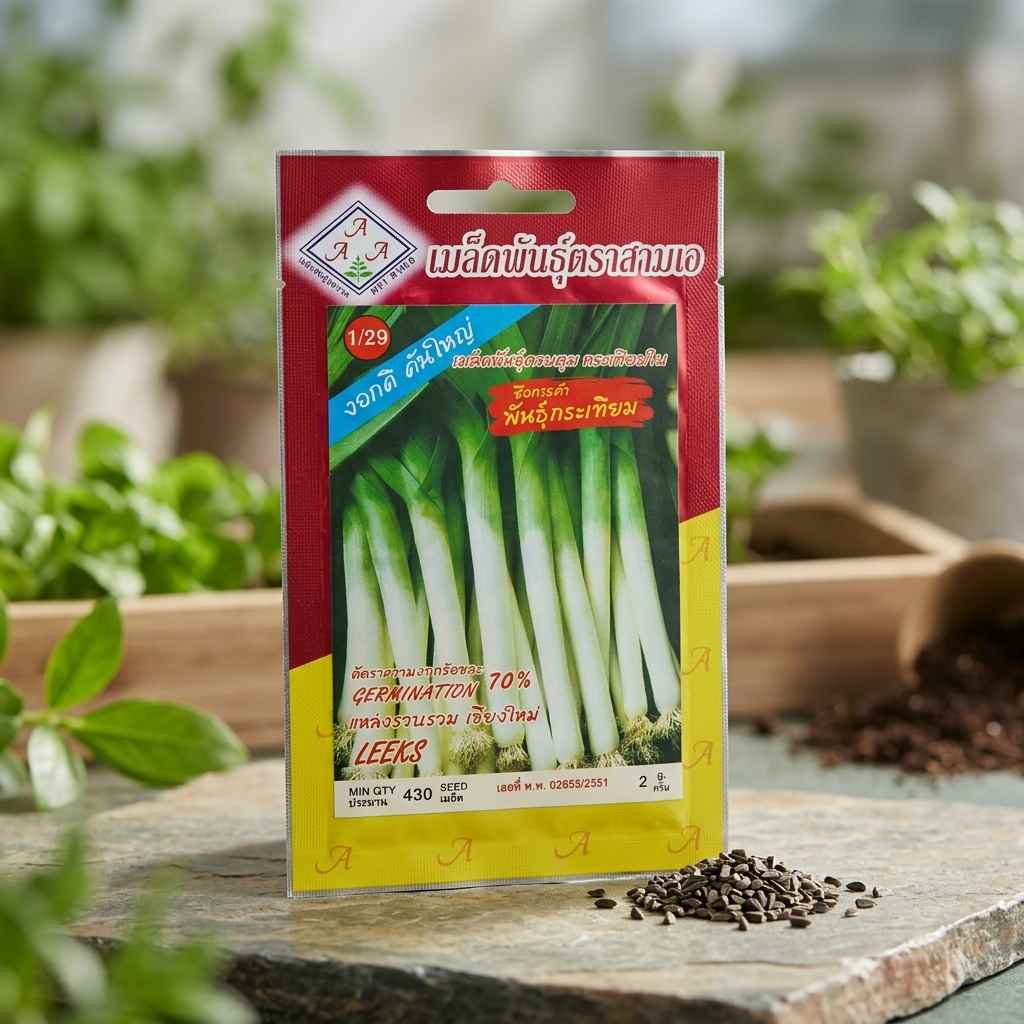
Leeks – 430 seeds – AAA – Thai
Original price was: ৳ 280.00.৳ 160.00Current price is: ৳ 160.00.
Available on backorder
Description
LEEKS
Price: 160 Taka per packet (sale price)
Quantity: 430 seeds (2 gram)
Brand: AAA (Chua Yong Seed Company LTD)
Country: Thailand
Germination Rate (approx.): 70%
Physical Purity (Min): 98%
Genetic Purity (Min): 98%
Seed Germination:
| Parameter | Value | Remarks |
| Minimum germination temperature | 4°C (39°F) | Germination is possible but extremely slow. (plantuse.plantnet.org) |
| Optimum temperature | 16–20°C (61–68°F) | Most university and scientific references agree this provides the highest germination percentage. (plantuse.plantnet.org) |
| Maximum practical temperature | 30°C (86°F) | Above this, germination percentage and seedling vigor decline sharply. (Cambridge University Press & Assessment) |
| Average recommended temperature | 18°C | Best compromise across multiple studies. |
| Germination success (fresh certified seed) | 80–95% | Commercial seed often exceeds 90%; older seed drops rapidly. (MSU Extension) |
| Seed viability | 1–3 years (best); up to 5 years under ideal cold storage | Germination decreases markedly after 2–3 years. (MSU Extension) |
| Dormancy | No true dormancy | Fresh seed germinates readily under favorable conditions. |
Comparison of reported optimum temperatures
| Source | Optimum |
| PROTA | 16–20°C (plantuse.plantnet.org) |
| Michigan State University | 4–35°C germination possible; optimum near 18–21°C (MSU Extension) |
| Cambridge Seed Science Research | Reduced performance above 25–30°C (Cambridge University Press & Assessment) |
Recommendation for Bangladesh
Because daytime temperatures frequently exceed 30°C from April through September, sowing during those months often results in:
- slower germination
- lower germination percentage
- weaker seedlings
Starting seeds indoors in an air-conditioned room or shaded nursery significantly improves success.
Germination Time
| Condition | Days |
| Fastest observed | 6–8 days |
| Average | 10–14 days |
| Slow | 18–21 days |
| Cold conditions | up to 28 days |
Factors affecting germination
| Factor | Effect |
| Temperature | Largest influence |
| Fresh seed | Higher germination |
| Consistent moisture | Essential |
| Deep sowing | Delays emergence |
| Soil crusting | Reduces emergence |
| Salinity | Decreases germination |
| Heat (>28°C) | Reduces vigor |
Plant Dimensions
| Characteristic | Metric | Imperial |
| Mature height | 60–90 cm | 24–36 in |
| Maximum height | 120 cm | 48 in |
| Plant spread | 15–25 cm | 6–10 in |
| Root depth | 20–35 cm | 8–14 in |
| Seed sowing depth | 0.6–1.3 cm | ¼–½ in |
Bangladesh rooftop recommendation
Because containers restrict root expansion, expect mature plants to reach:
- 55–75 cm tall
- 15–20 cm spread
unless very deep containers are used.
Plant Spacing
| Growing system | Recommended spacing |
| Containers | 10–15 cm (4–6 in) |
| Raised beds | 10–15 cm |
| Premium exhibition leeks | 20–25 cm |
| Commercial production | 10–15 cm |
Closer spacing produces thinner “baby leeks,” while wider spacing yields thicker stems.
Row Spacing
| Situation | Row spacing |
| Home garden | 30 cm (12 in) |
| Raised bed | 30–40 cm (12–16 in) |
| Commercial farm | 45–60 cm (18–24 in) |
The wider commercial spacing facilitates weeding, irrigation, and hilling (earthing up).
Support Requirement
| Support | Required? |
| Trellis | ❌ No |
| Stakes | ❌ Usually no |
| Cages | ❌ No |
| Netting | ❌ No |
| String support | ❌ No |
When support becomes useful
Support may be beneficial only when:
- plants exceed 90 cm
- exposed rooftop locations experience strong winds
- exceptionally long blanching sleeves are used
Otherwise, leeks are self-supporting due to their overlapping leaf sheaths.
Seed to Harvest
| Harvest stage | Days | Months |
| Baby leeks | 60–75 days | 2–2.5 months |
| Early harvest | 90–110 days | 3–3.5 months |
| Full maturity | 120–150 days | 4–5 months |
| Commercial harvest window | 120–180 days | 4–6 months |
Newer cultivars can mature in approximately 75–90 days, while traditional cultivars often require 140–150 days. (University of Minnesota Extension)
Seed to Flowering (Bloom)
Leeks are naturally biennial, grown as annuals for edible stems.
| Stage | Value |
| First flowering | 280–380 days |
| Peak flowering | Second growing season |
| Flowering season | Spring to early summer after winter vernalization |
Bangladesh
Natural flowering is uncommon in lowland Bangladesh because winter temperatures are generally insufficient for vernalization. Bolting is therefore rare under typical rooftop conditions. (plantuse.plantnet.org)
Container Recommendation
Individual plant
| Container | Diameter | Depth | Volume |
| Minimum | 20 cm (8 in) | 25 cm (10 in) | 6–8 L |
| Ideal | 25 cm (10 in) | 30 cm (12 in) | 10–12 L |
| Premium | 30 cm (12 in) | 35–40 cm (14–16 in) | 18–20 L |
Multi-plant container
| Size | Plants |
| 60 cm planter | 4–5 |
| 90 cm planter | 7–8 |
| 120 cm planter | 10–12 |
Raised bed recommendation
- Width: 90–120 cm
- Height: 25–30 cm
- Unlimited length
- Two to four rows per bed
Soil Requirements
| Property | Recommendation |
| Texture | Sandy loam to fertile loam |
| Organic matter | High (5–10%) |
| Drainage | Excellent |
| Water holding | Moderate to high |
| Aeration | High |
| Electrical conductivity | <1.5 dS/m preferred |
| Ideal pH | 6.2–6.8 |
| Acceptable pH | 6.0–7.5 |
Ideal soil characteristics
Leeks perform best in soils that:
- are rich in compost,
- remain evenly moist,
- are well aerated,
- do not become waterlogged,
- have a loose structure allowing stems to expand.
Heavy clay encourages disease and short, misshapen stems, while excessively sandy soils dry rapidly and require frequent irrigation.
Bangladesh rooftop recommendation
An ideal rooftop substrate should provide:
- rapid drainage during monsoon rains,
- good moisture retention between irrigations,
- high organic matter,
- low bulk density to reduce rooftop load.
Light Requirement
During Germination
| Parameter | Recommendation | Notes |
| Light requirement | Light is not required; seeds germinate in darkness or light | Cover seeds lightly (0.6–1.3 cm). |
| Ideal temperature | 16–20°C | Highest germination and vigor. |
| Relative humidity | 80–95% around the seed zone | Keep the medium consistently moist, not saturated. |
| Soil moisture | Evenly moist | Avoid drying during germination. |
Bangladesh recommendation: During warm months, use 40–50% shade cloth or germinate indoors to keep the medium cooler.
Mature Plants
| Parameter | Recommendation |
| Minimum direct sun | 5–6 hours/day |
| Optimum | 6–8 hours/day |
| Maximum tolerance | Full sun if moisture is adequate |
| Shade tolerance | Moderate (30–40% shade) |
Leeks tolerate light shade better than onions but produce thicker, sturdier stems under full sun.
Water Requirement
Leeks have relatively shallow roots and require consistent moisture throughout growth.
| Growth stage | Water per plant | Frequency | Goal |
| Germination | 0.05–0.10 L | Daily misting/light watering | Keep surface moist. |
| Seedling | 0.10–0.20 L | Every 1–2 days | Encourage steady root growth. |
| Vegetative | 0.40–0.70 L | Every 2–3 days (adjust for weather) | Support leaf and stem development. |
| Stem enlargement | 0.70–1.00 L | 2–3 times/week | Maintain uniform growth. |
| Mature plants | 0.80–1.20 L | 2–3 times/week | Avoid moisture fluctuations. |
Bangladesh rooftop note: In hot, windy weather, containers may need daily watering. During the monsoon, reduce irrigation and ensure excellent drainage.
Signs of Overwatering
- Yellowing lower leaves
- Soft stem base
- Slow growth
- Root rot
- Fungus gnats
Signs of Underwatering
- Blue-green or dull leaves
- Wilting during the day
- Reduced stem diameter
- Leaf tip dieback
- Premature toughening of the stem
Nutrient Requirement
Leeks are moderate to heavy feeders, especially for nitrogen.
| Nutrient | Relative demand | Role |
| Nitrogen (N) | High | Leaf and pseudostem growth |
| Phosphorus (P) | Moderate | Root development |
| Potassium (K) | Moderate–High | Water regulation and disease tolerance |
| Calcium | Moderate | Cell wall strength |
| Magnesium | Moderate | Chlorophyll formation |
| Sulfur | High | Characteristic Allium flavor compounds |
Essential Micronutrients
| Micronutrient | Importance |
| Iron | Chlorophyll synthesis |
| Zinc | Growth regulation |
| Boron | Cell division and root development |
| Copper | Enzyme activity |
| Manganese | Photosynthesis |
| Molybdenum | Nitrogen metabolism |
Organic Sources
| Material | Major nutrients supplied |
| Cow dung compost | Balanced NPK, organic matter |
| Vermicompost | N, P, K, beneficial microbes |
| Trichocompost | Organic matter + microbial activity |
| Horn meal | Slow-release nitrogen |
| Bone meal | Phosphorus and calcium |
| Neem cake powder | Nitrogen, micronutrients, pest suppression |
| Mustard cake powder | Nitrogen and sulfur |
| Oyster shell powder | Calcium |
| Epsom salt | Magnesium and sulfur |
Organic Fertilizer Program
Initial Potting Mix (per 10–12 L container)
| Ingredient | Amount |
| Cow dung compost | 500 g |
| Vermicompost | 300 g |
| Trichocompost | 200 g |
| Bone meal | 40 g |
| Horn meal | 25 g |
| Neem cake powder | 30 g |
| Mustard cake powder | 20 g |
| Oyster shell powder | 15 g |
| Epsom salt | 5 g |
Mix thoroughly before transplanting.
Monthly Feeding Schedule (per plant)
| Time | Materials | Application |
| Every 30 days | 150 g vermicompost | Surface application |
| Every 45 days | 50 g cow dung compost | Surface application |
| Every 60 days | 10 g neem cake | Mix lightly into the surface |
| Every 60 days | 10 g mustard cake (well-decomposed) | Surface application |
| Every 90 days | 10 g bone meal | Light incorporation |
| Every 90 days | 5 g horn meal | Light incorporation |
| Every 60–90 days | 2–3 g Epsom salt dissolved in water | Soil drench |
| Every 6 months | 5 g oyster shell powder | Surface application |
Yearly Calendar (for continuous sowing)
| Month | Activity |
| At planting | Full base mix |
| Month 1 | Vermicompost + cow dung compost |
| Month 2 | Vermicompost + neem cake + mustard cake |
| Month 3 | Vermicompost + bone meal + horn meal + Epsom salt |
| Month 4 | Repeat Month 1 |
| Continue | Repeat the cycle for successive plantings |
Chemical Fertilizer Program
| Growth stage | Fertilizer | Suggested rate (per m²) | Frequency |
| Before planting | TSP | 30–40 g | Once |
| Before planting | MOP | 20–30 g | Once |
| Before planting | Urea | 10–15 g | Once (starter) |
| 3–4 weeks | Urea | 10–15 g | Side-dress |
| 6–8 weeks | Urea + MOP | 10–15 g + 10 g | Side-dress |
| Stem enlargement | Calcium nitrate | 10–15 g | Every 2–3 weeks if needed |
| High-performance production | Potassium nitrate | 5–10 g in irrigation water | Every 2–3 weeks |
For containers, reduce rates proportionally based on soil volume and avoid placing fertilizer directly against the stem.
Rooftop Potting Mix (Bangladesh)
Recommended Composition (100%)
| Ingredient | % |
| Loamy soil | 25 |
| Coconut coir dust | 20 |
| Cow dung compost | 12 |
| Vermicompost | 10 |
| Trichocompost | 5 |
| Brown river sand | 8 |
| Perlite | 5 |
| Small stones (5–22 mm) | 3 |
| Jhama | 3 |
| Cinder | 2 |
| Wood charcoal | 2 |
| Coconut husk pieces | 2 |
| Wood bark | 1 |
| Neem cake powder | 0.8 |
| Mustard cake powder | 0.6 |
| Bone meal | 0.5 |
| Horn meal | 0.4 |
| Oyster shell powder | 0.4 |
| Epsom salt | 0.2 |
| Turmeric powder | 0.1 |
Approximate Volume Ratio
- 5 parts loamy soil
- 4 parts coir
- 2 parts compost
- 2 parts vermicompost
- 1 part trichocompost
- 1.5 parts sand
- 1 part drainage materials (perlite/jhama/cinder/stone)
Why each ingredient?
| Ingredient | Purpose |
| Coir | Moisture retention |
| Loamy soil | Nutrient buffering |
| Vermicompost | Microbial activity and slow nutrient release |
| Trichocompost | Disease suppression |
| Sand | Improves drainage |
| Perlite | Aeration |
| Charcoal | Adsorbs impurities, improves structure |
| Small stones/Jhama/Cinder | Prevent compaction and improve drainage |
| Neem cake | Reduces soil pests |
| Bone meal | Long-term phosphorus |
| Horn meal | Slow nitrogen release |
| Oyster shell | Calcium and pH buffering |
| Epsom salt | Magnesium and sulfur |
| Turmeric (small amount) | Traditional antimicrobial supplement; use sparingly |
Moisture and Drainage
- Moisture: Hold enough water to remain evenly moist without becoming waterlogged.
- Drainage: Water should drain freely within a few minutes after irrigation.
Companion Plants
Good Companions
| Plant | Benefit |
| Carrot | May help confuse certain pests through mixed scent. |
| Beetroot | Different rooting depth reduces competition. |
| Lettuce | Efficient use of space. |
| Celery | Similar moisture requirements. |
| Spinach | Short-season intercrop. |
| Strawberry | Often reported to coexist well in mixed beds. |
Plants to Avoid
| Plant | Reason |
| Beans | Growth suppression has been observed in mixed plantings. |
| Peas | Similar incompatibility reported in traditional companion planting. |
Note: Companion planting evidence varies. Pest reduction is often observational rather than consistently demonstrated in controlled trials.
Edible Characteristics
Leeks are harvested for their leaf sheaths (pseudostem) and tender leaves, not for a botanical fruit.
Fruit Characteristics
Not applicable.
Leaf / Pseudostem Characteristics
| Characteristic | Description |
| Taste | Mild onion flavor with slight sweetness |
| Texture | Crisp when raw; silky when cooked |
| Aroma | Delicate allium aroma |
| Bitterness | Very low |
| Flavor rating | 8.5–9/10 (culinary preference; subjective) |
Pest Management
| Pest | Symptoms | Chemical control (active ingredient) | Organic control | Prevention |
| Onion thrips (Thrips tabaci) | Silvery streaks, distorted leaves | Spinosad, abamectin (follow local labels) | Neem-based products, reflective mulch | Remove weeds, monitor regularly |
| Onion maggot (Delia antiqua) | Wilting, root tunneling | Cyromazine (where registered) | Crop rotation, exclusion netting | Avoid successive Allium crops |
| Cutworms | Seedlings cut at soil line | Chlorantraniliprole or other registered actives | Hand removal, collars | Weed control |
| Aphids | Curling leaves, sticky honeydew | Flonicamid or other registered actives | Insecticidal soap, beneficial insects | Encourage natural predators |
| Leafminers | Serpentine mines in leaves | Spinosad (where appropriate) | Remove affected leaves | Floating row covers |
Always follow Bangladesh registration status, label directions, and pre-harvest intervals for any pesticide.
Disease Management
| Disease | Cause | Symptoms | Favorable conditions | Chemical treatment | Organic treatment | Prevention |
| Downy mildew | Peronospora destructor | Pale lesions, gray-violet growth | Cool, humid weather | Appropriate fungicides registered for downy mildew | Improve airflow, remove infected leaves | Avoid overhead irrigation |
| Purple blotch | Alternaria porri | Purple lesions with yellow halos | Warm, humid conditions | Protective fungicides where registered | Sanitation, crop rotation | Reduce leaf wetness |
| White rot | Stromatinia cepivora | White fungal growth, plant collapse | Cool, moist soils | Limited; prevention is key | Long crop rotation | Avoid infested soil |
| Botrytis leaf blight | Botrytis spp. | Leaf tip dieback, gray mold | High humidity | Registered botrytis fungicides | Improve ventilation | Remove infected debris |
| Fusarium basal rot | Fusarium oxysporum | Yellowing, basal rot | Warm soils | Registered fungicides where available | Healthy planting material | Well-drained soil, rotation |
Harvest Maturity
Indicators of Harvest Readiness
| Characteristic | Ideal Harvest Stage |
| Stem (white shank) diameter | 2.5–5 cm (1–2 in) for standard leeks; baby leeks may be harvested at 1–2 cm. (Utah State University Extension) |
| Plant height | 40–80 cm (16–32 in), depending on cultivar |
| Leaf color | Dark blue-green to deep green |
| Stem texture | Firm, crisp, and solid |
| Aroma | Mild onion-like fragrance |
| Weight | Typically 150–350 g per market-size plant |
Harvest Timing
- Baby leeks: 60–75 days
- Standard leeks: 100–150 days
- Winter cultivars: up to 180 days (Utah State University Extension)
Leeks do not need to be harvested immediately upon maturity and can remain in cool-season soil for weeks if conditions remain favorable.
Household Production Requirement
Assuming a family of four in Bangladesh uses leeks mainly in soups, stir-fries, curries, fried rice, and mixed vegetables.
| Requirement | Estimated Consumption |
| Weekly | 2–4 leeks (0.4–0.8 kg) |
| Monthly | 8–16 leeks |
| Yearly | 100–180 leeks |
Recommended Planting Schedule
| Purpose | Number of Plants |
| Occasional use | 25–30 |
| Regular household supply | 50–70 |
| Heavy users | 80–100 |
Succession sowing every 3–4 weeks provides a more continuous harvest than planting all at once.
Yield
Yield varies greatly with cultivar, fertility, blanching method, and planting density.
| Unit | Average Yield |
| Per plant | 150–350 g |
| 10–12 L container | 1 plant = 150–350 g |
| 60 cm planter | 0.8–1.5 kg |
| Square foot | 0.6–1.2 kg |
| Square meter | 4–8 kg |
| Acre | 9–15 tonnes |
| Hectare | 22–37 tonnes |
Commercial yields commonly fall within this range under good management. (College of Agricultural Sciences)
Life Cycle
| Characteristic | Description |
| Botanical life cycle | Biennial |
| Cultivation | Usually grown as an annual |
| Productive period | 4–6 months |
| Flowering | Second year after vernalization |
| Maximum lifespan | Approximately 2 years |
Nutritional Value (per 100 g raw)
Based primarily on USDA FoodData Central.
| Nutrient | Amount |
| Energy | 61 kcal |
| Water | 83 g |
| Protein | 1.5 g |
| Fat | 0.3 g |
| Carbohydrate | 14.2 g |
| Dietary fiber | 1.8 g |
| Sugars | 3.9 g |
| Vitamin A | 83 µg RAE |
| Vitamin C | 12 mg |
| Vitamin K | 47 µg |
| Folate | 64 µg |
| Vitamin B6 | 0.23 mg |
| Potassium | 180 mg |
| Calcium | 59 mg |
| Magnesium | 28 mg |
| Phosphorus | 35 mg |
| Iron | 2.1 mg |
| Manganese | 0.48 mg |
Major Antioxidants
- Kaempferol
- Quercetin
- Allicin-related sulfur compounds
- Polyphenols
- Flavonoids
Evidence-Based Health Benefits
Scientific literature attributes several potential health benefits to regular consumption of Allium vegetables, including leeks:
- Supports cardiovascular health through flavonoids and potassium.
- Provides antioxidant compounds that help reduce oxidative stress.
- Supplies prebiotic fiber that supports beneficial gut bacteria.
- Contributes vitamins A, C, and K important for immune function and bone health.
- Provides folate, supporting normal cell growth and DNA synthesis.
- Sulfur-containing compounds may contribute to anti-inflammatory activity.
- Fiber promotes satiety and digestive health.
These benefits are associated with dietary patterns rather than being guaranteed effects of eating leeks alone.
Popular Recipes
Bangladeshi Adaptations
Leek Bhaji
Leeks sautéed with garlic, onion, green chili, and mustard oil.
Chicken & Leek Curry
A mild curry where leeks replace or complement onions, producing a sweeter flavor.
International
Potato-Leek Soup (France)
Classic creamy soup featuring potatoes, butter, stock, and leeks.
Welsh Leeks with Cheese
Traditional Welsh baked leeks topped with cheese and breadcrumbs.
Best Sowing Time in Bangladesh
Leeks are a cool-season crop. Bangladesh’s recent climatic patterns continue to favor sowing during the cooler months, while high summer temperatures reduce germination and quality. (BAMIS)
| Month | Suitability |
| October | ★★★★★ Excellent |
| November | ★★★★★ Excellent |
| December | ★★★★★ Excellent |
| January | ★★★★☆ Very good |
| February | ★★★☆☆ Acceptable |
| March | ★★☆☆☆ Marginal |
| April–September | ★☆☆☆☆ Generally unsuitable outdoors |
Why?
- Germination is best at 16–20°C.
- Temperatures above ~30°C reduce germination and increase stress.
- Cooler weather improves stem quality and reduces bolting risk.
For rooftop gardeners, seeds can still be started indoors under cooler conditions outside the main season.
Seeds per Gram
Multiple sources report noticeable variation because seed size differs among cultivars.
| Source | Seeds/g |
| Commercial seed companies | ~250 |
| Oregon State estimate (converted) | ~390 |
| Other horticultural catalogs | 300–350 |
Recommended Summary
| Parameter | Value |
| Minimum | 250 seeds/g |
| Average | 320 seeds/g |
| Maximum | 390 seeds/g |
Propagation
| Method | Success |
| Seed | 80–95% (fresh seed under optimum conditions) |
| Division (second-year clumps) | Moderate |
| Tissue culture | Research/commercial breeding only |
Best Method
Seed propagation is overwhelmingly preferred because it is economical, reliable, and preserves cultivar characteristics in commercial production.
Storage
| Method | Shelf Life |
| Refrigerator (0–4°C) | 2–3 weeks |
| Wrapped in perforated plastic | 3–4 weeks |
| Frozen (after blanching) | 8–12 months |
| Vacuum sealed (refrigerated) | 3–5 weeks |
| Vacuum sealed (frozen) | Up to 12 months |
| Dehydrated | 6–12 months (airtight) |
| Pickled | 3–6 months refrigerated |
(Utah State University Extension)
- Special Characteristics
- The edible “stem” is actually tightly overlapping leaf sheaths (a pseudostem), not a true stem.
- Leeks tolerate frost better than common bulb onions.
- Blanching by earthing up or using sleeves produces the prized long white shank.
- Inspirational Quotes
“Like the leek, true strength grows quietly—layer by layer, beneath patient care.”
“A well-grown leek reminds us that steady nourishment and time create lasting quality.”
- Lesser-Known Facts
- Leeks are one of the national emblems of Wales and have been worn as a symbol for centuries.
- Unlike onions, leeks are harvested before a true bulb develops.
- The flower heads are attractive to pollinators and are sometimes grown ornamentally if plants are allowed to flower in their second year.
- Native Region
| Item | Description |
| Native region | Eastern Mediterranean and Western Asia (ancestral forms) |
| Native habitat | Open grasslands and rocky habitats where wild Allium relatives occur |
| Ecosystem | Temperate Mediterranean environments |
- Origin and History
Leeks were domesticated from wild relatives of Allium ampeloprasum in the Mediterranean region. They have been cultivated for several thousand years and were valued by the ancient Egyptians, Greeks, and Romans for both culinary and medicinal purposes. Over time, selective breeding emphasized longer white pseudostems, improved winter hardiness, and better disease resistance, giving rise to modern cultivars grown worldwide.
- Taxonomy
| Category | Value |
| Scientific name | Allium ampeloprasum var. porrum |
| Common names | Leek, Garden Leek |
| Family | Amaryllidaceae |
| Subfamily | Allioideae |
| Genus | Allium |
| Species | Allium ampeloprasum |
| Variety | porrum |
| Chromosome number | 2n = 32 |
Recommended Core References
Peer-reviewed / Scientific
- Xie & Kristensen (2017). European Journal of Agronomy (intercropping and nitrogen dynamics). (Ask IFAS – Powered by EDIS)
- USDA FoodData Central nutrient database. (Ask IFAS – Powered by EDIS)
University Extension
- Utah State University Extension – How to Grow Leeks in Your Garden. (Utah State University Extension)
- University of Maryland Extension – Growing Leeks in a Home Garden. (University of Maryland Extension)
- Oregon State University Vegetable Production Guide. (College of Agricultural Sciences)
- University of Florida IFAS – Leek Cultivation Guide. (Ask IFAS – Powered by EDIS)
Government
- Bangladesh Agro-Meteorological Information Service (BAMIS), Department of Agricultural Extension. (BAMIS)
Commercial Horticultural Sources
- Continental Seeds – Leek production guide and seed specifications. (continentalseeds.com)
Overall Suitability for Bangladesh Rooftop Gardening
| Factor | Rating |
| Container suitability | ★★★★★ |
| Rooftop cultivation | ★★★★★ (winter season) |
| Beginner friendly | ★★★★☆ |
| Heat tolerance | ★★☆☆☆ |
| Monsoon suitability | ★☆☆☆☆ |
| Organic cultivation | ★★★★★ |
| Yield in containers | ★★★★☆ |
| Culinary value | ★★★★★ |
*The video links given below is just for reference. You can also try growing them in other known methods.
Reference Tutorial Link 1:
Reference Tutorial Link 2:
Disclaimer: In accordance with the universal custom of seed trade we give no warranty expressed or implied as to description, quality, productivity or any other matter of any way for the crop results beyond the purchased price especially under unsuitable season, abnormal weather, unsuitable soil and other unexpected conditions.
বীজ ব্যবসার সার্বজনীন প্রথা অনুযায়ী আমরা বিশেষত অনুপযুক্ত ঋতুতে, বিশেষত অনিয়মিত আবহাওয়া, অনুপযুক্ত মাটি এবং অন্যান্য ক্রয়মূল্যের বাইরে ফসলের ফলনের বর্ণনা, গুণমান, উৎপাদনশীলতা বা অন্য যে কোনও বিষয়ে বর্ণিত ওয়ারেন্টি প্রদান করি না। অপ্রত্যাশিত শর্ত।
#80T(01092024EPIMONA) #leek #leeks #AAA #Chua #Yeng #Yong #Seng #seeds #seed #thailand #thai #vegetable #herb #how #to #grow #from #garden #gardening #rooftop #recipe #online #store #shop #company #brand #good #quality #supplies #near #me #in #MyGardenBd #my #garden #bd #dhaka #Bangladesh #Leek #Leeks #AlliumAmpeloprasum #AlliumPorrum #CoolSeasonVegetable #VegetableGarden #KitchenGarden #OrganicGardening #UrbanGardening #ContainerGardening #RaisedBedGardening #HomeGarden #RooftopGardening #BangladeshGardening #WinterVegetables #GrowYourOwnFood #GardenToTable #HealthyEating #MyGardenBd #Bangladesh #লিক #লিক_শাক #সবজি #শীতকালীন_সবজি #ছাদকৃষি #বাগান #জৈব_কৃষি #সবজি_চাষ #কিচেন_গার্ডেন #বাংলাদেশ_কৃষি #মাইগার্ডেনবিডি
Only logged in customers who have purchased this product may leave a review.
Related products
-
Sale!

-Rock Melon Madhurima F1 Hybrid – 10 Seeds – MGS1134
Original price was: ৳ 130.00.৳ 50.00Current price is: ৳ 50.00. -

-

-


Reviews
There are no reviews yet.