
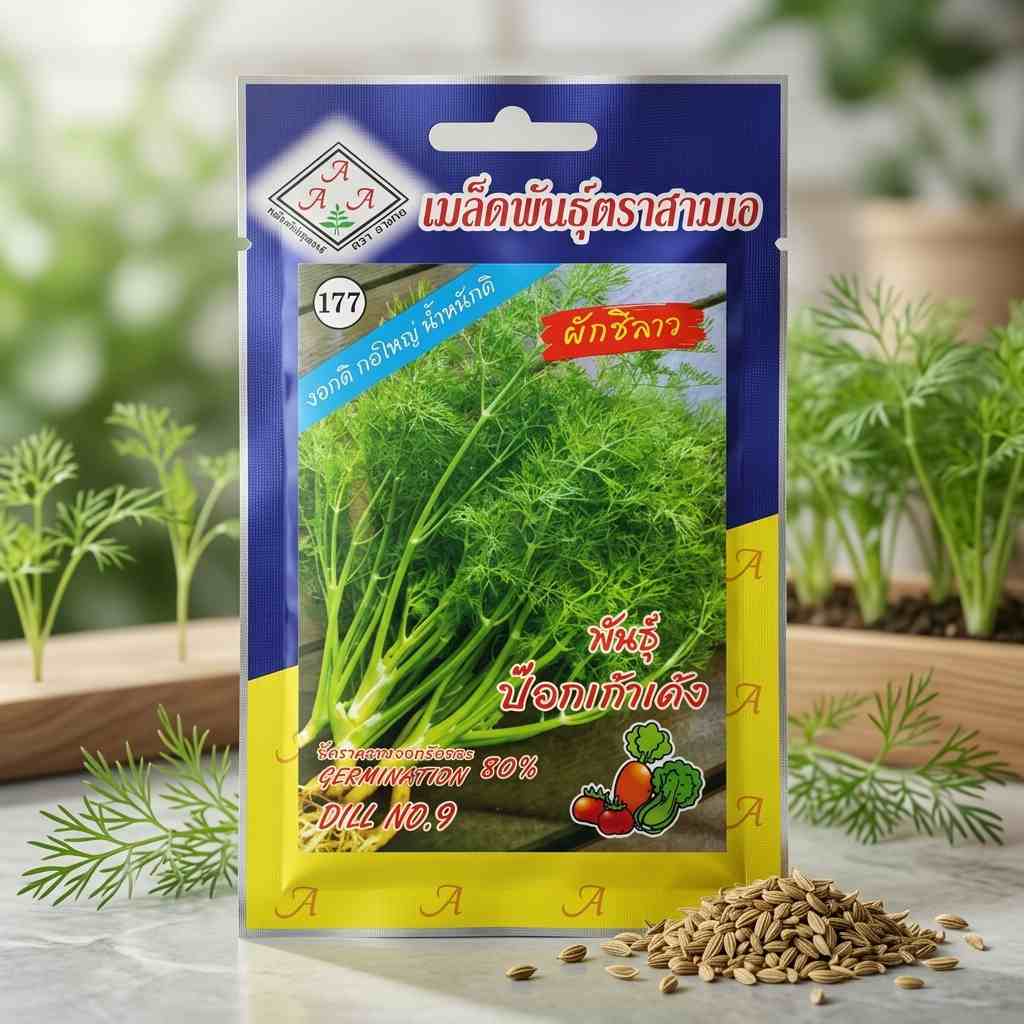
Dill – (2500 to 3500 seeds) – AAA – Thai
Original price was: ৳ 280.00.৳ 180.00Current price is: ৳ 180.00.
Available on backorder
Description
Dill
Price: 180 Taka per packet (sale price)
Quantity (approx.): 05 gram Seeds
Brand: AAA
Seed’s Origin: Thailand
Germination Rate (Approx.): 80%
Physical Purity (Min): 98%
Genetic Purity (Min): 98%
Complete Growing & Production Guide
Germination temperature
Recommended range
- Best practical range: 18–25°C
- Optimum target for rooftop seed starting: 20–25°C
- Seeds can germinate over a wider range, but germination becomes slower or less uniform at extremes.
- A controlled experiment found the fastest/highest germination under a 20/30°C thermoperiod, while both cooler and hotter regimes were less favorable. Another study found 25°C particularly favorable. (Mak Hill Publications)
- Johnny’s seed-production guide lists 15°C as the germination temperature for dill, with 10–21 days germination, while other horticultural references recommend 15–21°C soil temperature. (Johnny’s Selected Seeds)
Recommendation for Bangladesh
20–24°C soil temperature is an excellent target.
For Dhaka rooftop production, this makes November–January particularly attractive.
Germination time
Normally: 7–14 days
Allow:
- Excellent conditions: 7–10 days
- Normal conditions: 10–14 days
- Cool/poor-moisture conditions: 15–21 days
Sources report approximately 10–14 days, 10–21 days, and 15–20 days depending on temperature and seed quality. (Plant Toolbox)
Dill No. 9 expectation
8–14 days under good Bangladesh rooftop conditions.
Plant height, spread and sowing depth
Plant height
For ordinary Anethum graveolens:
- Typical: 60–100 cm
- Some cultivars: up to 120–150 cm
- Commercial Thai No. 9 appears to be a relatively vigorous/large-clumping type, but an authoritative height specification could not be located.
Dill references report approximately 60–100 cm, while some cultivars reach 1.5 m. (RHS)
Expected Dill No. 9 under Bangladesh conditions
60–90 cm is a practical planning figure.
With excellent nutrition and long days, taller plants are possible.
Mature spread
Approximately: 25–40 cm
Seed depth: 0.5–1.0 cm
Do not bury the seed deeply.
Dill has a long taproot and is best directly sown. Commercial recommendations commonly use about 6 mm–1 cm. (Runåbergs Fröer)
Plant spacing
For Dill No. 9 grown primarily for fresh leaves:
8–12 inches (20–30 cm) between plants.
For very dense baby-leaf production, closer planting is possible, but for a large-clumping type I recommend:
10 inches / 25 cm
This provides better airflow in humid Bangladesh conditions.
General references range from 3–12 inches depending on whether the crop is being grown for baby leaves, mature leaves or seed. (Runåbergs Fröer)
Row spacing
Recommended: 18–24 inches (45–60 cm)
For commercial/bed production:
- Leaf production: 30–45 cm
- Large mature plants: 45–60 cm
A research trial used 15–20 cm rows within strips and 50 cm between strips, while another horticultural reference recommends approximately 70 cm between rows. (MDPI)
For Bangladesh rooftop beds, 45 cm is a very good compromise.
Trellis/support requirement
Not normally required.
However, Dill No. 9 may benefit from support because:
- Tall stems are hollow.
- Rooftops experience strong wind.
- Heavy rain can bend the plants.
- Over-fertilization produces soft, tall growth.
- Wet foliage increases disease risk.
Tall dill cultivars may need staking, particularly in windy conditions. (Wisconsin Horticulture)
Rooftop recommendation
For plants above 50–60 cm:
Use a thin bamboo stick or 3–4 mm support stake.
Do not construct a heavy trellis.
Seed-to-harvest time
This depends on what you are harvesting.
Young leaves: 25–35 days
Commercial mature leaf harvest: 40–50 days
PROSEA gives approximately 40–50 days after sowing for dill herb harvested before flowering. (Pl@ntUse)
Dill No. 9 commercial claim
The Thai seed listing specifically advertises:
45 days to harvest. (Shopee)
Therefore:
Dill No. 9: approximately 40–45 days for the first major leaf harvest
Seed-to-bloom time
For normal dill:
Approximately 55–80 days
depending on:
- temperature
- day length
- nutrition
- moisture
- cultivar
- stress
Under Bangladesh’s warm conditions, bolting can occur considerably earlier than in cool climates.
For maximum leaf production, harvest before the yellow umbels open. (University of Minnesota Extension)
Recommended pot/container size
Dill develops a long taproot, so shallow containers are unsuitable.
Minimum
10–12 inch diameter × 10–12 inch deep
Recommended for Dill No. 9
12–14 inch diameter × 12–14 inch deep
Approximate volume: 15–25 L
Ideal rooftop container
14 × 14 inch equivalent / ~20 L
One large Dill No. 9 plant per container gives the best result.
Dill’s long taproot is one reason direct sowing is preferred over transplanting. (University of Minnesota Extension)
Soil type and pH
Ideal soil
A:
loamy + porous + organic-matter-rich + very well-drained medium
should be used.
Avoid:
- heavy clay
- permanently wet soil
- compacted soil
- very fine pure compost
- pure coco-coir
- poorly drained rooftop containers
Ideal pH: 6.0–6.8
Practical acceptable range: 5.5–7.0
One specialist crop database gives 5.5–6.5, while other horticultural sources place dill around slightly acidic to neutral conditions. (Ephytia)
Recommended for Bangladesh: pH 6.2–6.7
Sunlight and germination light
Mature plants: 6–8 hours of direct sunlight/day
Prefer: 7–8 hours
Dill grown with insufficient light becomes:
- thin
- tall
- floppy
- less productive
University of Minnesota recommends at least 6–8 hours of direct sunlight. (University of Minnesota Extension)
During germination
Dill seed does not require strong light to germinate.
The seed should be:
- lightly covered
- kept continuously moist
- protected from intense rooftop heat
After emergence:
Give maximum available light immediately.
Controlled research found that light can influence germination responses, but dill can germinate without requiring a strong-light germination regime. (Mak Hill Publications)
Water requirement
Water requirements are highly dependent on:
- temperature
- pot size
- wind
- sunlight
- humidity
- substrate
- plant size
Therefore, giving one fixed litre value for every Bangladesh day would be misleading.
For a ~20 L container, use this practical schedule:
| Plant stage | Approx. water/plant/day | Bangladesh rooftop interval |
|---|---|---|
| Seed | 100–200 ml | Small amounts daily/as needed |
| 2–3 inch seedling | 150–300 ml | Daily or every 1–2 days |
| 4–8 inch plant | 300–500 ml | Daily/alternate day |
| 8–16 inch | 500–800 ml | Daily |
| 16–24 inch | 700–1,200 ml | Daily |
| Mature hot-weather plant | 1,000–1,500 ml | Usually daily |
| Rainy/cloudy period | 200–600 ml or none | Only when needed |
Most important rule
Don’t water according to the calendar alone.
Water when the upper: 1–2 cm
becomes slightly dry.
The root zone should remain moist but never waterlogged. Dill is particularly vulnerable to problems associated with excessive wetness. (Pl@ntUse)
Essential nutrients
For vigorous leaf production, the most important nutrients are:
| Nutrient | Importance | Approximate fertilizer priority |
|---|---|---|
| N | Very high | ~3–4% of active fertilizer requirement |
| P | Moderate | ~1–2% |
| K | High | ~2–3% |
| Ca | High | structural growth |
| Mg | Moderate | chlorophyll |
| S | Moderate | protein/aroma |
| Fe | Important | chlorophyll |
| Zn | Important | enzyme function |
| B | Small but important | meristem/flower development |
| Mn | Important | photosynthesis |
| Cu | Trace | enzymes |
| Mo | Trace | nitrogen metabolism |
Those percentages should not be interpreted as the percentage of each nutrient in the plant. They are a practical indication of relative fertilizer emphasis.
For seed production, a Bangladesh Agricultural Research Institute/Bangladesh Agricultural University trial found a strong response to nitrogen and obtained its highest seed yield with approximately:
N 90 : P₂O₅ 35 : K₂O 50 : S 20 kg/ha
plus cow dung and small B/Zn doses. (ResearchGate)
Organic sources from your list
| Material | Important nutrients |
|---|---|
| Vermicompost | N, P, K + micronutrients |
| Trichocompost | N, P, K + organic matter/microbes |
| Cow-dung compost | N, P, K + Ca/Mg |
| Horn meal | ~12% N |
| Bone meal | P + Ca + some N |
| Neem cake | ~2–5% N + P/K |
| Mustard cake | ~4–5% N + P/K + S |
| Oyster shell | ~33–40% Ca |
| Epsom salt | ~9.8% Mg + ~13% S |
Organic fertilizer composition varies substantially between manufacturers and batches, so product-label/COA analysis should take priority. (UMass Amherst)
Organic fertilizer quantity per plant
For the recommended ~20 L container, I would use the following conservative organic programme.
At planting
Per plant:
| Organic fertilizer | Quantity |
|---|---|
| Vermicompost | 150 g |
| Trichocompost | 100 g |
| Cow-dung compost | 100 g |
| Horn meal | 8 g |
| Bone meal | 8 g |
| Neem cake | 8 g |
| Mustard cake | 5 g |
| Oyster shell powder | 3 g |
| Epsom salt | 1 g |
Total
Approximately:
383 g organic amendment/fertilizer per 20-L container
Do not place concentrated horn/bone/cake directly against the seed.
Mix thoroughly into the upper 8–10 cm of growing medium.
Top dressing
At approximately 25–30 days after germination:
- Vermicompost: 50 g
- Trichocompost: 30 g
- Neem cake: 3–4 g
- Mustard cake: 3 g
Then repeat approximately every:
25–30 days
if the crop is being maintained for repeated leaf harvesting.
Important
Do not repeatedly add large amounts of:
- mustard cake
- neem cake
- horn meal
- Epsom salt
- oyster shell
just because they are organic.
Organic does not automatically mean harmless at excessive rates.
Chemical fertilizer programme
For rooftop Dill No. 9, I prefer a low-dose soluble fertilizer programme rather than heavy granular feeding.
Seedling stage
From approximately 10–14 days after emergence:
19-19-19 at 0.5 g/L water
Apply approximately:
250–400 ml solution/plant
every:
10–14 days
Vegetative stage
From approximately 20–25 days:
19-19-19 at 1 g/L
Apply:
500–800 ml solution/plant
every:
10–14 days
Mature leaf-production stage
Continue:
1 g/L 19-19-19
every:
12–14 days
if plants remain vigorous.
If flowering/seed production is desired
A potassium-dominant fertilizer can be introduced after strong vegetative growth, but avoid excessive phosphorus.
For example:
0-0-50 at 0.5 g/L
once every 2–3 weeks during reproductive development.
Do not combine
Don’t apply a heavy organic cake dose + strong soluble fertilizer on the same day.
Recommended rooftop potting mix
Final potting mix
| Ingredient | Percentage |
|---|---|
| Loamy soil | 35% |
| Coconut coir dust | 15% |
| Vermicompost | 15% |
| Trichocompost | 10% |
| Cow-dung compost | 10% |
| Coconut husk, medium | 5% |
| Perlite | 4% |
| Brown river sand | 3% |
| Wood charcoal | 2% |
| Cinder | 1% |
| Total | 100% |
Example: 20 L container
Approximately:
- Loamy soil — 7.0 L
- Coir — 3.0 L
- Vermicompost — 3.0 L
- Trichocompost — 2.0 L
- Cow-dung compost — 2.0 L
- Coconut husk — 1.0 L
- Perlite — 0.8 L
- Brown sand — 0.6 L
- Charcoal — 0.4 L
- Cinder — 0.2 L
Then incorporate the organic fertilizer programme above.
Bangladesh rooftop modification
Because Dhaka rooftops can become extremely hot, the combination of:
coir + compost + husk + perlite + small amount of sand
helps prevent the root zone from becoming a dense, waterlogged mass.
Companion plants
Good candidates include:
- Cabbage
- Broccoli
- Cauliflower
- Kale
- Lettuce
- Cucumber
- Onion
- Chives
- Marigold
- Coriander
- Other brassicas
Research-based extension material identifies dill as useful around cole crops and some greens because it can attract beneficial insects and parasitoid wasps. (Penn State Extension)
Avoid placing large dill plants immediately beside carrots
Some extension references specifically list dill as incompatible with carrots. (Virginia Tech Publications)
Fruit taste
Dill does not produce a culinary fruit in the normal vegetable sense.
Its dry botanical fruit is commonly called dill seed.
Dill seed flavour
Taste rating: 7/10
Characteristics:
- aromatic
- warm
- slightly bitter
- citrusy
- anise-like
- caraway-like
- strongly resinous
The leaves are generally more delicate; seeds are considerably stronger and more pungent.
Leaf taste
Taste rating: 8/10
Fresh Dill No. 9 foliage should have:
- strong aromatic character
- fresh green flavour
- slight sweetness
- mild anise/caraway character
- citrus-like freshness
Fresh dill loses aroma relatively quickly after harvest. (Wisconsin Horticulture)
Pests and control
1. Aphids
Symptoms
- curled leaves
- sticky honeydew
- clusters on tender shoots
- weak growth
Chemical options
Depending on local registration and crop label:
- Acetamiprid
- Imidacloprid
- Spinosad where appropriate for the target insect
For edible herbs, use only products registered for the crop/use in Bangladesh and follow the label’s PHI.
Organic
- strong water spray
- insecticidal soap
- neem oil
- encourage ladybirds/lacewings
- remove badly infested shoots
Aphids are among the better-documented dill pests. (University of Delaware)
2. Caterpillars / armyworms
Chemical
Depending on registered local labels:
- Bacillus thuringiensis (Bt)
- Spinosad
- selected caterpillar insecticides registered for edible herbs
Organic
Bt is the preferred biological approach.
Hand-pick larger caterpillars.
Be cautious about destroying swallowtail caterpillars unnecessarily: dill is an important host plant for them. (Wisconsin Horticulture)
3. Cutworms
Chemical
Use only locally registered products; active ingredients commonly used against cutworms include:
- chlorantraniliprole
- spinosad
- suitable pyrethroids where legally labelled
Organic
- remove weeds
- inspect at night
- hand-pick
- physical collars around young plants
- Bt where appropriate
Diseases
Powdery mildew
Symptoms
White powdery coating on foliage.
Chemical
Possible fungicide groups include:
- sulfur
- copper-based fungicides
- selected systemic fungicides where the crop label permits
PROSEA specifically reports copper-containing fungicides for dill powdery mildew. (Pl@ntUse)
Organic/cultural
- improve airflow
- avoid overcrowding
- water soil rather than foliage
- remove badly affected leaves
- avoid excessive nitrogen
- avoid evening overhead irrigation
Downy mildew
Favoured by:
- high humidity
- wet foliage
- poor air circulation
Management
- wider spacing
- morning irrigation
- good airflow
- remove infected leaves
- avoid prolonged leaf wetness
Downy mildew is documented as a dill disease. (University of Delaware)
Alternaria leaf spot
Symptoms include dark/blackish lesions.
Chemical
Products containing appropriately registered fungicides such as:
- mancozeb
- difenoconazole
- azoxystrobin
may be used only where the product is registered for dill/edible herbs and the label permits it.
Alternaria on dill can be seed-borne, and sanitation, crop rotation and clean seed are important. (PNW Pest Handbooks)
Fusarium/root rot
Prevention is more important than treatment.
- Don’t overwater.
- Don’t use waterlogged containers.
- Use sterile/clean substrate.
- Avoid excessive nitrogen.
- Rotate crops.
- Remove severely infected plants.
Fusarium, Pythium and Rhizoctonia can be serious under prolonged wet conditions. (Pl@ntUse)
How to identify mature/ready seed
Since dill has no fleshy fruit, use the seed/fruit stage.
For leaf harvest
Harvest when:
- plant is approximately 20–40+ cm
- foliage is lush
- before the main flower umbels open
For seed
The fruits should:
- become fully developed
- change from green toward tan/brown
- become heavier
- begin drying
- be harvested before excessive seed shattering
Dill seed is commonly harvested as the seed clusters turn golden/tan or brown. (Plant Toolbox)
Monthly yield required for a family of four
Dill is a herb/seasoning, not normally eaten in large quantities like spinach or cabbage.
For a Bangladeshi family of four:
Practical household requirement
0.5–1.0 kg fresh dill/month
would be a generous home supply.
If dill is used frequently in:
- fish
- dal
- vegetables
- salads
- chutney
- pickles
- bhorta
- soups
you could use approximately:
1–1.5 kg/month
Average crop yield per square foot
Published fresh-herb yields are broad: approximately 3–20 tonnes/ha depending on system and harvest stage. (Pl@ntUse)
Conversion:
1 hectare = 107,639 ft²
Therefore:
Approximate fresh yield
0.028–0.186 kg/ft²/crop
or approximately:
28–186 g/ft²/crop
For realistic rooftop planning, I would use:
50–120 g/ft² per crop cycle
rather than assuming the theoretical upper end.
Average lifespan
Dill is primarily an:
Annual plant
Typical productive life: 3–5 months
Depending on climate and whether repeated leaf harvest delays flowering.
It generally completes its biological cycle in one growing season.
Nutritional values
Fresh dill is surprisingly nutrient-dense for an herb.
Approximately per 100 g fresh dill:
| Nutrient | Approximate amount |
|---|---|
| Energy | 43 kcal |
| Protein | 3.46 g |
| Carbohydrate | 7.02 g |
| Fat | 1.12 g |
| Fibre | 2.1 g |
| Water | 85.95 g |
| Potassium | ~738 mg |
| Calcium | ~208 mg |
| Magnesium | ~55 mg |
| Phosphorus | ~66 mg |
| Iron | ~6.6 mg |
| Manganese | ~1.26 mg |
| Vitamin A | ~386 µg RAE |
| Folate | ~150 µg |
Values vary with cultivar, maturity and growing conditions. The fresh-dill figures above are based on USDA FoodData Central-derived data. (What You Eat)
Five potential health benefits
Dill contains:
- vitamin C
- carotenoids
- polyphenols
- flavonoids
- aromatic essential-oil compounds
Potential benefits associated with normal dietary consumption include:
1. Antioxidant support
Dill contains polyphenols and other antioxidant compounds. (ScienceDirect)
2. Digestive support
Traditionally, dill has been used as a carminative herb to support digestion and reduce gas. (PubMed Central (PMC))
3. Micronutrient contribution
It contributes vitamin A, vitamin C, folate, calcium, iron, potassium and manganese. (栄養DB)
4. Potential antimicrobial activity
Dill extracts and essential-oil constituents have demonstrated antimicrobial activity in laboratory studies, but this should not be interpreted as a medical treatment. (PubMed Central (PMC))
5. Fibre contribution
Fresh dill contributes dietary fibre while adding very few calories. (What You Eat)
28. Four recipes
🇧🇩 1. Bangladeshi-style Dill Bhorta
Use:
- chopped fresh dill
- green chilli
- onion
- garlic
- mustard oil
- salt
- roasted dried chilli
Lightly sauté the dill, then mash together.
🇧🇩 2. Dill & Fish Curry
Excellent with:
- rui
- katla
- pangas
- small river fish
Add fresh dill near the end of cooking to retain its aroma.
🌍 3. Dill Potato Salad
Combine:
- boiled potatoes
- fresh dill
- yogurt
- lemon
- black pepper
- mustard
- salt
🌍 4. Dill Pickles
Dill is one of the classic herbs used in pickling.
Combine with:
- cucumber
- vinegar
- garlic
- salt
- dill seed
- fresh dill
- peppercorns
Dill is historically and commercially important in pickling. (Wisconsin Horticulture)
Best month for germination in Bangladesh
This is particularly important for your rooftop setup.
Bangladesh’s winter is substantially cooler and drier than the monsoon. BMD climatology puts Dhaka’s normal mean temperature around:
- November: 24°C
- December: 20°C
- January: 18°C
- February: 21°C (Bangladesh Meteorological Department)
Recent Dhaka observations also show that November–February has much lower rainfall than the monsoon period. (Japan Meteorological Agency)
Best month
🥇 November
Especially:
mid-November to early December
This gives:
- suitable germination temperatures
- relatively dry conditions
- strong winter sunlight
- reduced fungal pressure
- good leaf quality
Second-best
December
Third
January
January can work very well, but cold spells may slow germination.
Avoid for premium leaf production
April–September
because excessive heat, humidity, rain and fungal pressure make dill more difficult.
For the last two years, Dhaka observations show November–February conditions substantially closer to dill’s preferred growing environment than the hot/wet season. (Japan Meteorological Agency)
Average number of seeds per gram
This varies considerably according to cultivar and seed size.
Published references give:
- 550 seeds/g — one commercial seed supplier
- 600–700 seeds/g — seed supplier
- 700 seeds/g — scientific study using dill cv. Szmaragd
- ~868 seeds/g — Jelitto
- 900 seeds/g — seed-count reference
Best practical estimate for Dill No. 9
Because the Thai No. 9 is described as a relatively large seed/large-clumping type:
~700–850 seeds/g
For commercial calculations I would use:
750 seeds/g
as the working figure.
Best propagation method
Direct seed sowing
This is unequivocally the preferred method.
Procedure
- Prepare final container.
- Moisten growing medium.
- Make shallow grooves 0.5–1 cm deep.
- Sow seeds thinly.
- Lightly cover.
- Mist.
- Keep evenly moist.
- Provide bright light immediately after emergence.
- Thin to approximately 10 inches between plants.
Dill’s long taproot makes transplanting undesirable. (University of Minnesota Extension)
Do NOT routinely transplant nursery-grown dill.
Storage
Fresh leaves
Best:
Refrigerator at ~0–4°C
Wrap loosely in:
- slightly damp paper towel
- perforated food bag/container
Expected quality
Approximately: 5–7 days
under normal household refrigeration.
Commercial optimal storage conditions around 0°C and very high RH can preserve dill for approximately 1–2 weeks. (Ephytia)
Freezing
Best long-term household method:
- Wash.
- Dry thoroughly.
- Chop.
- Put into ice-cube trays.
- Add a little water.
- Freeze.
- Transfer cubes to airtight freezer bag.
This preserves usability for several months, although texture and some aroma change.
Dill can be frozen in water, and research has examined frozen dill for extended storage. (Wisconsin Horticulture)
Drying
Possible, but not my preferred method because fresh dill loses considerable aroma during drying. (Wisconsin Horticulture)
Few specialties
1. Extremely aromatic foliage
Its finely divided foliage contains volatile oils responsible for its characteristic aroma.
2. Dual-purpose crop
You can harvest: leaves + flowers + seeds from the same plant.
3. Beneficial-insect plant
Dill attracts pollinators and predatory/parasitoid insects, making it valuable in mixed gardens. (Penn State Extension)
Beautiful quotes
“Dill is the quiet fragrance of a garden—delicate in leaf, generous in flavour.”
“Grow dill for the kitchen, but let it flower for the life around it.”
Lesser-known facts
1. Dill is not actually a type of fennel
They look remarkably similar, but they are different genera and species.
2. The “seed” is technically a fruit
The structure commonly called a dill seed is botanically a dry fruit containing the seed.
3. Dill has an extremely old culinary history
Archaeological evidence places dill use in ancient Egypt thousands of years ago; it has also been associated with the tomb of Pharaoh Amenhotep II. (Middle East Studies Center)
Native region
Modern botanical databases describe Anethum graveolens as native primarily to:
North Africa through the Middle East/Iran–Arabian Peninsula region, while historical horticultural literature also describes dill more broadly as originating around South-West Asia/South-East Europe.
Kew’s current native-range treatment is North Africa to Chad and Iran to the Arabian Peninsula. (Plants of the World Online)
Therefore, I would describe its origin conservatively as:
North Africa–Middle East / Southwest Asian region
Origin story
There is no known single person who “invented” dill.
It is an ancient naturally occurring species that humans domesticated and cultivated over thousands of years.
The scientific name:
Anethum graveolens L.
was formally published by Carl Linnaeus in 1753 in Species Plantarum. (Plants of the World Online)
Dill had already been cultivated and used as a culinary and medicinal herb long before Linnaeus.
So:
- Ancient growers: domesticated/cultivated it
- Linnaeus: formally described/named the species scientifically
- Dill No. 9: appears to be a modern commercial seed line rather than a historically documented Linnaean cultivar
Scientific name and family
Scientific name
Anethum graveolens L.
- Family: Apiaceae
- Order: Apiales
- Genus: Anethum
- Species: graveolens
Kew, USDA/GRIN and NCBI all place dill within Apiaceae. (Plants of the World Online)
Info references
Dill botany, cultivation and general horticulture
University of Wisconsin–Madison — Dill, Anethum graveolens
University of Minnesota Extension — Growing dill in home gardens
North Carolina Extension — Anethum graveolens
University of Delaware Extension — Dill
Penn State Extension — Herb Garden Plants: Dill
Royal Horticultural Society — Anethum graveolens
Scientific/botanical references
Kew Plants of the World Online — Anethum graveolens L.
USDA GRIN-Global — Anethum graveolens L.
NCBI Taxonomy — Anethum graveolens
World Flora Online — Anethum graveolens
Agronomic/research literature
PROSEA/PlantUse — Anethum graveolens production and cultivation
Journal research — Effects of temperature and salinity on dill germination
Food Chemistry — Macro- and microelements in fresh and frozen dill
Journal of Food Composition and Analysis — Vitamins, carotenoids and polyphenols in dill
Nutrients/plant research — Nutritional value and phytochemical properties of dill
ScienceDirect — Dill, Handbook of Herbs and Spices
Bangladesh-specific evidence
Bangladesh Meteorological Department — Seasonal Forecast Portal
Bangladesh Meteorological Department — Winter 2025–26 outlook
JMA ClimatView — Dhaka monthly observations and normals
Seed information / Dill No. 9
Thai commercial listing — Dill Pok Kao Deng / No. 9, 45-day harvest claim
Thai seed retailer — Dill Pok Kao Deng seed information
Thai commercial listing — 500 g Dill Pok Kao Deng seed
Scientific seed-count reference — Dill approximately 700 seeds/g
Seed supplier — Dill approximately 600–700 seeds/g
Jelitto — Dill approximately 868 seeds/g
Core specifications:
| Parameter | Suggested specification |
|---|---|
| Scientific name | Anethum graveolens L. |
| Family | Apiaceae |
| Type | Annual culinary herb |
| Germination temperature | 20–24°C ideal |
| Germination | 8–14 days |
| Sowing depth | 0.5–1 cm |
| Plant height | 60–90 cm |
| Spread | 25–40 cm |
| Plant spacing | 10 inches |
| Row spacing | 18–24 inches |
| Sunlight | 6–8 hours/day |
| Soil pH | 6.2–6.7 ideal |
| First leaf harvest | ~40–45 days |
| Flowering | ~55–80 days |
| Container | 12–14″ diameter × 12–14″ deep |
| Container volume | ~15–25 L |
| Support | Usually unnecessary; stake in windy rooftop locations |
| Best Bangladesh sowing month | November |
| Seeds/g | ~750 working estimate |
| Propagation | Direct seed sowing |
| Expected fresh yield | ~50–120 g/ft²/crop, practical rooftop target |
| Household supply | ~0.5–1 kg/month for 4 people |
*Note: It is recommended to prepare seedling in a small cup or pot for better success rate and keep the soil moist. Keeps the seeds under water overnight before sowing.
Seed Germination Disclaimer:
Successful germination depends on several factors, including temperature, growing medium, moisture, watering, sunlight, soil pH, sowing depth, seed age, and local weather conditions. Germination results may therefore vary depending on the growing environment and cultivation method.
Before reporting a seed as defective, please ensure that the recommended growing conditions and proper sowing methods have been followed. You may also search Google or YouTube for crop-specific seed-sowing guides and tutorials, e.g. “How to grow Bird Chili from seeds.”
For any product-related questions, please contact our support team by inbox, email, or phone. We will do our best to assist you.
Please read the product description carefully before sowing.
Seed Quantity: In rare cases, there may be a slight variation in the number of seeds inside a packet due to packaging or handling. If you notice a significant shortage, please inform us immediately with relevant photos. Our support team will review the matter and provide a solution where possible.
বীজের জার্মিনেশন সংক্রান্ত তথ্য:
বীজের সফল জার্মিনেশন তাপমাত্রা, রোপণ মিডিয়া, আর্দ্রতা, পানি, সূর্যালোক, মাটির pH, বীজ বপনের গভীরতা, বীজের বয়স এবং স্থানীয় আবহাওয়াসহ বিভিন্ন বিষয়ের উপর নির্ভর করে। তাই পরিবেশ ও চাষের পদ্ধতি অনুযায়ী জার্মিনেশনের ফলাফল ভিন্ন হতে পারে।
বীজের মান নিয়ে অভিযোগ করার আগে অনুগ্রহ করে সঠিক পরিবেশ ও বীজ বপনের পদ্ধতি নিশ্চিত করুন। প্রয়োজনীয় নির্দেশনার জন্য Google বা YouTube-এ ফসলের নাম দিয়ে সার্চ করতে পারেন, যেমন: “How to grow Bird Chili from seeds.”
পণ্য সম্পর্কিত কোনো প্রশ্ন থাকলে ইনবক্স, ইমেইল অথবা ফোনের মাধ্যমে আমাদের সাপোর্ট টিমের সাথে যোগাযোগ করুন। আমরা যথাসাধ্য সহযোগিতা করার চেষ্টা করব।
বীজ ব্যবহারের আগে অনুগ্রহ করে পণ্যের বিবরণ ভালোভাবে পড়ে নিন।
বীজের পরিমাণ: বিরল ক্ষেত্রে প্যাকেজিং বা হ্যান্ডলিংয়ের কারণে প্যাকেটে উল্লেখিত সংখ্যার তুলনায় সামান্য কম-বেশি হতে পারে। উল্লেখযোগ্য ঘাটতি থাকলে অনুগ্রহ করে দ্রুত ছবি সহ আমাদের জানান। আমাদের সাপোর্ট টিম বিষয়টি পর্যালোচনা করে সম্ভব হলে উপযুক্ত সমাধান প্রদান করবে।
#110T #chia #tai #chiatai #MyGardenBd #MyGarden #dill #herb #Price #Dhaka #Bangladesh #Garden #HomeGrown #RooftopGarden #Balcony #Green #Healthy #Benefits #seed #Seeds #Thai #Thailand
#Dill #DillPlant #DillNo9 #DillNo9Seeds #DillSeeds #DillWeed #FreshDill #DillHerb #DillLeaves #DillSeed #AnethumGraveolens #DillGarden #GrowDill #GrowingDill #DillGrowing #DillGardening #HerbGarden #KitchenGarden #HomeGarden #RooftopGarden #RooftopGardening #ContainerGardening #UrbanGardening #OrganicGardening #OrganicGarden #EdibleGarden #HerbGrowing #HerbGardening #VegetableGarden #FoodGarden #HomeGrownFood #GrowYourOwnFood #GardenFresh #FreshHerbs #CulinaryHerbs #Herbs #HerbLovers #GardenLovers #GardeningBangladesh #BangladeshGardening #DhakaGardening #GardeningBD #BangladeshGarden #RooftopGardenBD #OrganicFarming #UrbanFarming #SustainableGardening #KitchenGardening #SeedStarting #GrowingFromSeed #SeedSowing #GardenTips #GardeningTips #PlantCare #PlantLovers #GreenLiving #HealthyGarden #Homegrown #FarmToTable #DillHarvest #DillCrop #DillFarming #HerbFarming #CommercialDill #LeafyHerbs
#ডিল #ডিলশাক #ডিলপাতা #ডিলগাছ #ডিলবীজ #ডিলনং৯ #DillNo9 #শুলফা #শুলফাশাক #শুলফাপাতা #শুলফাবীজ #শুলফাগাছ #শাকসবজি #শাকচাষ #শাকসবজিচাষ #মসলাজাতীয়ফসল #মসলা #ভেষজউদ্ভিদ #ভেষজগাছ #হার্বগার্ডেন #রুফটপগার্ডেন #ছাদবাগান #ছাদবাগানবাংলাদেশ #ছাদবাগানঢাকা #বাগান #বাগানকরা #বাগানপ্রেমী #বাগানপ্রেম #বাগানপরিচর্যা #গাছেরযত্ন #বীজ #বীজবপন #বীজথেকেগাছ #জৈববাগান #জৈবচাষ #অর্গানিকচাষ #অর্গানিকবাগান #নিজেরবাগান #নিজেরখাবারনিজেইফলান #ঘরেবাগান #রান্নাঘরেবাগান #কিচেনগার্ডেন #সবজিবাগান #হোমগার্ডেন #শহুরেকৃষি #নগরকৃষি #বাংলাদেশেরকৃষি #বাংলাদেশেরবাগান #ঢাকারছাদবাগান #মাটিবিহীনচাষ #কন্টেইনারগার্ডেনিং #গাছপ্রেমী #সবুজবাংলাদেশ
Only logged in customers who have purchased this product may leave a review.


Reviews
There are no reviews yet.