
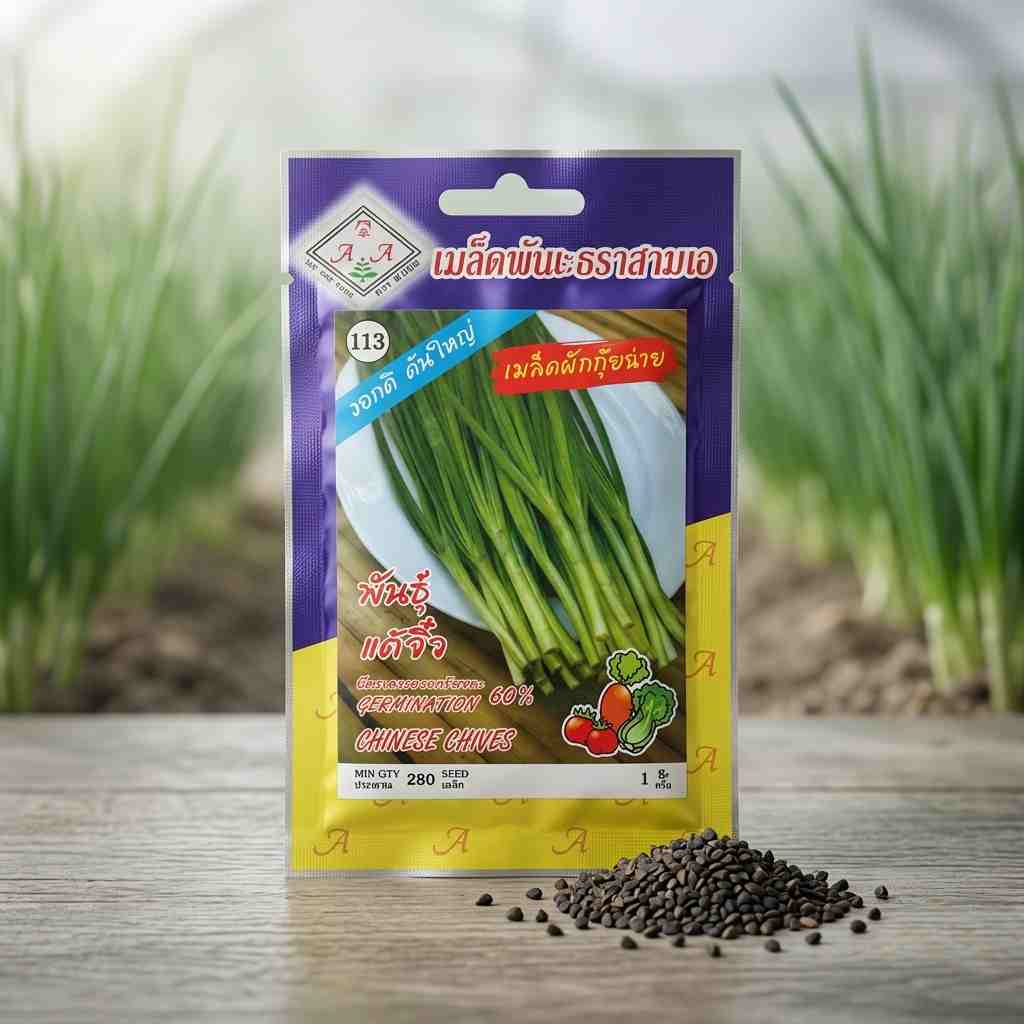
Chinese Chives – 280 seeds – AAA – Thai
Original price was: ৳ 280.00.৳ 160.00Current price is: ৳ 160.00.
Sow: November in Bangladesh
Temperature: 18–22°C
Depth: ¼ inch
Germination: 7–21 days
Transplant: 4–8 week-old seedlings
Spacing: 8 × 12 inches
Pot: 12–14 inch diameter × 10–12 inch height
pH: 6.2–6.8
Sun: 5–7 hours
First meaningful harvest: ~75–90 days
Harvest: cut leaves 1–2 inches above crown
Water: maintain evenly moist soil, never waterlogged
Fertilizer: light but regular feeding rather than heavy fertilization
Division: every 3–4 years
Expected life: several years
Available on backorder
Description
Chinese Chives
Price: 160 Taka per packet (sale price)
Quantity: approx. 280 seeds
Brand: AAA (Chua Yong Seed Co., Ltd)
Origin: Thailand
Germination Rate (approx.): 60%
Physical Purity (Min): 98%
Genetic Purity (Min): 98%
Quick cultivation summary
| Parameter | Recommended value for Bangladesh |
|---|---|
| Scientific name | Allium tuberosum Rottler ex Spreng. |
| Family | Amaryllidaceae |
| Common names | Chinese chives, garlic chives, Chinese leek, Oriental garlic |
| Life cycle | Perennial |
| AAA seed germination | 15–21°C |
| Practical optimum | 18–22°C |
| Germination | 7–21 days, normally ~10–15 days under good conditions |
| Seed depth | ¼ inch / 0.5–0.6 cm |
| AAA mature height | ~10–15 in |
| General mature height | ~12–24 in / up to ~50–60 cm |
| Plant spacing | 6–8 in for individual clumps |
| Row spacing | 12–18 in |
| First useful harvest | ~60–90 days |
| Better established harvest | ~85–100 days |
| Flowering | roughly 80–120+ days, depending on climate/plant age |
| Container | 12–14 in diameter × 8–12 in deep per mature clump |
| Ideal pH | 6.0–7.0, target ~6.3–6.7 |
| Sun | 5–7 hours direct sun preferred |
| Water | Moist but never waterlogged |
| Propagation | Seed or division; division is fastest |
| Expected longevity | Several years; productive clumps commonly divided every 3–4 years |
Research and horticultural sources broadly agree that Chinese chives are perennial, clump-forming, shallow-rooted, edible-leaved Alliums.
Germination temperature
Best range: 18–22°C
Independent sources give a similar range:
- 15–21°C — approximately 14–21 days. (The Seed Collection)
- 15–20°C — recommended sowing temperature. (Seeds to Sow Limited)
- ~18–21°C — commercial seed-growing recommendations.
- A Chinese-chive germination study found excellent germination performance around 20°C. (EurekaMag)
- A recent nursery study evaluated Chinese chive varieties at 20°C and found substantial differences between varieties, demonstrating that genetics also affects germination speed. (KSBEC)
For Bangladesh
target: 18–22°C soil temperature
rather than trying to germinate them at 25–30°C.
Above ~25°C, germination may still occur, but uniformity can decline depending on seed lot.
Germination time
Expected: 7–21 days
Other sources report:
- 10–15 days. (Botanical Interests)
- 14–21 days. (The Seed Collection)
- Some seed companies report 7–14 days around 18–21°C. (Swallowtail Garden Seeds)
- Some seed lots can take 3–4 weeks. (Jelitto)
Recommended expectation
| Condition | Expected germination |
|---|---|
| 18–22°C, fresh seed, excellent moisture | 7–14 days |
| Good normal conditions | 10–18 days |
| Cooler/less ideal conditions | 14–21 days |
| Poor/old seed | 21–28+ days |
Plant height, span & sowing depth
Horticultural references put mature plants around 12–24 inches depending on cultivar and conditions. (Pinetree Garden Seeds)
Practical Bangladesh expectation
Leaf height: 10–18 inches
Flower stalk: approximately 15–24 inches
Clump diameter: approximately 10–16 inches when mature
Sowing depth
¼ inch / 0.5–0.6 cm
Do not bury the seed deeply.
Plant and row spacing
For rooftop production:
Individual clumps:
6–8 inches apart
Commercial/bed production
8–12 inches between clumps
Row spacing
12–18 inches
Research on A. tuberosum has used approximately 25 × 25 cm (9.8 × 9.8 in) planting spacing, while horticultural recommendations range from 6–10 inches depending on whether plants are grown as individual plants or clusters. (Frontiers)
Best rooftop arrangement
8 inches plant-to-plant × 12 inches row-to-row
for good airflow and convenient harvesting.
Trellis/support requirement
No trellis required.
Chinese chives naturally form an upright clump.
The only exception is during flowering: tall flower stalks can occasionally bend in heavy rain/wind. A very low ornamental support can be used if necessary, but it is normally unnecessary.
Seed-to-harvest time
This varies substantially with what you consider “harvest.”
Commercial horticultural sources generally report around 85–90 days from seed. (Johnny’s Selected Seeds)
Bangladesh recommendation
- 60–70 days: first light harvest possible under excellent conditions
- 75–90 days: more realistic first substantial harvest
- 90+ days: well-established clump
Do not heavily scalp newly established seedlings.
For the first crop, wait until the clump is vigorous and leaves are approximately 15 cm / 6 inches or longer.
Seed-to-bloom time
Flowering varies greatly with seed lot, age, photoperiod and temperature.
Sources report flowering in the first year, generally around the warmer part of the growing season. (Jelitto)
Practical estimate
80–120+ days from seed
However, a newly established plant may flower later than this, particularly if it prioritizes vegetative establishment.
Flowers are white, star-shaped and arranged in umbels.
Recommended container size
For one mature clump:
Minimum
10–12 inch diameter × 8 inch deep
Recommended
12–14 inch diameter × 10–12 inch deep
Premium rooftop setup
14–16 inch diameter × 10–12 inch deep
Approximately:
| Container | Approx. volume | Recommended |
|---|---|---|
| 8″ × 8″ | ~5–7 L | seedlings/temporary |
| 10″ × 8″ | ~8–10 L | small mature clump |
| 12″ × 10″ | ~15–18 L | recommended |
| 14″ × 10″ | ~20–24 L | excellent |
| 16″ × 12″ | ~30 L | large productive clump |
Because Chinese chives are shallow-rooted, depth is less important than horizontal growing space and drainage.
Soil type & pH
Chinese chives prefer:
- fertile
- organic-matter-rich
- loose
- well-drained
- moisture-retentive but not waterlogged
- loamy soil
fertile, well-drained loam and gives a broad pH tolerance of 5–8.
FAO Ecocrop gives an optimum pH around 6.0–6.8, with a broader tolerance. (EcoCrop)
A Chinese-chive pH study tested 4.5, 6.5 and 7.5 and found significant differences in growth/nutrient uptake among types. (KCI)
For rooftop Bangladesh
pH 6.2–6.8
Ideal target:
~6.5
Avoid continuously wet, compacted soil.
Sunlight & germination light
Mature plant
Best: 5–7 hours direct sunlight/day
At least about 4–6 hours is desirable. (GardeningSG)
In Dhaka rooftop conditions, we would reccomend:
morning sun + filtered afternoon light
rather than extremely intense all-day summer afternoon exposure.
Germinating seeds
- Cover seeds lightly.
- Keep the seed medium shaded.
- Do not expose the seed tray to direct rooftop sun.
- Once seedlings emerge, immediately provide bright light.
Water requirement
Chinese chives like consistent moisture, but their roots must not remain saturated.
The correct approach is soil-moisture-based watering, not a fixed daily quantity.
Recommended water per 12–14 inch pot
| Plant condition | Approx. water/application |
|---|---|
| Newly germinated seedlings | 100–250 mL |
| 2–4 inch plants | 250–400 mL |
| 4–8 inch plants | 400–700 mL |
| 8–12 inch established clump | 700–1,000 mL |
| Large mature clump | 1.0–1.5 L |
Bangladesh rooftop interval
| Season | Typical interval |
|---|---|
| Nov–Feb | every 3–4 days |
| Mar–Apr | every 2–3 days |
| May | every 1–2 days |
| Jun–Sep | check daily; rain may eliminate watering |
| Oct | every 2–3 days |
But do not follow this blindly.
Water when the top 2–3 cm becomes slightly dry.
During a Dhaka heat wave, a 14-inch pot may require watering almost every day. During monsoon, the same pot may require no irrigation for several days.
Overwatering is particularly dangerous because fungal problems increase under waterlogged/dense conditions.
Essential nutrients
Chinese chives require the normal essential macro- and micronutrients:
Primary
- Nitrogen — N
- Phosphorus — P
- Potassium — K
Secondary
- Calcium — Ca
- Magnesium — Mg
- Sulfur — S
Micronutrients
- Iron — Fe
- Zinc — Zn
- Manganese — Mn
- Copper — Cu
- Boron — B
- Molybdenum — Mo
- Chlorine — Cl
- Nickel — Ni
A recent two-year study provides useful measured nutrient concentrations in fresh A. tuberosum foliage. (DOI)
Approximate nutrient concentration in fresh foliage
| Nutrient | Approx. concentration |
|---|---|
| N | 0.561% |
| K | 0.536% |
| S | 0.248% |
| Ca | 0.113% |
| P | 0.069% |
| Mg | 0.057% |
| Fe | 0.0397% |
| Zn | 0.00534% |
| Cu | 0.00162% |
| Mn | 0.00056% |
| B | 0.000193% |
These are plant tissue concentrations, not fertilizer recipes.
The study also found particularly high potassium, sulfur, calcium and phosphorus levels, with sulfur-containing compounds contributing to the characteristic Allium aroma. (PubMed Central (PMC))
Organic fertilizer sources
| Nutrient | Useful organic source |
|---|---|
| N | Vermicompost, cow compost, tricho-compost, horn meal, neem cake, mustard cake |
| P | Bone meal, vermicompost |
| K | Compost, vermicompost, mustard cake; supplemental K may be needed |
| Ca | Oyster shell, bone meal |
| Mg | Epsom salt |
| S | Mustard cake, Epsom salt, organic matter |
| Fe | Compost, vermicompost |
| Zn/Mn/Cu/B | Compost, vermicompost, trace minerals |
Organic fertilizer program for containers
We recommend treating one 12–14 inch pot as one mature clump, rather than calculating fertilizer per individual seedling.
Initial amendment per 15–24 L pot
| Material | Amount |
|---|---|
| Vermicompost | 150 g |
| Tricho-compost | 100 g |
| Cow-dung compost | 100 g |
| Horn meal | 8 g |
| Bone meal | 10 g |
| Neem cake powder | 10 g |
| Mustard cake powder | 8 g |
| Oyster shell powder | 8 g |
| Epsom salt | 2 g |
Mix thoroughly into the upper 5–8 cm of soil.
Total ≈ 396 g/pot
Do this at initial planting rather than putting concentrated fertilizer directly around the crown.
Organic top-dressing
Every 30–45 days during active growth:
- Vermicompost: 80–100 g
- Tricho-compost: 40–50 g
- Cow-dung compost: 40–50 g
- Neem cake: 5 g
- Mustard cake: 5 g
Total:
170–210 g/pot/application
Apply around the perimeter rather than against the crown.
Every 90–120 days
If growth is vigorous but leaves are becoming pale:
- Bone meal: 5 g
- Horn meal: 3–5 g
Do not continuously add large quantities of bone/horn meal.
Epsom salt
Use sparingly.
1–2 g per 15–20 L pot every 2–3 months is sufficient if magnesium is actually required.
Do not treat Epsom salt as a routine “growth booster.”
Chemical fertilizer requirement
For rooftop production I would use a much lower rate than commercial field research rates.
Research trials have used very high field NPK inputs; one study’s conventional treatment was equivalent to 655.5 kg N + 559.5 kg P + 154.5 kg K/ha, while a reduced slow-release treatment substantially altered the N/P/K proportions. These are commercial field treatments, not suitable doses for a household pot. (MDPI)
Recommended container program
19-19-19 or 20-20-20 soluble fertilizer
For an established 15–24 L pot: 0.5–1.0 g/L water
Apply approximately: 0.5–1.0 L fertilizer solution/pot
every: 14–21 days
during strong vegetative growth.
Start at the lower end.
After heavy harvest
A mild balanced fertilizer application can help regrowth.
Potassium
If the plant shows a genuine potassium requirement:
0:0:50
at approximately 0.3–0.5 g/L, occasionally.
Don’t routinely combine large quantities of balanced NPK + 0:0:50 + organic fertilizers.
For edible leaves, moderate nutrition is preferable to excessive nitrogen.
Recommended rooftop potting mix
| Ingredient | Percentage |
|---|---|
| Loamy soil | 35% |
| Coconut coir dust | 15% |
| Vermicompost | 15% |
| Tricho-compost | 10% |
| Cow-dung compost | 10% |
| Brown river sand | 5% |
| Cinder | 4% |
| Jhama | 3% |
| Wood charcoal | 3% |
| Total | 100% |
Why this works
35% loam
Provides mineral body and buffering.
15% coir
Improves moisture retention during Dhaka heat.
25% composts
Provides organic matter and biological activity.
5% river sand
Improves physical drainage.
4% cinder + 3% jhama
Creates additional pore space and prevents the rooftop mix from becoming excessively compact.
3% charcoal
Provides additional porosity and carbon surface.
Important
Do not use fresh cow dung.
All composts must be fully mature and pathogen-free.
And because this is an edible crop, avoid unknown industrial cinder or ash contaminated with heavy metals.
Companion plants
Useful companions include:
- Carrot
- Tomato
- Pepper/chilli
- Potato
- Brassicas
- Thyme
- Lemon balm
Some horticultural sources specifically recommend carrots, peppers, potatoes, brassicas and tomatoes with garlic chives. (Seeds to Sow Limited)
However, companion planting claims should not be interpreted as guaranteed pest control.
Leaf taste
Taste rating: 7/10
The leaves have:
- mild garlic flavour
- onion/chive undertone
- fresh grassy character
- increasing pungency as leaves become older
The flavour is generally milder than raw garlic but more distinctly garlicky than ordinary chives. (Pl@ntUse)
Tender young leaves
~7.5/10
Older leaves
~6/10
Flowers
Edible and mildly garlic/onion flavored.
Major pests
Chinese chives are relatively resistant, but pests can still occur. EPPO records several organisms associated with A. tuberosum, including thrips, onion flies, nematodes and other pests. (EPPO Global Database)
A. Thrips
Symptoms
- silver/white streaks
- distorted young leaves
- reduced growth
Organic/IPM
- strong water spray
- blue/yellow sticky traps
- insecticidal soap
- neem/azadirachtin
- remove badly affected foliage
- encourage predatory insects
Spinosad is another practical option where legally registered for the crop.
B. Aphids
Organic
- water jet
- insecticidal soap
- neem/azadirachtin
- ladybirds/lacewings
Chemical
Use a locally registered aphicide if infestation becomes severe.
C. Chinese chive gnat / fungus gnat-type soil pests
Bradysia species are particularly important Chinese-chive pests in commercial production; larvae attack roots and underground stem tissue. (ScienceDirect)
Organic/IPM
- excellent drainage
- avoid continuously wet soil
- sticky traps
- soil sanitation
- remove decaying organic matter
- biological control with predatory mites
- entomopathogenic nematodes
- solarization where practical
Research has demonstrated successful suppression using predatory mites such as Stratiolaelaps scimitus. (PubMed)
Chemical
Commercial research has investigated compounds such as thiamethoxam and clothianidin, but we would not recommend these as routine rooftop treatments for a frequently harvested edible leaf crop because residue and pre-harvest-interval considerations become important. (ScienceDirect)
Diseases
A. Downy mildew
Symptoms:
- pale/yellow leaves
- grey/purple fungal growth
- collapse under humid conditions
Prevention
- don’t overcrowd
- morning irrigation
- avoid prolonged leaf wetness
- improve airflow
- remove infected leaves
Fungicides containing appropriately registered active ingredients such as metalaxyl-M/related oomycete fungicides are used commercially for downy mildew in Chinese chive/Allium crops in some jurisdictions. Always follow the Bangladesh product label and PHI. (US EPA)
B. Purple blotch – Alternaria porri
Symptoms:
- small lesions
- expanding purple/brown spots
- leaf tip death
Organic
- sanitation
- airflow
- avoid overhead irrigation
- remove infected leaves
- reduce humidity
Chemical
Registered fungicides containing appropriate actives such as boscalid + pyraclostrobin or other locally registered Allium fungicides may be used according to the label. Some commercial labels specifically list Chinese chive for Botrytis/purple blotch suppression. (Bayer Content API)
C. Stemphylium leaf blight
A recent 2026 report documented Stemphylium lycopersici causing leaf spot on Chinese chive. (APS Journals)
This reinforces the importance of:
- airflow
- sanitation
- avoiding persistent leaf wetness
- removing infected foliage
D. White spot
Alternaria arborescens has also been reported as a causal agent of white spot disease in Chinese chive. (ScienceDirect)
E. Root/basal rots
Usually associated with:
- poor drainage
- excessive irrigation
- contaminated planting material
- compacted soil
Best treatment
Prevention is substantially more effective than trying to cure a badly rotted clump.
How to know leaves are ready to harvest?
Do not wait for a “fruit” to mature.
Harvest when:
- leaves are approximately 6–10 inches
- leaves are bright green
- leaves are firm and upright
- clump has several healthy shoots
- leaves are not yellowing
Cut approximately:
1–2 inches above the soil/crown
Do not repeatedly remove 100% of the foliage.
A commercial seed source recommends harvesting when leaves reach around 6 inches and cutting back while maintaining the crown. (Botanical Interests)
Average crop yield per square foot
Research has demonstrated very high production potential under commercial conditions. One two-year study reported a top accession producing 157.01 tonnes/ha over two years, while a particular harvest window reached about 30.75 t/ha. (PubMed Central (PMC))
That translates approximately to:
30.75 t/ha
≈ 2.86 kg/m²
≈ 0.266 kg/ft²
for that particular harvest window.
For a realistic rooftop expectation, accounting for:
- container edges
- lower root volume
- Bangladesh heat
- harvesting frequency
- monsoon
- less intensive fertigation
I would use:
0.4–0.8 kg fresh foliage/ft²/year
as a practical planning range.
Commercial field production can be considerably higher under optimized conditions.
Average lifespan
Chinese chives are perennial.
They can remain productive for:
3–5+ years
and potentially much longer if divided and rejuvenated.
NParks recommends division approximately every 3–4 years because of vigorous clump development. (Default)
For rooftop containers:
Recommended renovation
Every 3–4 years
Divide the clump and replace/rejuvenate the growing medium.
Nutritional value
Published analyses show Chinese chive is:
- low calorie
- high moisture
- source of dietary fibre
- source of vitamin C
- source of vitamin A/carotenoids
- source of vitamin K
- source of calcium
- source of potassium
- source of iron
- rich in sulfur-containing compounds
A recent analysis reported approximately:
- Energy: 36.13 kcal/100 g
- Protein: ~2.7%
- Fibre: ~3.2%
- Vitamin C: 18.12 mg/100 g
- Potassium: 5355 mg/kg
- Calcium: 1127 mg/kg
- Phosphorus: 692 mg/kg
- Sulfur: 2485 mg/kg. (ScienceDirect)
Values vary with cultivar, soil, maturity and analytical method.
Five potential health benefits
Based on its nutritional composition and bioactive compounds:
1. Antioxidant support
Contains flavonoids and other antioxidant compounds.
2. Vitamin C contribution
Fresh leaves provide vitamin C.
3. Vitamin A/carotenoid contribution
Carotenoid compounds contribute to dietary vitamin A activity.
4. Fibre contribution
Useful as part of a fibre-containing diet.
5. Sulfur-containing phytochemicals
Allium sulfur compounds such as allicin-related compounds are biologically active and contribute to the characteristic aroma. (PubMed Central (PMC))
These should be understood as nutritional/physiological benefits, not claims that Chinese chives treat or cure diseases.
Four recipes
🇧🇩 1. Chinese Chives Bhaji
Simple Bangladeshi preparation:
- Chinese chives
- onion
- green chilli
- garlic
- turmeric
- salt
- mustard oil
- optional potato
Lightly fry the aromatics and add chopped chives near the end so the leaves remain green and aromatic.
🇧🇩 2. Chives–Egg Bhurji
Excellent with:
- eggs
- Chinese chives
- onion
- green chilli
- coriander
- salt
- black pepper
- mustard oil
This is probably one of the easiest ways to introduce Chinese chives into Bangladeshi home cooking.
🇨🇳 3. Chinese Chive & Egg Dumplings
Classic Chinese-style filling:
- chopped Chinese chives
- egg
- sesame oil
- soy sauce
- ginger
- optional shrimp/pork
🇨🇳 4. Chinese Chive Stir-Fry
Stir fry:
- Chinese chives
- garlic
- shrimp/tofu
- soy sauce
- sesame oil
- chilli
The leaves should be cooked quickly to retain their aroma and texture.
Best Bangladesh month for germination
This is especially important for your rooftop operation.
Chinese chive germination is best around 18–22°C, while Dhaka becomes substantially warmer during spring and summer.
Dhaka climate data show approximately:
- October mean ~26–28°C
- November mean ~23–24°C
- December ~19–20°C
- January ~18–19°C
- February ~21–22°C. (Climate Data)
Recent Bangladesh agricultural bulletins also demonstrate that November temperatures can fall into the mid-to-high teens at night, while daytime temperatures remain around the upper 20s. (BAMIS)
Best natural sowing window
Late October → December
Best single month
November
This gives you the best balance between:
- declining heat
- moderate humidity
- manageable rainfall
- suitable night temperature
- suitable seed-bed temperature
Second choice
February
but February can warm rapidly toward the end of the month.
Avoid
April–September for natural rooftop germination if your objective is maximum germination uniformity.
During those months, germinate in a cooler/shaded seed-starting environment.
The 2020–2024 Dhaka climate reconstruction also shows October still considerably warmer and wetter than November, while November is markedly cooler and drier. (WeatherHack)
BMD’s current seasonal forecasting system confirms that Bangladesh’s seasonal conditions are variable, so the calendar should be treated as a planning window rather than a guaranteed temperature forecast. (Instant BMD)
Average seeds per gram
Published figures include:
- ~210 seeds/g. (Jelitto)
- ~220 seeds/g. (Jelitto)
- ~250 seeds/g. (Swallowtail Garden Seeds)
- 250 seeds/g from another commercial source. (Bolster)
- PROSEA gives a 1000-seed weight of 4–4.5 g, equivalent to approximately 222–250 seeds/g. (Pl@ntUse)
- ISTA data indicate 1000-seed weight around 10 g for a specified testing standard, showing that seed lots can differ considerably. (Scribd)
Best practical estimate
~225–250 seeds/g
For commercial calculation, use:
240 seeds/g
as a reasonable planning figure.
Therefore, 280 seeds ≈ 1.17 g at 240 seeds/g.
But the exact weight of the AAA packet cannot be inferred solely from the stated seed count.
Best propagation method
There are two excellent methods.
Method 1 — Division
Best for production
Divide an established healthy clump into smaller sections containing:
- roots
- rhizome
- several shoots
This gives much faster establishment than seed.
Method 2 — Seed
Best for producing new plants
- Use fresh seed.
- Sow ¼ inch deep.
- Keep 18–22°C.
- Keep uniformly moist.
- Germinate in shade/darkness.
- Move seedlings into strong light immediately after emergence.
- Transplant when established.
Chinese chives are commonly propagated by both seed and rootball division. (Default)
Storage of harvested leaves
Refrigerator
Best method:
- Do not wash before storage.
- Remove excess moisture.
- Wrap loosely in a slightly damp paper towel.
- Place in a perforated/loosely closed food bag.
- Refrigerate.
Expected quality
5–7 days
USDA/NRCS guidance specifically notes refrigerator storage for approximately one week. (Natural Resources Conservation Service)
Freezing
For longer storage:
- wash
- dry thoroughly
- chop
- freeze in an airtight bag/container
Approximate useful storage
2–3 months for good culinary quality.
Texture becomes softer, but the flavour remains useful for cooked dishes.
Drying
Possible, but not our first recommendation.
Dry at low temperature and store airtight.
Storage
Several months
but aroma and fresh-leaf quality decline.
Additional care tips
1. Never keep the crown submerged
This is probably the single most important rooftop rule.
2. Harvest regularly
Cut-and-come-again harvesting stimulates new foliage.
3. Don’t overharvest young plants
Allow the first clump to establish properly.
4. Avoid excessive nitrogen
Too much nitrogen can produce soft, excessively lush growth.
5. Maintain airflow
Especially during Bangladesh’s humid monsoon.
6. Morning watering is preferable
It reduces prolonged night-time leaf wetness.
7. Remove yellow/diseased leaves
Don’t allow infected material to remain in the pot.
8. Divide every 3–4 years
This rejuvenates crowded clumps. (Default)
9. Remove flower heads if maximum leaf production is the objective
Chinese chives can self-seed. Removing the flower heads prevents unwanted spread. (Default)
10. During extreme Dhaka heat
Use:
- morning sun
- afternoon 30–40% shade
- increased moisture monitoring
- thick organic mulch
rather than allowing the pot to bake completely dry.
Few specialties
🌿 1. Cut-and-come-again perennial
Once established, the same clump can supply leaves repeatedly.
🌼 2. Edible flowers
The attractive white flowers are also edible. (Default)
🐝 3. Excellent pollinator plant
The flowers provide nectar/pollen and attract pollinating insects. (RHS)
Fun quotes
“A little Chinese chive can turn an ordinary meal into something wonderfully aromatic.”
“Grow it once, harvest it again and again—the quiet little clump that keeps giving.”
Lesser-known facts
1. It isn’t actually a “chive” species in the strict botanical sense
Although commonly called Chinese chive, it belongs to Allium and is currently placed in Amaryllidaceae, subfamily Allioideae. (EPPO Global Database)
2. The flowers are edible
Not just decorative—the flowers, flower stalks and leaves are all edible. (Default)
3. It can become invasive outside its native range
It produces abundant seed and has naturalized in numerous regions, so removing spent flower heads can be useful if you don’t want volunteer plants. (RHS)
37. Native region
There is some variation in how references describe its geographic origin.
Kew currently gives its native range as:
Himalaya → China, especially southwestern Shanxi
with native records including:
- northern/central China
- Nepal
- West Himalaya
- Assam
Genetic/historical literature identifies China as an important centre of origin/domestication. (EurekaMag)
So would describe it commercially as:
Native to the Himalayan region and China, particularly northern/southwestern China; long cultivated throughout East and Southeast Asia.
Origin story
It is an ancient cultivated plant, not a modern commercial hybrid created by a named breeder.
The accepted scientific name is:
Allium tuberosum Rottler ex Spreng.
It was formally published in 1825. (Plants of the World Online)
Historical and genetic evidence points toward northern China as an important domestication centre, with A. ramosum considered a possible progenitor in some research. (EurekaMag)
Scientific name & family
Scientific name: Allium tuberosum Rottler ex Spreng.
Family: Amaryllidaceae
Subfamily: Allioideae
Genus: Allium
Common names
- Chinese chives
- Garlic chives
- Chinese leek
- Oriental garlic
- Asian chives
- Nira
- 韭菜 (jiǔcài)
Kew and EPPO both recognize Allium tuberosum as the accepted species. (Plants of the World Online)
Reference websites & journals
We used a mixture of botanical databases, university extension sources, government/agricultural resources and peer-reviewed research, rather than relying on one gardening website.
Botanical/taxonomic
- Kew – Plants of the World Online: Allium tuberosum
- EPPO Global Database – Allium tuberosum
- USDA GRIN – Allium tuberosum
- RHS – Chinese chives
Research/journals
- Frontiers in Plant Science – Cultivation viability of Allium tuberosum
- PubMed – Cultivation viability study
- Agronomy/MDPI – Slow-release fertilizer study
- Scientific Reports – Chinese chive fertilizer study
- Journal of Agricultural Science – Temperature and regrowth research
- Plant Disease – Stemphylium leaf spot report
- Korean Journal of Environmental Biology – pH study
Horticultural/extension
- University of Wisconsin Extension – Garlic Chives
- Utah State University Extension – Chives
- North Carolina Extension – Allium tuberosum
- Singapore NParks – Allium tuberosum
- FAO Ecocrop – Allium tuberosum
- USDA NRCS – Asian Vegetable Garlic Chives information
Seed/germination references
- Botanical Interests – Garlic Chives
- Renee’s Garden – Garlic Chives
- Swallowtail Garden Seeds – Garlic Chives
- Jelitto – Allium tuberosum seed data
Bangladesh weather
- Bangladesh Meteorological Department seasonal forecast portal
- Bangladesh Agricultural Meteorological Information Service
- JMA Dhaka climate normals
The most important Bangladesh-specific adjustment is timing the seed germination for the cooler October–December period, rather than treating Chinese chives as a summer-germinating crop. The germination research clustering around ~20°C and Dhaka’s substantially cooler November–December conditions make that the most useful practical window. (EurekaMag)
*Note: It is recommended to prepare seedling in a small cup or pot for better success rate and keep the soil moist.
Disclaimer: In accordance with the universal custom of seed trade we give no warranty expressed or implied as to description, quality, productivity or any other matter of any way for the crop results beyond the purchased price especially under unsuitable season, abnormal weather, unsuitable soil and other unexpected conditions.
বীজ ব্যবসার সার্বজনীন প্রথা অনুযায়ী আমরা বিশেষত অনুপযুক্ত ঋতুতে, বিশেষত অনিয়মিত আবহাওয়া, অনুপযুক্ত মাটি এবং অন্যান্য ক্রয়মূল্যের বাইরে ফসলের ফলনের বর্ণনা, গুণমান, উৎপাদনশীলতা বা অন্য যে কোনও বিষয়ে বর্ণিত ওয়ারেন্টি প্রদান করি না। অপ্রত্যাশিত শর্ত।
#80T #chinese #chives #chive #thai #thailand #garden #mygardenbd #gardening #seeds #seed #in #dhaka #bangladesh #aaa #ChineseChives #GarlicChives #ChineseLeek #AsianChives #OrientalGarlic #AlliumTuberosum #Chives #GarlicHerb #HerbGarden #VegetableGarden #EdibleGarden #KitchenGarden #HomeGarden #RooftopGarden #RooftopGardening #UrbanGardening #ContainerGardening #BalconyGarden #TerraceGarden #DhakaGardening #BangladeshGardening #GardeningBangladesh #GardeningBD #OrganicGardening #OrganicVegetables #GrowYourOwnFood #GrowYourOwn #HomeGrown #FreshHerbs #FreshVegetables #LeafyVegetables #PerennialHerb #PerennialVegetable #CutAndComeAgain #EdibleFlowers #HerbGrowing #VegetableGrowing #SeedToHarvest #SeedStarting #SeedGermination #GardeningTips #GardeningIdeas #PlantCare #PlantNutrition #OrganicFertilizer #Compost #Vermicompost #RooftopFarming #UrbanFarming #SustainableGardening #SustainableAgriculture #KitchenGardenBD #HomeGardeningBD #BangladeshGardener #MyGardenBd #চাইনিজচাইভস #চাইনিজচাইভ #গার্লিকচাইভস #গার্লিকচাইভ #চাইনিজলিক #চাইভস #রসুনচাইভ #চাইনিজশাক #পাতাশাক #শাকসবজি #সবজিবাগান #রান্নারবাগান #ছাদবাগান #ছাদেকৃষি #ছাদকৃষি #বাগান #বাগানকরুন #বাগানপ্রেমী #বাংলাদেশেরবাগান #বাংলাদেশেবাগান #ঢাকারছাদবাগান #ঢাকাবাগান #বারান্দাবাগান #টবেরবাগান #কন্টেইনারগার্ডেনিং #শহুরেকৃষি #শহুরেবাগান #জৈবকৃষি #জৈবসার #জৈবসারব্যবহার #ভার্মিকম্পোস্ট #কম্পোস্ট #সবজিচাষ #শাকচাষ #বাড়িরবাগান #বাড়িরছাদবাগান #নিজেরখাবারনিজেইফলান #বাগানকরারটিপস #গাছেরযত্ন #বীজ #বীজবপন #বীজথেকেগাছ #বীজঅঙ্কুরোদগম #গাছেরপুষ্টি #কৃষি #কৃষিটিপস #ছাদবাগানটিপস #বাংলাদেশকৃষি #কৃষিপ্রেমী #বাগানপ্রেমী #মাইগার্ডেনবিডি
Only logged in customers who have purchased this product may leave a review.


Reviews
There are no reviews yet.