
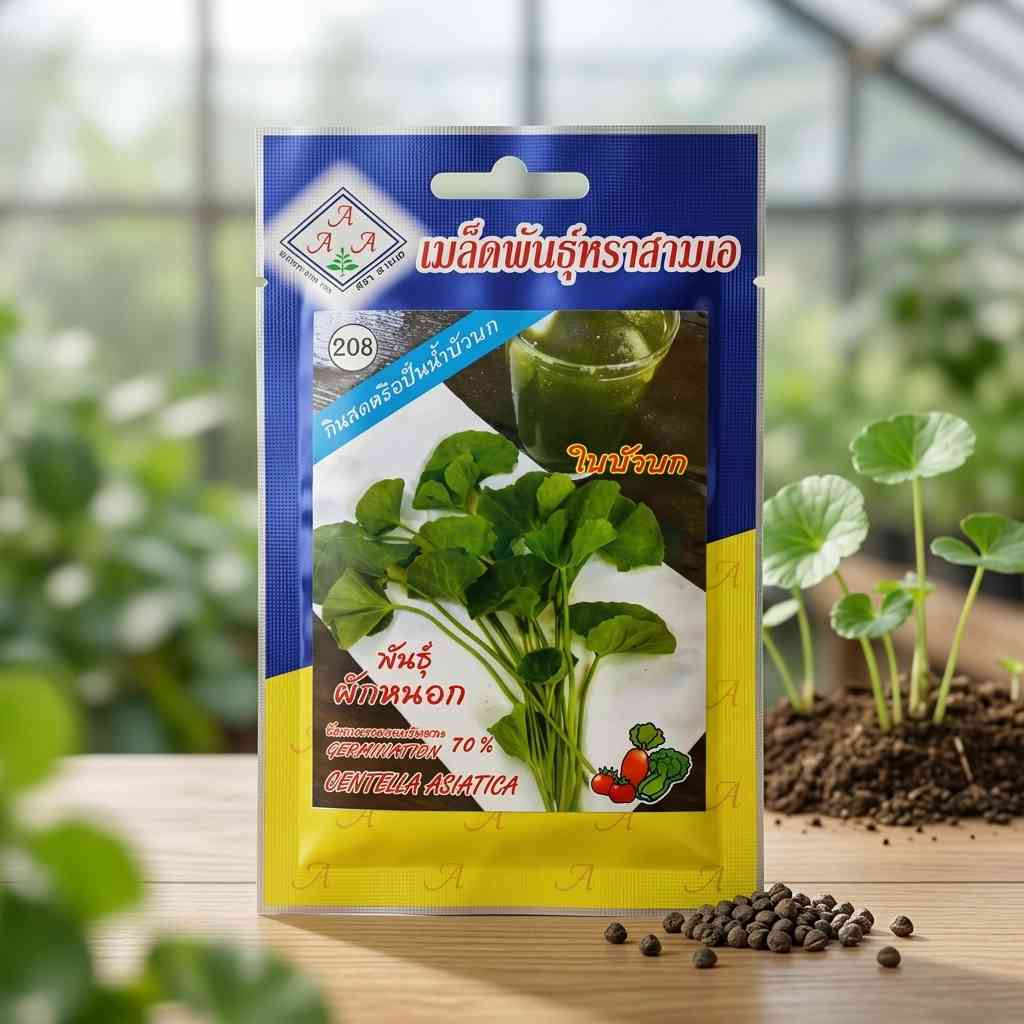

Centella Asiatica – 01 gram Seeds – AAA – Thai
Original price was: ৳ 280.00.৳ 160.00Current price is: ৳ 160.00.
Available on backorder
Description
CENTELLA ASIATICA – Seeds
Price: 160 Taka per packet (sale price)
Quantity: 01 gram seeds
Brand: AAA (Chua Yong Seng Seed Co. Ltd)
Country of origin: Thailand
Germination Rate (Approx.): 70%
Physical Purity (Min): 98%
Genetic Purity (Min): 98%
Centella asiatica (L.) Urb.
Bengali name: থানকুনি (Thankuni)
Common names: Gotu Kola, Indian Pennywort, Asiatic Pennywort, Tiger Grass
Family: Apiaceae (Carrot family)
Edible perennial medicinal herb
Centella asiatica is an excellent candidate for rooftop cultivation in Bangladesh. It is a low-growing, creeping, moisture-loving perennial herb whose leaves are commonly eaten as a vegetable and used in traditional preparations.
Unlike many conventional vegetables, Thankuni does not require deep soil, a trellis, or intensive sunlight. It is particularly suitable for shallow containers, raised beds and partially shaded rooftop gardens.
Important distinction: Centella asiatica is primarily cultivated for its leaves and tender shoots, not its fruits or seeds. Its flowers and small fruits are botanically important, but they are not the usual harvested food products.
The recommendations below distinguish between established botanical information, research-based cultivation guidance and practical starting recommendations adapted to Bangladesh. Some numerical values, particularly fertilizer rates, irrigation and rooftop yields, are horticultural estimates rather than experimentally established universal standards.
Germination Temperature
- Optimum starting range: 25–30°C.
- Practical acceptable range: approximately 20–32°C, provided the medium stays moist and aerated.
- Best conditions in Bangladesh: a shaded seed tray protected from extreme heat and heavy rain.
In a controlled germination study, seeds stored for 2–3 months germinated at up to 82% under warm conditions of 25–30°C without pretreatment. Freshly collected seeds did not germinate readily, even following some pretreatments. Red and white light produced better germination than blue and far-red light in the experiment. These findings explain why seed age and handling matter as much as temperature.
Germination Time
| Condition | Expected time |
| Suitable, mature seed at 25–30°C | About 14–35 days |
| Irregular or dormant seed | 4–8 weeks or longer |
| Freshly harvested seed | May fail to germinate within the expected period |
The 14–35-day range is a practical nursery estimate based on published germination observations; it is not a guaranteed duration for every seed lot.
Seed-starting method
- Use a clean, fine-textured, moist seed-starting medium.
- Scatter seeds over the surface and press them gently into contact with the medium.
- Cover with no more than a very thin dusting of fine medium, or leave them surface-sown.
- Keep in bright, indirect light at 25–30°C.
- Maintain uniform moisture with a fine mist; do not allow the surface to dry out.
- Avoid waterlogging, which can encourage damping-off.
Do not bury tiny seeds deeply. If germination is unsuccessful, try rooted runners instead of repeatedly resowing the same seed lot.
Plant height, span and seed sowing depth
| Characteristic | Practical estimate |
| Typical leaf canopy height | 2–6 inches |
| Leaf canopy height under favorable conditions | Approximately 6–8 inches |
| Horizontal spread | 1–3 feet or more over time |
| Seed sowing depth | Surface-sown to 1/16 inch (about 1.5 mm) |
| Growth habit | Creeping, mat-forming perennial |
Centella is a ground-covering herb. Its long petioles may stand above the low-growing runners, and its spread depends on available space, moisture and growing conditions. It roots at nodes along its creeping stems.
Plant spacing
- Home rooftop pots: one established rooted plant per 6–8 inches of planting area.
- Dense production beds: approximately 6–8 inches between plants.
- Vigorous planting material in very fertile, humid conditions: start closer to 8–10 inches if airflow is a concern.
For a container measuring 18 × 18 inches, start with 4–6 rooted plantlets distributed evenly. A few healthy plants can cover the container through their runners.
Row spacing
For commercial beds, use:
- Row-to-row spacing: 8–12 inches.
- Plant-to-plant spacing: 6–8 inches.
A research study of cultivated material reported a successful planting density of 25 plants/m², equivalent to approximately 2.3 plants/ft², although the ideal density varies with cultivar, production method and harvest schedule.
jos.hueuni.edu.vn+1
Trellis or physical support
Not required. Centella is a creeping herb, not a climbing vine. It spreads horizontally using stolons and roots at its nodes.
Avoid vertical trellises. Instead, use a broad container, hanging planter or shallow raised bed. Hanging baskets work, but the growing medium must not dry out rapidly.
Harvesting, flowering and container selection
Seed-to-harvest time
The time depends on the propagation method.
| Growing method | Approximate time to first light harvest |
| Seed | 90–150 days, sometimes longer |
| Rooted runners | 45–75 days after planting |
| Established nursery plants | 30–60 days after transplanting |
These are home-gardening estimates. For commercial medicinal-herb production, one study found that a first harvest at about five months performed well for dry-herbage yield and phytochemical production. Subsequent ratoon harvests were assessed at approximately four-month intervals in that particular production system.
Indian Journal of Agronomy+1
For fresh leafy vegetables, you can harvest tender outer leaves earlier than the full commercial harvest. Leave sufficient leaves and rooted nodes for regrowth.
Seed-to-bloom time
- Approximate first flowering: 3–6 months after successful establishment, depending on conditions.
- From seed: allow approximately 4–7 months as a planning estimate.
- Flowering season: can vary with local climate and plant maturity.
This timing is less firmly standardized than germination or vegetative harvest timing. Centella produces small greenish to purplish flowers in compact umbels, followed by small dry fruits. Flowering is not necessary for leaf production.
Pot, container and bed size
Small container: 10 × 10 × 6 inches
Suitable for one rooted plant or a small trial. Expect frequent watering in hot weather.
Recommended: 18 × 18 × 8 inches
Good balance of growing space, moisture retention and rooftop practicality. Use 4–6 rooted plantlets.
Production bed: 24 × 48 × 8–10 inches
Suitable for repeated leaf harvests and easier management of runners.
Use containers with unobstructed drainage holes. On rooftops, use lightweight containers where possible and ensure the balcony or roof structure can support the combined weight of wet soil, containers and standing water.
Soil type and ideal pH
Centella naturally occurs in damp grasslands, marshy areas and along waterways. It tolerates several soil textures as long as moisture is available. For a rooftop container, avoid heavy, airless soil even though the plant tolerates wet habitats.
Recommended soil characteristics
- Moisture-retentive but well-aerated.
- Rich in organic matter.
- Loamy or sandy-loam texture.
- Good nutrient availability without excess fertilizer salts.
- No prolonged stagnation of foul-smelling water.
- Free of contaminated soil, sewage and untreated manure.
Ideal pH: approximately 5.5–6.8 for the proposed container mix. A broader practical tolerance of around 5.5–7.5 is reasonable.
The species is reported from moist sandy to clayey soils and responds to different nutrient and soil-media combinations. A mildly acidic to near-neutral mix is a sensible target for container cultivation.
Sunlight and germination light
| Growth stage | Recommended light |
| Germination | Bright indirect light; seeds surface-sown |
| Young seedlings | 3–4 hours of gentle sun or bright filtered light |
| Established plants | 3–5 hours of sunlight, with afternoon shade |
| Very hot summer weather | Bright partial shade, especially around midday |
In Dhaka’s hot months, morning sunlight is preferable to harsh afternoon exposure. If the plant becomes leggy and produces small leaves, gradually increase light. If leaves scorch or wilt repeatedly, add shade and check root-zone moisture.
Seed germination studies support the importance of light quality, with red and white light outperforming blue and far-red light in one experiment. This does not mean specialized red grow lights are necessary for a home garden.
Water requirement and watering intervals
Centella likes consistently moist soil. The quantities below are starting estimates for the recommended 18 × 18 × 8-inch container, not fixed daily requirements.
| Plant size | Approximate water per application | Starting interval |
| Newly planted runner | 0.2–0.4 L | Check daily; water as needed |
| Small plant, 2–4 inches high | 0.3–0.6 L | Every 1–2 days |
| Established plant, 4–6 inches high | 0.5–1.0 L | Every 1–2 days |
| Full canopy, hot/dry weather | 0.8–1.5 L | Daily if the medium dries |
| Full canopy, rainy/humid weather | 0–0.5 L additional | Only when needed |
How to adjust correctly
- Check the upper ½–1 inch of soil before watering.
- Water when the surface starts to lose moisture, but the root zone should remain moist.
- During hot, windy weather, check the container morning and late afternoon.
- During monsoon rain, reduce irrigation and keep drainage holes clear.
- Avoid letting the container stand in stagnant, contaminated water.
Do not apply the listed volume automatically if the medium is already saturated. A mature plant may use less water in humid weather than a small plant in a shallow pot on a hot rooftop.
Nutrients and fertilizer management
Essential nutrients and organic fertilizer sources
Plants need 17 essential elements. The percentages below are approximate common fertilizer-analysis ranges, not guaranteed values for every locally sold product. For the exact composition, check the product label or obtain a laboratory analysis.
| Nutrient | Role in Centella | Potential organic sources |
| Nitrogen (N) | Leaf growth and chlorophyll | Vermicompost, cow-dung compost, mustard cake |
| Phosphorus (P) | Root growth and energy transfer | Bone meal, compost |
| Potassium (K) | Water regulation and stress tolerance | Compost, vermicompost |
| Calcium (Ca) | Cell walls and growing tissues | Oyster shell powder, bone meal |
| Magnesium (Mg) | Central component of chlorophyll | Epsom salt, compost |
| Sulfur (S) | Protein synthesis | Mustard cake, Epsom salt |
| Iron (Fe) | Chlorophyll formation and enzymes | Compost, vermicompost |
| Manganese (Mn) | Photosynthesis and enzymes | Mature compost |
| Zinc (Zn) | Enzymes and growth regulation | Compost, vermicompost |
| Copper (Cu) | Enzyme function | Compost in trace amounts |
| Boron (B) | Cell walls and growing points | Trace amounts in compost |
| Molybdenum (Mo) | Nitrogen metabolism | Trace amounts in compost |
| Chlorine (Cl) | Photosynthesis and ionic balance | Usually present in water and soil |
| Nickel (Ni) | Urea metabolism and enzymes | Trace amounts in organic matter |
| Carbon (C), hydrogen (H), oxygen (O) | Plant structure and energy | Air and water |
The following figures describe approximate product composition, not the nutrient requirement of the plant.
| Fertilizer | Typical composition or useful characteristic |
| Trichocompost | Variable; commonly around 1–2% N, with P and K depending on feedstock |
| Vermicompost | Commonly around 1–3% N, 0.5–2% P₂O₅ and 0.5–2% K₂O |
| Cow-dung compost | Commonly around 0.5–1.5% N, with variable P and K |
| Horn meal | Slow-release N, often approximately 10–14% N |
| Bone meal | Often approximately 3–5% N and 10–15% P₂O₅ |
| Neem cake powder | Often approximately 2–5% N; composition varies |
| Mustard cake powder | Often approximately 4–6% N, with variable P and K |
| Oyster shell powder | Primarily calcium carbonate; commonly around 35–38% elemental Ca |
| Epsom salt | Magnesium sulfate heptahydrate; approximately 9.8% Mg and 13% S |
Important: Epsom salt is a mineral fertilizer, not an organic fertilizer. Do not add all available fertilizers merely because they are listed. Excessive nitrogen can produce soft, disease-prone growth, and excessive salts can damage the roots. Centella research also indicates that fertilizer management can influence both biomass and phytochemical composition.
Organic fertilizer blend and application rate
For the recommended 18 × 18 × 8-inch container, use the following conservative maintenance blend. These quantities are practical starting recommendations rather than a validated species-specific fertilizer formula.
Organic fertilizer blend for one container
Initial incorporation into approximately 25–30 L of potting medium
| Trichocompost | 300 g |
| Vermicompost | 300 g |
| Well-matured cow-dung compost | 200 g |
| Neem cake powder | 30 g |
| Mustard cake powder | 20 g |
| Horn meal | 10 g |
| Bone meal | 10 g |
| Oyster shell powder | 0 g initially |
| Epsom salt | 0 g initially |
| Total | 870 g |
Oyster shell powder is omitted because the mix should already be near the desired pH, and unnecessary calcium carbonate may raise pH. Epsom salt is omitted because magnesium and sulfur should not be added without evidence of a deficiency.
Application schedule
- At potting: incorporate the initial blend evenly into the medium before planting.
- Every 30 days: apply 100–150 g of vermicompost around the edges of the canopy, then water.
- Every 6–8 weeks: if growth is weak and the soil is not excessively rich, apply 50–100 g of mature compost or trichocompost.
- Neem cake: use a further 10–15 g every 8–12 weeks only if needed.
- Mustard cake, horn meal and bone meal: do not repeat routinely. Their nutrient release and concentration vary.
Do not apply the entire initial blend again at every monthly feeding. That would create unnecessary nutrient accumulation.
For a container holding less than 15 L of soil, start with approximately half the initial amounts. If the mix contains unusually nutrient-rich compost, reduce them further.
Chemical fertilizer requirements
Centella responds to nitrogen, phosphorus and potassium, but no single chemical fertilizer schedule is suitable for every soil or cultivar. Field research has evaluated NPK treatments, farmyard manure and split applications across repeated harvests.
For a rooftop plant, a cautious starting schedule is:
| Plant stage | Fertilizer | Application |
| First 2 weeks after transplanting | None if the medium is pre-fertilized | Establish roots |
| Active vegetative growth | Balanced water-soluble NPK, such as 19:19:19 | 0.5 g/L of water |
| Established plant | Same balanced fertilizer | 0.5–1 g/L every 3–4 weeks |
| Leaf harvest period | Continue only if growth or soil condition warrants it | Avoid excess nitrogen and salt buildup |
Apply approximately 250–500 mL of the diluted solution per medium-sized container, replacing an equivalent part of a normal watering. Do not pour it into already saturated soil.
For edible leaves: use fertilizers approved for food crops, observe label directions and preharvest restrictions, and avoid mixing concentrated fertilizers directly with roots. If the plant is growing vigorously in a rich organic medium, chemical fertilizer may not be necessary.
Recommended potting mix for Bangladesh
The aim is to retain enough moisture for this creeping herb while preserving oxygen around the roots during Dhaka’s monsoon.
Loamy soil — 30%
Provides mineral structure, water retention and buffering.
30%
Vermicompost — 20%
Supplies organic matter and a broad range of nutrients.
20%
Coconut coir dust — 20%
Helps hold moisture without relying on heavy soil alone. Use washed, low-salt coir.
20%
Trichocompost — 15%
Adds organic matter and beneficial compost-associated microorganisms.
15%
Perlite — 10%
Improves air space and reduces compaction.
10%
Cow-dung compost — 5%
Provides additional organic matter. Use only fully decomposed, hygienically suitable compost.
5%
Total potting mix
100%
For a nominal 30 L batch: 9 L loamy soil, 6 L vermicompost, 6 L coir dust, 4.5 L trichocompost, 3 L perlite and 1.5 L cow-dung compost.
These are volume percentages, not weight percentages. Mix thoroughly, moisten and check the pH before planting. Aim for pH 5.5–6.8. If your compost is very rich or salty, reduce its proportion and increase loamy soil or washed coir.
Why I excluded the other items
- Coconut husk, wood bark and coarse stones are unnecessary in this particular blend; drainage should come from the mix structure and open drainage holes.
- Wood charcoal, cinder and jhama have variable composition and may introduce salts, alkalinity or contaminants.
- Brown river sand can be heavy and may compact if the particle size is unsuitable.
- Horn meal, bone meal, neem cake, mustard cake, oyster shell powder and Epsom salt belong in a measured fertilizer plan, not automatically in the base potting mix.
- Turmeric powder is not needed as a routine soil ingredient.
Do not put a thick layer of stones at the bottom of the container; it does not replace drainage and can leave a wetter zone above the layer.
For a rooftop garden, weigh the container after watering and avoid unnecessary heavy materials. The species’ preference for moist soil does not mean the container must remain waterlogged.
Hydroponics
Can Centella be grown hydroponically?
Yes. Centella asiatica has been grown successfully using hydroponic nutrient-film techniques. Research has found that nutrient-solution electrical conductivity affects both plant growth and the production of centellosides, with a treatment around EC 1.2 dS/m performing better than higher-strength treatments in one experiment.
Recommended system
NFT or a shallow recirculating system, with the roots kept moist and adequately oxygenated.
Target nutrient-solution parameters
pH 5.5–6.0 and EC 0.8–1.2 mS/cm as a starting range for young established plants.
A controlled 2025 study used pH 5.6 ± 0.2 and EC 0.9 ± 0.1 dS/m, while another experiment found favorable growth around EC 1.2 dS/m. These values support starting with a relatively mild solution rather than a strong nutrient mix.
Example hydroponic nutrient target
Use a complete commercial hydroponic A/B fertilizer formulated for leafy crops, following its dilution instructions. A useful starting target for the final solution is:
| Parameter | Starting target |
| Nitrogen (N) | 100–130 mg/L |
| Phosphorus (P) | 20–35 mg/L |
| Potassium (K) | 120–170 mg/L |
| Calcium (Ca) | 80–120 mg/L |
| Magnesium (Mg) | 25–40 mg/L |
| Sulfur (S) | 35–60 mg/L |
| Iron (Fe) | 1–2 mg/L |
| Manganese (Mn) | 0.3–0.6 mg/L |
| Boron (B) | 0.2–0.4 mg/L |
| Zinc (Zn) | 0.05–0.1 mg/L |
| Copper (Cu) | 0.02–0.05 mg/L |
| Molybdenum (Mo) | 0.02–0.05 mg/L |
| pH | 5.5–6.0 |
| EC | 0.8–1.2 mS/cm |
These are proposed starting targets, not the exact chemical recipe used in the cited studies. A complete commercial solution with micronutrients is easier and safer than attempting to formulate every salt individually.
Operating instructions
- Begin with a weak nutrient solution during transplant acclimation.
- Increase strength gradually as new leaves and roots develop.
- Monitor pH and EC daily at first.
- Keep the solution aerated, shaded from direct sun and cool enough to avoid overheating.
- Replace or rebalance solution when salts, algae or root problems develop.
- Use clean water and food-safe materials because the leaves will be eaten.
Do not add organic compost, mustard cake or other decomposing organic solids to an NFT reservoir. They can clog the system, consume oxygen and encourage microbial growth.
- Companion plants
- Suitable companions
Centella is low-growing, so its best companions are plants with compatible moisture requirements and a taller growth habit that does not create dense shade.
| Companion | Suitability | Reason |
| Coriander | Good in cooler months | Similar preference for moist soil |
| Mint | Good, with root separation | Moisture-loving; can spread aggressively |
| Leafy amaranth | Conditional | Taller canopy; avoid excessive shading |
| Lemongrass | Conditional | Taller plant; needs more space |
| Taro or other moisture-loving leafy plants | Conditional | Similar moisture preference, but container size must be adequate |
| Basil | Fair | Can share partial shade, but may prefer a drier root zone |
For rooftop containers, I recommend growing Thankuni alone or with a few coriander plants rather than combining it with aggressive mint. Different root zones and irrigation needs make mixed planting harder to manage.
There is no strong evidence that any particular companion plant reliably improves Centella yield through a special biological partnership.
- Taste and culinary uses
- Fruit taste
- Fruit consumption: not a common culinary use.
- Taste rating: not rated; no established household food use that justifies a score.
- Scoville rating: not applicable.
Centella is grown mainly for its foliage. Its small dry fruits are botanical structures, not the fruit crop for which this plant is cultivated.
- Leaf taste
Green leaves of centella asiatica plant
5/10
Fresh leaf taste rating
Subjective estimate, not a scientific measurement.
Mildly herbal, grassy and slightly bitter, sometimes with a distinctive earthy or pungent aftertaste.
Young, tender leaves are generally more pleasant in salads, chutneys and mixed herb preparations. Cooking can soften the stronger taste.
- Pests and management
Centella’s moist growing conditions can attract pests, especially when the canopy is dense and airflow is poor.
| Pest | Signs | Chemical options* | Organic or lower-risk alternatives |
| Aphids | Clusters of small insects, curled leaves | Insecticidal soap or a locally registered aphicide | Wash leaves with water; remove heavily infested tips |
| Whiteflies | Tiny white insects flying from leaf undersides | Registered insecticidal soap or other labeled product | Yellow sticky cards, remove weeds, improve airflow |
| Spider mites | Fine stippling, sometimes webbing | Registered acaricide such as abamectin where approved | Wash leaf undersides, reduce plant stress |
| Slugs and snails | Irregular holes and slime trails | Iron-phosphate bait where registered | Hand-pick at night; remove hiding places |
| Caterpillars | Chewed leaves and droppings | Bacillus thuringiensis (Bt) product labeled for the target pest | Hand-pick and remove damaged leaves |
| Fungus gnats | Small flies around wet medium | Registered biological or chemical control if needed | Allow the surface to dry slightly; improve drainage |
\*The products listed are active ingredients or product types to discuss with an agricultural supplier, not blanket recommendations for edible crops in Bangladesh. Use only products registered for the crop or applicable edible-leaf use, follow the label and observe the preharvest interval. Do not use a pesticide merely because it works on a similar plant.
Best prevention: clean planting material, adequate airflow, controlled irrigation, removal of weeds and regular inspection of the undersides of leaves. Avoid spraying edible leaves with unregistered household insecticides or concentrated homemade mixtures.
- Diseases and management
| Disease/problem | Typical symptoms | Management |
| Leaf spot | Brown or black spots that may enlarge | Remove affected leaves, avoid prolonged leaf wetness, improve airflow |
| Root rot | Brown roots, wilting despite wet soil | Improve drainage, discard severely affected plants and contaminated medium |
| Damping-off | Seedlings collapse near the soil line | Clean seed trays, use clean medium, avoid excessive moisture |
| Powdery mildew | Pale or powdery growth on leaves | Improve airflow, remove affected leaves, avoid excessive nitrogen |
| Bacterial leaf spot | Water-soaked or dark lesions | Remove infected tissue, avoid splashing water between plants |
| Algal growth | Green slippery surface on constantly wet medium | Reduce persistent surface saturation and improve drainage |
Chemical options: depending on the confirmed disease and local registration, copper-based products may be labeled for some leaf diseases, while certain fungicides such as azoxystrobin may be registered for specific fungal diseases. Neither is a universal cure for every leaf spot or root rot. Fungicides do not cure bacterial diseases, and root rot can have several different causes.
For food production, start with sanitation, moisture control and removal of affected material. Obtain a reliable diagnosis before using a pesticide or fungicide, especially when the leaves will be consumed. The 2025 cultivation study and the production review emphasize the importance of environmental and production management for healthy Centella crops.
PubMed Central (PMC)+1
- How to identify maturity and harvest readiness
Centella does not have a conventional fruit-maturity stage for household harvest.
Harvest leaves when:
- The plant has a well-established root system and multiple healthy leaves.
- New leaves are appearing from the growing points.
- Leaves are fully expanded but still tender.
- The canopy has enough foliage to permit cutting without removing all the growing points.
Use clean scissors to harvest outer leaves and tender petioles, leaving the crown and several healthy leaves intact.
For commercial production, harvest timing depends on whether the goal is fresh leafy vegetables, dry herb or medicinal compounds. The research literature reports different optimum harvest ages for these objectives.
Indian Journal of Agronomy+1
- Yield, nutrition and health considerations
- Monthly yield needed for a family of four
Thankuni is typically eaten as a small leafy component of a meal rather than as the sole vegetable.
For planning a Bangladeshi household diet, a reasonable starting estimate is:
- Fresh leaves per adult: 20–30 g per serving.
- Frequency: 2–3 servings per week.
- Family of four: approximately 0.7–1.6 kg of fresh leaves per month.
This is a meal-planning estimate, not an official dietary recommendation. Actual consumption will depend on recipes, family preferences and whether the leaves are eaten in salads, chutneys or cooked dishes.
For a continuous supply, start with multiple containers and stagger planting or propagation. A single 18 × 18-inch container may not consistently supply the entire household’s monthly requirement.
- Average crop yield per square foot
Published results vary substantially with cultivar, soil, irrigation, shade and harvest age.
One Indian production study reported cumulative fresh-herbage productivity of 32.2 tonnes/ha in an open-field treatment and 33.1 tonnes/ha under 50% shade with a specified manure and nitrogen treatment. These figures are equivalent to approximately 0.30–0.31 kg/ft² over the study’s production period, not a guaranteed monthly yield.
Taylor & Francis Online
A separate review describes annual fresh-herb yields in a broad range of approximately 5–15 tonnes/ha, or 0.046–0.139 kg/ft² per year, depending on conditions and production system.
PubMed Central (PMC)
For initial rooftop planning, use 0.05–0.15 kg of fresh foliage per square foot per year as a conservative estimate, then measure your own yield over several harvests. Intensively managed crops may exceed this, but don’t assume that field-trial yields translate directly to a small container.
- Average life span
Centella is a perennial herb that can persist for several years under suitable conditions.
In a rooftop pot, practical longevity depends on drainage, heat stress, root crowding, nutrient management and disease. Rejuvenate the planting periodically by rooting healthy runners and replacing tired or diseased plants.
There is no single well-established lifespan that applies to all cultivated Centella plants.
- Nutritional values
The following is an approximate reference profile for 100 g of fresh leaves. Composition varies with cultivar, maturity, environment and analytical method.
| Nutrient | Approximate amount per 100 g |
| Water | 85–90 g |
| Energy | 30–35 kcal |
| Protein | 1.5–3 g |
| Carbohydrate | 4–6 g |
| Dietary fiber | Approximately 2–4 g |
| Vitamin C | Approximately 20–40 mg |
| Calcium | Approximately 150–200 mg |
| Iron | Approximately 2–4 mg |
| Potassium | Variable; commonly several hundred mg |
These figures are indicative rather than a laboratory-certified composition for Bangladeshi Thankuni. Published food-plant data report substantial moisture content, vitamin C, protein and minerals in the leaves.
assets-global.echocommunity.org+1
For nutrition tracking, use a verified food-composition database entry or laboratory analysis if exact quantities are required. Do not assume that every mineral measured in a plant is absorbed equally by the human body.
- Five potential health benefits
Centella contains triterpenoids, including asiaticoside, madecassoside, asiatic acid and madecassic acid, as well as flavonoids and other compounds. These are active areas of laboratory and clinical research.
NCBI+1
- Antioxidant activity: extracts have demonstrated antioxidant effects in laboratory studies. The magnitude of any benefit from eating ordinary servings of fresh leaves is not established.
- Skin and wound research: Centella-derived compounds are studied for their role in skin repair and wound-related processes. Evidence for a particular supplement or topical product cannot automatically be applied to fresh leaves.
- Circulation and venous health: standardized Centella extracts have been investigated for symptoms associated with chronic venous insufficiency. This does not establish that a household serving of Thankuni treats the condition.
- Inflammatory pathways: laboratory research has examined anti-inflammatory effects of various Centella compounds. More human evidence is needed to determine the significance of eating the plant.
- Cognitive health research: Centella has a long history of traditional use, including claims related to memory and cognition. Human evidence remains limited and is not sufficient to recommend it as a treatment for memory disorders.
Safety note: Centella is a food plant in many cultures, but rare cases of clinically apparent acute liver injury have been associated with its use, particularly reported medicinal use. Wash leaves thoroughly, use clean growing media and avoid assuming that concentrated extracts are as safe as ordinary food servings. People with liver disease, those taking regular medication, and pregnant or breastfeeding individuals should consult a qualified healthcare professional before using it medicinally.
NCBI
- Four popular recipes
- Two Bangladeshi recipes and two international preparations
Thankuni Pata Bhorta | I’ve Been Cooking
- Thankuni Pata Bhorta (থানকুনি পাতা ভর্তা)
Ingredients: washed Thankuni leaves, green chili, onion, salt and mustard oil.
Method: finely chop the leaves, mix with the other ingredients and mash lightly. Serve with rice and dal. Blanch the leaves briefly if you prefer a milder taste.
Indian Pennywort’s Culinary Uses: Unique Bengali Dishes With Thankuni Pata To Try
- Thankuni Pata Bora (থানকুনি পাতা বড়া)
Ingredients: chopped leaves, besan or rice flour, onion, green chili, salt and a little water.
Method: make a thick batter, fold in the chopped leaves and shallow-fry small portions until cooked. Avoid excessively high heat that burns the outside before the center cooks.
Thịt gà luộc để nguyên không ai gắp, trộn thành món này cả nhà thích mê
- Vietnamese-Style Pennywort Salad
Ingredients: fresh Thankuni leaves, cucumber, carrot, lime juice, a little sugar, salt, peanuts and herbs.
Method: wash the leaves carefully, dry them, toss with the vegetables and a light lime dressing, then add peanuts. Use potable water and clean preparation surfaces.
Nước rau má: Uống mỗi ngày có tốt cho gan? – Báo và phát thanh, truyền hình Tây Ninh
- Gotu Kola Green Smoothie
Ingredients: a small handful of washed leaves, cucumber, lime juice, water and a little fruit for sweetness.
Method: blend until smooth and serve immediately. Start with a small amount of Thankuni because its distinctive flavor can dominate the drink.
These are practical home recipes, with the international dishes adapted to common ingredients. For raw preparations, use only positively identified edible plants grown in clean, uncontaminated conditions.
- Bangladesh growing calendar and seed information
- Best month for germination in Bangladesh
Recommended first choice: February–March. A second suitable period is October–November, depending on local temperatures and rainfall.
| Period | Suitability | Reason |
| February–March | Very good | Warm conditions with generally more manageable rainfall |
| October–November | Good | Rainfall usually decreases and temperatures become more moderate |
| April–May | Conditional | Heat can be intense; use shade and maintain moisture |
| June–September | Conditional | Humidity and monsoon rain increase risks of waterlogging and seedling disease |
| December–January | Conditional | Cooler conditions may slow germination and establishment |
The 25–30°C germination range aligns well with the warmer spring period in Bangladesh. Kew recognizes the species as native to Bangladesh and other tropical and subtropical regions.
SciELO+1
Weather-data limitation: I have not verified a complete, day-by-day archive of Bangladesh’s 2024–2025 weather forecasts in this research, so the calendar above is based on seasonal growing conditions, not a calculated two-year forecast average. For a particular sowing date, check current Bangladesh Meteorological Department forecasts for temperature, rainfall and extreme weather.
For rooftop cultivation, rooted runners can be planted across a wider part of the year than seed-starting schedules might suggest, provided the container is protected from intense heat and heavy rain.
- Average number of seeds per gram
A seed-germination study reported a weight of 0.13 g for 100 air-dried seeds.
ResearchGate+1
Calculation:
\[ \frac{100\text{ seeds}}{0.13\text{ g}} \approx 769\text{ seeds/g} \]
Estimated average: approximately 770 seeds per gram.
This is a calculation from one study’s seed sample, not a universal commercial seed specification. Seed size, moisture, maturity and purity will affect the actual number. The small seed size and variable germination mean that the number of viable seedlings per gram will be lower than the theoretical seed count.
- Best propagation method
Cây rau má (Centella asiatica (L.) Urb.): Cây dược liệu giá trị và sẵn có của Việt Nam
First choice: rooted stolons
Select a healthy runner with at least one well-rooted node and several healthy leaves. Place the rooted node in moist potting mix and keep it in partial shade until new growth is visible.
Centella Asiatica: Coltivazione, Proprietà e Benefici per la Salute
Second choice: division
Separate an established clump into smaller sections, each with roots and growing points. Replant immediately and keep the medium moist.
Third choice: seeds
Use mature, appropriately stored seed. Surface-sow in warm conditions and expect irregular germination.
For a MyGardenBd rooftop growing kit or home-gardening demonstration, rooted runners are the best option because they establish more predictably and can be divided to make additional plants.
- Harvested leaf storage
Thankuni leaves wilt quickly if left in hot, dry air.
| Storage method | Recommended procedure | Approximate storage life |
| Refrigeration | Keep unwashed leaves dry in a breathable bag or container with a dry paper towel | About 3–5 days |
| Refrigeration after washing | Dry thoroughly before packing; avoid trapped water | About 2–4 days |
| Freezing | Wash, blanch briefly if desired, cool, drain and pack airtight | About 2–3 months for best quality |
| Drying | Dry in a clean, shaded, well-ventilated or controlled low-temperature environment | Several months if thoroughly dried and stored airtight |
| Immediate use | Wash with potable water and prepare fresh | Best flavor and texture |
These are practical household estimates; exact shelf life depends on leaf condition, moisture, packaging and refrigerator temperature. Freezing and drying alter texture and may change some nutrients or phytochemicals.
For commercial sale, use clean harvest baskets, rapid cooling and hygienic packaging. Discard slimy, moldy or foul-smelling leaves.
- Special characteristics, history and taxonomy
- Three specialties of Centella asiatica
2 Pack of 500 Seeds – Gotu Kola Seeds Centella Sri Lanka | Ubuy
- Naturally spreading ground cover
Its creeping stems root at nodes, allowing a few healthy plants to fill a wide, shallow container without trellising.
Fresh Vallarai Asiatic Pennywort UAE — Keerai Karan
- Food and traditional medicinal uses
The leaves are eaten in several Asian cuisines, while extracts of the plant have been studied for their distinctive triterpenoid compounds.
Green Pennywort Growing Along Rocks Near shallow Garden Pond
- Adaptable to different production systems
It can grow in moist soil, partial shade, containers and managed hydroponic systems.
- Two original quotes about Thankuni
“Where the soil stays gentle and the water lingers, Thankuni turns humble ground into a carpet of green.”
“A handful of Thankuni leaves reminds us that a small plant can hold a deep connection between nature, food and tradition.”
These are original quotes written for this guide, not historical quotations.
- Three lesser-known facts
- Its botanical name has a historical connection to another genus. The earlier name Hydrocotyle asiatica L. appears in botanical nomenclature, while Centella asiatica (L.) Urb. is the currently accepted name.
Kew Science+1
- Its fruits are tiny and flattened. Mature fruits are only a few millimetres across and have distinctive ribs; they are not fleshy berries like the fruits of many common food crops.
Kew Science
- Seed dormancy is a practical propagation challenge. A published study found that freshly harvested seed could be difficult to germinate, while seed stored for two to three months performed substantially better under warm conditions. This is one reason vegetative propagation is so useful.
SciELO
- Native region
Kew’s Plants of the World Online records the native range of Centella asiatica across a broad area from the Caucasus and tropical/subtropical parts of the Old World to eastern Australia and the western Pacific. The range includes Bangladesh, India, Sri Lanka, Nepal, China, Southeast Asia and many African regions.
Kew Science+1
It is therefore inaccurate to describe the species as native exclusively to India or Bangladesh. It has a wide natural distribution across tropical and subtropical regions.
- Origin story: who discovered it?
There is no known single founder or discoverer of Thankuni. It is a naturally occurring species that has been used as food and in traditional medicine across multiple cultures for a long time.
The name and taxonomic history are better documented than a specific discovery story:
- Carl Linnaeus originally described the species under the name Hydrocotyle asiatica L. in 1753.
- The currently accepted name is Centella asiatica (L.) Urb.
- The author abbreviation “L.” refers to Linnaeus, and “Urb.” refers to botanist Ignatz Urban, who published the current combination in 1879.
Kew Science+1
This is a botanical naming history, not the story of a person inventing or creating the plant.
- Scientific name, family and Bengali name
Accepted scientific name
Centella asiatica (L.) Urb.
Family
Apiaceae
Order
Apiales
Bengali name
থানকুনি (Thankuni)
English names
Gotu Kola, Indian Pennywort, Asiatic Pennywort
Growth habit
Creeping perennial herb
Taxonomic reference: Royal Botanic Gardens, Kew, Plants of the World Online.
Kew Science+1
- References and research sources
- Websites, journals and research papers
The following sources support the botanical, germination, agronomic, hydroponic and nutritional information in this guide. The journal papers are especially useful for cultivation decisions; general web summaries should not be treated as substitutes for the original research.
Secondary pre and post visit activities | Kew
- Royal Botanic Gardens, Kew — Plants of the World Online
Accepted scientific name, taxonomy, native distribution and synonyms.
Gotu Kola (Centella asiatica) graines
- Devkota & Jha (2010) — Seed germination responses of the medicinal herb Centella asiatica
Seed maturity, germination temperature, light quality and pretreatment effects.
Alternative article page:
Gotu Kola vs Bacopa: Seeking the Real Brahmi | Organic India
- Productivity, soil fertility and economic indicators in Centella asiatica production systems in semi-arid India
Field productivity, shade conditions, farmyard manure and nitrogen management.
- Variability in yield and phytochemicals content in mandukapanri as influenced by nutrient management
Research on herbage yield, nutrient treatments and triterpenes.
Green leaves of centella asiatica with rain drop (Gotu Kola) Fresh herb plant
- Herbage and phytochemicals yield of mandukaparni as influenced by time of harvest
First harvest timing and subsequent harvest management.
Đột phá trồng rau má thủy canh, chàng trai 8X thu nhập ‘khủng’
- The Electrical Conductivity of Nutrient Solution Influenced the Growth, Centellosides Content and Gene Expression of Centella asiatica in a Hydroponic System
Hydroponic nutrient strength and plant growth.
- Integrated Smart Farm System for Centella asiatica L. Cultivation (2025)
Controlled-environment cultivation, light intensity and nutrient solution management.
Read the Frontiers research paper
- The Effect of Production and Post-Harvest Processing Practices on Quality Attributes in Centella asiatica — Review
Production methods, medicinal compounds and post-harvest quality.
Gotu Kola (Centella Asiatica) – The Ayurvedic Herb for a Clear Mind, Calm Nervous System & Longevity
- Centella asiatica — LiverTox, NCBI Bookshelf
Traditional uses, active constituents and safety information concerning reported liver injury.
Read the clinical safety reference
Fresh green centella asiatica leaves or water pennywort plant
- Food Plants International — Centella asiatica
Food use and indicative nutritional values.
Open the food-plant reference PDF
- Global prospects for cultivating Centella asiatica: An ecological niche modeling approach (2024)
Climate suitability and geographic cultivation prospects.
Indian pennywort seeds, Gotu Kola for sale
- Medicinal Plant Names Services — Kew
Accepted name and medicinal-plant nomenclature references.
Open Kew medicinal-plant record
*Note: It is recommended to prepare seedling in a small cup or pot for better success rate and keep the soil moist.
CLICK HERE TO LEARN MORE ABOUT GROWING TIPS
Accessories Required For Seedling Preparation:
OR
Seed Germination Disclaimer:
Successful germination depends on several factors, including temperature, growing medium, moisture, watering, sunlight, soil pH, sowing depth, seed age, and local weather conditions. Germination results may therefore vary depending on the growing environment and cultivation method.
Before reporting a seed as defective, please ensure that the recommended growing conditions and proper sowing methods have been followed. You may also search Google or YouTube for crop-specific seed-sowing guides and tutorials, e.g. “How to grow Bird Chili from seeds.”
For any product-related questions, please contact our support team by inbox, email, or phone. We will do our best to assist you.
Please read the product description carefully before sowing.
Seed Quantity: In rare cases, there may be a slight variation in the number of seeds inside a packet due to packaging or handling. If you notice a significant shortage, please inform us immediately with relevant photos. Our support team will review the matter and provide a solution where possible.
বীজের জার্মিনেশন সংক্রান্ত তথ্য:
বীজের সফল জার্মিনেশন তাপমাত্রা, রোপণ মিডিয়া, আর্দ্রতা, পানি, সূর্যালোক, মাটির pH, বীজ বপনের গভীরতা, বীজের বয়স এবং স্থানীয় আবহাওয়াসহ বিভিন্ন বিষয়ের উপর নির্ভর করে। তাই পরিবেশ ও চাষের পদ্ধতি অনুযায়ী জার্মিনেশনের ফলাফল ভিন্ন হতে পারে।
বীজের মান নিয়ে অভিযোগ করার আগে অনুগ্রহ করে সঠিক পরিবেশ ও বীজ বপনের পদ্ধতি নিশ্চিত করুন। প্রয়োজনীয় নির্দেশনার জন্য Google বা YouTube-এ ফসলের নাম দিয়ে সার্চ করতে পারেন, যেমন: “How to grow Bird Chili from seeds.”
পণ্য সম্পর্কিত কোনো প্রশ্ন থাকলে ইনবক্স, ইমেইল অথবা ফোনের মাধ্যমে আমাদের সাপোর্ট টিমের সাথে যোগাযোগ করুন। আমরা যথাসাধ্য সহযোগিতা করার চেষ্টা করব।
বীজ ব্যবহারের আগে অনুগ্রহ করে পণ্যের বিবরণ ভালোভাবে পড়ে নিন।
বীজের পরিমাণ: বিরল ক্ষেত্রে প্যাকেজিং বা হ্যান্ডলিংয়ের কারণে প্যাকেটে উল্লেখিত সংখ্যার তুলনায় সামান্য কম-বেশি হতে পারে। উল্লেখযোগ্য ঘাটতি থাকলে অনুগ্রহ করে দ্রুত ছবি সহ আমাদের জানান। আমাদের সাপোর্ট টিম বিষয়টি পর্যালোচনা করে সম্ভব হলে উপযুক্ত সমাধান প্রদান করবে।
#130T #Centella #Asiatica #AAA #thai #thailand #chua #yong #seng #Plant #Herb #Rooftop #বীজ #seed #seeds #Balcony #online #store #shop #near #me #my #garden #bd #mygardenbd #nature #ছাদ #বাগান #টব #গাছ #in #Dhaka #Bangladesh
#CentellaAsiatica #Thankuni #ThankuniPata #GotuKola #IndianPennywort #AsiaticPennywort #Pennywort #Centella #CentellaPlant #CentellaLeaves #GotuKolaPlant #GotuKolaLeaves #AsiaticPennywortPlant #HerbPlant #PerennialHerb #HomeGardening #RooftopGardening #ContainerGardening #UrbanGardening #KitchenGarden #EdibleGarden #HerbGarden #OrganicGardening #OrganicGrowing #GrowYourOwnFood #GrowYourOwnHerbs #GardeningTips #GardeningIdeas #PlantCare #PlantPropagation #HerbPropagation #SeedGermination #SoilHealth #PottingMix #Compost #Vermicompost #OrganicFertilizer #SustainableGardening #GardeningInBangladesh #DhakaGardening #BangladeshGardening #TropicalGardening #ShadeGardening #Hydroponics #HydroponicGardening #MedicinalPlantGarden #EdiblePlants #EdibleHerbs #LeafyGreens #HealthyEating #FreshHerbs #TraditionalFood #TraditionalHerbs #AsianHerbs #BangladeshiFood #BengaliCuisine #ThankuniBhorta #ThankuniBora #HerbalPlants #BotanicalGarden #PlantNutrition #FoodPlants #FreshHarvest #HomegrownFood #FarmToTable #HerbalTradition
#থানকুনি #থানকুনিপাতা #থানকুনিগাছ #থানকুনিচাষ #থানকুনিশাক #থানকুনিভর্তা #থানকুনিবড়া #ভেষজউদ্ভিদ #ভেষজগাছ #ঔষধিগাছ #ঔষধিউদ্ভিদ #দেশিগাছ #দেশিশাক #শাকসবজি #পুষ্টিকরখাবার #প্রাকৃতিকখাদ্য #সবুজপাতা #তাজাপাতা #নিজেরবাগানেরখাবার #বাড়িরবাগান #ছাদবাগান #ছাদকৃষি #বারান্দাবাগান #কিচেনগার্ডেন #জৈববাগান #জৈবসার #ভার্মিকম্পোস্ট #কম্পোস্টসার #বাগানকরুন #গাছলাগান #গাছেরযত্ন #বীজথেকেগাছ #গাছেরচারা #শাকচাষ #পাতাশাক #ভেষজবাগান #বাংলাদেশেরগাছ #বাংলাদেশেরকৃষি #কৃষিকাজ #নিরাপদখাদ্য #স্বাস্থ্যকরখাবার #টাটকাশাক #সবুজবাংলা #প্রকৃতিপ্রেমী #গাছপ্রেমী #মাটিরযত্ন #প্রাকৃতিকচাষ #টেকসইকৃষি #ঢাকাছাদবাগান #মাটিছাড়াচাষ
Only logged in customers who have purchased this product may leave a review.


Reviews
There are no reviews yet.