
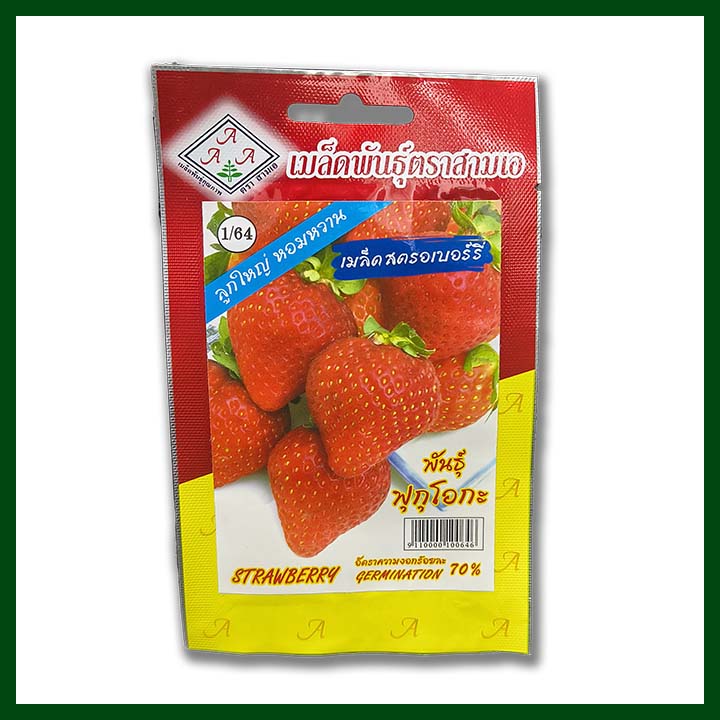
Strawberry (Fukuoka variety) – 5 seeds – AAA – Thai
Original price was: ৳ 260.00.৳ 160.00Current price is: ৳ 160.00.
Available on backorder
Description
Strawberry (Fukuoka variety)
Price: 160 Taka per packet
Quantity: 05 seeds
Brand: AAA (Chua Yong Seed Co. Ltd.)
Country: Thailand
Germination Rate (approx.): _70_%
Physical Purity (Min): 98%
Genetic Purity (Min): 98%
Detailed cultivation guide for Bangladesh rooftop gardening
Basic growing requirements
| # | Requirement | Recommended value for Fukuoka S6 / Bangladesh |
| 01 | Germination temperature | 20–25°C optimum; 18–24°C practical target |
| 02 | Germination time | 10–21 days normally; allow 14–28 days |
| 03 | Plant height | 20–30 cm normally; Fukuoka S6 is somewhat taller/more upright than some cultivars |
| Plant span | 30–45 cm, excluding runners | |
| Seed sowing depth | Surface sow / ≤2–3 mm; do not bury deeply | |
| 04 | Plant spacing | 30–35 cm (12–14 in) |
| 05 | Row spacing | 60–75 cm (24–30 in) for rooftop beds |
| 06 | Trellis/support | Not required |
| 07 | Seed → first harvest | Approximately 5–9 months under favourable conditions; potentially 12+ months for a June-bearing plant grown from seed |
| 08 | Seed → first bloom | Approximately 4–7 months, highly dependent on temperature, photoperiod and seedling maturity |
| 09 | Container | 14–16 in diameter × 10–12+ in deep; ~20–30 L per plant |
| 10 | Soil pH | 5.3–6.5; target 5.8–6.2 |
| 11 | Sunlight | 6–8 h direct sun/day; morning + early afternoon is particularly useful in Dhaka |
| Germination light | Light is beneficial/important; do not bury seed | |
| 12 | Water | Keep continuously moist but never saturated; typically 0.3–0.7 L/plant/day, adjusted for weather and container size |
Strawberry seed is unusually light-sensitive. A classic Japanese seed-germination study found strong photosensitivity, with germination greatly inhibited in darkness; 20–30°C was generally suitable and 25°C performed best among the constant temperatures tested. (J-STAGE)
A commercial F. × ananassa seed reference gives 18–20°C as a germination target and 10–12 days under suitable conditions, while practical seed propagation commonly takes longer because dormancy, seed age and moisture affect germination. (Lute Seeds)
Very important sowing technique
For your MyGardenBd-type rooftop conditions:
- Use a sterile, fine, moisture-retentive seed medium.
- Moisten before sowing.
- Scatter seeds on the surface.
- Press them gently into the surface.
- Do not cover with a normal layer of soil.
- Mist rather than pour.
- Maintain approximately 20–24°C.
- Give bright light for approximately 12–14 hours/day during indoor seedling production.
- Cover with a transparent humidity dome until emergence, but ventilate daily.
The strong photosensitivity of strawberry seed is supported by controlled Japanese research. (J-STAGE)
- Plant size
A practical mature size is:
- Height: 20–30 cm / 8–12 in
- Canopy width: approximately 30–45 cm / 12–18 in
- Crown: relatively compact
- Runners: potentially much longer than the main canopy
Fukuoka S6 itself is described as semi-erect and slightly taller than ‘Toyonoka’, with good winter growth. (Fukuoka FAR Center)
Bangladesh strawberry trials have recorded considerable cultivar variation; for example, plants of Camarosa reached about 35.7 cm under some planting conditions, while BARI Strawberry-1 was considerably shorter. (Academic Journals)
04–05. Spacing
Rooftop container
1 Fukuoka plant per 14–16 inch pot is my recommendation.
You can put 2 plants in a 16–18 inch container, but for maximum fruit size and airflow in Dhaka, one plant/container is superior.
Raised bed
Recommended:
- Plant-to-plant: 12–14 in
- Row-to-row: 24–30 in
- Bed width: 36–40 in
- Bed height: 8–12 in
General strawberry extension recommendations commonly use approximately 12–18 inches between plants. (University of Minnesota Extension)
- Trellis / physical support
No trellis is required.
The strawberry is a low-growing crown-forming plant. However:
Useful physical support
Use:
- straw/coco-husk mulch,
- black/white horticultural mulch,
- elevated strawberry pot,
- hanging basket,
- low support ring,
- small fruit support mesh.
The objective isn’t to support the plant—it is to keep developing berries off wet soil/media.
This is particularly important in Dhaka’s humid conditions because fruit touching continuously wet media greatly increases fruit-rot risk.
07–08. Seed → bloom → harvest
This is one area where internet gardening guides often give misleadingly short figures.
From seed
For a June-bearing F. × ananassa:
Seed → germination: 10–28 days
↓
Seedling establishment: ~4–8 weeks
↓
Vegetative development: several months
↓
Flower initiation: strongly influenced by temperature + photoperiod
↓
Flower → ripe fruit: approximately 28–30 days under suitable conditions.
Penn State notes that strawberry berries are generally ripe about 28–30 days after full bloom. (Penn State Extension)
For seed-grown plants, 5–9 months is a reasonable optimistic target, but a June-bearing hybrid can take considerably longer, particularly if started under warm tropical conditions. Therefore I would not promise customers “90 days from seed” for Fukuoka S6.
The biggest advantage of strawberry is obtained by starting with a healthy runner/plug plant, which can crop substantially earlier.
- Recommended container
My recommended MyGardenBd rooftop specification
14–16 inch diameter × 12 inch deep
Approximately:
20–30 litres growing medium / plant
Use:
- one plant,
- central crown,
- crown kept exactly at media level,
- excellent drainage holes,
- no saucer holding stagnant water.
A Japanese Fukuoka S6 research system has successfully grown the cultivar in containers and soilless media; one experiment used peat moss, coconut shell and charcoal at 3:5:2. (Taylor & Francis Online)
- Soil type and pH
Ideal soil
A light, fertile, well-aerated sandy loam / loamy growing medium is ideal.
Requirements:
- high organic matter,
- excellent drainage,
- good water-holding capacity,
- high oxygen availability,
- low salinity,
- slightly acidic reaction.
Target pH
5.8–6.2
Acceptable:
5.3–6.5
Strawberries prefer slightly acidic soil, with extension guidance giving approximately pH 5.3–6.5. (University of Minnesota Extension)
Avoid
❌ heavy clay
❌ compact fine soil
❌ permanently wet media
❌ excessive lime/oyster shell
❌ excessive manure
❌ salty fertilizer accumulation
- Light requirement
Mature plant
6–8 hours direct sunlight/day
For maximum fruit production:
8 hours is preferable if temperatures are not excessively high.
In Dhaka, however, there is an important distinction:
more light ≠ more heat.
During October–November, direct sun is desirable. During unusually hot periods, afternoon heat can become more damaging than insufficient light.
Seed germination
Strawberry seeds are photoblastic / light-sensitive. Keep them on the surface and provide bright light.
The Japanese germination study found substantial inhibition when seeds were germinated in darkness. (J-STAGE)
- Water requirement
Strawberry has a shallow root system and is highly sensitive to both drought and waterlogging. Container strawberries may require watering every day and, during very hot periods, sometimes twice daily. (Yard and Garden)
Practical rooftop schedule
| Plant stage | Approx. water/plant | Interval |
| Newly germinated seedling | 30–80 mL | Daily/misting |
| 5–8 cm seedling | 100–150 mL | Daily |
| 10–15 cm plant | 150–300 mL | Daily |
| Mature vegetative plant | 300–500 mL | Daily |
| Flowering | 400–600 mL | Daily |
| Fruit development | 500–700 mL | Daily |
| Very hot rooftop day | 600–900 mL | Split into 2 applications if necessary |
These are starting volumes, not fixed prescriptions.
The correct rule is:
Water when the upper ~2–3 cm of medium begins drying, but before the root zone becomes dry.
In monsoon conditions, don’t follow the litre schedule blindly. Drainage and actual moisture should control irrigation.
- Nutrient requirements
Strawberry requires:
Macronutrients
N — Nitrogen
Leaf/crown development and overall growth.
P — Phosphorus
Root development, flowering and reproductive development.
K — Potassium
Fruit filling, sugar movement, firmness and stress regulation.
S — Sulfur
Protein synthesis and enzyme function.
Secondary nutrients
- Calcium
- Magnesium
Micronutrients
Especially:
- Zinc
- Boron
- Iron
- Manganese
- Copper
- Molybdenum
For Bangladesh, particularly useful evidence comes directly from BARI strawberry research.
One Bangladesh terrace-soil experiment found the strongest yield response around:
N 115 : P 40 : K 110 : S 25 kg/ha, with 10 t/ha cow dung and Zn/B supplementation. It produced approximately 9.59 t/ha. (ResearchGate)
A later BARI study used a recommended inorganic treatment of:
N-P-K-S-Zn-B = 140-40-110-20-3-2 kg/ha, while combining organic manure with inorganic fertilizer improved production in several treatments. (Nature)
Relative nutrient priority
Using the BARI recommendation and setting N = 100:
| Nutrient | Relative requirement |
| N | 100 |
| K | 79 |
| P | 29 |
| S | 14 |
| Zn | 2.1 |
| B | 1.4 |
This is a relative nutrient ratio, not the percentage composition of fertilizer.
- Organic fertilizer blend
For your specified 14–16 inch / 20–30 L container, I recommend a relatively conservative organic feeding program because strawberries dislike excessive salt and excessively rich media.
Initial organic amendment per plant
| Fertilizer | Amount |
| Vermicompost | 250 g |
| Tricho-compost | 150 g |
| Cow-dung compost | 100 g |
| Horn meal | 10 g |
| Bone meal | 15 g |
| Neem cake powder | 15 g |
| Mustard cake powder | 10 g |
| Oyster shell powder | 5 g maximum |
| Epsom salt | 2 g |
Total initial amendment
Approximately 557 g/plant.
Mix the composts thoroughly through the upper 10–15 cm of the growing medium.
Why so little oyster shell?
Because strawberries prefer acidic media. Oyster shell is primarily calcium carbonate and can gradually increase pH.
Therefore:
Do not use oyster shell as a major component.
If your irrigation water/media already contains sufficient calcium, omit it entirely.
Top dressing
Every 30–40 days during active growth:
- Vermicompost: 50–75 g
- Tricho-compost: 25–40 g
Alternate with a very small amount of neem cake:
5–10 g/plant every 45–60 days.
During flowering/fruiting
Do not continuously increase nitrogen.
Shift the nutritional emphasis toward:
K > N, with adequate P, Ca, Mg and micronutrients.
The Bangladesh research strongly supports integrated organic + inorganic fertilization rather than simply piling on organic manure. (Nature)
- Chemical fertilizer program
For a rooftop container, I would not directly copy the BARI hectare rate into a pot. Instead, use it as the nutrient target and divide the fertilizer into small doses.
Recommended program
Stage A — 3–4 weeks after transplanting
19-19-19:
1.0–1.5 g/plant
Every 14 days, for 2 applications.
Stage B — strong vegetative development
19-19-19:
1.5 g/plant every 14–21 days
Maximum approximately 2–3 applications.
Stage C — flowering/fruiting
Use a potassium-dominant fertilizer.
For example:
0-0-50: approximately 0.5–1.0 g/plant, every 14–21 days.
Or use a suitable commercial strawberry/fruiting formulation according to its label.
Important
If the organic program above is used, do not simultaneously apply heavy chemical fertilizer.
A good rooftop strategy is:
Moderate organic base + low-dose soluble fertilizer + observation.
Excess nitrogen produces beautiful leaves and disappointing strawberries.
- PERFECT ROOFTOP POT MIX
From your supplied list, I would not use everything.
For Bangladesh rooftop conditions, the best balance is approximately:
| Ingredient | % by volume |
| Coconut coir dust | 25% |
| Loamy soil | 25% |
| Vermicompost | 15% |
| Tricho-compost | 10% |
| Cow-dung compost | 5% |
| Coconut husk – medium | 8% |
| Wood bark | 5% |
| Perlite | 4% |
| Wood charcoal | 2% |
| Brown river sand | 1% |
| Small stones 5–22 mm | 0% in the main mix |
| Epsom salt | not counted in volume |
| Others | 0% |
Final formula
25 : 25 : 15 : 10 : 5 : 8 : 5 : 4 : 2 : 1
Coir : loam : vermicompost : trichocompost : cow-dung : husk : bark : perlite : charcoal : sand
Why I excluded several items
Jhama — exclude:
Not necessary when you already have perlite + husk + bark.
Cinder — exclude:
Can be useful, but unnecessary here and quality varies greatly.
Small stones — exclude from bulk media:
They do not create useful drainage throughout the root zone; use them only structurally around drainage if needed.
Turmeric — exclude:
There is no need to deliberately incorporate turmeric powder into a strawberry potting medium. Keep it out of the root-zone recipe.
Important Bangladesh adjustment
For a rain-exposed rooftop, increase drainage slightly:
20% coir + 25% loam + 15% vermicompost + 10% tricho + 5% cow-dung + 10% husk + 7% bark + 5% perlite + 3% charcoal
This is my preferred version for Dhaka rooftop containers exposed to monsoon rain.
- Companion plants
There is no strong scientific evidence that one particular companion plant dramatically increases Fukuoka S6 yield.
However, compatible rooftop neighbours include:
- Garlic
- Chives
- Onion
- Thyme
- Basil
- Lettuce
- Spinach
- Coriander
Keep companion plants outside the strawberry’s main root zone rather than overcrowding the strawberry container.
Most importantly, maintain:
airflow + sunlight + low humidity around the fruit.
- Fruit taste
Fukuoka S6 / Amaou
Taste rating: 9.3/10
Characteristics:
- strongly sweet,
- juicy,
- aromatic,
- relatively high soluble solids,
- noticeable acidity,
- deep strawberry flavour.
Fukuoka S6 is documented as having high soluble-solids content and relatively high acidity, producing a balanced taste. (PubMed Central (PMC))
A recent Japanese food-science study measured Fukuoka S6 at approximately 9.0° Brix in the winter samples studied. (Wiley Online Library)
- Leaf taste
The leaves are not normally consumed as a vegetable.
Rating:
2/10
They are edible in the sense that strawberry leaves are not normally considered toxic, but they are not a desirable culinary crop.
Therefore, for MyGardenBd product information:
Fruit: edible and highly desirable.
Leaves: not normally consumed.
- Major pests
| Pest | Symptoms | Chemical active ingredient examples | Organic/IPM alternative |
| Aphids | Curling leaves, honeydew | Acetamiprid / suitable registered aphicide | Neem oil, insecticidal soap, ladybirds |
| Thrips | Silvering, flower damage | Spinosad | Blue/yellow traps + predatory insects |
| Spider mites | Stippling, bronzing | Abamectin / bifenazate / fenpyroximate | Predatory mites, horticultural oil |
| Cyclamen mites | Distorted young leaves | Fenpyroximate / spiromesifen | Remove severely infested plants; predatory mites |
| Caterpillars | Leaf holes | Emamectin benzoate / Bt | Bacillus thuringiensis |
| Whiteflies | Sap loss, honeydew | Appropriate registered insecticide | Yellow sticky traps + soap/neem |
UC IPM identifies aphids, thrips, whiteflies, spider mites and cyclamen mites among important strawberry pests and provides active-ingredient-based control options. (UC IPM)
Important Bangladesh food-crop warning
Only use a pesticide registered for strawberries/food crops in Bangladesh, follow the exact label dose and pre-harvest interval (PHI).
Do not spray insecticides during active bee visitation.
- Major diseases
| Disease | Typical symptom | Chemical options* | Organic/IPM |
| Botrytis / gray mold | Gray fuzzy fruit rot | Cyprodinil + fludioxonil, fenhexamid etc. | Remove infected berries, airflow, avoid overhead irrigation |
| Powdery mildew | White powder on leaves | Sulfur, myclobutanil, suitable registered fungicide | Sulfur where appropriate, potassium bicarbonate, airflow |
| Anthracnose | Dark sunken fruit/crown lesions | Azoxystrobin or appropriate registered fungicide | Sanitation, clean planting material |
| Phytophthora crown/root rot | Wilting, crown/root browning | Appropriate phosphonate/registered oomycete fungicide | Excellent drainage, raised beds, clean stock |
| Fusarium wilt | Yellowing and collapse | Limited chemical options | Sanitation, resistant/clean plants |
| Leaf spot | Brown/purple leaf lesions | Copper/registered fungicide | Remove leaves + airflow |
| Rhizopus/Mucor fruit rot | Soft rapidly collapsing berries | Appropriate registered fungicide | Harvest promptly + sanitation |
UC IPM specifically lists Botrytis, powdery mildew, anthracnose, Phytophthora diseases, leaf spots and several crown/root diseases as important strawberry diseases. (UC IPM)
*Chemical names above are active-ingredient examples, not a recommendation to use any particular commercial brand in Bangladesh. Registration and PHI must be checked locally.
- How to identify maturity
This is especially important with strawberries.
Harvest when:
✅ Fruit is completely red
✅ Green/white shoulder has disappeared
✅ Surface is glossy
✅ Fruit has developed its characteristic size
✅ Aroma is strong
✅ Berry is firm but not hard
✅ Seeds/achenes are prominently visible
Fukuoka/Amaou is particularly attractive when the red colour extends almost completely around the berry.
The Fukuoka official description emphasizes its deep red, glossy colour, while extension guidance recommends harvesting when berries are fully coloured. (Fukuoka FAR Center)
Best harvesting time
Early morning after surface moisture has dried.
Cut with a small piece of stalk/calyx rather than pulling the berry violently.
- Monthly yield required for a family of four
Strawberry is not a staple component of Bangladeshi cuisine, so there isn’t a scientifically established “recommended strawberry kg/month” for a family of four.
For a family of four wanting strawberries primarily as:
- fresh fruit,
- breakfast,
- dessert,
- smoothie,
- chutney/jam,
I would target:
2–3 kg/month
A useful target is:
≈ 2.5 kg/month
However, strawberry production is seasonal, so this will not be evenly distributed every month.
For a household wanting substantial fresh consumption, I would aim for approximately:
8–12 healthy plants
rather than trying to produce exactly 2.5 kg every month.
- Average crop yield per square foot
Bangladesh studies have reported approximately 9.6–11.5 t/ha under appropriate nutrient management, while BARI’s current guidance gives a general target around 10–12 t/ha for its local cultivars. (ResearchGate)
Conversion:
10 t/ha ≈ 0.93 kg/m² ≈ 86 g/sq ft
12 t/ha ≈ 1.20 kg/m² ≈ 111 g/sq ft
Therefore a practical Bangladesh figure is:
0.09–0.11 kg/sq ft per crop cycle
or approximately:
90–110 g/sq ft
Fukuoka S6 can perform differently from BARI cultivars, especially under rooftop/container conditions, so this should be treated as a planning benchmark rather than a guaranteed yield.
- Average lifespan
Botanically:
3–5+ years
But commercial productivity usually declines earlier.
For rooftop production:
Best productivity: approximately 2–3 years
After that, replace the mother plant with healthy runners.
- Nutritional value
Approximately per 100 g raw strawberry:
- Energy: ~32 kcal
- Water: ~91 g
- Carbohydrate: ~7.7 g
- Fiber: ~2 g
- Protein: ~0.7 g
- Fat: ~0.3 g
- Vitamin C: ~50–53 mg
- Potassium: ~125–153 mg
- Folate: ~24 µg
- Magnesium: ~12–13 mg
- Phosphorus: ~22–24 mg
- Manganese: ~0.3–0.4 mg
Values vary somewhat by database and cultivar. (NutritionRef)
- Five health benefits
- Excellent vitamin C source
Supports normal immune function and collagen synthesis.
- Antioxidant-rich
Strawberries contain anthocyanins and other polyphenolic compounds.
Fukuoka S6 has particularly strong red pigmentation associated with anthocyanins. (J-STAGE)
- Heart-friendly fruit
Its combination of potassium, fiber and polyphenols makes it a useful component of a healthy diet.
- High nutrient density
Only about 30–32 kcal per 100 g while supplying substantial vitamin C.
- Useful source of dietary fiber
Supports normal digestive health.
These are nutritional benefits, not treatments for disease.
- Four recipes
🇧🇩 1. Strawberry Chutney
A very good Bangladeshi-style application.
Strawberry + sugar + salt + mustard tempering + chilli/spices.
Bangla recipes specifically use strawberry for chutney, including mustard tempering. (Cookpad)
🇧🇩 2. Strawberry Firni
Traditional rice-milk dessert combined with strawberry purée.
It works particularly well because strawberry acidity balances the richness of milk.
Bangla recipe collections include strawberry firni. (Cookpad)
🌎 3. Strawberry Yogurt / Smoothie
Strawberry + plain yogurt + banana + small amount of honey.
🌎 4. Strawberry Jam
A classic preservation method and particularly useful when the crop peaks simultaneously.
- Best month for germination in Bangladesh
Here we need to distinguish seed germination from planting established runners.
For seed germination
My recommendation for natural conditions in Dhaka:
Late October–November
with:
November = safest natural target
Why?
Dhaka’s recent weather records show that October can still be relatively hot. In 2024, October averaged about 28.4°C, with substantial rainfall, while November became considerably cooler. In 2025, October averaged about 28°C, while November averaged about 25°C. (www.tutiempo.net)
BARI research independently found early October to be the most suitable strawberry planting period among September–December treatments, with yield declining as planting became later. (Thai-Journal Online)
But for your seed specifically
Because seeds require approximately 20–25°C for good germination, I would actually recommend:
Seed germination indoors/under controlled shade in October–November → transplant outdoors once temperatures moderate.
For established seedlings/runners
September–October is the traditional Bangladesh planting window.
Bangladesh’s Agricultural Information Service gives approximately mid-August to mid-October as an appropriate planting period, with later planting still possible. (AIS)
- Number of seeds per gram
Strawberry seed size varies by species and cultivar.
Available commercial seed references generally fall around:
~3,000–3,500 seeds/gram
For example, a Fragaria vesca seed reference reports approximately 3,430 seeds/g, while another strawberry seed source reports about 3,000 seeds/g. (Jelitto)
Practical figure for product information:
≈ 3,000–3,400 seeds/g
Do not use this number to calculate exact germination because seed viability varies considerably.
- Best propagation method
🥇 Runner propagation
For Fukuoka S6, runner propagation is far superior to seed propagation.
Procedure
- Select a healthy mother plant.
- Allow strong runners to develop.
- Place the first daughter plant onto a small pot of growing medium.
- Keep the runner attached.
- Maintain moisture until roots develop.
- Once well-rooted, cut the connecting runner.
- Transplant the daughter plant.
Why?
Fukuoka S6 is a hybrid cultivar. Vegetative propagation produces genetically identical daughter plants, whereas seed propagation introduces genetic segregation.
Fukuoka S6 has been extensively used as a cultivar in Japanese research through runner-derived nursery plants. (PubMed Central (PMC))
Best commercial method
Disease-free runner/plug → transplant
is substantially preferable to starting this particular cultivar from seed.
- Fruit storage
Fresh
Do not wash immediately after harvest.
Store:
- dry,
- unwashed,
- with calyx attached,
- in refrigerator,
- preferably in a shallow ventilated container.
Best quality:
1–3 days
Potentially:
5–7 days
under excellent refrigeration and handling.
Extension guidance recommends refrigeration and notes that strawberries are highly perishable. (Utah State University Extension)
Freezing
Best long-term household method:
- Wash.
- Drain thoroughly.
- Remove caps.
- Freeze individually on a tray.
- Transfer to airtight freezer bags/containers.
Best quality:
6–12 months
OSU recommends using frozen strawberries within about 12 months for best quality. (OSU Extension Service)
Drying
Strawberries can also be dehydrated at approximately 54–60°C and stored airtight. (Penn State Extension)
- Three specialties of Fukuoka S6
🍓 1. Large fruit
One of its defining breeding objectives was producing large, attractive fruit.
❤️ 2. Deep glossy red colour
Fukuoka S6 produces characteristically dark-red glossy berries. (Fukuoka FAR Center)
🍬 3. Sweet + acidic balance
It combines relatively high soluble solids with noticeable acidity, giving a richer flavour rather than simply tasting sugary. (PubMed Central (PMC))
- Two beautiful quotes
“A strawberry is winter’s little promise that sweetness can grow even when the world is cold.”
“From a tiny seed to a crimson berry, the strawberry turns patience, sunlight and care into something worth tasting.”
- Three lesser-known facts
- The strawberry’s “seeds” aren’t technically seeds in the botanical sense people often assume.
The visible dots on the surface are achenes, each containing a true seed.
The fleshy red portion is an enlarged floral receptacle.
- Amaou isn’t actually the cultivar name.
The cultivar is:
Fukuoka S6
while Amaou is the famous commercial brand. (Minolier)
- Fukuoka S6 is a short-day strawberry.
Flower initiation is strongly connected with environmental cues including day length and temperature. Research on Fukuoka S6 has specifically investigated photoperiod and supplemental lighting because of its short-day response. (ResearchGate)
- Native region
Fukuoka S6
Fukuoka Prefecture, Kyushu, Japan
The broader cultivated garden strawberry, Fragaria × ananassa, is an interspecific hybrid whose ancestral species originated primarily from North and South America and European strawberry lineages.
- Origin story
The story of Fukuoka S6 is particularly interesting.
Fukuoka wanted a premium strawberry capable of replacing/improving upon the region’s established Toyonoka strawberry.
Breeders at the Fukuoka Agricultural Research Center crossed:
Kurume 53 × 92-46
The resulting selection became:
Fukuoka S6
It was released in 2001 and registered in Japan in 2005. (Fukuoka FAR Center)
Its marketing name was later established as:
Amaou
derived from Japanese words representing:
- Aka — red
- Marui — round
- Ookii — large
- Umai — delicious
(Jataff)
- Scientific name and family
Scientific name
Fragaria × ananassa Duch.
Fukuoka S6
Fragaria × ananassa cv. Fukuoka S6
Family
Rosaceae
Common names
- Strawberry
- Garden strawberry
- Cultivated strawberry
- Fukuoka S6
- Amaou — commercial brand
A very important point about the MyGardenBd “Fukuoka variety” seeds
Your own product listing describes the product as “Strawberry (Fukuoka variety) – 5 seeds – AAA – Thai” and gives an approximately 70% germination rate. (My Garden Bd)
However, the scientific literature identifies Fukuoka S6/Amaou as a hybrid cultivar normally maintained vegetatively. Therefore:
I would NOT market seed-grown plants as guaranteed true-to-type “Amaou.”
A much safer product description is:
Fukuoka-type strawberry / Fukuoka S6-type seed, subject to variation
unless your seed supplier provides documented cultivar identity and seed-production information.
This distinction is particularly important for customer expectations regarding fruit size, sweetness, colour and yield.
- Key reference websites and research papers
Fukuoka S6 / Amaou origin
- Fukuoka Agricultural Research Center — Fukuoka S6 breeding paper (Fukuoka FAR Center)
- Fukuoka Prefecture — Hakata Amaou information (Umakamon)
- Japan Association for Technology and Agriculture — Amaou/Fukuoka S6 (Jataff)
- Breeding Science — Strawberry MAGIC population/Fukuoka S6 (J-STAGE)
Strawberry seed germination
- Journal of the Japanese Society for Horticultural Science — Germination of Strawberry Seeds (J-STAGE)
Bangladesh cultivation research
- Bangladesh strawberry planting-date research (Thai-Journal Online)
- Scientia Horticulturae — strawberry planting time and genotype study (ScienceDirect)
- Bangladesh Journal of Agricultural Research — NPKS response (ResearchGate)
- Scientific Reports — organic/inorganic strawberry fertilization in Bangladesh (Nature)
- Bangladesh Agricultural Information Service — Strawberry production technology (AIS)
General strawberry cultivation
- University of Minnesota Extension — home strawberry growing (University of Minnesota Extension)
- University of Minnesota Extension — strawberry nutrient management (University of Minnesota Extension)
- Iowa State University Extension — strawberries in containers (Yard and Garden)
- Penn State Extension — growing strawberries (Penn State Extension)
- UC IPM — strawberry pest management (UC IPM)
⭐ MyGardenBd practical recommendation
For Dhaka rooftop cultivation, I would rank the approaches:
🥇 Healthy Fukuoka S6 runner/plug + 14–16″ pot
🥈 Healthy Fukuoka S6 seedling + 14–16″ pot
🥉 Seed propagation → only if the objective is experimentation
And the single biggest mistake to avoid is treating strawberry like a normal vegetable seedling. The combination of light-sensitive seed + shallow roots + crown sensitivity + cool-season flowering + excessive Dhaka heat/humidity + overwatering is what makes strawberry considerably more demanding than chilli, tomato or leafy vegetables.
For a commercial MyGardenBd growing guide, I would therefore state 20–25°C germination, surface sowing, 14–28-day germination window, 14–16-inch container, pH 5.8–6.2, 6–8 hours sunlight, and runner propagation as the preferred method rather than promising a fixed 90-day seed-to-fruit cycle.
Disclaimer: In accordance with the universal custom of seed trade we give no warranty expressed or implied as to description, quality, productivity or any other matter of any way for the crop results beyond the purchased price especially under unsuitable season, abnormal weather, unsuitable soil and other unexpected conditions.
বীজ ব্যবসার সার্বজনীন প্রথা অনুযায়ী আমরা বিশেষত অনুপযুক্ত ঋতুতে, বিশেষত অনিয়মিত আবহাওয়া, অনুপযুক্ত মাটি এবং অন্যান্য ক্রয়মূল্যের বাইরে ফসলের ফলনের বর্ণনা, গুণমান, উৎপাদনশীলতা বা অন্য যে কোনও বিষয়ে বর্ণিত ওয়ারেন্টি প্রদান করি না। অপ্রত্যাশিত শর্ত।
#AAA #chua #yong #Thai #thailand #seed #how #to #grow #from #price #in #good #quality #brand #online #store #near #me #in #mygardenbd #my #garden #bd #sweet #gardenbd #brikkho #dhaka #bangladesh #Amaou #AmaouStrawberry #FukuokaStrawberry #StrawberryFukuoka #JapaneseStrawberry #KingOfStrawberries #AmaouBerry #FukuokaAmaou #LuxuryStrawberry #AmaouHarvest #GrowAmaou #AmaouRecipes #AmaouFacts #OrganicAmaou #AmaouSeason #StrawberryLovers #BerryDelicious #JapaneseFruit #PremiumStrawberry #AmaouGarden
#Strawberry #Strawberries #FukuokaStrawberry #FukuokaS6 #Amaou #AmaouStrawberry #JapaneseStrawberry #JapaneseFruit #PremiumStrawberry #GardenStrawberry #GardenStrawberries #FragariaAnanassa #StrawberryPlant #StrawberryPlants #StrawberryGrowing #GrowStrawberries #GrowingStrawberries #StrawberryGarden #StrawberryGardening #StrawberryFarming #StrawberryCultivation #StrawberryProduction #StrawberrySeeds #StrawberrySeed #StrawberrySeedling #StrawberryRunner #StrawberryPropagation #StrawberryHarvest #StrawberrySeason #StrawberryLover #StrawberryLovers #StrawberryFruit #FreshStrawberries #OrganicStrawberry #OrganicGardening #OrganicFarming #RooftopGardening #RooftopGarden #RoofGarden #UrbanGardening #UrbanFarming #ContainerGardening #ContainerGrowing #BalconyGarden #HomeGardening #HomeGarden #EdibleGarden #FruitGarden #FruitGardening #KitchenGarden #FoodGarden #GardeningBangladesh #GardeningInBangladesh #BangladeshGardening #DhakaGardening #DhakaRooftopGarden #BangladeshAgriculture #BangladeshFarming #GardeningTips #GardeningIdeas #GardenTips #GrowYourOwnFood #GrowYourOwn #HomeGrown #FarmToTable #FreshFruit #HealthyFruit #VitaminC #BerryGarden #BerryLovers #JapaneseCultivar #Fukuoka #Kyushu #JapaneseAgriculture #StrawberryLove #StrawberryLovers
#স্ট্রবেরি #স্ট্রবেরী #ফুকুওকা_স্ট্রবেরি #ফুকুওকা_স্ট্রবেরী #ফুকুওকা_এস৬ #আমাউ #আমাউ_স্ট্রবেরি #জাপানি_স্ট্রবেরি #স্ট্রবেরি_গাছ #স্ট্রবেরী_গাছ #স্ট্রবেরি_চাষ #স্ট্রবেরী_চাষ #স্ট্রবেরি_চাষাবাদ #স্ট্রবেরী_চাষাবাদ #স্ট্রবেরি_বীজ #স্ট্রবেরী_বীজ #স্ট্রবেরি_চারা #স্ট্রবেরী_চারা #স্ট্রবেরি_বাগান #স্ট্রবেরী_বাগান #স্ট্রবেরি_ফল #স্ট্রবেরী_ফল #ছাদ_বাগান #ছাদবাগান #ছাদে_বাগান #ছাদে_স্ট্রবেরি #ছাদে_স্ট্রবেরী #টবে_স্ট্রবেরি #টবে_স্ট্রবেরী #টবের_বাগান #বাড়ির_বাগান #বাগান_করা #বাগান_করুন #বাগান_প্রেমী #বাগানপ্রেমী #শখের_বাগান #শহুরে_বাগান #শহুরে_কৃষি #জৈব_চাষ #জৈব_সার #অর্গানিক_গার্ডেনিং #বাগান_পরিচর্যা #গাছের_যত্ন #ফল_বাগান #ফল_চাষ #ফলজ_গাছ #নিজের_বাগান #নিজের_খাবার_নিজেই_ফলান #কৃষি #কৃষক #কৃষি_বাংলাদেশ #বাংলাদেশের_কৃষি #বাংলাদেশের_বাগান #ঢাকার_ছাদবাগান #ঢাকা_ছাদবাগান #ছাদবাগান_বাংলাদেশ #বাগান_বাংলাদেশ #স্ট্রবেরি_চাষ_বাংলাদেশ #বাংলাদেশে_স্ট্রবেরি #বাংলাদেশে_স্ট্রবেরি_চাষ #স্ট্রবেরি_বাগান_বাংলাদেশ
Additional information
| Weight | 0.01 kg |
|---|
Only logged in customers who have purchased this product may leave a review.
Related products
-

-
Sale!

-Rock Melon Madhurima F1 Hybrid – 10 Seeds – MGS1134
Original price was: ৳ 130.00.৳ 50.00Current price is: ৳ 50.00. -

-
Reviews
There are no reviews yet.